

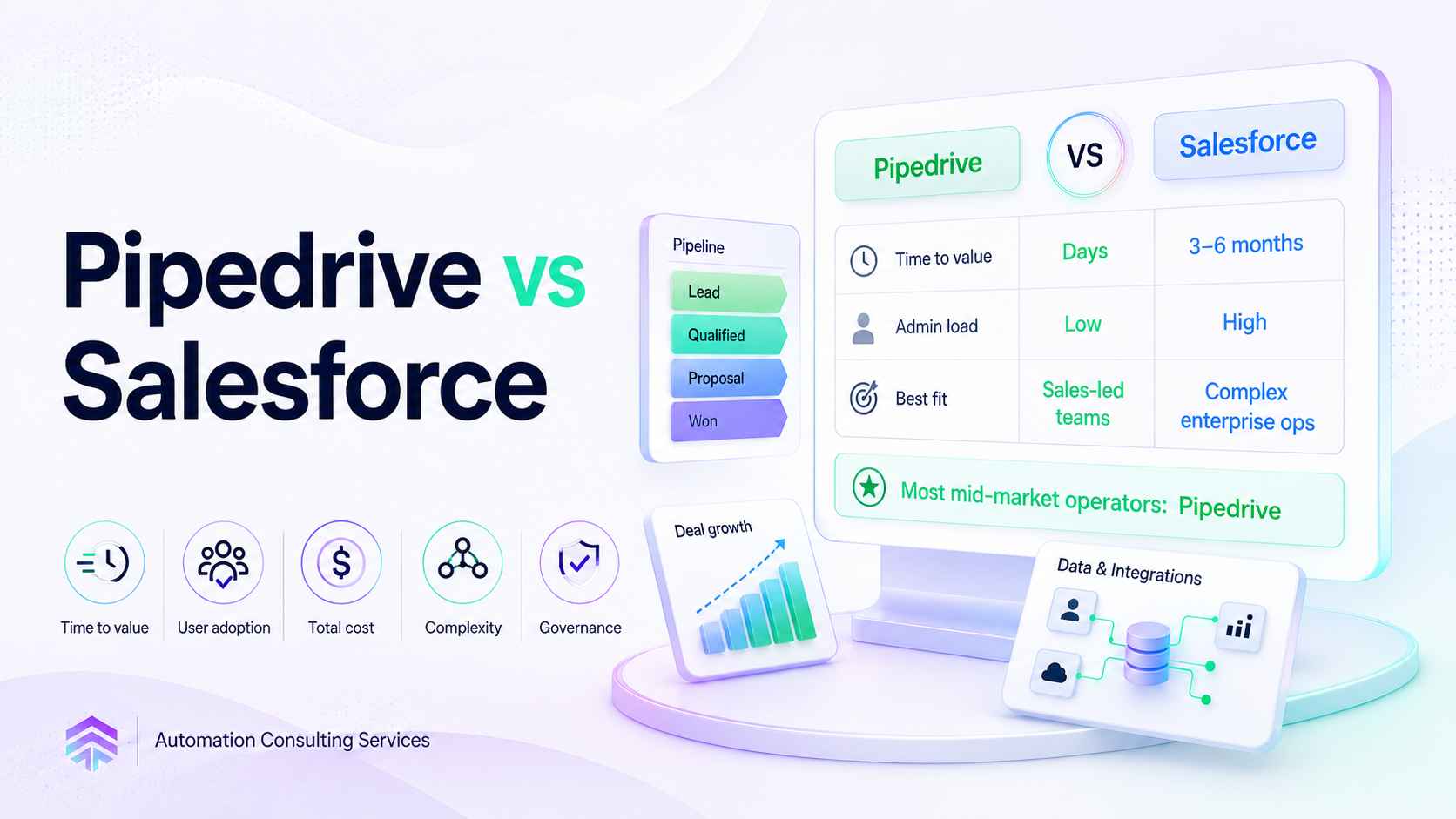
We build operations infrastructure with engineering discipline for $10M-$50M operators. CRM selection is where most engagements start. The question we field weekly is Pipedrive vs Salesforce. This post gives the direct answer.
Both platforms are good. Neither is universally right. The question is which one fits your operation at $10M-$50M revenue scale. The answer depends on four things: how your sales team actually works, how much you can spend on ongoing admin, how much complexity your data model needs, and if you have someone to own the CRM long-term.
We hold verified partnerships with Attio and Zapier. We do not hold a Salesforce or Pipedrive partnership. That neutrality is why this comparison is honest. We have nothing to gain from pushing either.
The honest verdict
Salesforce is overkill for most $10M-$50M operators. Pipedrive wins for the majority of B2B companies in this revenue band. Salesforce wins in specific scenarios that we lay out below.
The platform is rarely the problem. The implementation and the adoption are. A well-configured Pipedrive outperforms a poorly-configured Salesforce every time. The reverse is also true. But the odds of a $10M-$50M operator poorly-configuring Salesforce are much higher than the odds of poorly-configuring Pipedrive. Complexity has a cost.
We watch this pattern repeat. Team signs Salesforce because it is the recognized name. Team hires a consultancy to configure it. Configuration takes months. Rollout stalls. Reps drift back to spreadsheets. Twelve months later, the operator is paying enterprise licenses for a CRM used by nobody.
Where Salesforce genuinely wins
Salesforce is the most capable CRM ever built. When capability matches the operation, it delivers. Here is where that happens.
Custom objects and complex data models
Pipedrive organizes around a linear pipeline. Organizations, Persons, Deals, Activities. That model is fast because it is compressed. Salesforce is deeply relational. You get Accounts, Contacts, Leads, Opportunities, custom objects, and configurable relationships between all of them.
If your business needs many-to-many relationships, product catalogs, or data structures a flat pipeline cannot express, Salesforce is the correct choice. Manufacturers with complex product hierarchies, services firms with matrix account structures, and any operator whose data model needs custom objects should pick Salesforce.
Multi-department platform breadth
Salesforce is not one product. Sales Cloud, Service Cloud, Marketing Cloud, CPQ, and Revenue Cloud share one data model. If you need sales, service, and marketing operating on the same customer record, Salesforce removes the integration tax of stitching separate tools together.
Pipedrive does sales. It does not do customer service. It does not do marketing automation. It does not do e-commerce. Operators who need all of these under one roof should not fight Salesforce on this.
Enterprise governance and automation depth
Salesforce Flow handles multi-step, branching automation across objects. It can create a renewal opportunity ninety days before contract end, assign it by territory, notify the CS manager, and update the forecast. Add field-level security, profiles, permission sets, sharing rules, and full audit trails.
Regulated operators in financial services and healthcare need this level of control. Salesforce delivers it. Pipedrive does not.
Ecosystem and talent
Salesforce has the largest CRM ecosystem. Thousands of integrations exist through AppExchange. Certified admins and developers are easier to hire than for any other CRM. If your growth plan includes scaling the CRM team past two admins, Salesforce offers the deepest talent pool.
Where Pipedrive genuinely wins

Pipedrive is the most underrated CRM for transactional B2B. For a $10M-$50M operator running a sales-led motion, Pipedrive wins on the metrics that actually drive ROI.
Speed to deploy and time to value
A competent sales manager configures Pipedrive over a weekend. Most teams are productive within days. Salesforce Enterprise deployments run three to six months with a partner. Real adoption typically follows in month four or five.
Time to value is not a soft metric. Every month your CRM sits half-configured is a month of forecasting done in spreadsheets. Every quarter delayed is a quarter of missed pipeline visibility.
User adoption
This is the number that decides everything. Pipedrive scores higher than Salesforce on independent ease-of-use benchmarks. On G2 and Capterra, Pipedrive consistently outperforms Salesforce for setup speed and user satisfaction.
The reason is design. Reps adopt the tool they find easy. Reps avoid the tool they find hard. Salesforce is powerful and complex. Pipedrive is focused and simple. For teams without a dedicated admin, simple wins.
Cost predictability
Pipedrive publishes clean tier pricing. What you sign is what you pay. Salesforce lists headline prices that are where spending starts, not where it ends. Add-ons, Premier Support percentages, API access as a paid line item, and Marketing Cloud attach rates mean the quote you sign is rarely the bill you pay.
For CFOs modeling three-year total cost of ownership, Pipedrive is meaningfully lower and vastly more predictable. Salesforce cost scales in ways that are hard to forecast until year two or three.
Focus on the sales motion
Pipedrive was built by salespeople. Every feature answers a specific sales workflow question. Salesforce was built as a platform. Every feature is configurable, and every configuration decision is a decision your admin has to make.
For a sales-led B2B operator with a defined pipeline and clear stages, Pipedrive fits. For an operator whose CRM is really a data platform serving many teams, Salesforce fits.
The pricing conversation nobody has honestly
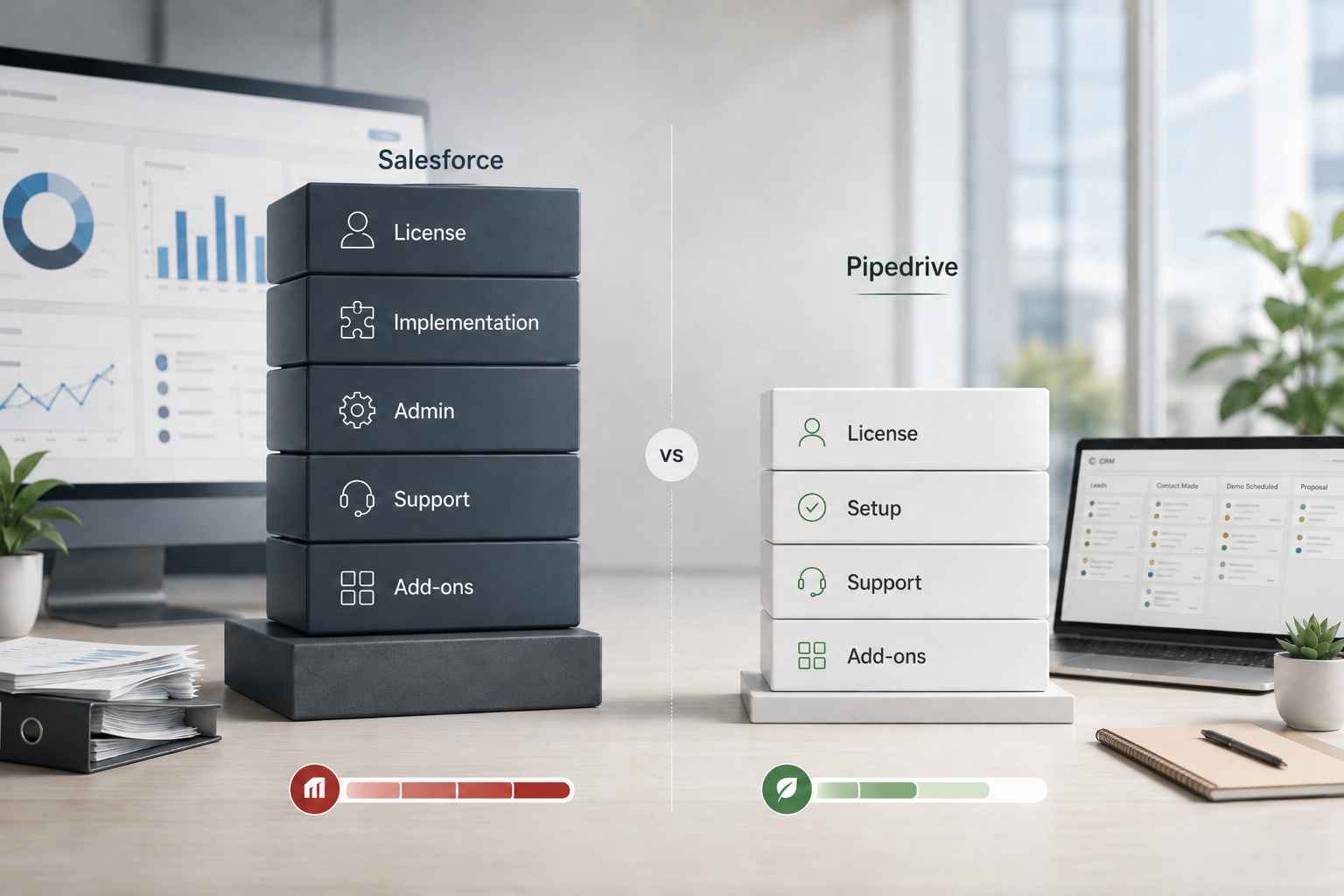
We will not publish specific dollar figures. Prices change. Both vendors raise prices annually, adjust tier structures, and change what is included in each tier. Any specific number we published today would be wrong within twelve months.
What does not change is the structure. Here is what to model.
Salesforce total cost of ownership components
Salesforce spend is not one line. It is five.
Per-user license fees are the first line. These are what the vendor quotes. This number scales linearly with team size and jumps significantly between Professional, Enterprise, and Unlimited tiers.
Implementation cost is the second line. A mid-market Salesforce implementation through a certified partner is a real engineering project. Data migration, security model design, Flow automation, and integration testing take months. Partners bill by the hour at mid-market consulting rates.
Ongoing admin cost is the third line. Salesforce Enterprise without a dedicated admin decays. Most $10M-$50M operators hire a full-time or fractional Salesforce administrator. That is a salary line, not a subscription.
Support costs are the fourth line. Salesforce charges Premier Support as a percentage of license fees. It is optional but effectively required for enterprise deployments.
Add-ons are the fifth line. Marketing Cloud, CPQ, Service Cloud, Data Cloud, and Einstein AI features are separate purchases. They multiply the base cost quickly.
Modeling all five lines honestly, a mid-market Salesforce Enterprise deployment costs several multiples of the license figure alone in year one, and a meaningful multiple every year thereafter.
Pipedrive total cost of ownership components
Pipedrive spend has fewer lines.
Per-user license fees scale linearly with team size. Tier jumps are smaller than Salesforce.
Implementation cost is significantly lower. A professionally managed Pipedrive build for a $10M-$50M operator runs in weeks, not months. Fixed-fee delivery is standard.
Ongoing admin cost is often zero. Most Pipedrive operators do not hire a dedicated admin. The sales manager or ops lead handles maintenance.
Support is included at all paid tiers. No separate Premier Support tax.
Add-ons exist but are limited. LeadBooster and Campaigns are the main ones. They add modest cost, not multiples.
For a 20-seat mid-market team, Pipedrive year-one total cost of ownership is roughly one-quarter to one-eighth of Salesforce Enterprise. The gap funds a lot of engineering work.
Implementation cost differences
Both platforms need proper implementation. Salesforce implementation is heavy because the platform is heavy. Pipedrive implementation is lighter because Pipedrive is lighter. Neither is optional.
We deliver both as fixed-fee engagements. We start with a paid discovery diagnostic that is refundable if we conclude a different platform fits your operation better. See our pricing tiers for the full structure. Hourly billing pays consultants to think slowly. Fixed-fee pricing forces the consultancy to scope correctly upfront.
Migrating from Salesforce to Pipedrive
This is the fastest-growing request we field. Teams signed Salesforce, used a fraction of it, and want out.
When migration makes sense
Migrate when your team uses a fraction of Salesforce, has no dedicated admin, runs a straightforward one-to-three-pipeline sales motion, and views the renewal quote with dread. If reps run deals out of spreadsheets because the CRM is too painful, you are paying enterprise prices for a glorified contact list.
We have watched teams spend more on the consultant configuring Salesforce than on the licenses themselves. That is a signal to migrate.
What migration actually involves
Migration from Salesforce to Pipedrive is a schema translation project, not a CSV upload. Salesforce Accounts map to Pipedrive Organizations. Contacts map to Persons. Opportunities map to Deals. Custom fields map by mapping table.
Automations do not transfer. You rebuild them. Document existing workflow logic first. This step is the most underestimated task in any migration.
Export historical reports before you decommission Salesforce. Attribution history and logged emails rarely survive a clean cut. Preserve what matters for reporting continuity.
Set a hard cutover date. Running two CRMs in parallel kills adoption. Reps default to the tool that is easier. Force the decision.
Run weekly validation reports for the first thirty days after cutover. Broken automations and duplicate records surface fast if you look for them.
Cost and timeline realistic expectations
A migration for a team up to fifty users takes two to four weeks at a fixed price when scoped properly. Zero data loss is the standard we deliver. Our Pipedrive service page and Salesforce service page detail how we scope each side.
When each is the right choice
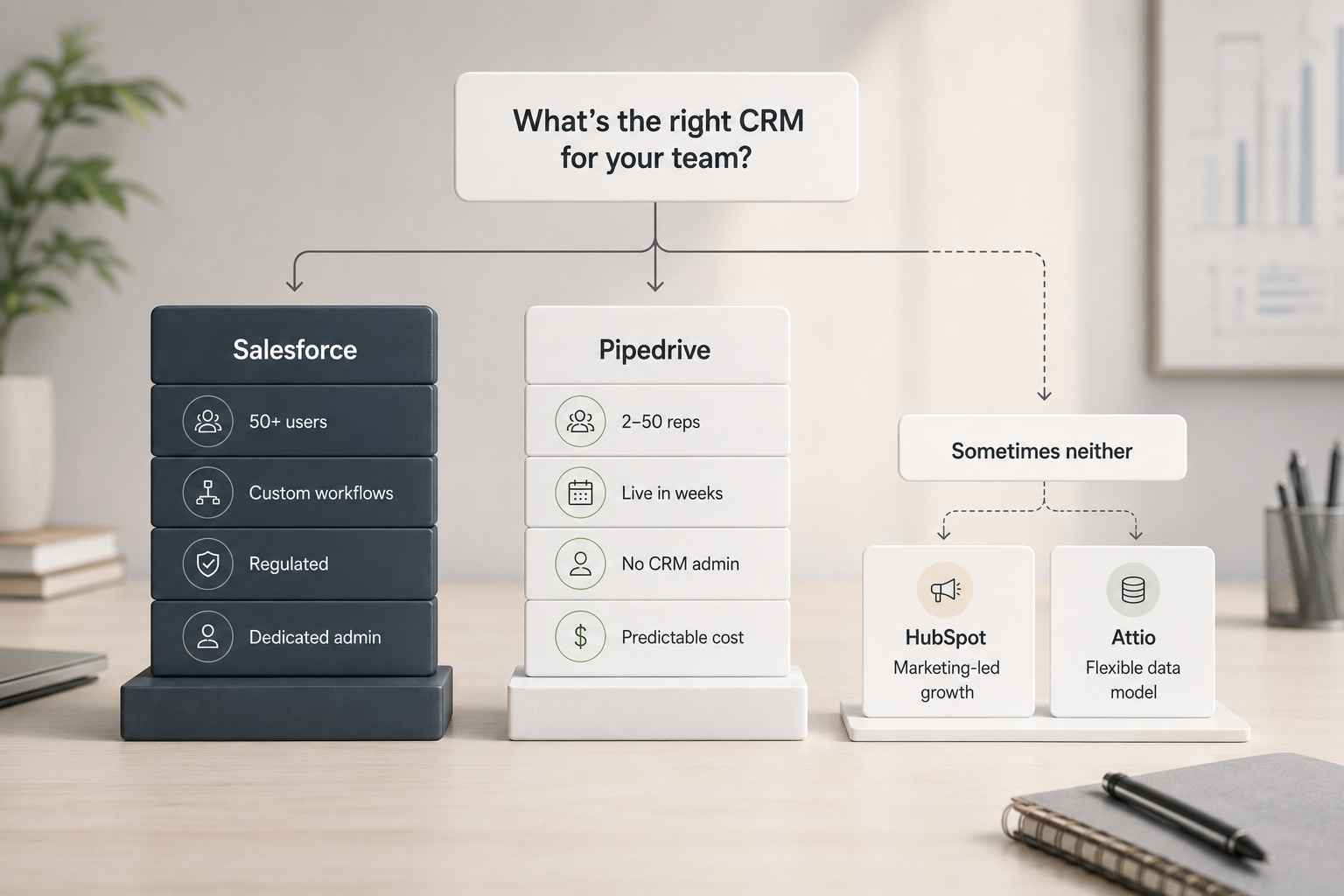
Choose Salesforce when
Choose Salesforce when you have fifty-plus users across sales, service, and marketing. When you need custom objects and complex approval workflows. When you operate in a regulated industry demanding audit trails and granular permissions. When you have a dedicated admin on payroll.
Salesforce without an admin rots. If you have that person, it performs.
Choose Pipedrive when
Choose Pipedrive when you run a sales-led motion with two to fifty reps. When you want to be live in weeks. When you do not want to hire a CRM admin. When cost predictability matters to the CFO.
For most B2B operators in the $10M-$50M band, this describes the situation exactly. Pipeline in days. Team owns its own CRM. No hidden line items.
Our guide on how to choose a CRM for a mid-market operator walks through the full decision tree.
When both are wrong
Sometimes neither fits. If marketing automation drives your pipeline, HubSpot may serve you better. See our Pipedrive vs HubSpot breakdown and our HubSpot implementation guide.
If you want a modern flexible data model without Salesforce weight, Attio is worth serious evaluation. As an Attio Expert Partner, we assess that trade-off honestly in our four-way CRM comparison.
How ACS thinks about the choice
We build CRM systems, workflow infrastructure, and integration architecture for $10M-$50M operators. Our bias runs toward the simplest system that solves the problem. Complexity has a cost, and the cost usually shows up as adoption failure.
Most CRMs become glorified spreadsheets within twelve months. That decay has one root cause: pipeline stages without exit criteria become forecasting fiction. A stage means nothing if any deal can sit in it indefinitely. Reps update Salesforce because they have to. Reps update Pipedrive because it helps them close.
We start with your sales process, not the software. We define exit criteria for every stage. We automate the handoffs that waste rep time. Then we pick the platform that fits. We build it as a fixed-fee engagement. We ship a runbook.
Across 500-plus workflows shipped, we have reclaimed more than 10,000 hours for clients and saved them over $2 million. Our seven named case studies show the pattern.
As a Zapier Certified Solutions Partner and Attio Expert Partner, we hold no incentive to push Pipedrive or Salesforce. The right CRM is the one your team uses without being told to.
Frequently asked questions
Is Pipedrive a real alternative to Salesforce for a $25M company?
Yes, for most. A $25M B2B operator running a sales-led motion with fewer than fifty reps gets more value from Pipedrive than Salesforce. Salesforce becomes the better fit when you add service and marketing teams on one platform, or when your data model needs custom objects.
How long does switching from Salesforce to Pipedrive take?
For a team of up to fifty users, a professionally managed migration takes two to four weeks. Timeline depends on data complexity, automation rebuild scope, and how much historical data you preserve.
What does Salesforce include that Pipedrive does not?
Custom objects, Service Cloud, Marketing Cloud, CPQ, Commerce Cloud, Apex code, and enterprise governance controls. Salesforce Flow handles far more complex automation than Pipedrive rule-based builder. If your operation needs these, Pipedrive cannot compete.
Is Salesforce worth it for a small sales team?
Rarely below fifty seats. Multiple industry analyst studies find operators activate only a fraction of the Salesforce feature set. Paying Enterprise prices for capability you will not activate until $25M+ in revenue is poor capital allocation.
Why do so many CRM implementations fail?
User adoption. Industry research consistently shows more than half of CRM implementations fail to meet objectives, and the majority of those failures trace to people-related issues, not the software. Complexity drives reps away. Simpler tools with clear process design win.
Can Pipedrive handle sales forecasting and reporting?
Yes. From Growth tier up, you get forecast views, custom dashboards, and revenue reports. Salesforce reporting is more powerful and pairs with Tableau, but most $10M-$50M operators do not need that depth.
Should we consider HubSpot or Attio instead?
Possibly. HubSpot fits marketing-led pipelines. Attio fits teams wanting a flexible modern data model. We hold an Attio Expert Partnership and a Zapier Certified Solutions Partnership. We assess all four without a house bias.
Ready to make the call?
We help $10M-$50M operators choose and build the CRM their team actually uses. Three ways to start.
Book a paid discovery. We audit your sales process and recommend a platform. Refundable if we conclude a different tool fits your operation better. See pricing for the current structure.
Read the direct comparison. Our Pipedrive vs Salesforce comparison page breaks down the decision by specific scenario.
Review the proof. Our case studies show the builds and the hours reclaimed for real operators.
Right CRM. Built right. Once.