
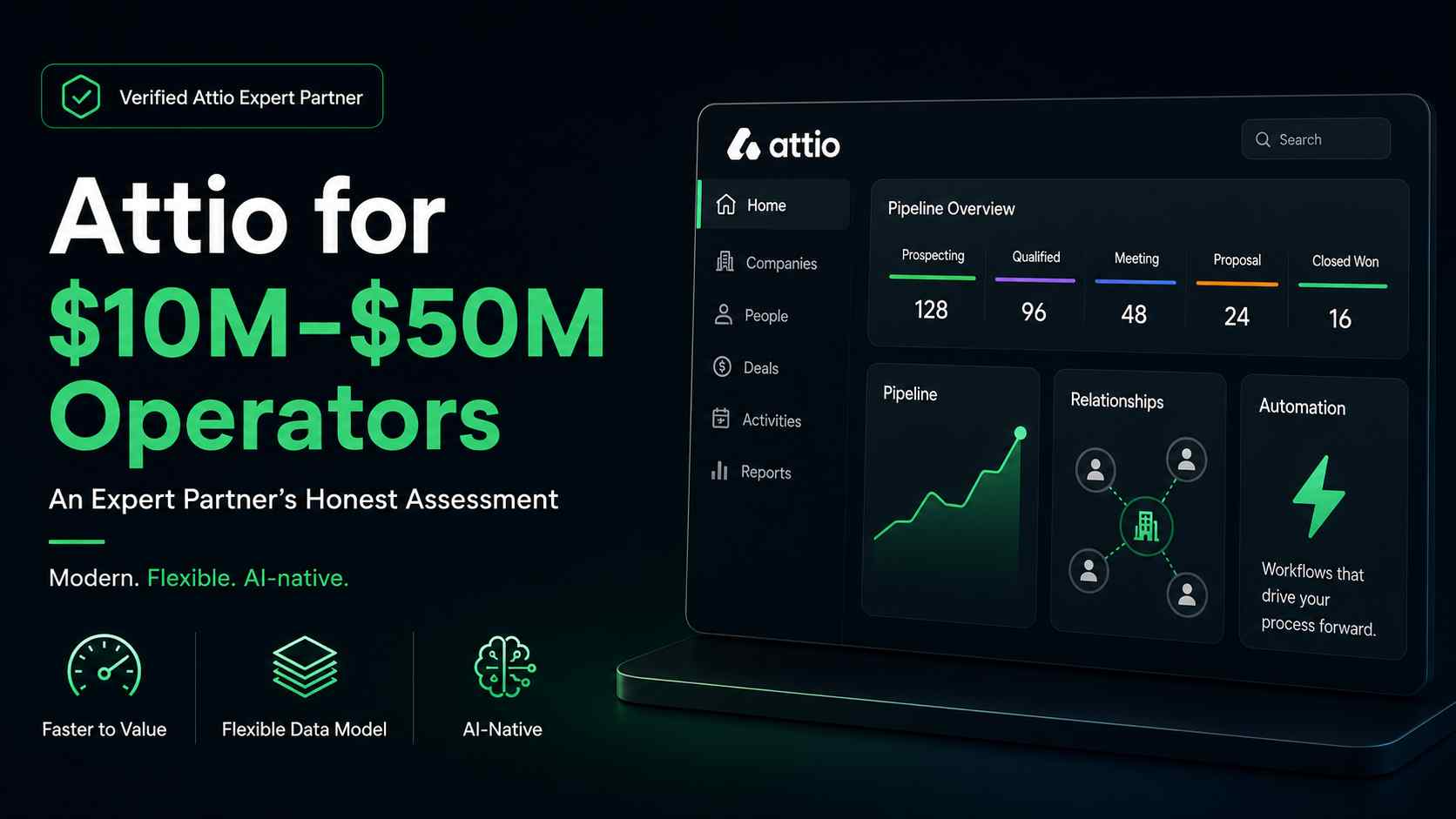
We are Automation Consulting Services (ACS), a verified Attio Expert Partner listed in Attio's public partner directory. We build operations infrastructure with engineering discipline for $10M-$50M operators.
That means CRM systems, workflow infrastructure, and integration architecture. We are also a Zapier Certified Solutions Partner. We are not a HubSpot partner.
We are not a Pipedrive partner. We are not a Salesforce partner. That neutrality matters here. When we recommend Attio, no vendor commission drives the call.
This post is a practitioner assessment, not a product review. We have shipped 500+ workflows, reclaimed 10,000+ hours for clients, and driven $2 million+ in client savings across seven named case studies.
The honest verdict
Attio is the strongest modern CRM foundation for most $10M-$50M B2B operators building today. It wins on data model flexibility, speed to value, and native AI.
It has real gaps in marketing automation, customer service, and ecosystem breadth. For teams that need a marketing suite in one tool, HubSpot still fits better. For regulated enterprises with complex approval chains, Salesforce still fits better.
For most operators in our target range, Attio is usually the right call. The caveat is implementation quality. A well-architected Attio beats a poorly configured legacy CRM every time.
What Attio actually is
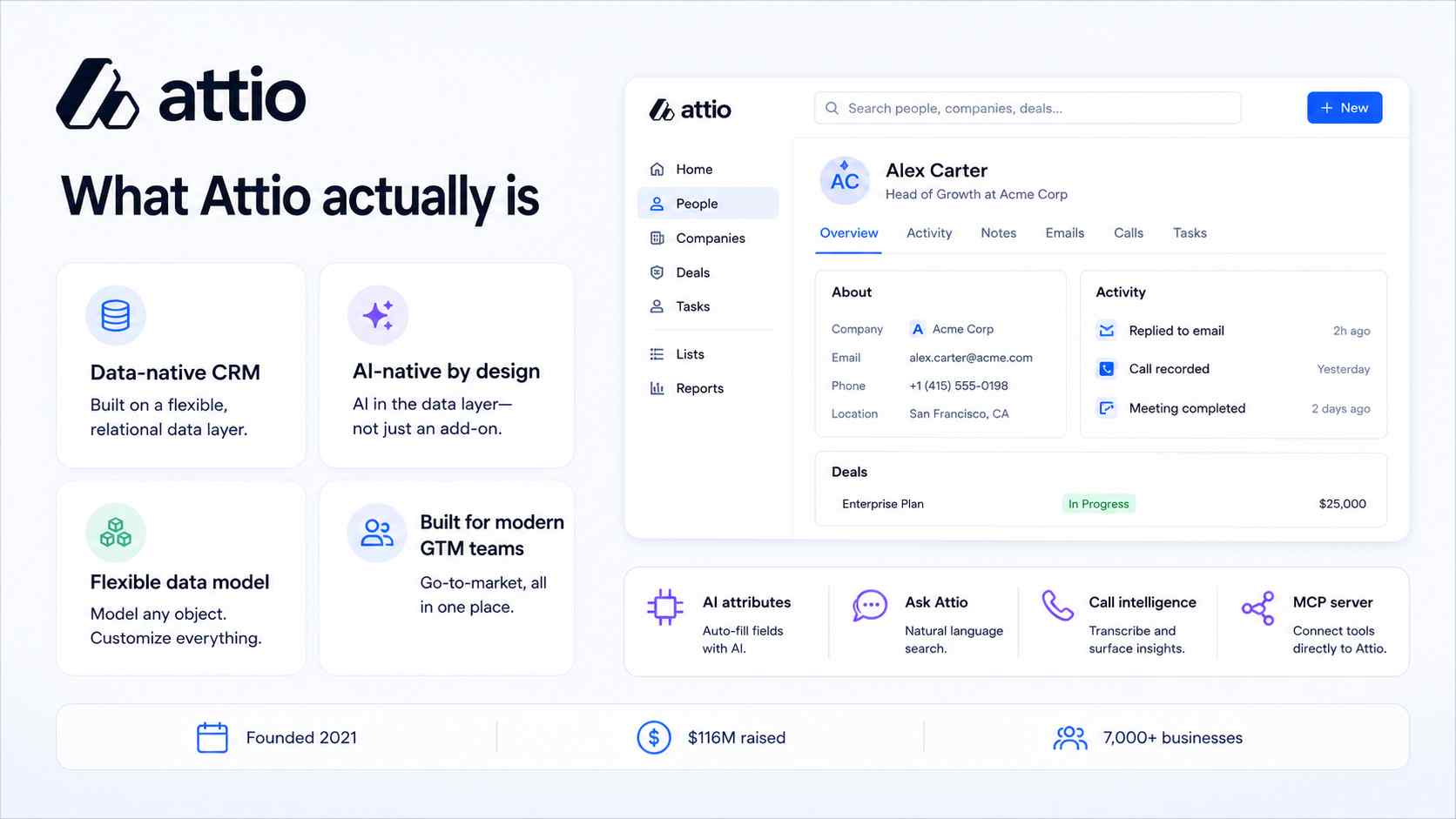
Attio is a data-native CRM built for modern go-to-market teams. It launched in 2021 and reached general availability in 2023. It was founded by Nicolas Sharp (CEO) and Alexander Christie (CTO), who first built a VC-focused CRM called Fundstack before pivoting to a horizontal CRM.
The company has raised $116 million to date. This includes a $52 million Series B announced August 26, 2025, led by GV (Google Ventures), with Redpoint Ventures, Balderton Capital, Point Nine, and 01A participating.
GV General Partner and former GitLab CRO Michael McBride joined the board. At that raise, Attio reported 5,000 paying customers and was on track to quadruple ARR that year.
Later company statements cite more than 7,000 businesses using the product. Category-defining AI companies like Lovable, Granola, Modal, and Replicate run their go-to-market on it.
The AI-native CRM claim examined
The AI-native CRM category is real, and Attio defined it. Most legacy CRMs bolt AI onto an existing system as a chat panel. Attio built AI into the data layer itself.
In practice, this means AI attributes, which are fields on any object that auto-fill using a web research agent. It means Ask Attio, a natural-language layer that queries records, calls, and emails.
It means Call Intelligence, which transcribes calls and populates fields automatically. In 2026, Attio shipped an MCP server, so tools like Claude and ChatGPT read and write to the CRM directly.
Test the label against your own data first. The AI features consume workspace credits, and heavy usage exhausts allocations before the cycle resets.
Attio's data model vs legacy CRM architecture
Attio's data model is closer to Airtable plus Notion than legacy CRM. It has four core parts: objects, attributes, records, and lists. Objects are blueprints, like Companies, People, or Deals. You also build custom objects for Investors, Partners, or Products.
Attributes are the fields on those objects. Records are the individual entries. Lists model a specific process without changing the underlying record. Compare this to Salesforce.
Salesforce is opinionated around Account, Contact, Opportunity, Lead, and Case. Custom objects extend that schema but often feel bolted on. In Attio, a custom object has the same standing as a standard one. This is a graph data model, not a rigid relational one.
Why Matthew Piwko built it this way
Most CRMs became glorified spreadsheets within twelve months. Fields multiply, nobody maintains them, and the system decays. Attio's flexible data model addresses this at the schema layer, not the workflow layer.
Matthew Piwko built Attio after living with clunky legacy tools while building their prior company. Their bet was that data growth and AI would break the two-decade-old CRM architecture. That bet looks correct. The data layer, called Particle, filters and sorts millions of records in milliseconds.
Where Attio genuinely wins
Modern GTM teams building today
Attio is the modern default for teams building today. It started with VC firms, where relationship mapping and deal flow break the standard contact-and-account model.
It expanded into startups, product-led growth companies, and RevOps teams. For a VC firm, you model Funds, LP commitments, and warm intro sources as first-class objects.
For a PLG company, you sync product usage against Workspaces and Users. The pattern is consistent. Teams with non-standard processes find legacy CRMs restrictive, and Attio lets them build their exact motion.
Data model flexibility without engineering
You reshape Attio without writing code. A sales lead builds views, custom objects, and automations directly. Hackceleration's hands-on client testing found that "setting up custom objects took us about 15 minutes for the first one."
This is the core value for our target range. A $10M-$50M operator rarely wants a dedicated admin salary. Attio removes that dependency for most configuration work. The flexibility is real, and it is also a risk without a plan.
Speed to value for revenue operations
Attio is fast to stand up. In Ziel Lab's hands-on 2026 comparison for a 10-person team migrating from spreadsheets, building a clean Attio data model and pipelines took 18 hours versus 30 hours for HubSpot. Their conclusion: "Attio is roughly 30 percent faster to stand up."
Teams often import and work on leads the same afternoon. Email and calendar sync with Gmail and Outlook automatically. That enriches the timeline around each contact and company and reduces manual entry, the number one cause of CRM decay.
The AI features that actually move the needle
Three AI capabilities earn their keep. Call Intelligence removes note-taking and populates deal fields from conversations. AI attributes run web research at scale, classifying accounts against your ICP. Ask Attio answers questions in plain language across your data.
These are not gimmicks. AI attributes summarize long threads and classify contacts automatically inside your lists and record pages. The credit model is the trade-off. Budget for it, because serious automation drains the allocation.
Where Attio has real gaps
Marketing automation depth
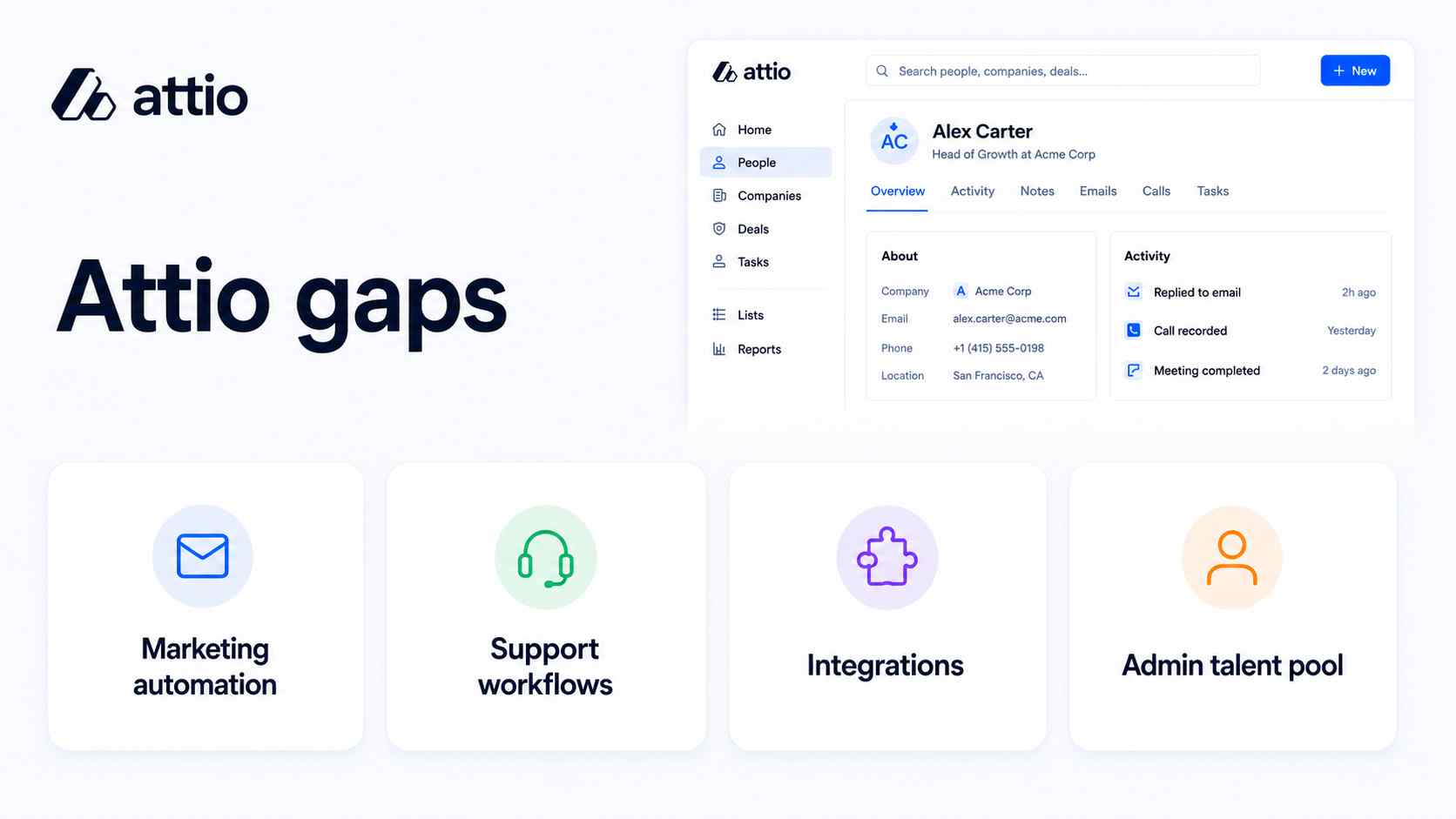
Attio does not compete on marketing automation. There is no native email marketing, no landing page builder, no forms suite. If you run newsletters, nurture sequences, and campaigns from one tool, HubSpot fits better.
Attio has email sequences for outreach, but that is a sales motion, not a marketing suite. We tell marketing-led teams this plainly.
Customer service and support workflows
Attio has no native ticketing, no SLA management, and no knowledge base. There is no health scoring or renewal pipeline out of the box. Teams that need service functionality assemble point solutions around Attio.
That creates integration work and fragmented data. For a support-heavy operation, this gap is significant.
Ecosystem and integration breadth
This is Attio's most cited weakness. Ziel Lab counts roughly 250 integrations in Attio's marketplace against HubSpot's 1,800-plus. G2 reviewers flag the gap consistently. For mainstream tools like Slack, Gmail, and Clay, coverage is solid.
For niche tools, you lean on the API, webhooks, or Zapier. This is where our Zapier Certified Solutions Partner status matters. We close the integration gap that Attio's native catalog leaves open.
Reporting is also newer than the incumbents. Most teams pipe complex analytics to a BI tool.
Talent pool and long-term admin
Attio is a younger product. The pool of experienced administrators is smaller than the Salesforce or HubSpot talent market. There are thousands of Salesforce admins for hire.
There are far fewer seasoned Attio architects. This is exactly why verified partner status matters for implementation. The flexibility that makes Attio powerful also makes a bad build easy.
Attio vs the alternatives
Attio vs Salesforce (when each wins)
Salesforce is overkill for most $10M-$50M operators. It wins when you run custom Apex code, complex approval chains, CPQ, or territory hierarchies that genuinely matter. It wins in regulated industries with strict compliance gates.
At $10M-$50M revenue, the maintenance burden grows faster than the value for most teams. Attio wins on speed, cost predictability, and no admin dependency. See our deeper Attio vs Salesforce breakdown and our full Salesforce implementation page.
Attio vs HubSpot (when each wins)
HubSpot per-seat cost compounds painfully past 10 users. It wins when you use the full Marketing plus Sales plus Service suite together. The unified contact database is the real pitch for marketing-led orgs.
Attio wins when your need is narrower, mostly CRM plus a few workflows. Many teams start on Attio and add HubSpot only if marketing complexity demands it. See our Attio vs HubSpot comparison and our HubSpot implementation services guide for details.
Attio vs Pipedrive (when each wins)
Pipedrive wins on pure pipeline simplicity. A rep masters it in an afternoon, and it is pipeline-first by design. Attio wins when your business needs more than a linear funnel.
If you track partners, investors, or products alongside deals, Attio's custom objects handle it natively. Pipedrive to Attio is a rarer migration. It happens when a team hits Pipedrive's flexibility ceiling. See our Attio vs Pipedrive comparison and our Attio vs Close breakdown.
Attio vs Airtable (an underrated comparison)
This comparison is underrated. Airtable is a database builder first, so you assemble the CRM yourself. Attio ships a working CRM with native email sync, enrichment, and pipeline tools.
If you have time to build, Airtable works. If you have time to sell, Attio ships faster. Airtable-native teams migrate to Attio when they want relationship context without maintaining a custom build.
The Attio Expert Partner Program and what it means
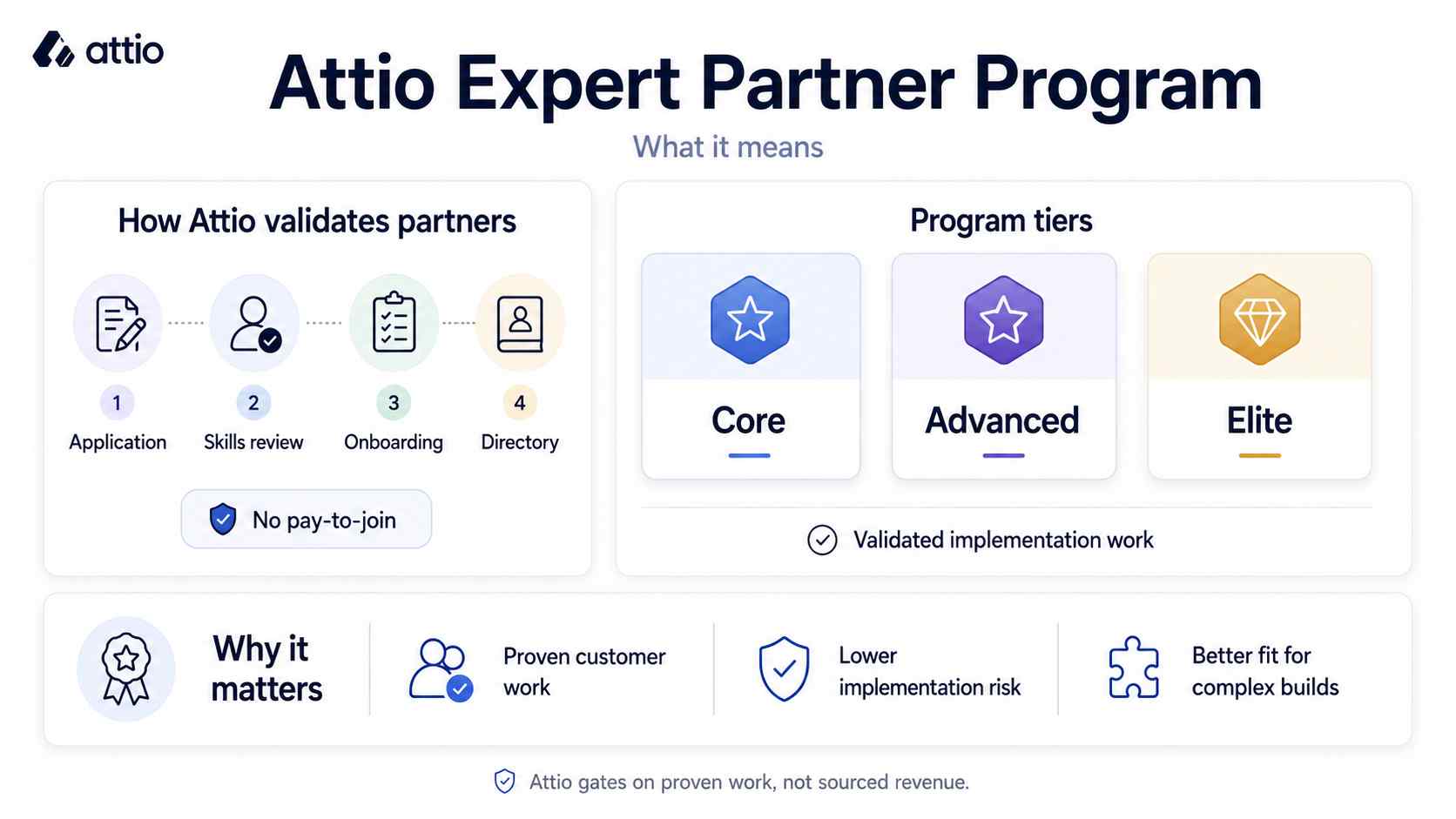
How Attio validates partners
Attio runs a merit-based Expert Partner program. The path has four steps: an application form, a skills presentation, an onboarding call, and a directory listing. The skills presentation requires you to walk through real Attio customer work or complete a case study project.
There is no pay-to-join option. This is a competency gate, not a purchase. The directory launched January 16, 2025 with six Experts. It has since grown to roughly two dozen partners worldwide.
What Expert Partner status actually guarantees
The program has three tiers: Core, Advanced, and Elite. Attio's own language is direct: start at Core, grow into Advanced, and build your way to Elite. Higher tiers unlock deeper access, quarterly business reviews, and co-marketing.
What the status guarantees is validated, demonstrated Attio implementation work. Attio vetted the partner's customer results. That is different from a self-declared consultant. You can verify our listing directly. See partners for our credentials.
Why verified partners matter for implementation
Most Attio implementations are configuration exercises. Real implementations are architecture decisions. Anyone can add objects and fields. Few design a data model that scales past twelve months. The partner directory is a filter for demonstrated competency in a thin talent market.
Compare this to HubSpot's Solutions Partner program, which gates tiers on sourced revenue and certifications. Attio's Expert program gates on proven customer work instead. For a $10M-$50M operator, that distinction reduces implementation risk directly.
Migrating to Attio: what actually happens
From HubSpot to Attio
Companies, contacts, deals, and custom properties carry over cleanly. HubSpot's marketing features do not come with you. Workflows and outbound sequences need a full rebuild. The number one cause of duplicates is leaving email sync on during import.
Disable mailbox sync first, validate, then re-enable. Most teams complete a clean HubSpot migration in days, not weeks. The real work is rebuilding the automation layer.
From Salesforce to Attio
Budget three to four weeks for a standard Salesforce migration. The challenge is data complexity, not technical difficulty. Salesforce stores business meaning in record types, validation rules, and nested hierarchies.
Every relationship chain must be reconstructed deliberately. We recommend a fresh-start approach. Identify the data you actually need, then migrate only what matters. Teams usually discover that much of their Salesforce complexity was not serving them.
From Airtable to Attio
This is a common and clean migration. Airtable-native teams already think in objects and relationships. The move is mostly about mapping bases to objects and rebuilding views. The gain is native email sync, enrichment, and pipeline discipline that Airtable lacks.
Common migration mistakes we've seen
Adding fields as needs arise creates a museum of dead fields. Do not replicate your old CRM structure inside Attio. You switched for a reason. Do not build pipelines before you design relationships.
Do not over-automate before the manual process works. And do not migrate dirty data into a clean system. Attio amplifies both good and bad design decisions.
When to choose Attio (and when not to)
Choose Attio when...
Choose Attio when you are a $10M-$50M B2B operator with a non-standard process. Choose it when you want speed to value without an admin salary. Choose it when relationship context matters as much as deal progress.
Choose it when you want native AI at the data layer. Choose it when predictable per-seat cost beats a marketing-contacts model.
Do not choose Attio when...
Do not choose Attio when you need a full marketing suite in one tool. Do not choose it when you need native ticketing and service workflows. Do not choose it when you run custom Apex or complex CPQ.
Do not choose it when compliance gates require enterprise feature parity Attio does not yet publish. Do not choose it when your stack needs dozens of native connectors Attio lacks.
The wait-and-see decision (when it's actually the right call)
Sometimes the right call is to wait. If you sit below the $10M line and a spreadsheet still works, wait. If your process is genuinely simple and linear, a lighter tool fits. If a HubSpot renewal is a year out and marketing is your core motion, evaluate at renewal.
The right CRM is the one your team uses without being told to. Forcing a migration before the pain is real wastes money. That decision often changes as a team crosses $25M+ and process complexity climbs.
How ACS approaches Attio implementation
We apply engineering discipline to operations. Every engagement starts with refundable paid discovery. We map your process before we touch the schema.
We design the data model first, because pipeline stages without exit criteria become forecasting fiction. Then we build custom object architecture, workflow automation, and integrations.
We use fixed-fee engagements, so scope is clear, and cost is predictable. Every build ships with a runbook as a deliverable. That runbook documents data model decisions, workflow logic, and troubleshooting steps.
Your team owns the system after we leave. We also handle post-implementation administration and training.
See our shipped work in our case studies and the full Attio implementation approach. For CRM selection help across tools, review our CRM hub. To understand adoption failure modes, see six reasons most CRM rollouts fail. For a broader tool view, read our four-way CRM comparison.
Frequently asked questions
What makes Attio different from other CRMs?
Attio is built AI-native with a flexible, graph-based data model. Instead of a fixed contact-and-account schema, you define custom objects, attributes, and relationships. It functions more like Airtable plus Notion than a legacy CRM. AI lives in the data layer, not a bolted-on chat panel.
Is Attio worth it for a $10M-$50M B2B company?
For most, yes. It delivers speed to value, flexibility, and native AI without a dedicated admin. The main trade-offs are marketing automation depth and ecosystem breadth. If you need a full marketing suite, HubSpot fits better. For CRM plus workflows, Attio usually wins.
Who are Attio Expert Partners?
Attio Expert Partners are firms vetted through Attio's merit-based program. They demonstrate real customer implementation work or complete a case study project.
The directory launched with six partners in January 2025 and has grown to roughly two dozen worldwide. ACS is a verified Attio Expert Partner. Verify our status at partners.
How does Attio compare to Salesforce and HubSpot?
Salesforce is overkill for most operators under 50 people. It wins on custom code, compliance, and enterprise scale. HubSpot wins on the unified marketing suite, but per-seat cost compounds past 10 users. Attio wins on flexibility, speed, and predictable cost.
Can Attio replace HubSpot for marketing?
No. Attio has no native email marketing, landing pages, or forms suite. It has sales sequences for outreach, but not a marketing automation platform. Teams that need marketing keep a tool like Mailchimp or move the full suite to HubSpot.
What are Attio's biggest limitations?
The largest gaps are integration breadth, marketing automation, and customer service functionality. Reporting is newer than the incumbents. The administrator talent pool is smaller. Enterprise compliance features are still maturing.
How long does an Attio implementation take?
Most take two to eight weeks. Clean data with a simple model can go live in two to four weeks. A complex Salesforce migration runs three to four weeks or more. The variable is data complexity, not the tool.
Ready to build on Attio?
Take one of three next steps.
First, verify our credentials as a verified Attio Expert Partner. Second, read our full Attio implementation approach. Third, book a paid discovery diagnostic to scope your build.
We build operations infrastructure with engineering discipline for $10M-$50M operators. For teams building today, Attio is where we start.