
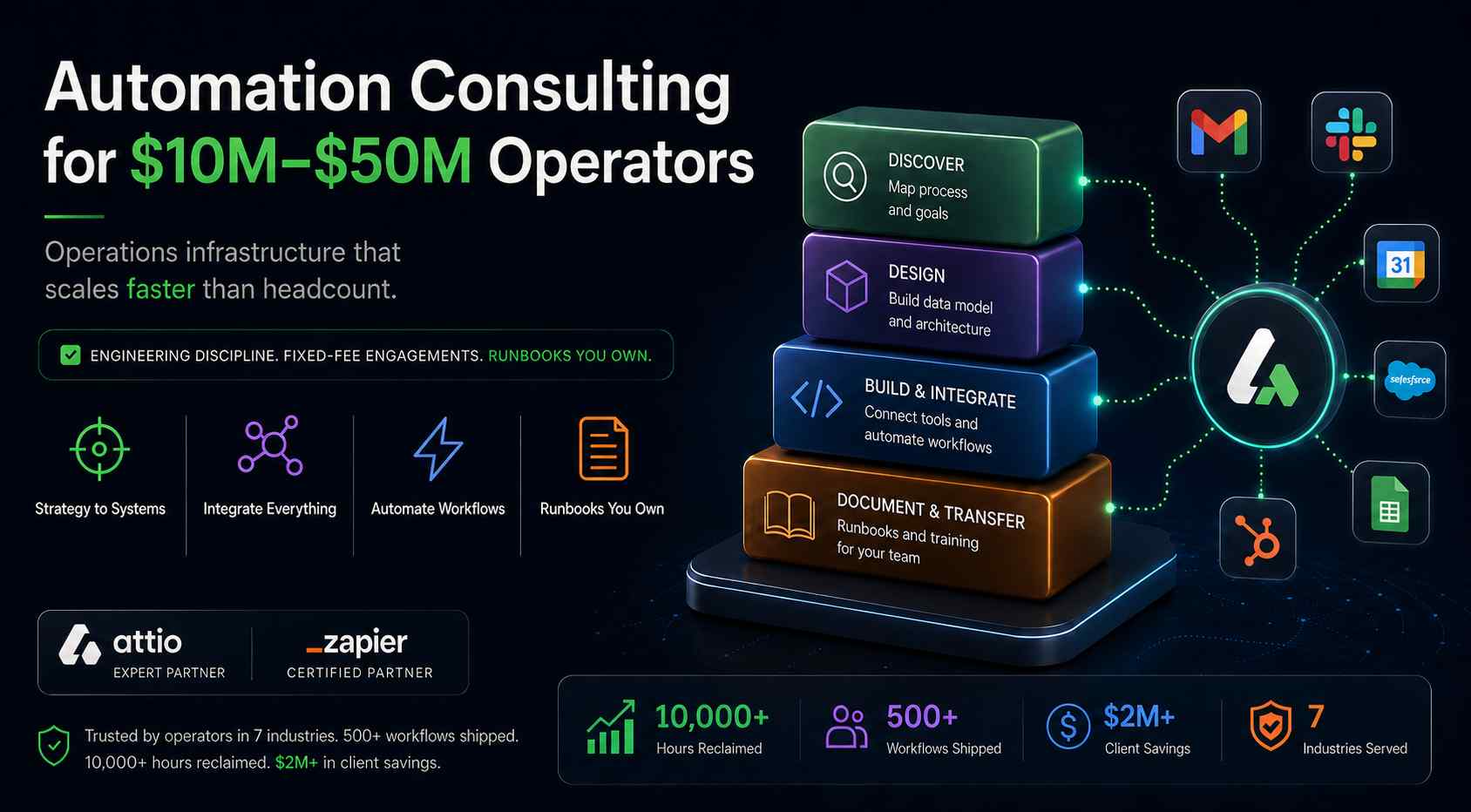
At Automation Consulting Services (ACS), we build operations infrastructure built with engineering discipline for $10M-$50M operators. We are a Zapier Certified Solutions Partner and an Attio Expert Partner.
We spent over a decade in software development before launching ACS. We build CRM systems, workflow infrastructure, and integration architecture for operators who need their back office to scale faster than their headcount. This post defines the category. Every other guide we publish links back to it.
The honest definition
Automation consulting at $10M-$50M scale is operations infrastructure work. It is not slide decks. It is not a maturity assessment. It is the design and construction of the systems your business runs on every day. CRM data models. Pipeline logic. Integration architecture between tools that do not talk. Workflow engineering that survives after the senior operator leaves.
Most firms sell something else and call it automation consulting. They sell hours of advice, or clicks inside a platform, or a strategy document nobody opens twice. Engineering discipline applied to operations is what separates infrastructure from configuration. That distinction runs through everything below. It also shapes how we run every CRM implementation we take on.
The three types of automation consulting (and why most operators buy the wrong one)
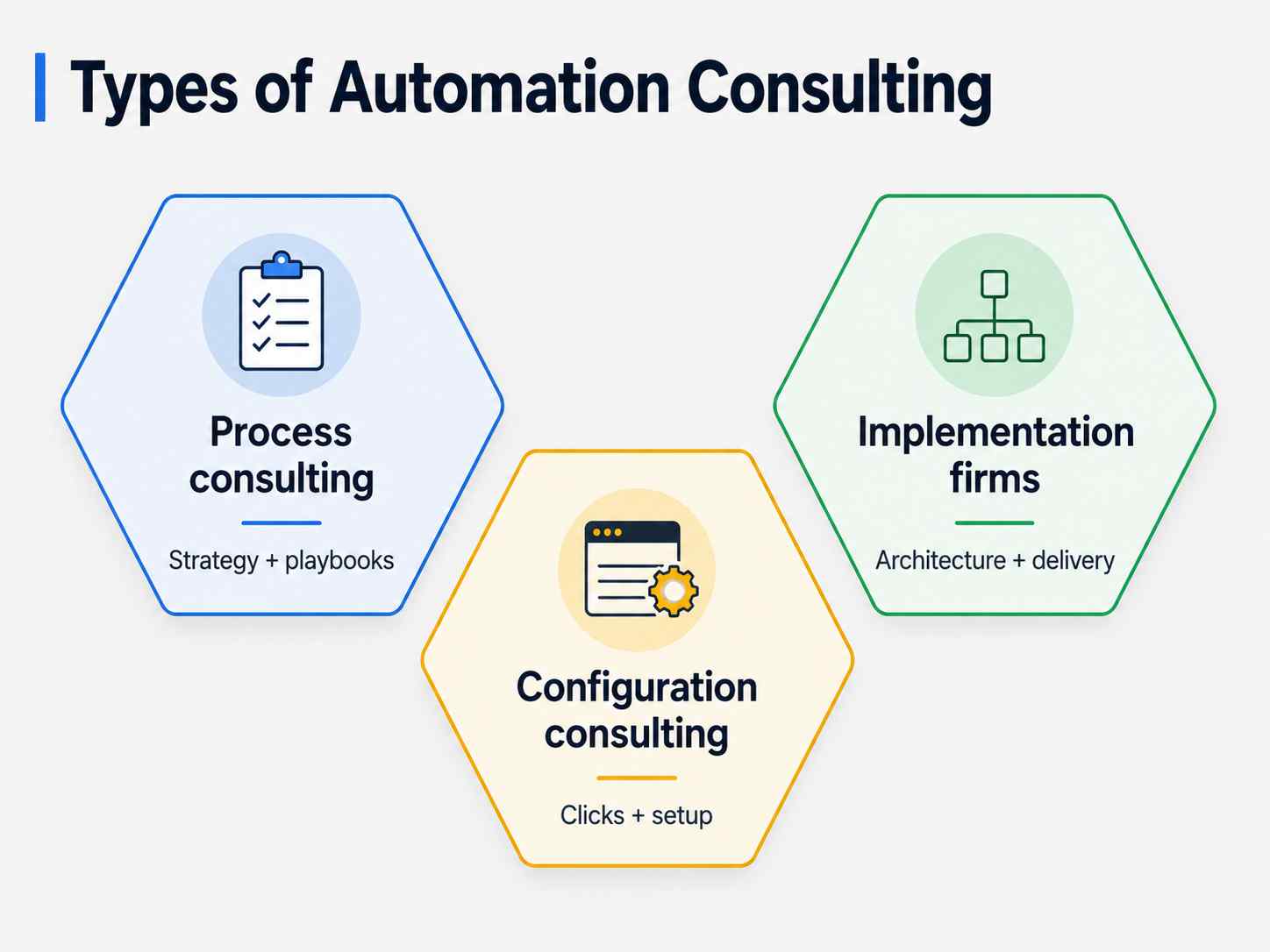
Three distinct things get sold under one label. Operators pay for one type and expect another. That mismatch is the root of most disappointment.
Process consulting (strategy without shipping)
Process consultants map your workflows and hand you recommendations. They produce documented processes and adoption playbooks. The output is a plan. The build is your problem.
This works when the gap is organizational and political. It fails when the gap is technical. A regional operator with a broken CRM does not need a framework. They need someone to fix the data model. Frameworks do not drive revenue.
Execution does. McKinsey has found that 70% of transformations fail, and Johnny Grow's 2025 research puts the CRM failure rate at 55% of deployments that never hit their planned objectives. Advisory engagements often end with recommendations sitting unused in a shared drive.
Configuration consulting (clicks without architecture)
Configuration consultants log into your platform and change settings. They add fields, build a few automations, and adjust dashboards. This is faster than strategy work and cheaper too. It also decays fast.
Configuration without process design creates operations debt. Adding fields as needs arise creates a museum of dead fields. Nobody remembers why half of them exist. Pipeline stages get added one at a time until the forecast means nothing.
The work looks like progress. Twelve months later the system is worse than before. We break down that decay pattern in six reasons most CRM rollouts fail.
Implementation firms (engineering discipline)
Implementation firms own the outcome. They design the architecture, build the system, test it, and document it. The difference between a consultancy and an implementation firm is who owns the outcome. A consultancy owns the advice. An implementation firm owns the working system.
This is where ACS sits. We do not bill for thinking. We ship systems that run. That is the model $10M-$50M operators actually need, and almost nobody sells it to them at their scale.
What $10M-$50M operators actually need (the gap the market misses)
$10M-$50M operators are underserved. They are too big for freelancers and too small for enterprise consultancies. A freelancer on a marketplace can build a single Zap. They cannot architect a CRM migration across five states with 150 employees. An enterprise firm can, but will not take the engagement at a reasonable price.
The economics are brutal at this band. Per a Q1 2026 Big Four pricing audit by nextbestaction.ai, Deloitte and PwC quotes start in the high six figures, with a typical agent deployment landing in the seven-figure range over an 18-month window, and even scaled mid-market offers run $250,000 to $500,000.
Senior partners rotate off the account after the pitch. The frameworks are built for organizations with tens of thousands of employees and enterprise IT budgets. McKinsey's own data shows companies with fewer than 100 employees are 2.7 times more likely to report a successful transformation than those with over 50,000. Big-firm scale actively works against the mid-market operator.
So the mid-market operator gets squeezed. They try a freelancer and get a fragile one-off. They try an agency and get junior work under a senior sales pitch. They consider enterprise consulting and walk away at the price.
Meanwhile the real problem compounds. Sales runs in a spreadsheet. Operations lives in Slack threads. Admin work rebuilds itself in three places every week. The team works harder and output stays flat.
The friction is structural, not tactical. These operators do not need more tools. They need their operations treated as infrastructure and engineered the way software is engineered.
What real automation consulting deliverables look like
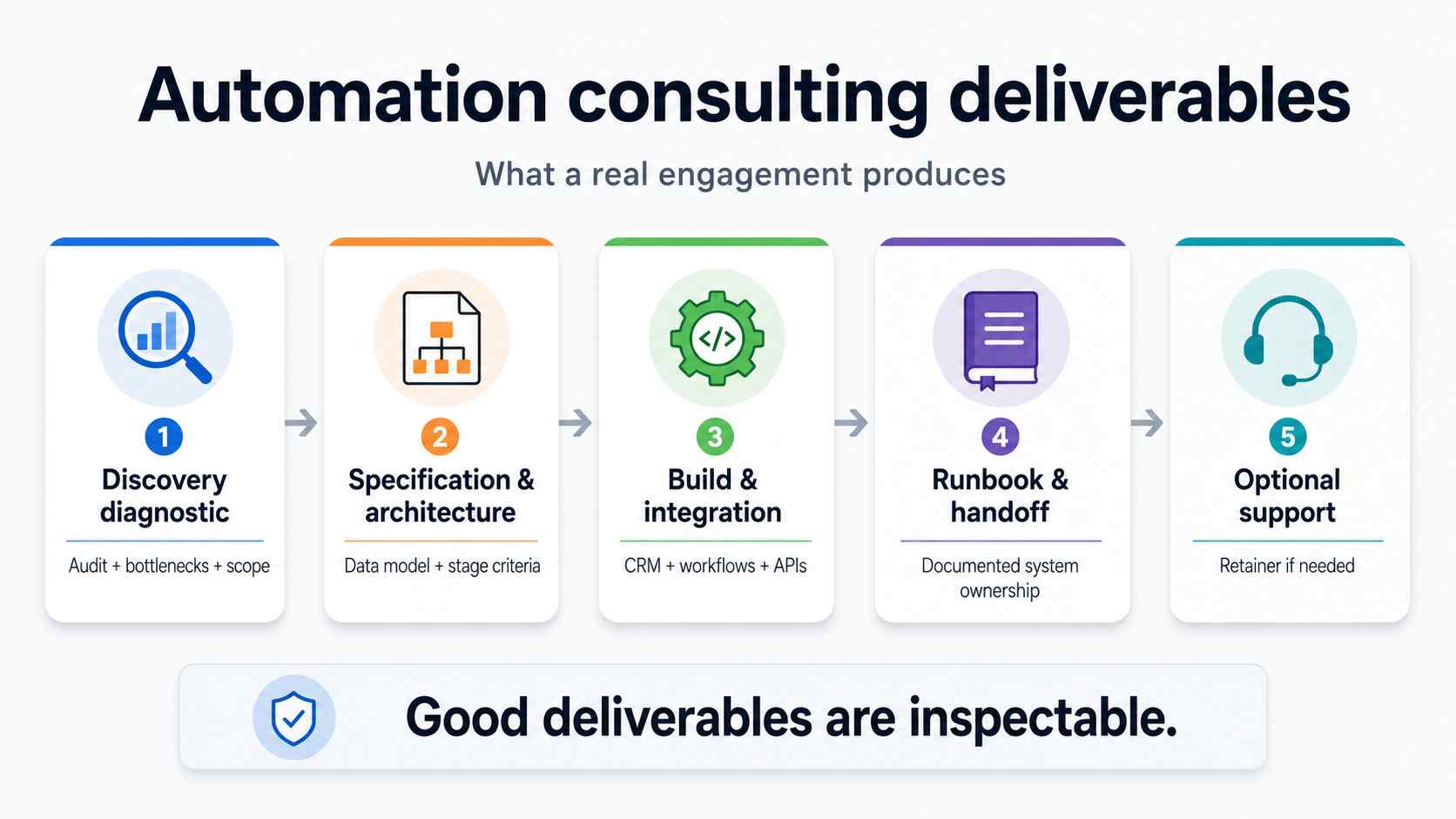
Good deliverables are inspectable. Bad ones are vague. Here is what a real engagement produces, using the ACS model.
The paid discovery diagnostic
Every serious engagement starts with paid discovery. We charge for it because free discovery is a sales pitch in disguise. Paid discovery is a diagnostic. The output is a written audit, a ranked bottleneck list, and a recommended scope.
If we are not the right fit, we say so on the call. Our discovery is refundable against the build, so the operator carries no dead cost. See the pricing page for the current structure.
The specification and architecture
Before we build, we specify. Data model design comes first. Pipeline stages get exit criteria. Pipeline stages without exit criteria become forecasting fiction. A stage should represent a buyer commitment, not a rep activity.
Every stage transition should require a field update that proves the buyer did something. This is a data-modeling exercise disguised as a sales-process exercise, and it governs forecast accuracy more than any automation layer bolted on later.
The build and integration
Then we build. Custom integrations, workflow engineering, CRM configuration, and API connections between systems that did not speak before. We work in Attio, HubSpot, Salesforce, Pipedrive, and Close on the CRM side.
Zapier and Make for workflows. n8n for self-hosted automation. Custom Python and Node when off-the-shelf stops being enough. We quality check until the system runs without bugs. This spans sales automation, operations automation, admin workflows, and integration builds.
The runbook and handoff
Every build ships with a runbook. Runbook-as-deliverable is the difference between a system and a debt. Most automation projects fail at handoff, not at build. The build works on demo day. Six months later the person who understood it has left, and the knowledge left with them.
A runbook preserves institutional knowledge. It should be detailed enough that a new operator can run the system without being told how. We test runbooks with the same discipline we test code.
The ongoing support (optional retainer)
Some operators want ongoing management. We offer a retainer for that. One fencing contractor we support has grown its workflow estate by 40% during the retainer with zero increase in incidents. Support is optional, never forced. The system belongs to you either way.
Six red flags in automation consulting proposals
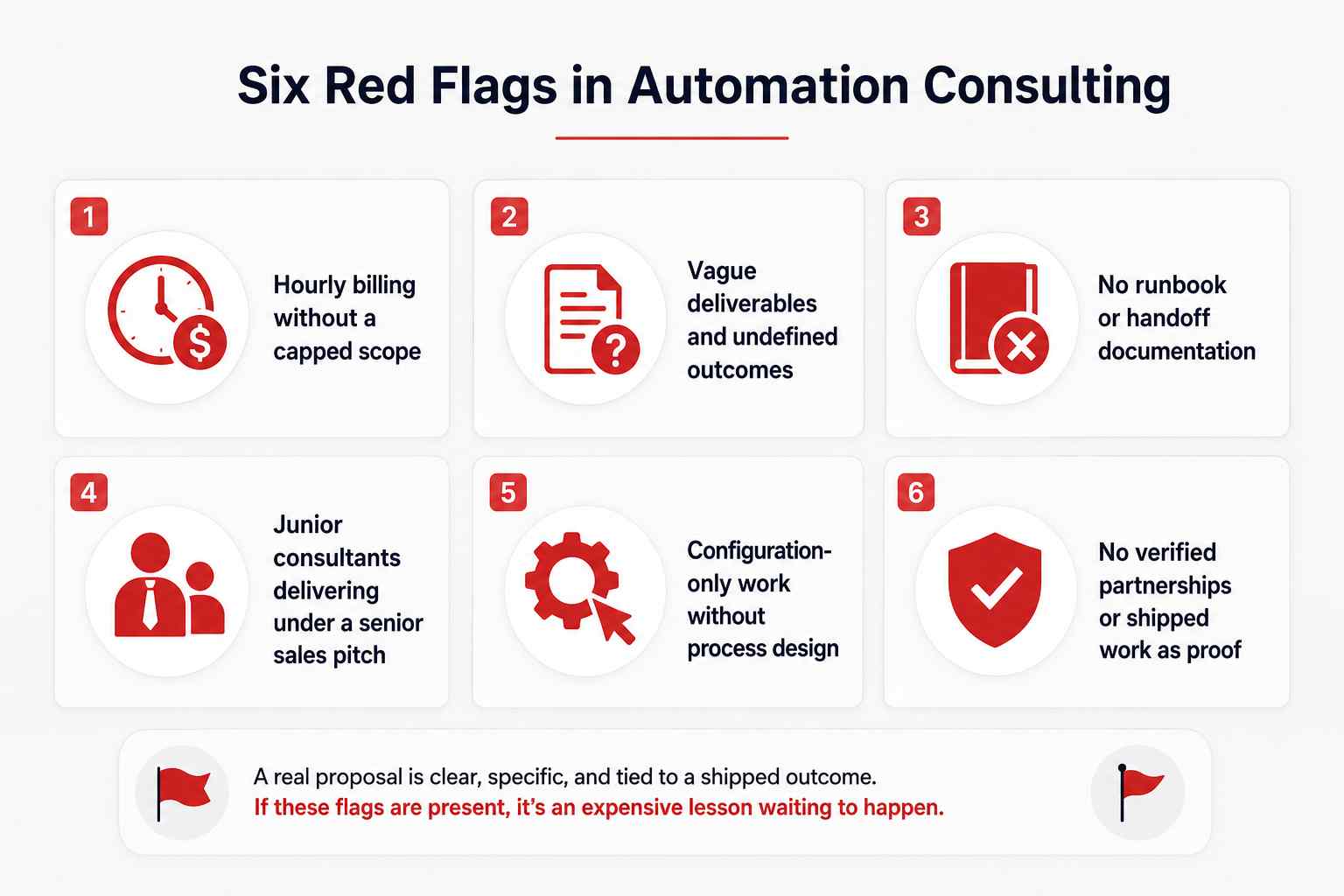
This is the section to read before you sign anything. Six warning signs separate a real proposal from an expensive lesson.
Hourly billing without a capped scope
Most automation consultancies sell hours. We sell shipped systems. Hourly billing pays consultants to think slowly. Every inefficiency becomes revenue for the vendor and cost for you.
If a proposal bills open-ended hours with no capped outcome, the incentive is misaligned from day one. Fixed-fee engagements put the estimation risk on the firm, where it belongs.
Vague deliverables and undefined outcomes
If the proposal cannot name what you will own at the end, walk. "Ongoing automation support" is not a deliverable. A documented CRM with defined pipeline logic and a tested runbook is a deliverable. Ambiguity in a proposal becomes scope creep in the engagement.
No runbook or handoff documentation
Ask directly what documentation ships with the build. If the answer is thin, the firm is selling you a dependency, not a system. A build with no handoff is operations debt you will pay down later, usually at the worst possible moment.
Junior consultants delivering under a senior sales pitch
The person who sold you the engagement should resemble the person who does the work.
Per Rovers Strategic Advisory's 2026 analysis, Big Four firms staff engagements with analysts and associates billed at $200 to $400 per hour while selling the expertise of partners who appear only quarterly. You get the polish in the sales call and the learning curve in production.
Configuration-only work without process design
If the firm goes straight to changing settings without designing the process first, you are buying configuration consulting. That is the path to a museum of dead fields. Process design comes before platform clicks, always.
No verified partnerships or shipped work as proof
Certifications confirm platform familiarity. Shipped case studies confirm the firm can finish. Ask for both.
ACS holds Zapier Certified Solutions Partner status and Attio Expert Partner status, and we point to named case studies rather than anonymous testimonials. You can confirm both credentials on our partners page.
The industries where ACS has shipped
We keep this section proof-heavy, not brag-heavy. Seven engagements across seven industries, all shipped.
An $8M HVAC distributor in Massachusetts carried 5,500+ SKUs across multiple supplier lines. Inside sales burned four to six hours a day answering "is this in stock?" calls.
We built hourly scrapers and API pulls that now keep 5,500+ SKUs accurate with zero manual updates. See the HVAC lead-time automation case study.
A $25M fencing contractor with 150 employees ran on tribal knowledge. We documented and now manage 100+ workflows on retainer. See the fencing automation management case study.
A Series B healthcare SaaS CEO ran 20+ external meetings a week with action items lost in handwritten notes. Our meeting-to-action pipeline reclaimed six to eight executive hours per week. See the healthcare meeting automation case study.
A $10M supplement manufacturer generated quotes by hand, each taking 30 to 45 minutes. Our quoting system cut turnaround by 80% and drove pricing errors to zero. See the supplement quoting automation case study.
A $5M LED display company needed pipeline fast. We stood up an outbound stack that produced 60+ qualified opportunities in 14 days. See the LED display lead gen case study.
A Series B AdTech operator wanted look-alike targets from every closed deal. Our enrichment pipeline now returns 12 to 25 ranked accounts per close with a duplicate rate under 2%. See the competitor intelligence case study.
A $1.5M mobile pet grooming operator had data scattered across QuickBooks, Gusto, and Samsara. We built a custom dashboard unifying all three into one source of truth. See the mobile pet grooming dashboard case study.
Together those engagements represent 500+ workflows shipped, 10,000+ hours reclaimed, and $2 million+ in client savings.
How ACS approaches automation consulting differently
Four commitments define our model. You can read the Matthew Piwko story on our about page.
Fixed-fee engagements
We do not bill hourly. Fixed fees align our incentive with your outcome. We win by shipping fast, not by dragging the clock.
Refundable paid discovery
Discovery is paid, and it is refundable against the build. You get a real diagnostic with no dead cost and no free-consultation sales theater.
Runbook-as-deliverable
Every system ships with documentation you own. When your team changes, the system keeps running. That is the difference between infrastructure and a person-shaped dependency.
Engineering discipline applied to operations
We treat your operations the way we treat software. Specification first. Data model second. Build third. Test and document last. That sequence is what separates a system that scales from a pile of tools that breaks.
When automation consulting is worth it (and when it is not)
Automation consulting is not always the right call. Here is how we frame it.
Hire outside when
The gap is bigger than one hire can close in 90 days. Your systems have outgrown spreadsheets. You are scaling fast enough to feel the pain of manual operations. You need patterns imported quickly rather than learned slowly.
Boutique firms deliver first value in four to twelve weeks, per bosio. Digital's 2026 analysis, while Big Four programs run 12 to 24 months. A focused engagement compresses months of internal ramp into weeks.
Do it in-house when
The work is simple and single-tool. A basic email trigger or one connected app does not need a consultant. You have technical capacity in-house and a stable foundation. At that point the work is optimization, and your own team can carry it.
The hybrid approach that usually fits
Most $10M-$50M operators land in the middle. Bring in a firm to build the infrastructure and ship the runbook. Then run and extend it in-house. You get the architecture from specialists and the ownership from your own team. That combination usually beats either extreme.
Frequently asked questions
What is automation consulting?
Automation consulting is the design and construction of the operational systems a business runs on. At the $10M-$50M scale, it means CRM implementation, workflow engineering, and integration architecture. It is infrastructure work, not advisory work.
How much does automation consulting cost?
Cost structures vary by model. Hourly billing exposes you to open-ended totals. Fixed-fee engagements price the outcome up front. Retainers cover ongoing management. ACS uses fixed fees with refundable paid discovery. See our pricing page for the current structure.
Who needs automation consulting?
$10M-$50M B2B operators whose back office has outgrown spreadsheets and shared inboxes. Teams scaling fast enough to feel manual pain but not large enough for an internal operations engineering function.
This band feels the friction most acutely around $25M+, as the sales team and ops team scale in different directions.
What is the difference between automation consulting and process consulting?
Process consulting produces recommendations and playbooks. Automation consulting produces working systems. Process consultants own the advice. Implementation firms own the outcome. The mid-market gap sits squarely on the implementation side.
How long does an automation consulting engagement take?
At ACS, first workflows often ship into production within two weeks. Median time to a live system runs four to six weeks. Enterprise-grade programs at larger firms routinely run six to twenty-four months.
How do I choose an automation consulting firm?
Check for verified partnerships, named case studies, fixed-fee pricing, and a runbook as a named deliverable. Avoid open-ended hourly billing and vague scopes. Ask who does the actual build.
Is automation consulting worth it for a $10M B2B company?
Yes, when the operational debt is structural. Nucleus Research puts the average CRM return at $8.71 for every dollar spent, and Forrester has measured a 245% ROI over three years. The right CRM is the one your team uses without being told to, and a good engagement gets you there.
Next steps
Three ways to start.
Book a paid discovery diagnostic. Our discovery is refundable and produces a written audit with a ranked bottleneck list. Start on the pricing page.
Review the case studies. Seven industries, seven shipped systems, real numbers. See the case studies page.
Verify the partnerships. Zapier Certified Solutions Partner and Attio Expert Partner status are both verifiable. See the partners page.