

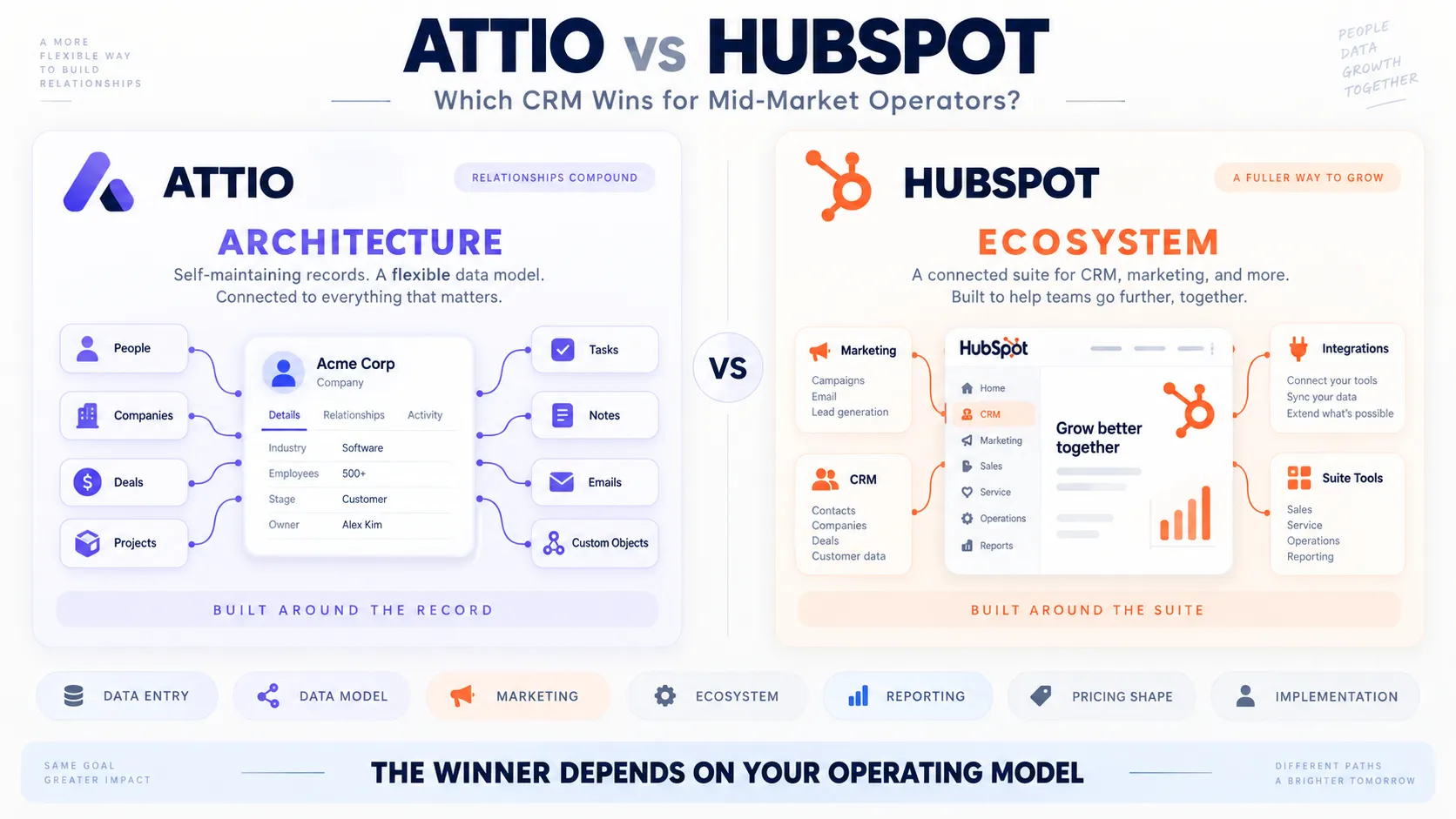
Disclosure before the bell: we implement both platforms. We build operations infrastructure with engineering discipline for $10M-$50M operators. Attio and HubSpot builds both run through that practice, constantly. We win either way, so the verdicts below can be conditional instead of convenient.
The comparison is simpler than the feature grids suggest. One bet decides it, and seven rounds show you which side of the bet you are on. Feature grids count checkmarks. Operators count outcomes. This match is scored for the second group.
Attio vs HubSpot: The Short Answer
For operators who want the CRM doing its own data entry on a data model shaped to their business, with marketing running outside the CRM: Attio. For teams whose revenue engine runs on marketing automation, content tooling, and a deep app ecosystem: HubSpot. Attio is a bet on architecture.
HubSpot is a bet on ecosystem. Anyone declaring a universal winner skipped your operating model. The rest of this page exists to locate yours.
The Two Bets: AI-Native vs Retrofitted
The frame comes from our AI-native CRM guide, and it settles most of this match before the rounds start. Attio is AI-native: the system captures, enriches, and maintains records itself. HubSpot is AI-added: a powerful human-fed platform with intelligence layered on, and the deepest suite in the mid-market. Neither description is an insult.
Both are bets, and bets are supposed to be named. Architecture pays off daily, quietly, in records that keep themselves. Ecosystem pays off broadly, visibly, in tools that already connect. Pick the payoff your revenue actually needs, not the one the louder demo sold.
Attio vs HubSpot Round by Round
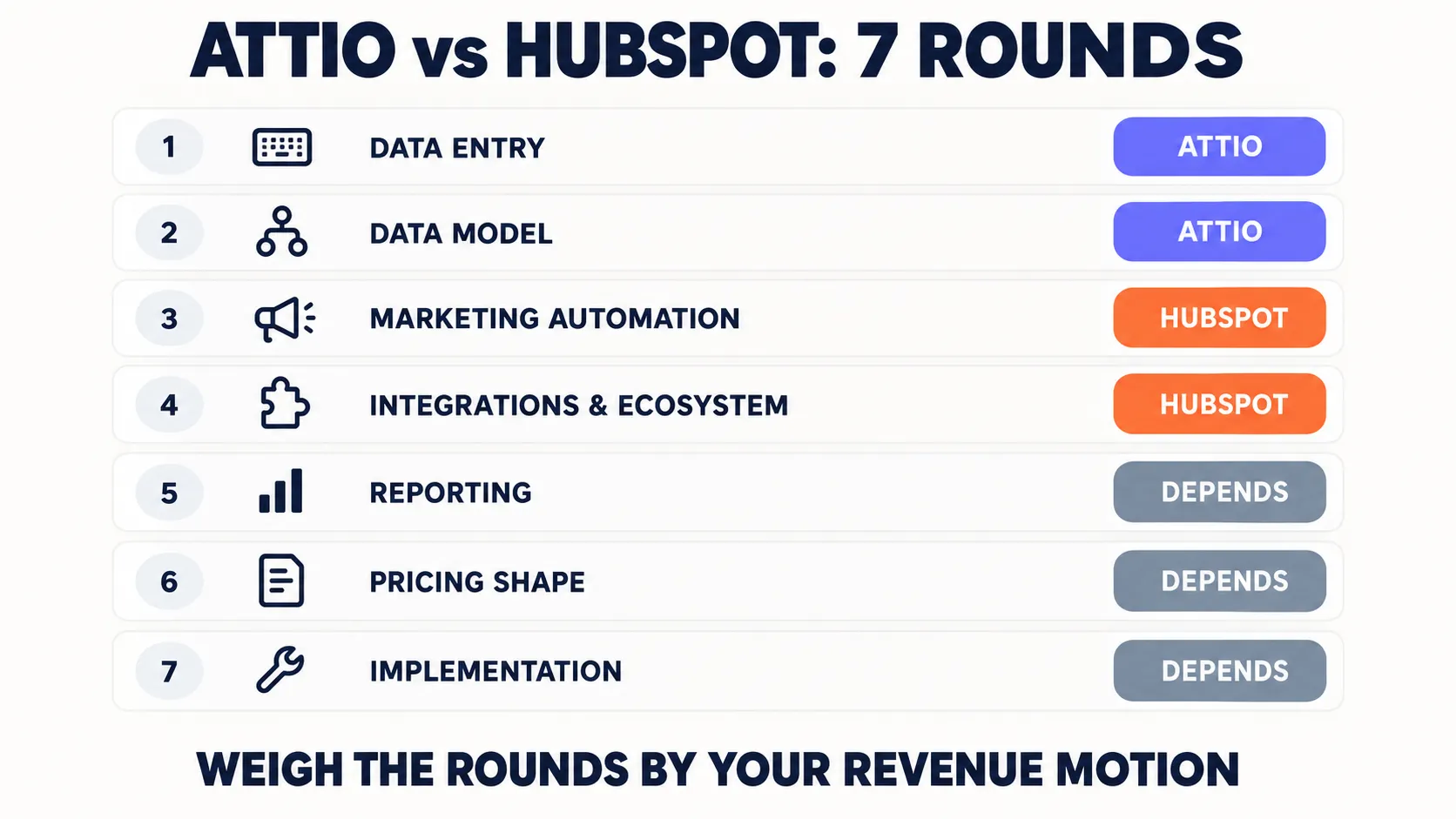
Seven rounds. Each gets a winner and the condition that decides it. Read your situation into every verdict, because the conditions are doing the real work here. A round you do not care about is a round that should not count.
Round 1: Data Entry and Record Maintenance
Attio, cleanly. Records create and update themselves from email, calendar, and connected systems. Reps correct rather than type. The correction takes seconds. The typing took the afternoon. HubSpot's AI features assist a human-fed core, and they improve steadily, but the architecture still expects the rep to feed it.
Run the thirty-second test from the five-tests guide: watch a new contact appear without a human creating it. If self-maintaining records are the point, this round is the match. Most mid-market data problems die right here. So does most of the Friday cleanup ritual.
Round 2: Data Model Flexibility
Attio, for most operating models. Custom objects and relationships are first-class citizens, so the CRM models your actual business: properties, projects, partnerships, whatever runs revenue. HubSpot's custom objects exist and work, gated by tier, shaped by its pipeline-first heritage. The heritage shows under load. Standard motions never notice.
Unusual businesses always do. Model your weirdest entity in both demos and watch which one fights you. The one that bends without workarounds is the one that survives year two.
Round 3: Marketing Automation
HubSpot, and it is not close. Email marketing, landing pages, forms, campaign attribution, content tooling: a mature suite refined over more than a decade of shipping. Attio does not pretend to be this, and pairing it with dedicated marketing tools is the pattern.
Respect the round for what it decides. If marketing automation is half your revenue motion, this round outweighs two others. The match may end here in HubSpot's favor, honestly. Weight it accordingly.
Round 4: Integrations and Ecosystem
HubSpot on breadth, honestly. The app marketplace is enormous, and your stack probably assumes it. Attio counters differently. A modern API and clean webhooks make engineered integrations a pleasure to build. The catalog is smaller. The pipes are better.
Middleware through the platforms we compared equalizes most gaps for a build-minded team. So score the round by your team. Plug-and-play buyers: HubSpot, no contest. Build-and-own operators: closer than the marketplace counts suggest, and the built connections fit tighter than the installed ones.
Round 5: Reporting and Visibility
Split, on an honest technicality. HubSpot ships more prebuilt reporting surface, tiered upward. Dashboards, attribution views, forecast tooling, all in the box. Attio's reporting is cleaner-limbed and improving, and it sits on data that maintains itself.
Here is the technicality. A report is only as truthful as its records. Self-maintaining records tilt the round for teams who lost faith in their dashboards. The prettiest chart on rotted data is still rot, formatted.
Round 6: Pricing Shape
Split by shape, with no figures, because figures change and your seat count is yours. Read both pricing pages at your real numbers. The shapes below tell you what to look for when you do.
How the HubSpot Bill Grows
By hub, tier, and seats, with required onboarding fees published for certain higher tiers, a structure our implementation cost guide unpacks. The suite is the value and the bill reflects the suite. Unused hubs are the waste to watch, because shelf space renews annually when nobody visits the shelf. Buy the hubs your first year actually configures.
How the Attio Bill Grows
By seats on a simpler ladder, with the AI priced as the product rather than an add-on tier. The shape stays legible as you scale. Legibility is worth something at budget time. The discipline is different: you will still buy marketing tools separately, so total the stack, not the CRM line. A cheap CRM line inside an untotaled stack is how comparisons lie politely.
Round 7: Implementation and Migration Reality
Split by scope. HubSpot implementations carry the six line items our cost guide dissects, multiplied by hubs. Attio implementations shift the work upstream, per our implementation guide. Data model design and capture configuration lead.
The configuration surface itself stays smaller. Different work, both real, and neither optional. Either way, migration truths hold: clean data first, sample first, match keys always. Budget the work your choice creates, not the work the demo showed.
The Scoreboard, Tallied Honestly
Attio takes data entry and data model, the architecture rounds. HubSpot takes marketing automation and ecosystem breadth, cleanly, the suite rounds. Reporting, pricing shape, and implementation split on conditions named above.
No sweep, because sweeps are advertising, and you have read enough of those. The bet you named in round three probably decided your match. That is the point. Weigh the rounds by your revenue motion, not by the count.
When Attio Wins: The Operator Profile
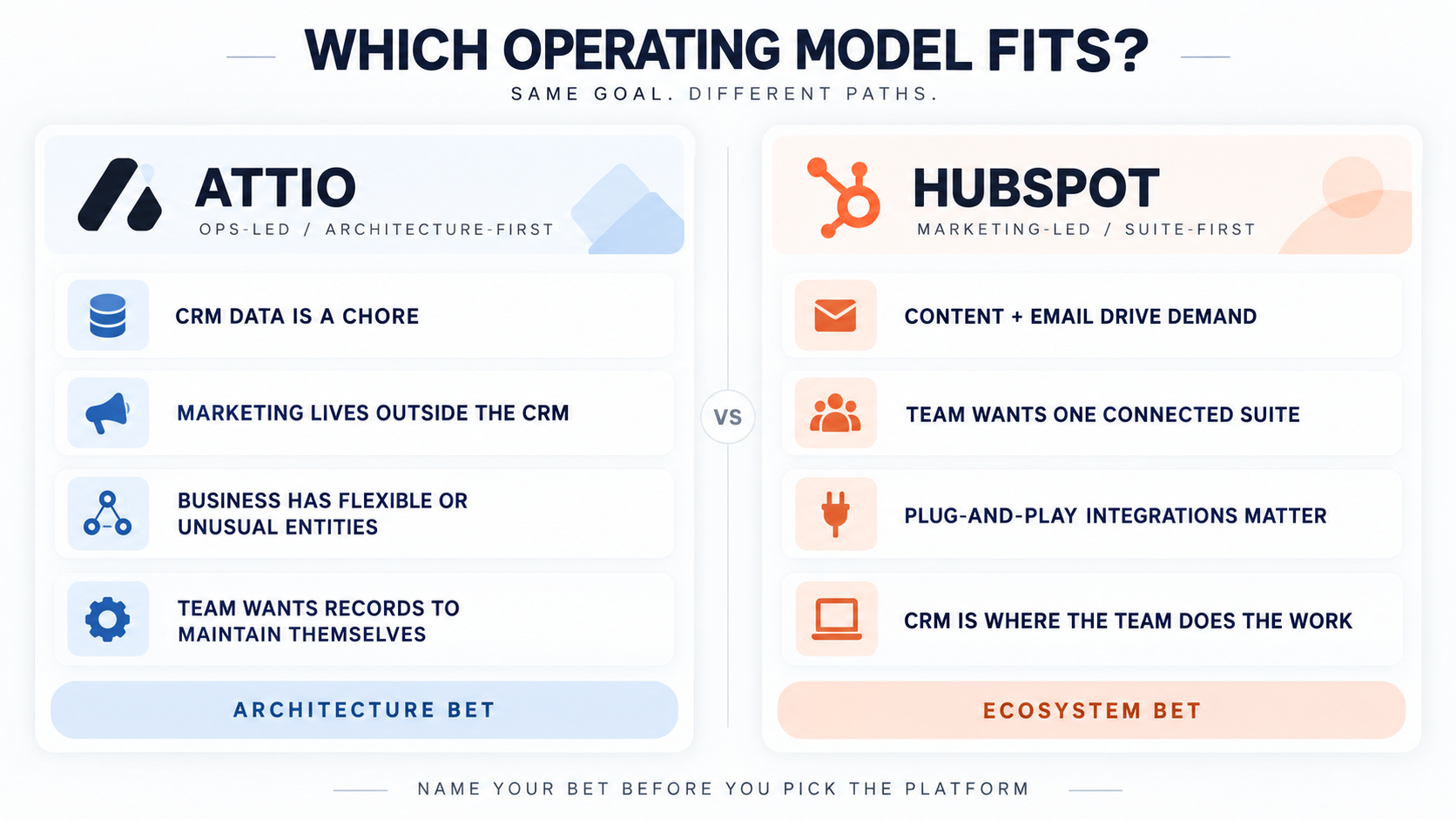
A $10M-$50M operator with a working sales motion and rotting CRM data. Marketing runs in dedicated tools or through an agency, happily separate. The business has entities a pipeline template cannot hold. The team is small enough to feel every hour of data entry and senior enough to review instead of type.
Ops-led buyers fit this profile more often than marketing-led ones do. The tell in discovery calls: they describe their CRM as a chore, not a hub. Chores get automated. That is the whole pitch, and it lands hardest with founders who once did the typing themselves.
When HubSpot Wins: The Operator Profile
A team whose demand engine is content, email, and campaigns, run in one place. An ecosystem-heavy stack where the marketplace connection already exists for everything, installed in minutes. A marketing-led buying committee that will live in the suite daily.
Or an organization standardizing on one vendor for CRM, marketing, and service together, and funding the implementation that makes it real, line items and all. The tell here: they describe the CRM as the place work happens, not the place records live. Suites reward residents. That is the other pitch, equally honest.
Can You Run Both Attio and HubSpot?
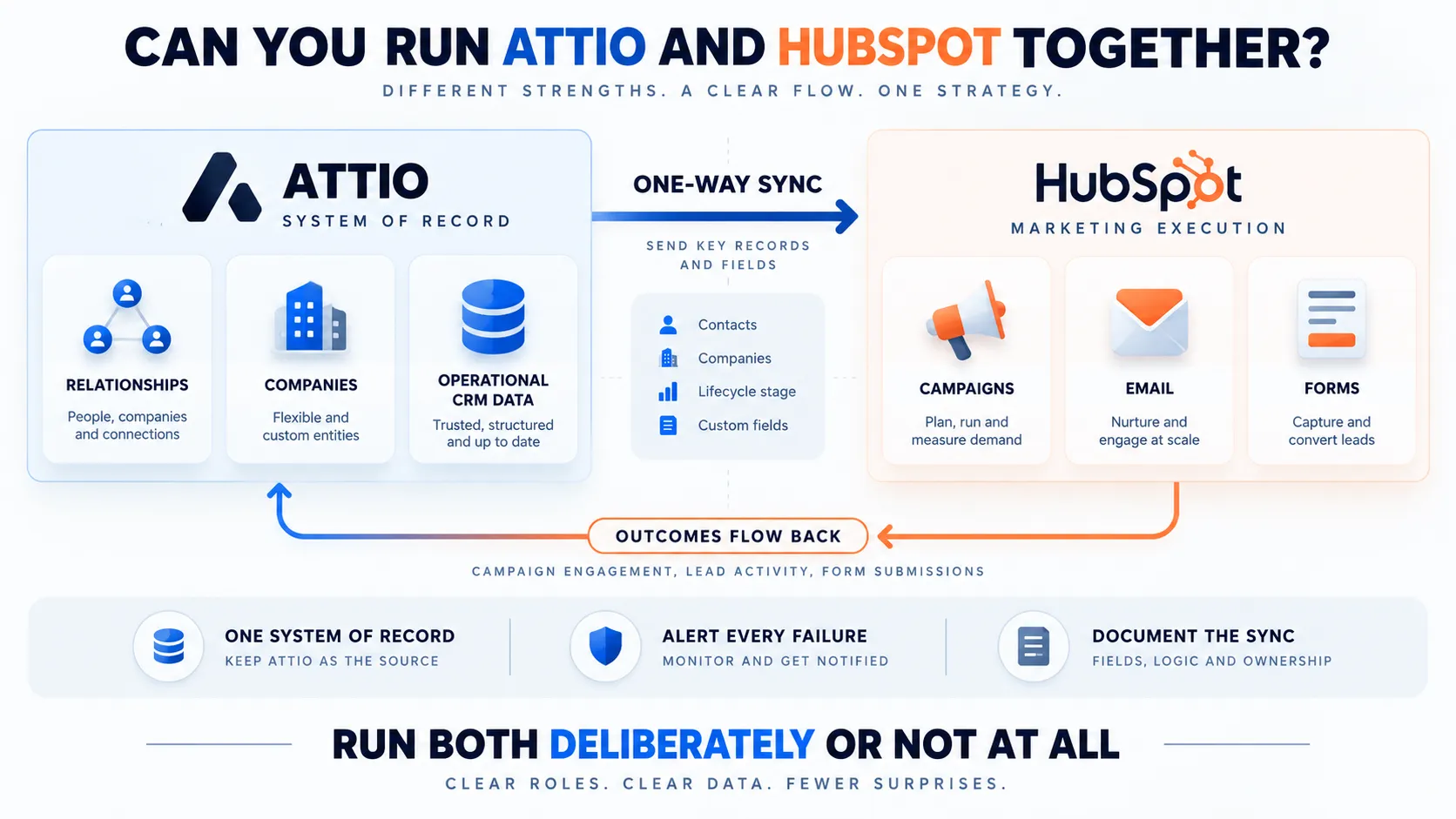
A real pattern, not a cop-out. Some operators run Attio as the system of record for relationships and operations. Marketing executes in a dedicated platform, HubSpot included. A one-way sync feeds outcomes back. It buys native architecture and suite marketing at once, which is the appeal. It costs an integration you must own, alerted and documented like any production system, which is the price.
Decide the system of record in writing on day one. Sync one direction only. Alert every failure. Review the sync monthly like the production system it is. Run it deliberately or not at all: two half-adopted CRMs is the worst outcome on this page, and it happens by drift, never by decision.
Switching Between Attio and HubSpot
Both directions happen. HubSpot-to-Attio migrations move relationship history into a redesigned data model, and the model workshop is where the value hides. The old pipeline template does not have to survive the trip. Attio-to-HubSpot moves happen too, usually when a company votes marketing-led after living ops-led. Either direction, the same five truths.
Export everything, history included. Clean before moving. Migrate a sample. Keep the match keys. Run parallel until the numbers reconcile. Switching costs are real, which is exactly why the bet deserves naming before the first purchase, not after the second one. A named bet survives contact with the roadmap. An unnamed one migrates every eighteen months.
How ACS Implements Both
Platform-agnostic and disclosed: the recommendation follows your operating model, not our margin. Engagements run fixed fee after a paid and refundable discovery. Discovery maps your data model, migration reality, and integration list.
Then it applies the two-bets frame to your actual revenue motion, with the rounds scored for your situation in writing. No demo theater. Your data, your motion, your scorecard. The document is yours either way, and it ends the vendor-page phase of the decision.
Builds carry the constants: documentation your team keeps, training to named roles, accounts in your name, error-alerted integrations. Engagement structure sits on pricing. The record sits in the case studies: 500+ workflows shipped, more than 10,000 hours reclaimed, over $2 million in client savings.
Frequently Asked Questions About Attio vs HubSpot
Is Attio better than HubSpot?
For self-maintaining records on a flexible data model, yes. For marketing automation depth and ecosystem breadth, no. The honest answer is conditional, and the condition is your operating model. Name your bet first, then the ranking writes itself. Rankings without conditions are ads.
Is Attio an AI-native CRM and HubSpot not?
Yes, by architecture, the durable kind. Attio was built with AI as the record-keeper. HubSpot is a mature AI-added platform: human-fed core, intelligence layered on, improving steadily. Both descriptions are neutral. The five tests in our AI-native guide settle it in one demo each, no marketing required.
Can Attio replace HubSpot?
As the CRM and system of record, for the right profile, yes. As the marketing suite, no, and it does not try. Replacing HubSpot with Attio usually means Attio plus dedicated marketing tools, totaled honestly as a stack. Compare stacks to suites, never lines to suites. The comparison stays honest that way, in both directions.
Does Attio do marketing automation?
Not the suite, by design. Workflow automation around records and pipelines, yes. Email campaigns, landing pages, and attribution live in paired tools. Ecosystem-minded teams should weigh that pairing cost before switching, in money and in one more login.
Which is cheaper, Attio or HubSpot?
Shapes, not figures, since figures change. HubSpot grows by hub, tier, and seats, plus published onboarding for higher tiers. Attio grows by seats with AI in the plan, plus whatever marketing tools you pair. Total your stack both ways at your real seat count, at this year's team and at next year's. The pricing pages hold the current numbers, and the totals hold the truth.
Which is easier to implement?
Attio carries less configuration surface and more upstream thinking: data model and capture design. HubSpot carries more surface across hubs, per the six line items in our cost guide. Easier depends on which work your team is built for. Thinkers find Attio faster. Configurers find HubSpot familiar. Staff the implementation to match.
Can I migrate from HubSpot to Attio?
Yes, and the move is a data model redesign wearing a migration. Export all objects and history, clean first, map to the new model, sample-migrate, keep match keys, run parallel briefly. Give the model workshop the respect it earns. The workshop decides how good the next five years of data will be.
Are HubSpot's AI features catching up to Attio?
They improve every quarter, genuinely. The architecture gap is the durable part: added intelligence assists a human-fed core, while native intelligence is the core. Features converge faster than architectures do, on both sides. Verify the current state at evaluation time, and run the data-entry test live rather than trusting either side's marketing.
What is the main difference between Attio and HubSpot?
Architecture versus ecosystem, in one line. Attio is an AI-native CRM that maintains its own records on a flexible data model. HubSpot is an AI-added suite where CRM, marketing, and service share one mature platform. Everything else on this page is that difference, applied to seven rounds and two profiles.
Which should a startup choose, and which fits mid-market?
Early teams pick by motion. Product-led and ops-led lean Attio. Content-led lean HubSpot. Mid-market operators, our lane, feel the data-entry tax hardest and own the weirdest entities. That is why the architecture bet pays best there. Enterprise buyers add governance to the scale, and that conversation changes.
Ready to Name Your Bet?
Three ways forward.
Run the five tests. The AI-native guide turns two demos into a decision, thirty minutes per vendor, architecture separated from adjectives.
Read the deeper cuts. The Attio head-to-head and the implementation guide cover the native path in full, from platform choice to go-live.
Book a paid discovery. Your revenue motion mapped against both bets, a recommendation with reasons, one fixed price, refundable if the fit is wrong. The scorecard comes filled in. Details on pricing.
Architecture or ecosystem. Name the bet, and Attio vs HubSpot answers itself, because it was never really a fifty-feature question in the first place.