

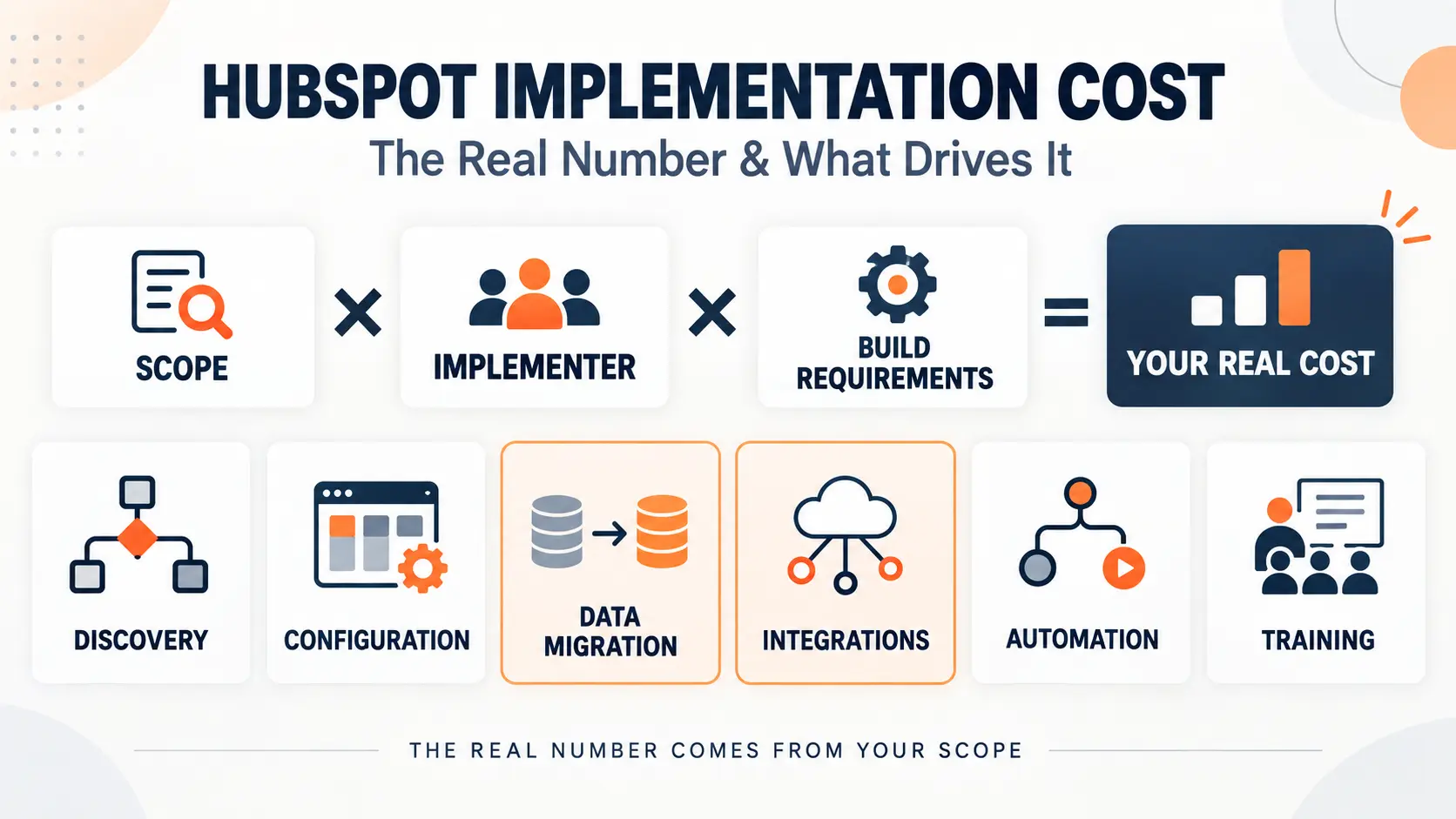
How much does HubSpot implementation cost? Here is the honest answer nobody leads with. The real number is the one built from your scope. Every figure published without knowing your scope is a guess wearing a price tag.
We build operations infrastructure with engineering discipline for $10M-$50M operators, and HubSpot implementations sit inside that work, detailed on our HubSpot services page. This guide gives you what a figure cannot: the equation, the line items, and the drivers, so any quote you receive becomes readable.
One promise, consistent with everything we publish: no invented market rates here. The pricing structures are real. The numbers will be yours.
How Much Does HubSpot Implementation Cost? The Honest Answer
Three variables set the number before anyone opens a laptop.
Scope: which hubs, how much data, how many integrations, how much automation. Tier: higher HubSpot tiers add more machinery, and more machinery means more configuration. And the implementer: the same scope prices differently across an agency, an independent consultant, and your own team's hours. Write those three down. That is the equation, and the rest of this guide fills in your values.
The equation beats the figure because the figure lies in both directions. A number too low anchors you to a build that skips training and documentation. A number too high scares you away from work that pays for itself. Compute yours from the line items below, and every vendor conversation changes. You stop asking what it costs. You start asking what each line costs, and why.
Our automation consulting cost guide covers the wider pricing landscape. This one goes deep on HubSpot specifically.
HubSpot License vs Implementation Cost: Two Different Bills
The first confusion to kill: the subscription and the implementation are separate spends, and conflating them wrecks budgets.
The license is the recurring fee to HubSpot for the software. Hub, tier, and seats set it, published on HubSpot's pricing pages. The implementation is the one-time project that turns the empty portal into your operating system.
The license buys the tool. The implementation buys the outcome. Budget both, separately, because the license renews forever and the implementation, done once and well, does not.
One structural note worth knowing: HubSpot itself lists required onboarding fees for certain higher-tier purchases, published on its pricing pages. Check current figures there, because they change. That required onboarding is guided setup. It is not the same thing as a full implementation, a distinction the implementer section below unpacks.
The tier decision and the implementation decision also interact. Buying a tier for features nobody will configure buys shelf space. Sequence honestly: pick the tier your first-year build actually uses, and let the roadmap justify upgrades later.
The Six Line Items of a HubSpot Implementation Quote
Every honest quote decomposes into six lines. Read any proposal against this list, and the gaps announce themselves. A missing line is not a discount. It is a cost moved to later, wearing better packaging.
Discovery and Process Mapping
The paid look before the build: your sales process documented, your data sources inventoried, your integration map drawn. Skipping discovery does not save its cost. It relocates the cost into rework, because a portal configured to a guessed process gets configured twice. The output is a document set. Process map, data inventory, integration list, build plan. Paper first, portal second.
Portal Configuration and Pipeline Architecture
The core setup: pipelines and stages matching your real process, properties designed instead of defaulted, teams and permissions, lifecycle stages. The record architecture sits underneath all of it.
Cheap quotes treat this as clicking through settings. Real implementations treat it as designing the system your reporting will stand on for years. Property discipline is the tell. Every property gets a definition and an owner, or it becomes next year's cleanup line.
Data Migration and Cleanup
The line where quotes go to double, and the one to scrutinize hardest. Cost follows record volume, source-system mess, deduplication needs, and how much history must survive the move. Clean data in a modern CRM migrates gently.
A decade of spreadsheets and a half-abandoned legacy system migrate expensively, and honestly so. One de-risking move: migrate a sample first. A few hundred records through the full path surfaces the surprises while they are still cheap. Our migration guide shows what the work involves when done properly.
Integrations
The variance monster. A native integration configured well is a small line. A middleware build through the platforms we compared is a medium one. A custom API integration to an ERP or a niche industry system is integration engineering, priced like the engineering it is.
Count your integrations and sort them into those three buckets before requesting any quote. Ten minutes of sorting removes the biggest surprise most quotes carry.
Automation and Workflow Builds
Lead routing, sequences, deal automation, internal notifications, data hygiene workflows. Cost tracks the count and complexity of what you automate at launch. The honest scoping move: automate the workflows with proven manual versions first, and let the rest earn their build in phase two. The nice-to-haves keep. The launch does not need them.
Training and Adoption
The line cheap quotes delete and expensive failures skipped. Training to named roles, documentation your team keeps, and a hypercare window after launch. Hypercare means fast answers in the first weeks, while habits form and questions are small.
An implemented portal nobody uses correctly is configuration theater. Adoption is where the license and the implementation both start paying rent.
What Drives HubSpot Implementation Cost Up or Down
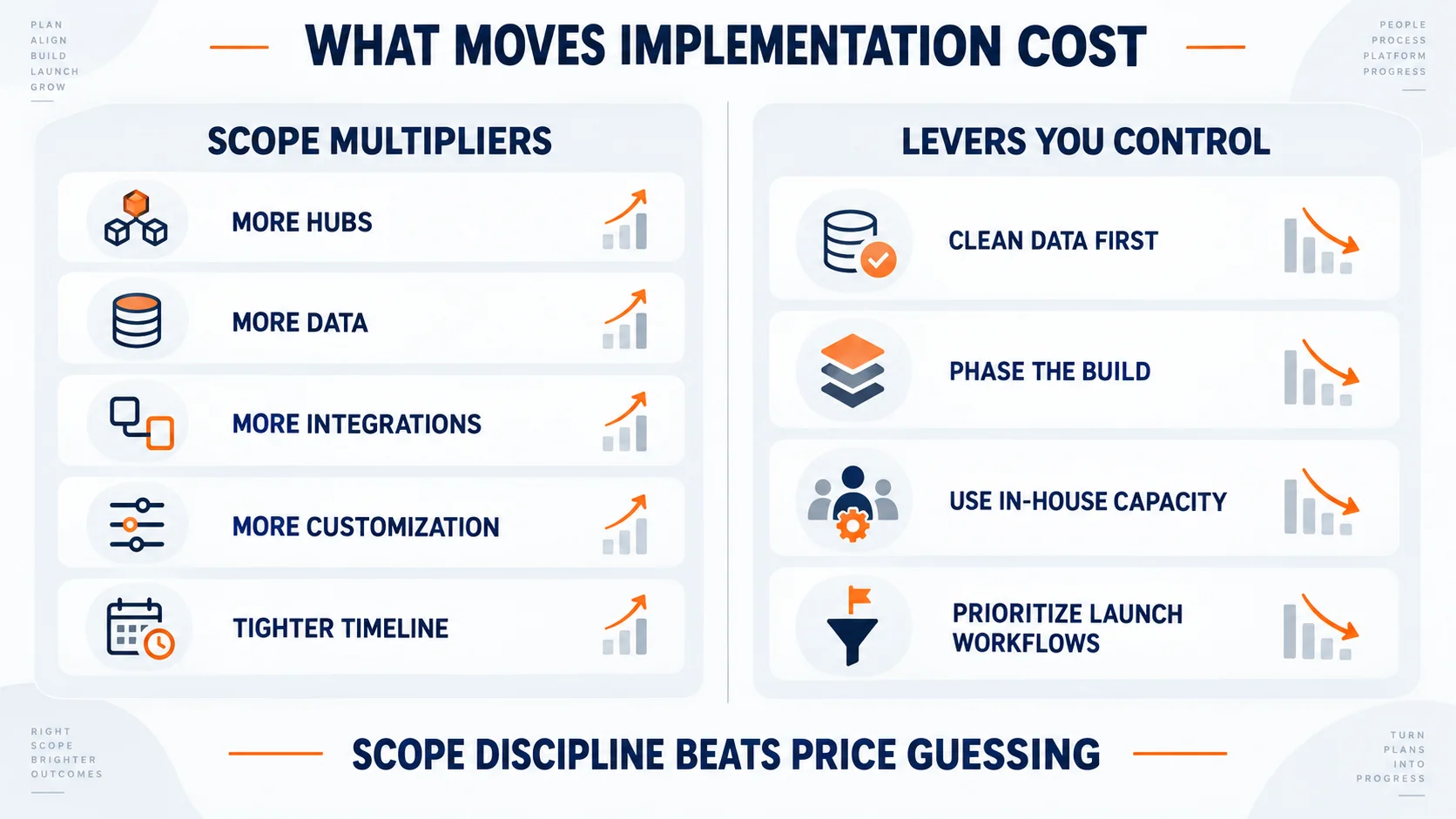
The drivers, sorted by direction.
The Multipliers
Hub count multiplies scope, because each hub is its own configuration surface. Tier raises the machinery available and the machinery configured. Data volume and mess grow the migration line nonlinearly. Integration count and custom objects expand architecture work. Compressed timelines price like the overtime they are. None of these is negotiable by talking. All of them move by scoping.
The Levers You Control
In-house capacity lowers the bill honestly: a team that owns training rollout or data cleanup shrinks those lines. Phasing lowers launch cost by deferring what can wait. Launch sales hub core in month one.
Add the service workflows in quarter two. Clean data before migration is the single cheapest cost reduction available, and it is work you can start today. Scope discipline beats negotiation every time.
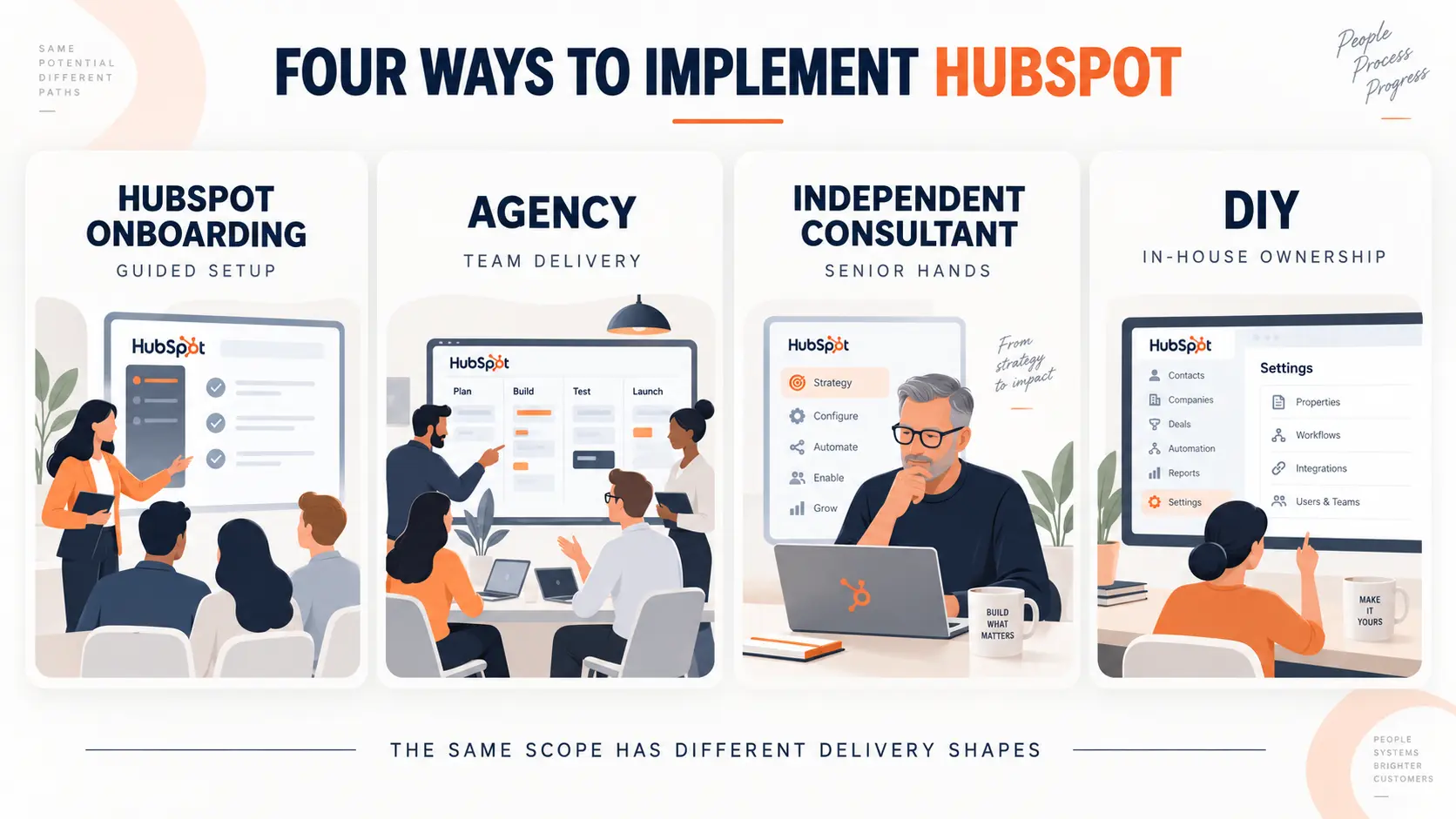
Who Implements HubSpot: The Four Routes Compared
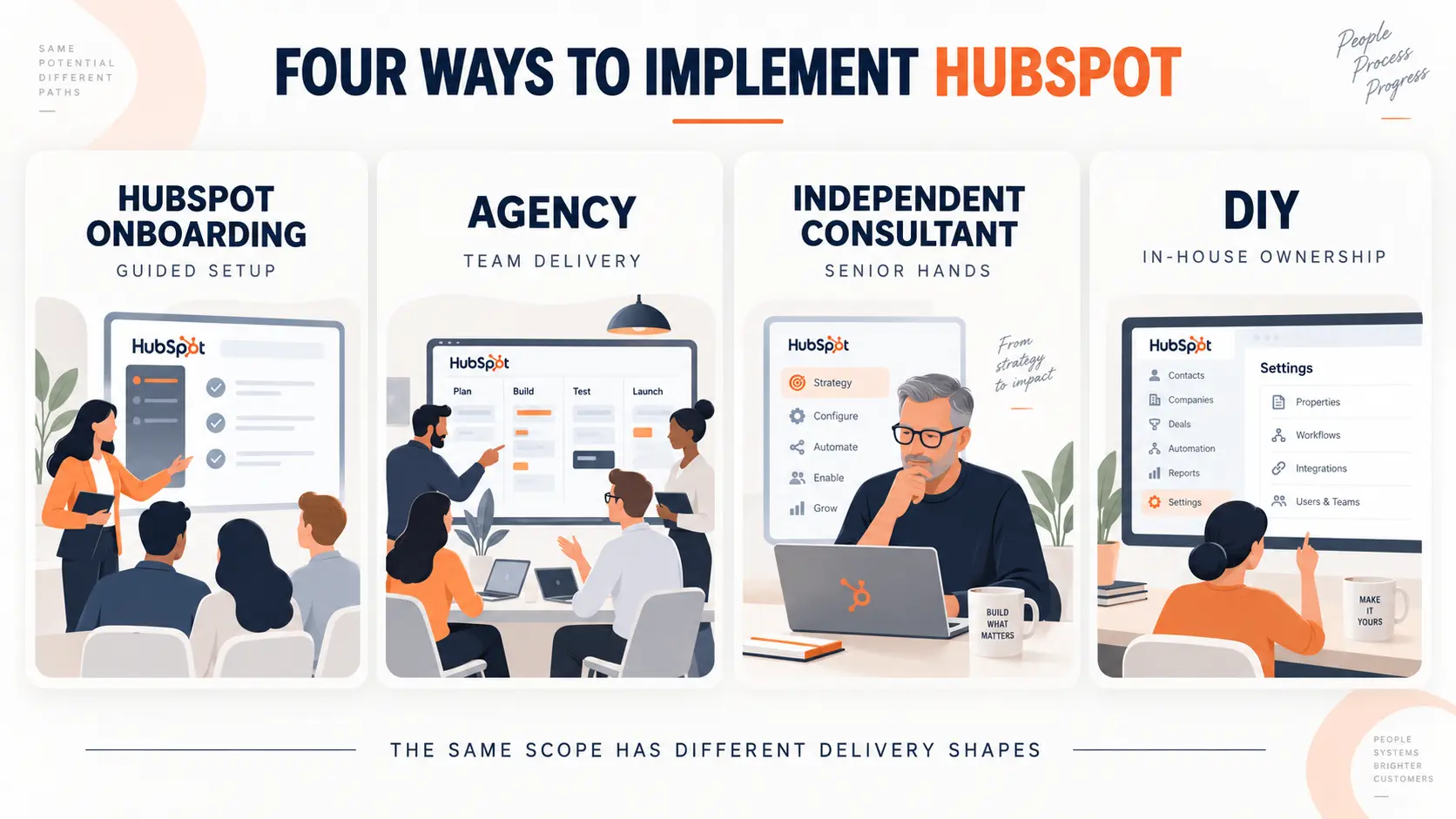
Same scope, four price shapes. The route decides more of the number than most buyers expect, and the honest comparison is per line item, not per brand.
HubSpot's own onboarding is guided setup: structured sessions pointing your team through configuration, with your team doing the work. Right for simple portals and capable in-house owners. The guidance is real. The hands are yours.
Agencies bring teams, process, and bandwidth, with pricing that carries the overhead of all three. Right for large multi-hub builds and marketing-heavy scopes.
Independent consultants and small firms price leaner for the same senior hands, with less bandwidth by design. Right for focused sales and operations implementations where the builder and the strategist are the same person.
DIY works at the Starter tier with a motivated owner and modest scope. The cost is attention, and the risk is architecture decisions made without having seen the consequences before. The evaluation standards in our hiring guide apply to all four routes.
Routes also mix, and the mix is often the answer. Required onboarding plus an independent for the build. An agency for launch plus in-house for adoption. Buy each line from whoever prices it best.
Mid-Market HubSpot Implementation: The $10M-$50M Reality
Our own lane, described honestly. A mid-market implementation almost always means existing data with history worth keeping. At least one system of record to integrate. Sales and operations workflows that already run manually. And a team large enough that training is a project rather than a meeting.
That profile lights up every line item above the minimum. The compensating advantage: mid-market operators usually know their process, which shrinks discovery and sharpens configuration.
The same dynamics we documented for Salesforce mid-market implementations apply here with a friendlier learning curve. The operator who can draw their pipeline on a whiteboard saves real money at every line.
How to Get a Real HubSpot Implementation Quote
Walk in with your scope and the quotes converge. Prepare five things.
Your hub and tier decision, or the shortlist. Your record counts by object, honest about the mess. Your integration list, sorted native, middleware, custom. Your top ten workflows, with the manual versions described. Your training audience, counted by role. One page, one hour, and most of it you already know.
That one page turns quoting from theater into math. Vendors who receive it quote tighter and faster. Vendors who ignore it and quote anyway have told you something useful. Send the same page to three implementers, and the spread itself becomes information. Converging quotes confirm the scope. A wild outlier is asking for a different conversation.
HubSpot Implementation Pricing Red Flags
Five patterns that reliably predict regret.
An instant quote with no discovery, because scoping-free numbers are marketing. Open-ended hourly with no cap or milestone, because the meter should never be the business model.
License-reseller economics dressed as implementation advice, because commission and counsel pull different directions. No training or documentation line, because the deleted line is the one you needed. And no named deliverables, because "set up HubSpot" is not a scope, it is a wish.
Any one of these is a question to ask. Two or more is an answer. The pattern behind all five: pricing detached from scope. Every honest quote can show its math, line by line, and every evasive one has a reason it cannot.
How ACS Prices HubSpot Implementation
Fixed fee, after a paid and refundable discovery. Discovery produces the scope document above from your actual systems: hubs, data reality, integration map, workflow list, training plan. The document is yours either way, and it makes every competing quote comparable, including ours. Timelines get stated per phase in the same document, because a price without a date is half a quote.
Builds carry the constants: documentation your team keeps, training to named roles, accounts in your name, error-alerted integrations. The full HubSpot practice lives on our HubSpot page. Engagement structure sits on pricing. The shipped record is in the case studies: 500+ workflows, more than 10,000 hours reclaimed, over $2 million in client savings.
Frequently Asked Questions About HubSpot Implementation Cost
How much does HubSpot implementation really cost?
The scope decides, through six line items: discovery, configuration, data migration, integrations, automation, and training. Compute yours with the one-page scope in this guide. Any figure offered before scoping is a guess, including the reassuring ones. The equation travels. The figures do not.
How long does a HubSpot implementation take?
Scope again: simple single-hub portals move in weeks, mid-market multi-hub builds with migrations and integrations run months. Phasing shortens time to first value either way. Launch the core, prove it, then extend. The calendar risk sits in the same place the cost risk does: data migration and custom integrations. Sequence those early.
Is HubSpot onboarding required?
HubSpot lists required onboarding for certain higher-tier purchases on its pricing pages, and the current terms live there. That onboarding is guided setup, not a full implementation. Many teams pair it with, or replace it through, partner-led implementation for the hands-on build.
Can I implement HubSpot myself?
At Starter scope with a motivated owner, yes. Multi-hub, migration-heavy, or integration-heavy scopes punish first-timers, because architecture mistakes surface months later in reporting and cleanup. Price your own hours honestly before choosing the free-looking route. The middle path works too: implement the simple hubs yourself and buy help for the migration.
What is the difference between onboarding and implementation?
Onboarding guides your team through setup. Implementation does the build: architecture, migration, integrations, automation, training. The words get used loosely in sales conversations, so ask any provider which one they are quoting, line by line.
What do HubSpot agencies and consultants charge?
Models, honestly, since rates vary and change. Agencies quote project fees carrying team overhead. Independents quote leaner fixed fees or capped engagements. Hourly-open-ended deserves the skepticism our red-flag list gives it. Same scope, different shapes. Your one-page scope makes them comparable.
Do I need a consultant for HubSpot Starter?
Usually not for the portal itself. Sometimes for the process design underneath it, because a clean pipeline design outlives the tier. Start simple, document your process, and bring in help when integrations or migrations arrive. The upgrade moment is the natural consulting moment.
Does migrating from another CRM change the cost?
It becomes the biggest variable. Record volume, source mess, and history depth drive the line, per our migration guide. Clean the data before the move. It is the cheapest cost reduction in the entire project, and the only one that also improves the portal you land in.
Is enterprise HubSpot implementation different?
Structurally similar, multiplied: more hubs, custom objects, governance, sandbox workflows, and integration depth. The six line items hold. The coefficients grow. The scope document matters even more, because enterprise vagueness prices worst of all. Governance deserves its own line at that scale: who can change what, reviewed how, documented where.
Ready to Compute Your Number?
Three ways forward.
Build your one-page scope. Hubs, records, integrations, workflows, training roles. An hour of honesty that converges every quote you request, including the one you never send for.
Book a paid discovery. The scope document produced from your actual systems, fixed price, refundable if the fit is wrong, yours to shop either way. Details on pricing.
Read the practice. The HubSpot page covers what we build and how we build it.
The license buys the tool. The implementation buys the outcome. Scope the outcome line by line, and the real number stops hiding, because it was your number all along.