
We build operations infrastructure with engineering discipline for $10M-$50M operators. Attio sits at the center of that work. We are a verified Attio Expert Partner, listed in Attio's public directory, and a Zapier Certified Solutions Partner. We hold no partnership with Clarify or any other name in this post.
The AI-native CRM category is real, and Attio defined it. Now a field of challengers, neighbors, and lookalikes has grown around it. This post sorts that field honestly.
The honest verdict
Clarify is the only true head-to-head rival on the list. It is a genuine AI-native CRM with a different philosophy, and for some teams it wins. Everything else in the "Attio vs" search field belongs to a different category or a different job.
Clay is an enrichment engine that feeds CRMs, including Attio. Monday.com is work management with a CRM product attached. Planhat is customer success software. Affinity is relationship intelligence for venture and private equity. Twenty is the open source route. Folk is the lightweight route.
Sorting the field correctly is most of the decision. The rest of this post does the sorting first, then goes deep on the one real matchup.
Sort the field before comparing
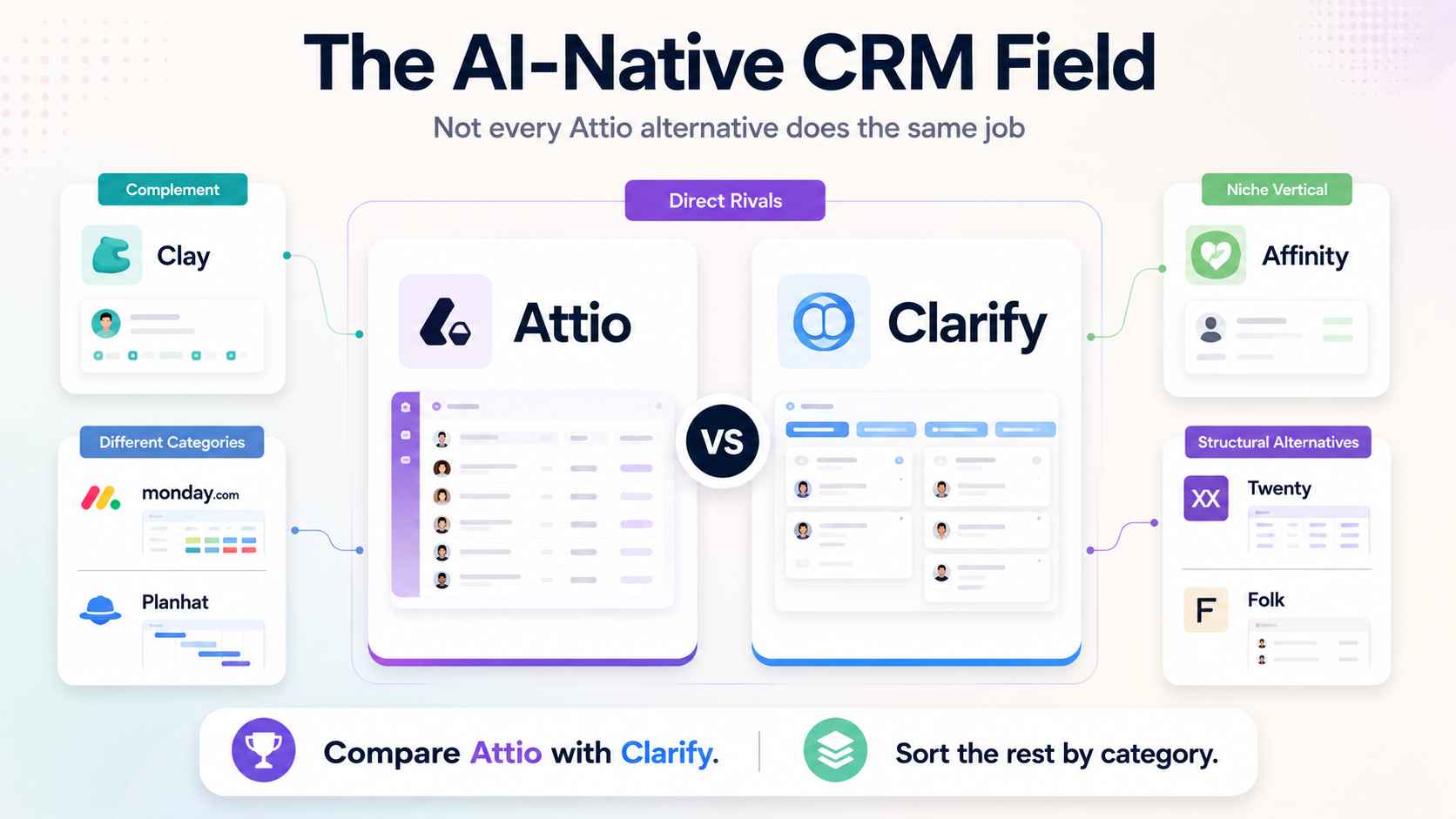
Most Attio vs X searches are category confusion. Here is the map.
Direct rivals: Clarify, plus a wave of newer AI-native entrants. These compete for the same system-of-record job with AI in the architecture.
Complements: Clay. It orchestrates enrichment and outbound data, then pushes results into a CRM. Teams run Clay and Attio together, not instead of each other.
Different categories: monday.com and Planhat. One manages work. The other manages customers after the sale. Both get compared to Attio because both hold customer data. Neither is built to be a sales system of record.
Niche verticals: Affinity. Built for investors who sell through networks, with automatic relationship capture. Superb for that job, narrow outside it.
Structural alternatives: Twenty and Folk. Twenty trades vendor dependence for self-hosted ownership. Folk trades depth for speed. Both are honest trades for specific teams.
Now the real matchup.
Attio vs Clarify: the real head-to-head
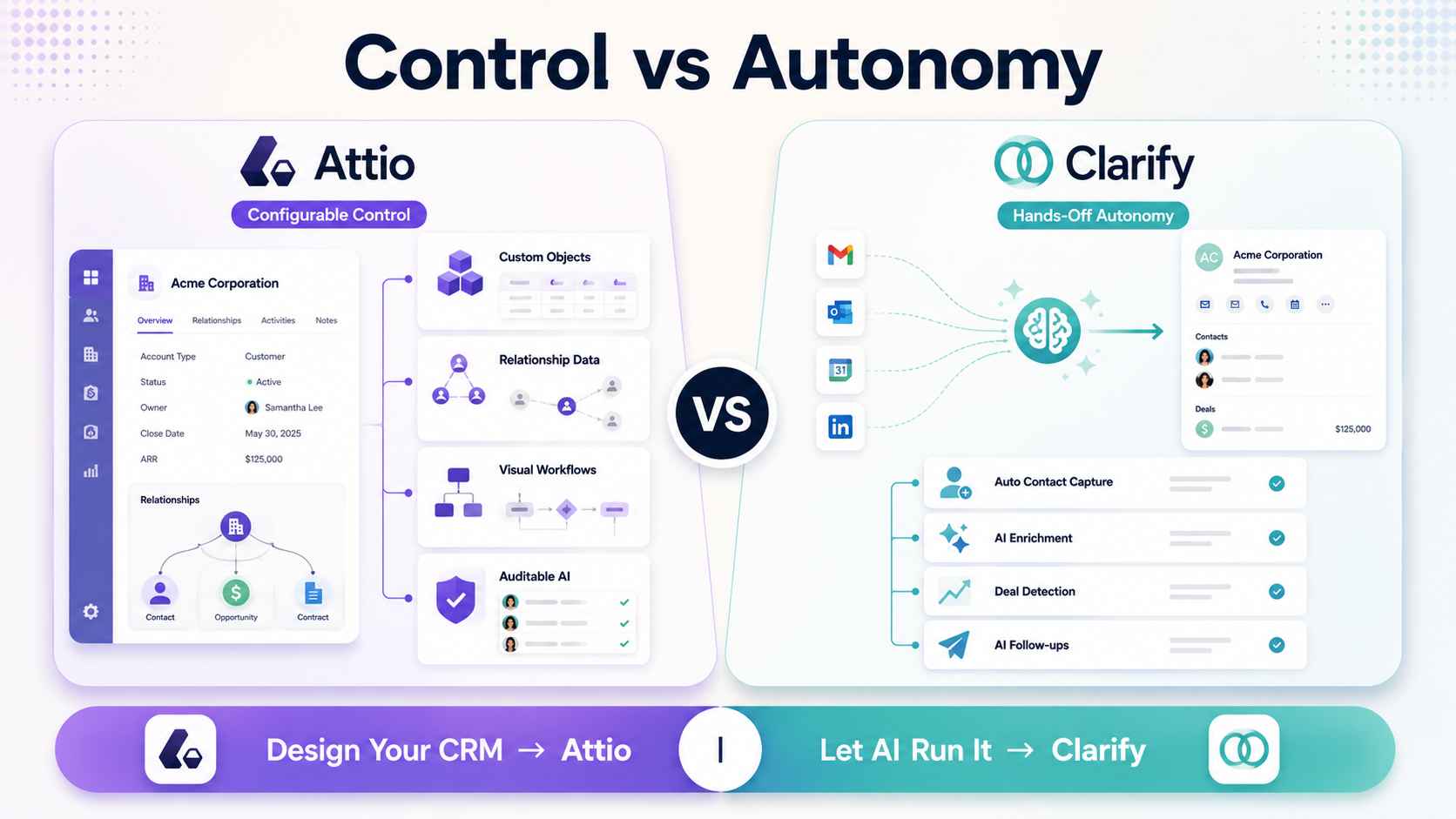
Two bets: control versus autonomy
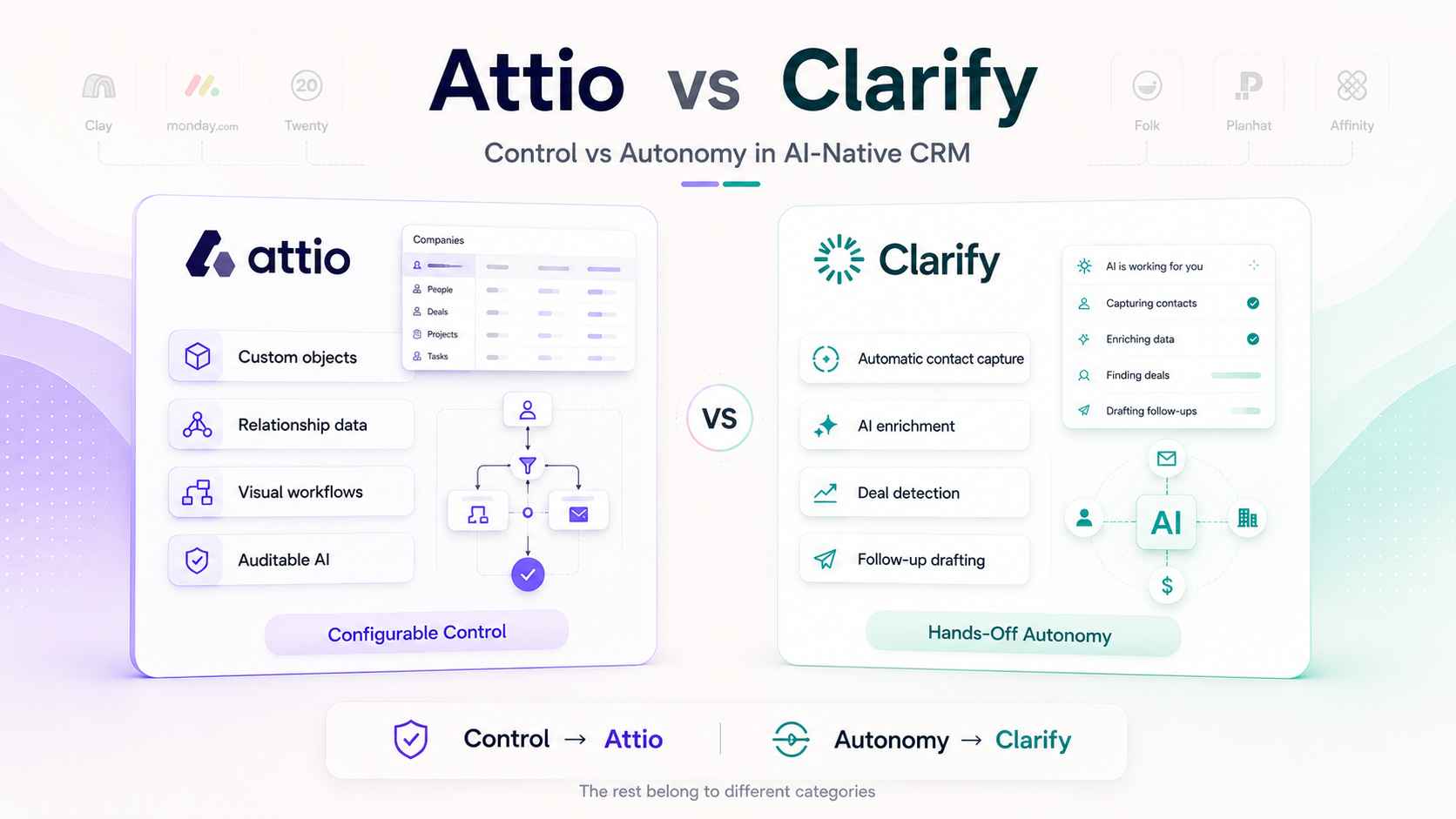
Attio bets on configurable control. You get custom objects, relationship attributes, lists, a visual workflow builder, an API, an MCP server, and an app platform. You shape the CRM to match your business, and AI runs where you point it. Ask Attio answers questions. AI attributes research and classify records on trigger. Call intelligence fills fields from conversations.
The backing matches the ambition. Attio has raised $116 million to date, including a Series B led by GV in 2025, and it grew out of the venture capital world before going horizontal. The data model carries that heritage: four primitives, objects, attributes, records, and lists, that assemble into whatever your motion contains.
Clarify bets on hands-off autonomy. Connect email and calendar, and the system builds itself. Its AI agent, called Rep, captures contacts, enriches records, detects deals, briefs meetings, and drafts follow-ups. Clarify positions this as removing the vast majority of manual data entry. Meeting recording and transcription ship built in. A built-in prospect database adds lead sourcing inside the same tool.
Same category. Opposite philosophy. Attio asks you to design the system. Clarify asks you to get out of its way.
Where Clarify genuinely wins
Clarify wins for founder-led teams that will never staff CRM ownership. Its own positioning targets seed to Series A companies with small teams. For a founder running sales alone, a CRM that fills itself in beats a CRM that waits for input.
The pricing model fits that buyer. Clarify bills on credits for AI work with unlimited users, not per seat. A team with many light users pays for outcomes instead of logins. The consolidation story is real too: meeting recording, enrichment, and follow-up drafting replace separate tools that early teams usually duct-tape around a CRM.
Speed to first value is the other honest win. Clarify claims working, auto-populated contact records within minutes of connecting email and calendar. No schema design session required. For a two-person team, that gap between connect and useful is the entire purchase decision.
Early reviews run strongly positive. The base is small and the product is young, which is the honest caveat. As of mid 2026, Attio's review body is roughly fifteen times larger. Young products move fast and break assumptions. Bet on one with eyes open, and revisit the comparison every two quarters, because this category does not sit still.
Where Attio genuinely wins
Attio wins when the business has structure worth modeling. Custom objects carry partners, products, funds, or whatever your motion actually contains. Relationship attributes connect them. Workflows enforce process. That depth is why we call Attio the modern default for teams building today.
The AI itself is deeper than the label suggests. Call intelligence extracts qualification data straight into fields using frameworks like MEDDPICC and BANT. AI attributes run on trigger, which leaves a trail: you can see what ran, when, and why the field changed. Trigger-based AI is auditable AI.
Attio also wins on governance, and at $10M-$50M scale governance is not optional. You define what the AI does, when it runs, and how it classifies. You can audit why a field says what it says.
Autonomy without governance becomes data you cannot audit, and an autonomous system writing your forecast is a system someone must be able to question. When the board asks why pipeline moved, "the AI did it" is not an answer.
The developer surface seals it for operators with real integration needs. API, MCP server, and app platform mean Attio joins an existing stack instead of demanding the stack shrink around it. Our full platform assessment lives in the Attio Expert Partner review.
The pricing models differ at the root
We publish no vendor prices. The structures matter more anyway.
Attio bills per seat across tiers, with AI usage metered by workspace credits. Cost scales with team size and heavy AI use. Predictable for stable teams.
Clarify bills on credits for completed AI work, with seats unlimited. Cost scales with how much the AI does, not how many people log in. Efficient for small teams, harder to forecast at volume.
Model your seat count against your expected AI workload. The structure that matches your shape wins the math. And budget the AI line honestly on both sides: heavy automation drains credit allocations faster than teams expect, and metered AI is a running cost, not a one-time setup.
Attio vs Clay: complement, not competitor
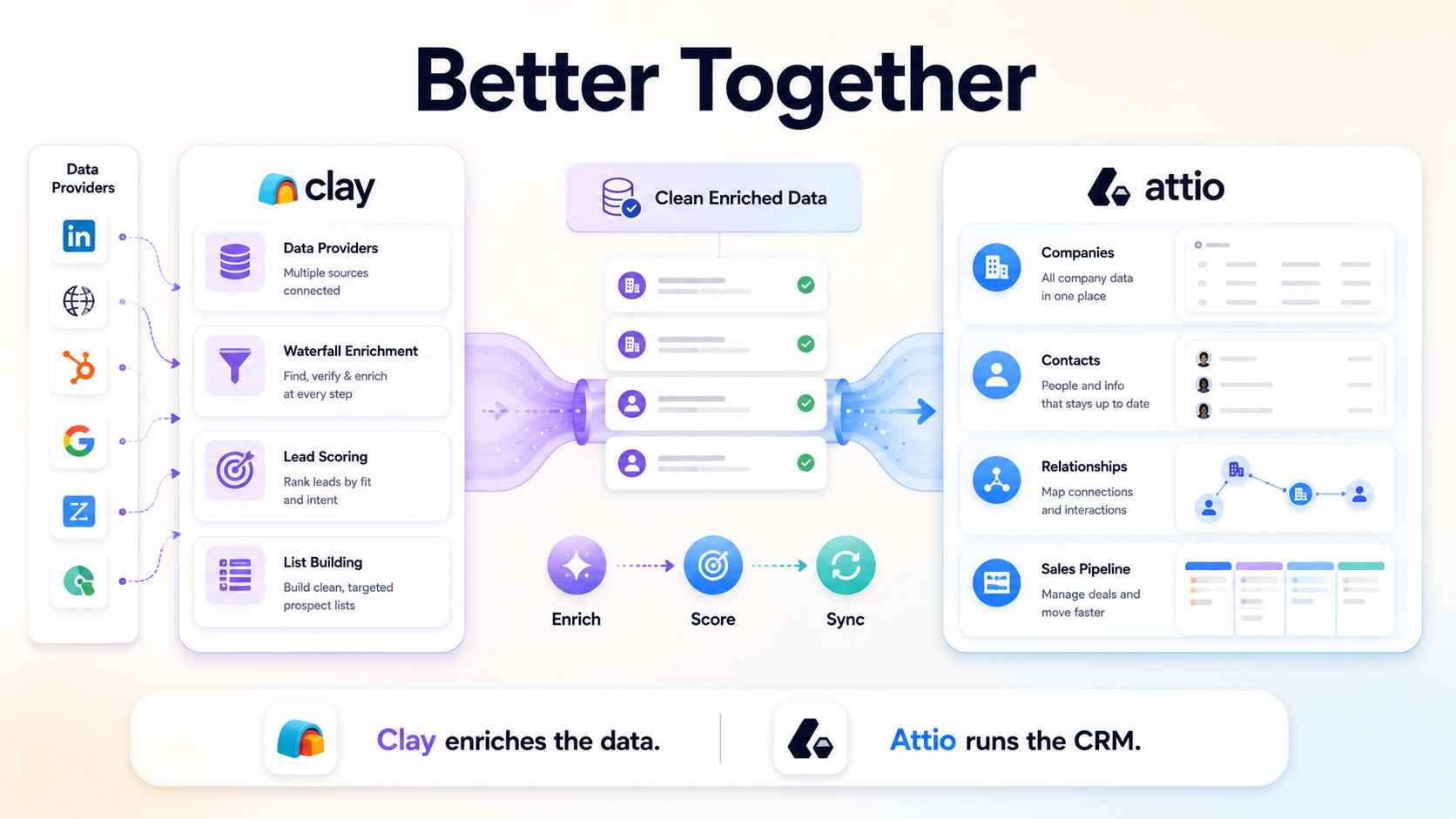
Clay is not an Attio alternative. Clay feeds Attio. Clay orchestrates enrichment across dozens of data providers, scores and filters lists, and pushes clean records into a CRM. Attio stores the records, models the relationships, and runs the pipeline.
The mechanics explain the pairing. Clay runs waterfall enrichment: it tries one data provider, falls through to the next on a miss, and keeps going until the field fills. No single-source CRM enrichment matches that coverage. The output lands in Attio through native connection or API.
Teams searching this comparison usually mean one of two questions. If the question is "which one is my CRM," the answer is Attio, because Clay is not a system of record. If the question is "do I need both," the answer is often yes for outbound-heavy teams. Attio's native enrichment covers the basics. Clay covers the long tail. We wire this pair together in integration builds regularly.
Attio vs monday.com: different categories
Monday.com is a work operating system. Boards, projects, tasks, and a CRM product built on the same board metaphor. It shines when one platform must hold projects and pipeline for a team that lives in task views.
Attio is a CRM first, built on a relational data model rather than boards. Deal data, relationship history, and GTM workflows run deeper. A sales-led operator picking between them is usually asking the wrong question.
Pick the CRM for revenue. Pick the work platform for delivery. Some companies run both and sync the handoff: a won deal in Attio spawns a delivery board in monday.com automatically. That handoff automation is a small build with a large payoff.
Attio vs Twenty: the open source trade
Twenty is the open source entry in the field. The trade is clean. You gain code-level control, self-hosting, and freedom from vendor pricing. You take on hosting, maintenance, upgrades, and the engineering time all of that consumes.
For a software company with spare engineering capacity and strict data residency needs, that trade can work. For a $10M-$50M operator whose engineers have better things to build, a managed platform wins. Total cost of ownership includes the salaries that keep the server alive.
It also includes security patching, version upgrades, and the integration work a vendor would otherwise ship for you. Open source is free the way a puppy is free.
Attio vs Folk, Planhat, and Affinity: the quick sort
Folk is the lightweight pick. Chrome extension capture from LinkedIn and inboxes, minimal setup, minimal depth. Right for freelancers and very small teams. Wrong once workflows and reporting matter.
Planhat is customer success software. Health scores, renewals, and post-sale account management. It sits after the sale that Attio manages. Some operators run both, connected.
Affinity is relationship intelligence for venture capital and private equity. It maps networks automatically and answers "who knows whom." Inside that vertical it is excellent. Outside it, Attio covers the relationship model with far more flexibility. Notably, Attio itself started in the VC world before going horizontal.
New entrants keep arriving. Day AI, founded by a former HubSpot product leader and backed by a Sequoia-led round in early 2026, builds the CRM around conversation capture and context.
Several others follow the same pattern with serious funding behind them. The category is heating up, which validates the original bet. Watch them. Adopt proven.
How to choose inside the AI-native category
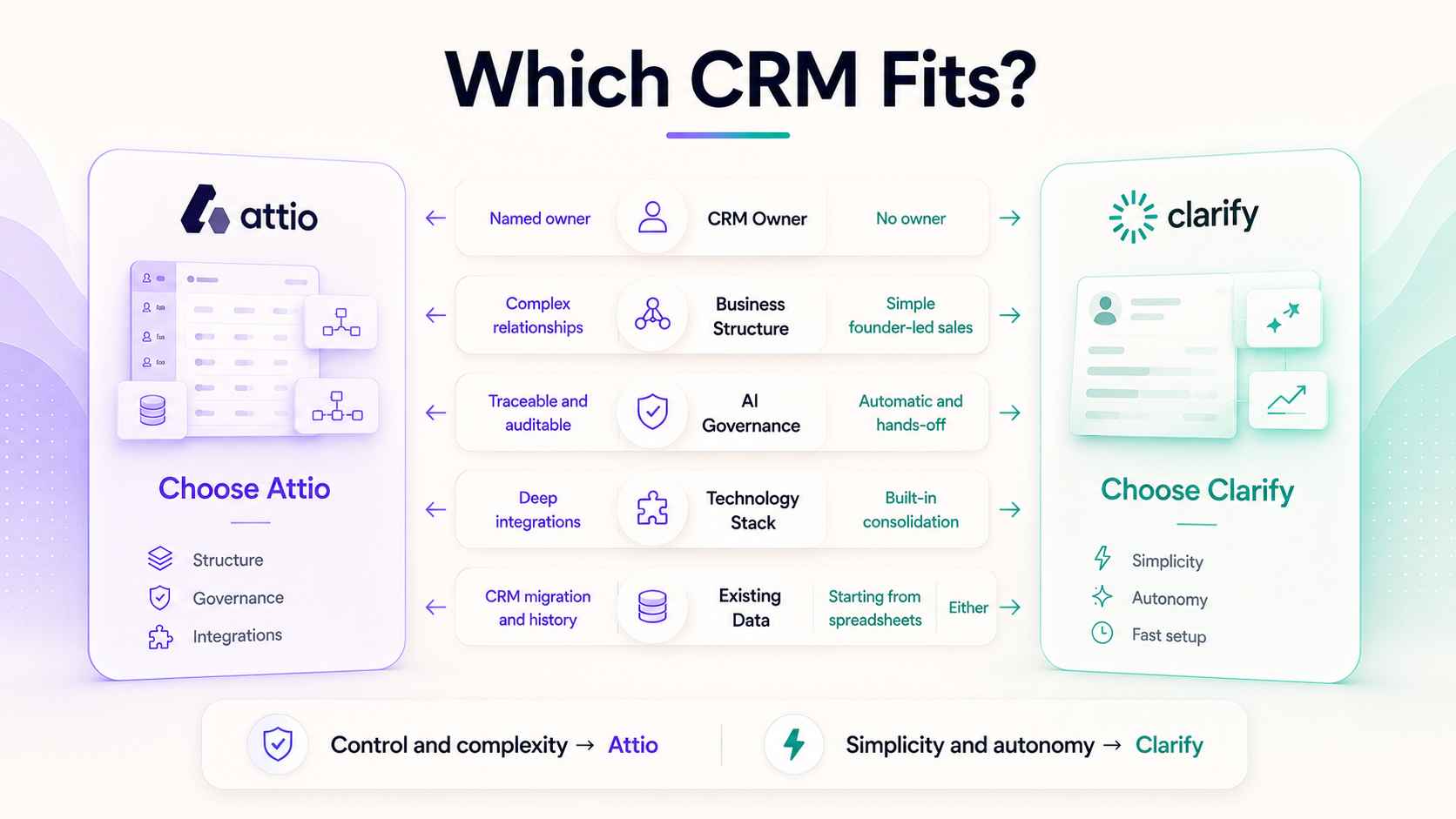
Five questions settle it.
Who owns the system?
A named owner favors Attio. Nobody available favors Clarify.
Does your business have structure worth modeling?
Custom objects and relationships favor Attio. A simple founder-led motion favors autonomy.
Can you audit the AI?
If your forecast feeds decisions, you need traceable data. Configured AI beats ambient AI on auditability.
What does the stack look like?
Deep integration needs favor Attio's developer surface. A tool-consolidation goal favors Clarify's built-ins.
Where does your data live today?
Coming from spreadsheets, either onboards fast. Coming from HubSpot or Salesforce, Attio's migration path and import tooling carry more history across.
Score honestly. The right CRM is the one your team uses without being told to, and both of these get used when matched correctly.
How ACS approaches this
We implement Attio as a fixed-fee engineering project. Discovery first, refundable. Data model design before configuration, because most CRMs become glorified spreadsheets within twelve months when the schema gets improvised.
Then workflows, integrations, migration, and a runbook your team owns. The model is operations infrastructure built with engineering discipline, applied to the newest category in the CRM market.
The Expert Partner credential means Attio verified our implementation work, and you can check the listing yourself. When Attio is the wrong fit, we say so and point at the right tool, because no license commission sits behind the recommendation.
Our comparison pages cover the adjacent matchups: Attio vs Pipedrive, Attio vs HubSpot, Attio vs Salesforce, and Attio vs Close. Platform detail sits on our Attio page, credentials on the partners page, and shipped work in the case studies.
Frequently asked questions
What is the difference between Attio and Clarify?
Philosophy. Attio is a configurable CRM: you design the data model and direct the AI. Clarify is an autonomous CRM: it captures, enriches, and updates records on its own. Control versus autonomy is the whole comparison in two words.
Is Clarify a good Attio alternative?
For small founder-led teams, yes. Clarify's self-maintaining design and unlimited-seat credit pricing fit teams with no CRM owner. For operators with structured data, integration needs, and governance requirements, Attio remains the stronger system of record.
Is Clay a CRM like Attio?
No. Clay is a data enrichment and outbound orchestration tool. It finds, enriches, and scores records, then pushes them into a CRM. Attio is the system of record. Outbound-heavy teams often run both together.
Attio vs monday.com: which one is the CRM?
Attio. Monday.com is a work management platform with a CRM product attached. It suits teams that want projects and pipeline in one board-based tool. Attio runs a real relational data model built for go-to-market work.
Is Twenty CRM a real alternative to Attio?
For teams with engineering capacity and self-hosting requirements, yes. Twenty is open source, so you own the code and the maintenance. Most $10M-$50M operators get better economics from a managed platform once engineering time is priced in.
Which AI-native CRM fits a $10M-$50M operator?
Usually Attio. At that scale you have structure to model, systems to integrate, and a forecast that must survive an audit. Clarify's sweet spot sits earlier stage. Confirm with the five-question test: owner, structure, auditability, stack, and data history.
Is Attio still the leader of the AI-native CRM category?
By maturity, funding, review volume, and ecosystem, yes. Attio defined the category and holds the largest proven install base among AI-native CRMs. Well-funded challengers are arriving fast, which validates the category more than it threatens the leader.
Who are Attio Expert Partners?
Firms vetted through Attio's merit-based program by demonstrating real customer implementation work. The public directory lists them. ACS is a verified Attio Expert Partner. Check our listing on the partners page.
Choosing inside the AI-native field?
Three ways to move.
Book a paid discovery. We run the five-question evaluation and recommend the platform. Refundable if the fit is wrong. See pricing.
Read the Attio deep dive. Our Attio Expert Partner assessment covers the platform end to end.
Review the proof. The case studies show shipped systems for real operators.
Sort the category. Then pick the tool. In that order.