
Every CRM on the market now claims AI. The word "native" is doing unpaid marketing work in half those claims. Buyers are left sorting architecture from adjectives, and the adjectives are winning. The fix is not more demos. It is better tests.
We build operations infrastructure with engineering discipline for $10M-$50M operators, and CRM sits at the center of that work. Disclosure up front: we implement Attio, and we also implement the incumbents it competes with.
We win either way, so the answer here can be yours. This guide defines the category. It hands you five tests any vendor claim must pass. And it gives the best-pick answer with its conditions attached, because conditions are what make a pick honest.
What Is an AI-Native CRM?
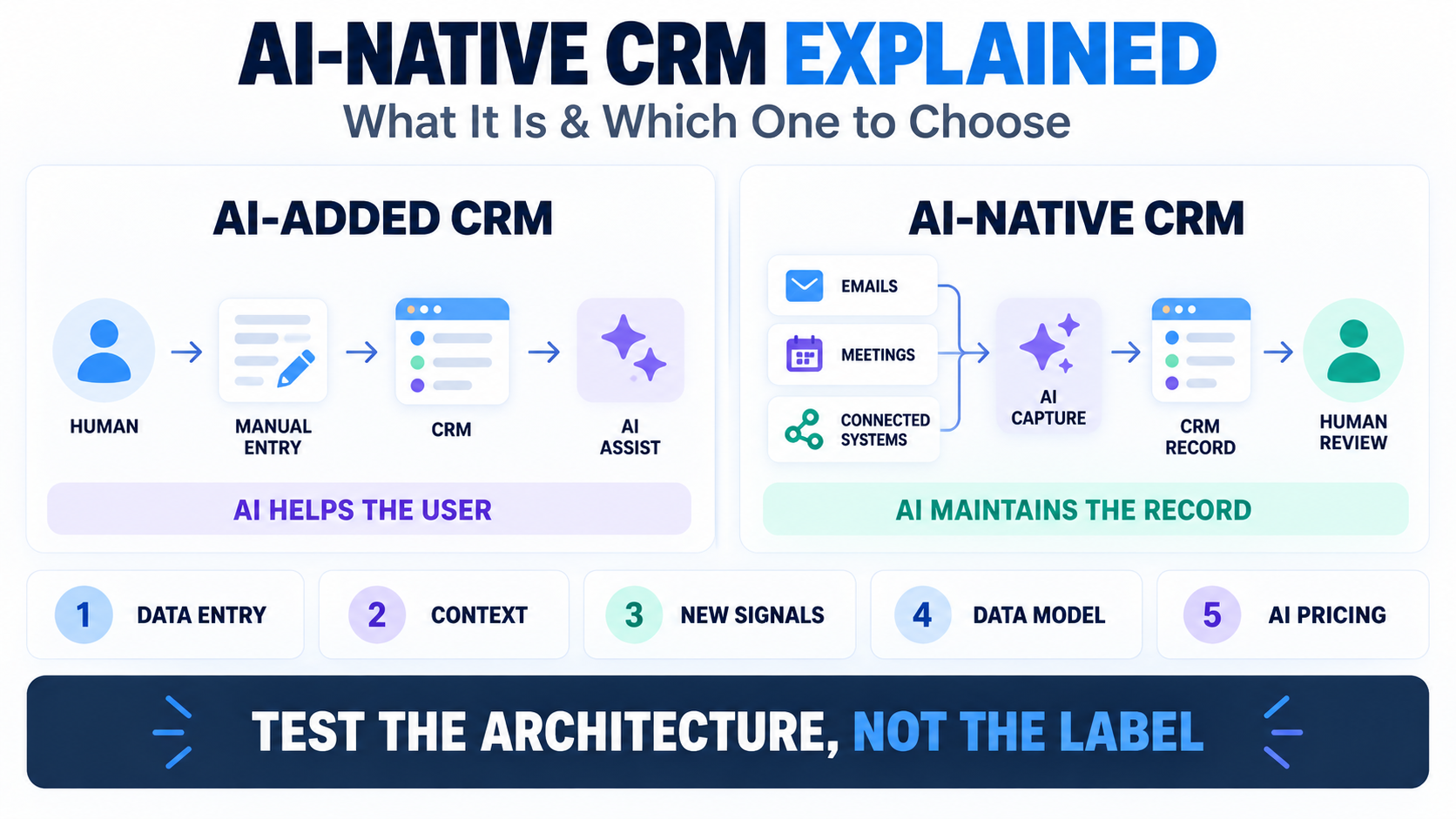
An AI-native CRM is a customer relationship system designed from the ground up with AI as the primary record-keeper. The system captures interactions, creates and enriches records, and maintains data quality itself. Humans review and decide. The machine does the clerical work.
The category exists because the old deal was bad. Traditional CRMs promised insight and charged for it in typing.
Reps paid the tax or the data rotted, and usually both. AI-native platforms invert the deal: the system earns its data, and the humans spend their attention on judgment. Inverted incentives, inverted outcomes.
The contrast is the AI-added CRM: a traditional system, human-fed at its core, with AI features layered on top for summaries, suggestions, and drafts. Useful features, real ones. But the human still feeds the machine.
Architecture is the difference, and architecture decides what the tool feels like in month six. A demo shows features. Month six shows architecture. Buy for month six.
AI-Native vs AI-Added CRM: The Five Tests
Marketing cannot pass these. Architecture can. Apply all five to any vendor claim, including the one we make below. Each test takes minutes in a live demo. Together they replace weeks of comparison-page reading, because they interrogate the system instead of the brochure.
Test 1: Who Does the Data Entry?
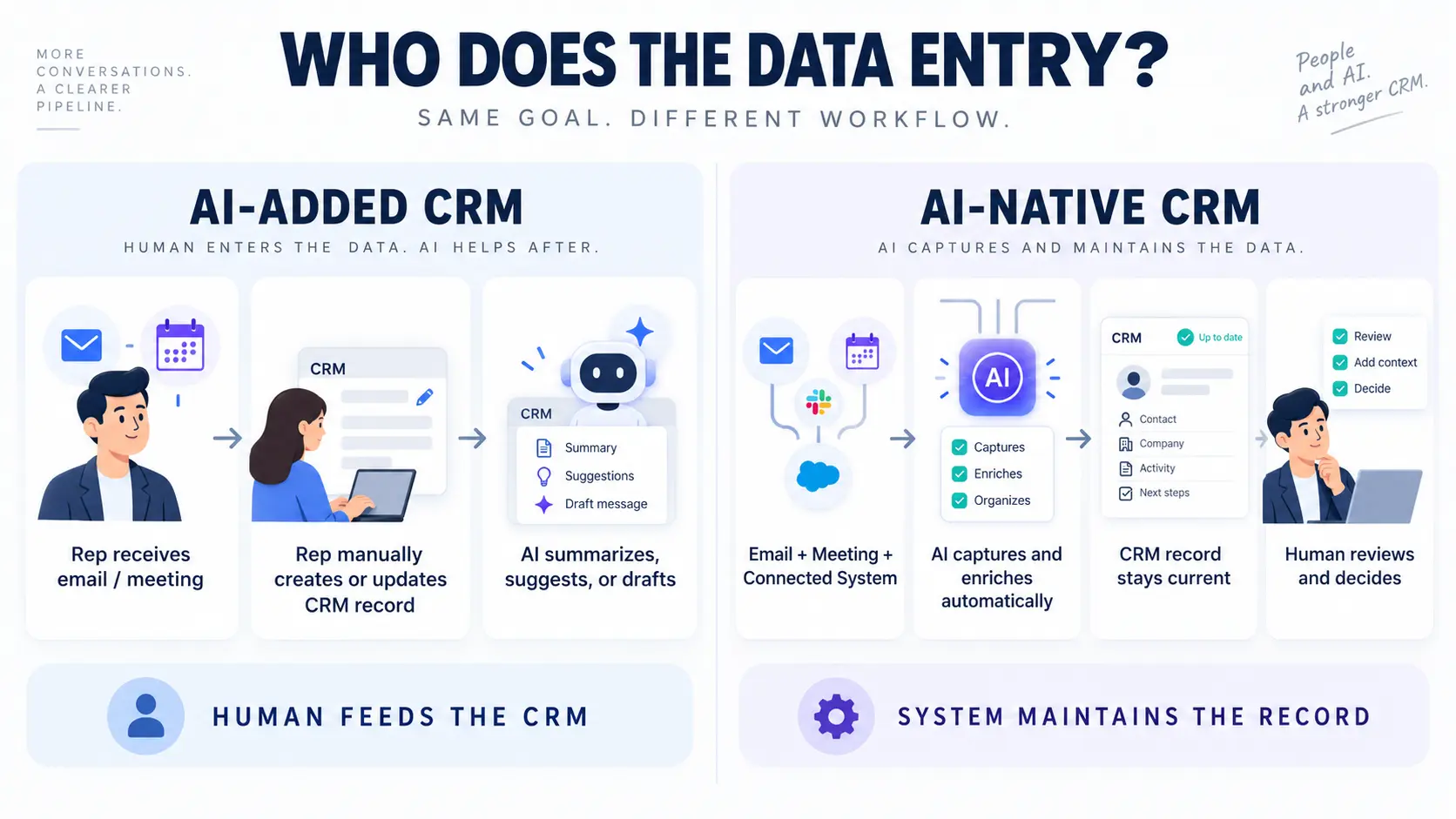
The whole question, honestly. In an AI-native system, records create and update themselves from emails, meetings, and connected systems. Reps correct rather than type. In an AI-added system, the rep types and the AI suggests.
Ask for a live demo of a new contact appearing without a human creating it. The demo answers in thirty seconds. Everything else in this category is downstream of this one behavior.
Test 2: Where Does Context Live?
Native systems treat every interaction as data. The email thread. The call. The meeting notes. All captured into the record automatically, the way our meeting capture builds work. Added systems keep context in activity logs a human remembered to file. The difference compounds monthly. Ask where last Tuesday's call lives, and who put it there. Then ask about a call from last quarter.
Test 3: What Happens to a New Signal?
A new lead, a new company, a job change. Native systems enrich on arrival: firmographics, roles, and connections filled from data sources, the work tools like Clay industrialized. Added systems wait for a human or a paid add-on. Watch what a fresh record looks like five minutes after creation. An empty record is a to-do. An enriched one is a starting point.
Test 4: Can It Model Your Business?
AI-native platforms grew up with flexible data models: custom objects and relationships as first-class citizens. The CRM shapes to your operating reality instead of a sales pipeline template. Rigid models force workarounds, and workarounds rot.
Ask to model your weirdest entity, live. Properties, partnerships, projects, whatever your business actually runs on. The modeling session tells you more than the feature grid ever will.
Test 5: Does the AI Cost Extra?
In a native system, the AI is the product, priced in the plan. In added systems, intelligence often arrives as a premium tier or add-on seat. Neither is wrong. But "AI-native" with a separate AI price tag is a claim failing its own adjective. Read the pricing page with this test in mind. The pricing page is the one document marketing cannot fully decorate.
Score the five honestly, in writing, per vendor. Native platforms pass all five by design. Strong added platforms pass one or two, loudly. The score is not a verdict on quality. It is a verdict on the label, and the label is what you came to check.
What Is the Best AI-Native CRM?
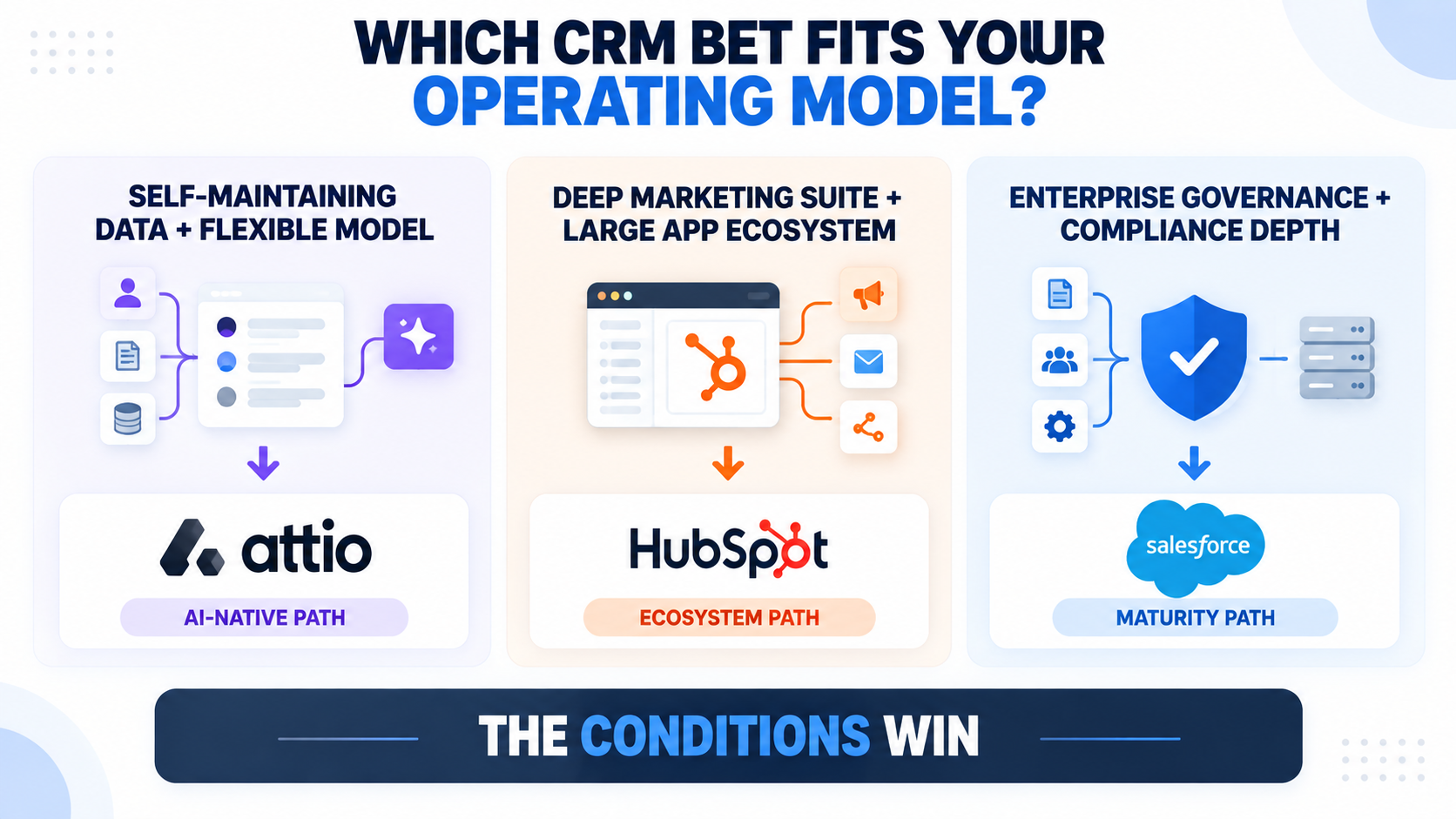
The conditional answer, disclosed: we implement what we recommend, and we implement the alternatives too. No referral economics shape this section. Your operating model does.
For $10M-$50M operators who want the CRM doing its own data entry on a data model that matches their business, Attio is our pick. It passes the five tests cleanly. The data model handles real operating complexity.
The capture works the way the category promises. Our Attio implementation guide covers what building on it involves. For the head-to-head against its closest AI-native rival, our comparison runs that match in full.
Two honest conditions. If your revenue engine depends on a deep marketing suite and a massive app ecosystem, a retrofitted incumbent like HubSpot may serve you better today. Our implementation cost guide prices that path honestly, line by line.
If enterprise governance and compliance machinery lead your requirements, Salesforce's maturity is the argument. The pick holds inside its conditions. Outside them, the conditions win. Anyone who names one best CRM without asking about your operating model is selling something.
What an AI-Native CRM Changes Day to Day
The category earns its label in the daily texture, not the demo.
Records stay current without a Friday cleanup, because capture is continuous. Pipeline reviews argue about deals instead of data quality, which is what they were always supposed to argue about. New reps inherit context instead of tribal knowledge.
The history lives in the system, not in a departed colleague's memory. Reporting gets truthful, since reports built on self-maintaining data stop lying by omission. And the CRM stops being the tax reps pay and starts being the place answers live. None of this is magic. All of it is architecture doing clerical work at machine patience. The change reads small in a demo. It reads large in a quarter.
One composite scene, shaped by client work. Picture a Monday pipeline review, eight minutes in. Nobody has asked whose deal is missing notes, because none are. The argument is about a stalled negotiation, with the full thread on screen. That is the category, experienced. Not smarter suggestions. Fewer apologies to the data.
The Honest Limits of AI-Native CRMs
The section nobody selling the category writes.
The platforms are young, and youth has costs. Thinner app marketplaces. Fewer prebuilt integrations. Communities still growing. Marketing automation depth trails the incumbent suites, often by years. Enterprise governance features arrive on a roadmap, not a legacy.
AI capture is very good and imperfect, so review workflows still matter, and a human owns the exceptions. And migration is real work: moving years of history into a new data model deserves engineering, not optimism. Vendors improve on all five fronts quarterly. Verify the current state rather than trusting either the pitch or the skeptics.
None of these kills the category. All of them belong in the decision, weighted by your situation. A limits list you never heard from the vendor is the reason evaluations exist.
When a Retrofitted CRM Is the Right Call
Fairness, because we build both. Choose the incumbent path when the ecosystem is the point: hundreds of integrations your stack already assumes, per our platform integration work. When marketing automation is half your revenue motion, the suite depth wins.
When procurement demands enterprise compliance artifacts, maturity wins. And when your team runs a proven playbook inside a sales automation architecture that already works, switching costs deserve respect. Working systems earn their keep. Momentum is a feature too.
Retrofitted is not an insult. It is a different bet: ecosystem over architecture. Name your bet, then buy accordingly. The failure mode is refusing to name it and buying the loudest demo.
Implementing an AI-Native CRM: What Actually Matters
AI-native does not mean implementation-free. It shifts where the work lives, and knowing where saves the budget. The vendors undersell this part. The failed rollouts oversell it. The truth sits in two lists.
Where the Work Shifts
Data model design matters more, not less. Flexible objects reward planning and punish improvisation, so the modeling workshop becomes the most valuable day of the project. Capture configuration replaces field-by-field form design. Which sources connect.
What the AI touches. Where review happens. Enrichment rules need choosing, because filled-by-default is a policy decision, not just a feature. The upstream thinking grows. The downstream clicking shrinks.
What Stays the Same
Migration carries the usual truths: clean before moving, sample first, keep the match keys. Integrations still run through engineering, since the AI maintains records, not your cross-system pipelines.
Adoption still needs owners: review workflows, exception queues, training to named roles. And documentation still decides who owns the system in month eighteen. The operations spine does not disappear. The CRM just stops being its manual-entry bottleneck.
How ACS Builds on AI-Native CRMs
Platform-agnostic by design, disclosed throughout. We implement Attio and the incumbents, so the recommendation follows your operating model rather than our margin. Engagements run fixed fee after a paid and refundable discovery.
Discovery maps your data model, migration reality, and integration list, and it applies the five tests to your shortlist with you in the room. The document is yours either way, and it makes every vendor conversation shorter.
Builds carry the constants: documentation your team keeps, training to named roles, accounts in your name, error-alerted integrations. Engagement structure sits on pricing, the shipped record in the case studies: 500+ workflows, more than 10,000 hours reclaimed, over $2 million in client savings.
Frequently Asked Questions About AI-Native CRMs
What is an AI-native CRM in one sentence?
A CRM designed with AI as the record-keeper: it captures interactions, creates and enriches records, and maintains data quality itself, while humans review and decide. The machine does the clerical work. The people do the judgment. That division is the whole category.
What is the difference between an AI-native CRM and a regular CRM with AI?
Architecture. Native systems do the data entry and treat interactions as data by default. Added systems keep the human as the primary data source and layer AI features on top. Both can be good products, and both can be right buys. Run the five tests, and the difference stops being a marketing argument and becomes a purchase criterion.
What is the best AI-native CRM?
For $10M-$50M operators wanting self-maintaining records on a flexible data model, our pick is Attio, disclosed as a platform we implement. The best answer stays conditional: ecosystem-heavy or marketing-led motions may still favor an incumbent. Match the bet to your operating model, and distrust any answer that skipped the question.
Is Attio an AI-native CRM?
Yes, by the tests that matter: automatic capture and enrichment, interactions as data, a flexible object model, and AI priced as the product. Our implementation guide covers what building on it looks like in practice, from data model design through go-live.
Are HubSpot and Salesforce AI-native?
No, and that is a description, not a criticism. Both are powerful AI-added platforms: mature systems with intelligence layered onto human-fed architecture. Their ecosystems and suite depth remain the strongest arguments in the market. Different bet, honestly named.
Do AI-native CRMs really eliminate data entry?
They eliminate most of it and change the rest. Typing becomes reviewing. Exceptions still need owners, and a review workflow keeps the machine honest. The clerical hours drop hard. The accountability stays human, which is exactly where you want it.
Are AI-native CRMs ready for enterprise?
Maturing fast, honestly not everywhere yet. Governance depth, compliance artifacts, and marketplace breadth still favor incumbents at large-enterprise scale. Mid-market operators sit in the sweet spot today, which is exactly our lane. Check the current state at evaluation time, because the roadmaps move quarterly.
What does AI-native CRM implementation involve?
Data model design first, because flexibility rewards planning. Then migration with clean data and match keys, integrations engineered into your stack, and adoption with review workflows and named owners. The work shifts upstream. It does not vanish, and pretending otherwise is how cheap quotes get expensive.
When is the right time to switch to an AI-native CRM?
At a friction point you already feel: a migration being planned anyway, a data-quality crisis, a growth stage outgrowing the spreadsheet-plus-basic-CRM setup, or a renewal date forcing the question. Switching without a forcing function invites drift. The five tests plus a real deadline make the decision honest, and the migration plan makes it safe.
Is my customer data used to train AI models?
Vendor-specific and changing, so review the current data terms of any platform you evaluate, and ask the question directly in procurement. Good vendors answer plainly, in writing, with the controls named. Treat a muddy answer as an answer.
Ready to Pick Your Bet?
Three ways forward.
Run the five tests. Book demos and apply them live. Thirty minutes per vendor separates architecture from adjectives, and the vendors who welcome the tests are telling you something too.
Read the head-to-head. The Attio comparison and the implementation guide go deeper on the native path, from platform choice through build reality.
Book a paid discovery. Your data model, migration reality, and integration list mapped, a platform recommendation with reasons, one fixed price, refundable if the fit is wrong. The five tests run on your shortlist, with you in the room. Details on pricing.
The label is marketing. The architecture is real. Test for the architecture, name your bet, and the choice gets easy, because it was always about who does the data entry.