


Each handoff is a place data stops moving, and three of the four break silently. Automation Consulting Services builds operations automation around those handoffs, using the systems a contractor already runs.
What construction operations automation covers
Construction operations automation connects the systems that already hold your job data rather than replacing any of them.
Project management software manages the project: drawings, submittals, RFIs, change orders. Field service software manages visits. Workforce software manages people, schedules, and time. Accounting and ERP hold the financial record. Each category is good at the layer it owns.
None of them own the moment a job leaves one layer and enters the next. That seam has no product category, no vendor, and usually no named owner inside the business either. It is where the retyping happens, and it is why an operation running five good systems still rebuilds the week every Friday.
Buying a sixth system adds a sixth version of the job.
The four handoffs a construction job passes through
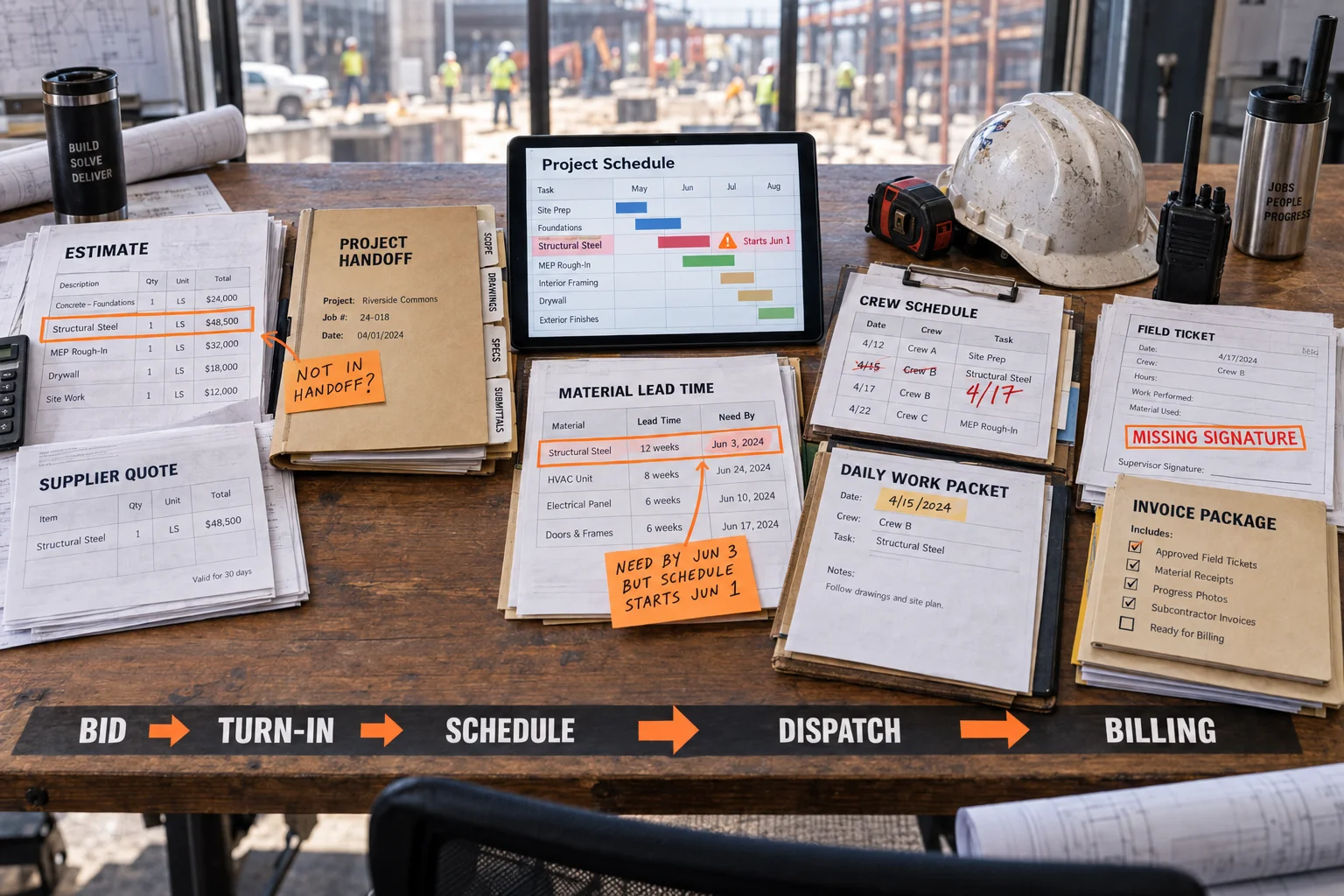
A construction job changes hands four times before it is billed, and each handoff is a place data stops moving.
Bid to turn-in
Turn-in is the handover from estimating to operations, where a won bid becomes a live job. Scope, cost codes, work breakdown structure, budget, supplier quotes, and submittal requirements should all arrive in the operations system carrying the same values the estimator priced.
What usually happens is that someone rebuilds the estimate by hand. From that moment the estimate and the job record are two documents describing one job, and they never reconcile again. Every cost variance reported later is measured against a budget nobody can trace back to a line item.
Turn-in to schedule
The schedule needs the job, its phases, its dependencies, and its gates: permits filed, inspections booked, materials confirmed, subcontractors committed.
What usually happens is that the schedule gets built from what the estimate assumed rather than what procurement confirmed. A six-week lead time on switchgear was a pricing assumption in March. In May it is a start date. Nobody moved the number between the two.
Schedule to dispatch
Dispatch needs the crew assignment, the certifications that assignment requires, the equipment, site access, and the day's work packet.
What usually happens is that the crew is dispatched against a schedule that changed after it was published, and the correction arrives by phone at 7am. The mechanics of building a dispatch system are covered in our guide to scheduling and dispatch for field teams.
Dispatch to billing
Billing needs hours against cost codes, materials consumed, progress against schedule, and signed field records.
What usually happens is that field data arrives as photos, texts, and paper, and the office reconstructs the week on Friday from memory and receipts. Progress claims go out based on what someone believes was completed.
Three of these four break silently. The fourth breaks on an invoice.
Which system owns the job

Every stage needs one system declared as the authority on where the job is.
Job state authority means that for each stage, one system decides the current status and every other system reads it rather than setting it. Without that declaration, systems compete.
Estimating marks a job won when the contract is signed. The operations system marks it active when a project manager opens it, which may be four days later. The scheduler treats it as ready when a crew is attached. Three systems now hold three different answers to a simple question: is this job live? Reporting sits on top of all three and averages the confusion.
The operational cost is specific. A crew gets dispatched against a job state that was superseded before the truck left the yard. A pipeline number gets quoted to a lender that nobody in the business can defend line by line.
Declare the authority per stage, in writing, before wiring anything between the systems. A handoff without a declared authority is a race, and the last write wins.
The declaration takes one line per stage. Won status is set by estimating and read by everyone else. Job readiness is set by operations. Crew commitment is set by the scheduler. Completion is set by the field record. Anything else writing those fields is a defect, not a feature, and it will be found eventually by an accountant.
What a change order does to a job already in motion
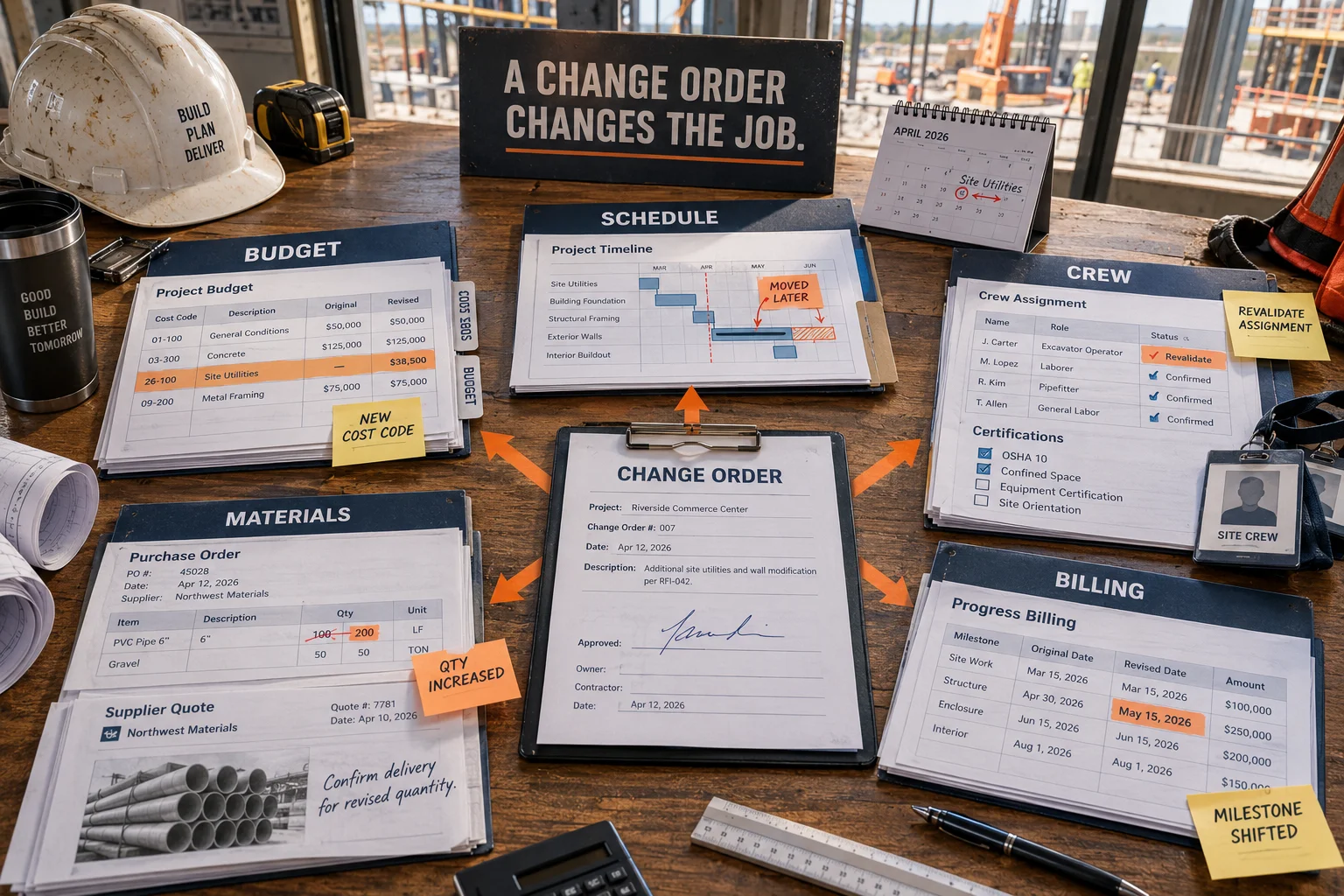
A change order alters a job that has already been scheduled, staffed, and budgeted.
The document gets signed and the scope changes. Four systems now hold a job that no longer exists as described.
The budget needs the new cost codes. The schedule needs the revised duration and possibly a new dependency. The crew assignment may need a different certification. The material order changes. The billing schedule changes. The client-facing timeline changes.
One or two of those get updated the same day. The rest get updated when somebody notices, which is usually when a number stops reconciling.
The design rule is short. A change order is not a document, it is a state change. Every system holding that job state needs to receive it from the declared authority, on the day it is signed, without anyone remembering to forward it.
In practice the signed change order fires one update and the downstream systems read it. The budget adds the new cost codes. The schedule extends and re-checks its dependencies.
The crew assignment re-validates certifications. The purchase order revises. The billing schedule shifts. The project manager approves the change once instead of remembering six places to type it.
The expensive part of a change order is rarely the scope. It is the four systems that never heard about it.
Which handoff to fix first
The handoff to automate first depends on your trade, the systems you already run, and where the hours are actually going.
If your operation bids high volume and wins only a fraction, the hours go to estimators rebuilding the same package, so fix bid to turn-in first.
If you run long jobs with few starts, the hours go to project managers retyping scope into the job record, so fix bid to turn-in first.
If you run many short jobs across sites, the hours go to coordinators rebuilding the schedule daily, so fix turn-in to schedule first.
If you run gated work with permits and inspections, the hours go to waiting on confirmations nobody tracks, so fix turn-in to schedule first.
If you dispatch multiple crews daily, the hours go to phone calls confirming the day's work, so fix schedule to dispatch first.
If you bill progress or time and materials, the hours go to reconstructing the week on Friday, so fix dispatch to billing first.
Fix the earliest broken handoff first. Every handoff downstream inherits whatever it was handed, so automating billing while turn-in is still manual just moves bad data faster.
On a $25M fencing contractor running 150 employees, bid history, turn-in, and scheduling were stabilised as one connected system rather than as separate automations, and the estate now runs over 100 workflows under active management. The engagement is documented in the fencing operations retainer.
When the tools are not the problem
Some operations do not have an integration problem, they have an undefined process.
If two people in the business give different answers to what makes a job ready to schedule, no automation will settle it. It will encode one of the answers and hide the disagreement inside a workflow nobody reads.
The first tell is that every exception escalates to the same person. That person is the process, and they are not documented.
The second tell shows up in audits. On one inherited estate, more than ten workflows were found broken and still running, firing on schedule and producing nothing. Nobody had written down what they were supposed to do, so nobody could tell they had stopped doing it.
Define the gate before automating the handoff. Automation makes a defined process faster and an undefined process harder to see.
What ships with a working system
A construction operation that depends on one person knowing the workflow has not been automated, it has been staffed.
Every workflow should ship with three artefacts:
A written specification naming the trigger, the steps, the failure modes, and the rollback path
An integration map naming which system holds authority at each handoff
A runbook written for whoever inherits the system, not for whoever built it
The documentation is what survives the project manager who leaves.
Finding the handoff that is costing you
Your job data is already in your systems. The work is making them agree on it, in the right order, without a person in the middle retyping.
A paid discovery audit maps the workflow estate you are running now, identifies which handoff is losing the hours, and returns a ranked bottleneck list with a fixed-fee scope to fix it.
Frequently asked questions
What is turn-in in construction operations?
Turn-in is the handover from estimating to operations, where a won bid becomes a live job with a budget, cost codes, and a schedule. It is the handoff where project data is most often lost, because the estimate and the job record are usually built in different systems by different people.
Do I need to replace my project management software to automate these handoffs?
No. The handoffs sit between systems, not inside them. Replacing a platform changes which system holds one layer of the job and leaves the seams exactly where they were.
Which handoff should we automate first?
The earliest one that is broken. Every downstream handoff inherits whatever the one before it produced, so fixing billing while turn-in is still manual moves inaccurate data faster rather than fixing it.
What happens to the schedule when a change order lands mid-job?
In most operations, the schedule gets updated and the budget, crew assignment, material order, and billing schedule get updated later or not at all. Treating the change order as a state change rather than a document, issued from one declared authority, is what keeps the other systems current.