

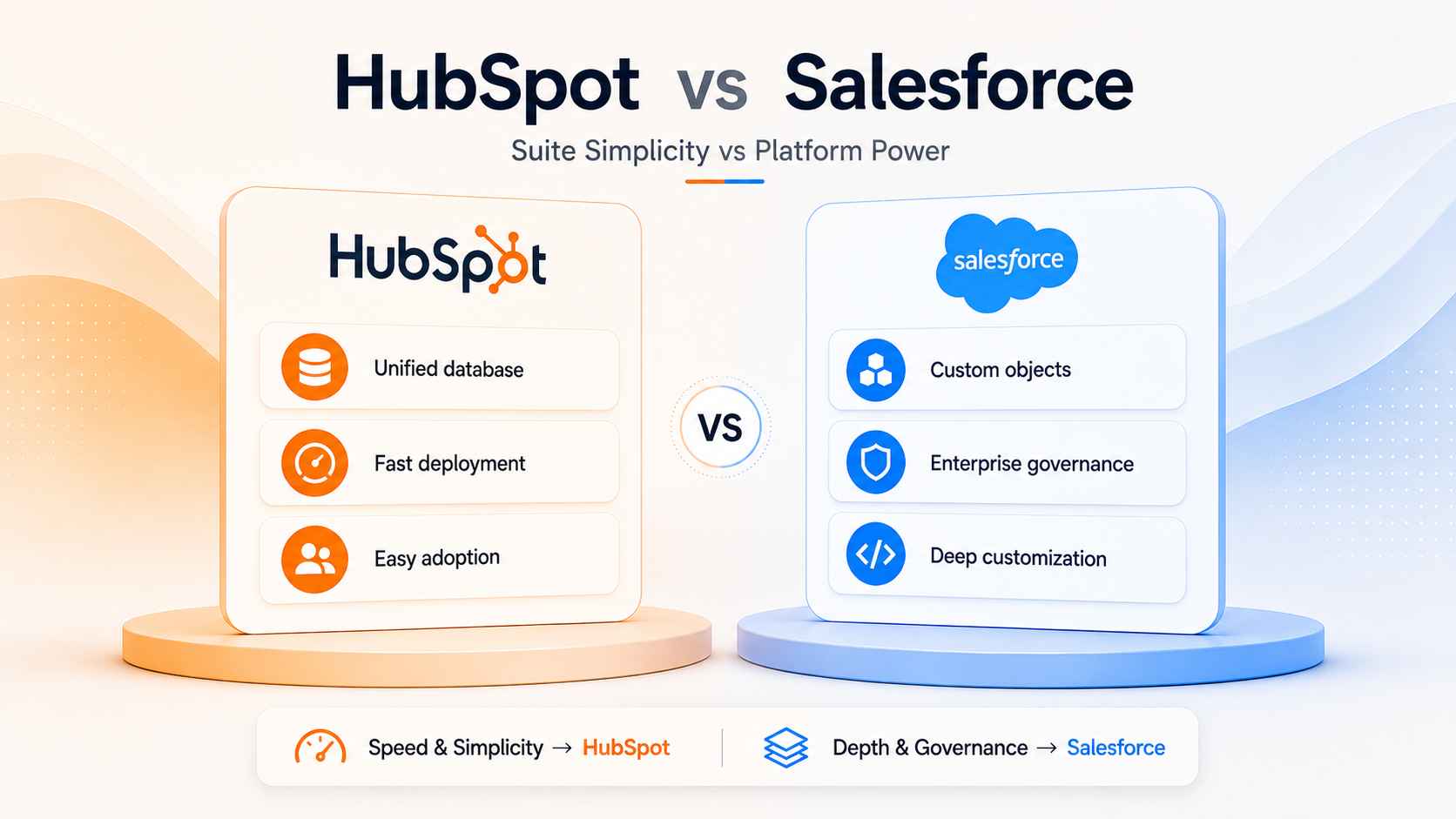
We build operations infrastructure with engineering discipline for $10M-$50M operators. HubSpot vs Salesforce is the most searched CRM matchup in the market, and almost every page ranking for it is written by a HubSpot partner or a Salesforce integrator.
We are neither. No HubSpot partnership. No Salesforce partnership. We implement both, and our verified credentials sit with Zapier and Attio instead. That double neutrality is the point of this post. Nobody here earns a commission on your choice.
The honest verdict
HubSpot wins when marketing and sales must run on one database and speed matters. Salesforce wins when your data model, governance, and process complexity genuinely demand a platform. Neither wins by default.
At $10M-$50M revenue, the honest math is uncomfortable for both vendors. Salesforce is overkill for most $10M-$50M operators. Most enterprise CRM implementations pay for capability the operator will not use until $25M+. And HubSpot is fastest to ship and most expensive to live with, because its costs compound across seats, contacts, and hubs.
So treat this as a fit question, not a brand question. The full side-by-side lives on our HubSpot vs Salesforce comparison page. This post gives you the decision logic.
What this comparison actually is
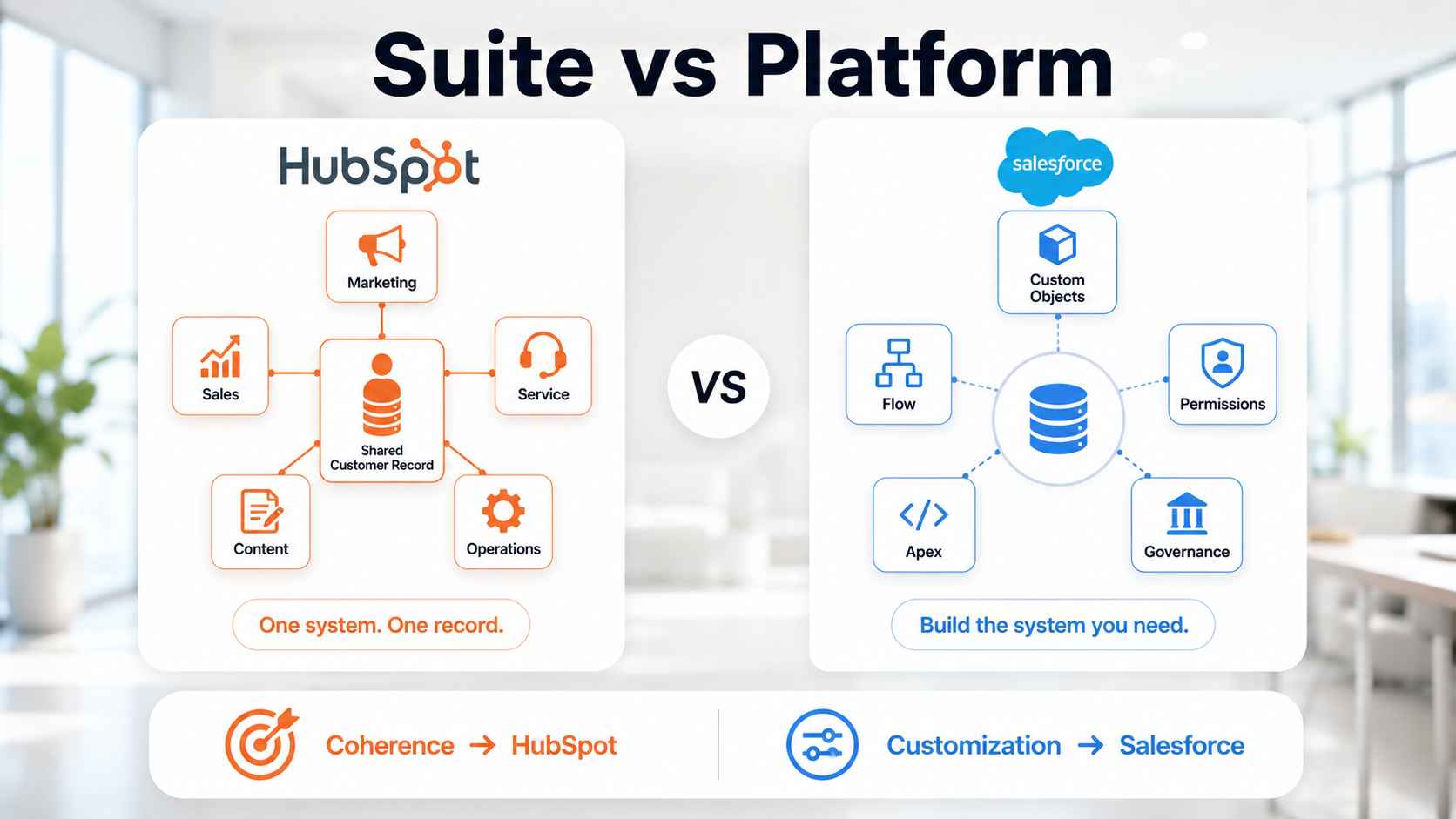
The two products are not the same category wearing different logos. They made opposite bets, and the bets explain everything downstream.
HubSpot: the suite bet
HubSpot bet that companies want one system for marketing, sales, service, and content. One contact database. One interface. Hubs that switch on as you grow. The product optimizes for adoption: teams configure most of it without a developer, and reporting across marketing and sales works out of the box.
Five hubs carry the suite: Marketing, Sales, Service, Content, and Operations. Breeze Intelligence adds enrichment on top, built from the Clearbit acquisition. Everything reads one record.
The trade is depth for coherence. Each hub is good. None is the deepest tool in its category.
Salesforce: the platform bet
Salesforce bet that companies want a platform they can shape into anything. Custom objects, configurable relationships, Apex code, Flow automation, and granular permissions. Per IDC's tracker, Salesforce held 20.7% of the global CRM market in 2024, more than its four largest rivals combined. The ecosystem and talent pool have no equal.
Sales Cloud runs a tier ladder from Starter through Enterprise and Unlimited, with an Agentforce tier above. Flow shows the depth: it can create a renewal opportunity ninety days before contract end, assign it by territory, and update the forecast without a human touch.
The trade is coherence for depth. Power arrives with configuration surface, and configuration surface demands an owner. Salesforce without an admin decays. Salesforce with one performs.
The question underneath
Strip the features away and one question remains. What drives your pipeline?
Marketing-led operators, where inbound content and nurture produce the revenue, lean HubSpot. Sales-led and process-heavy operators, where complex deal structures and governance rule, lean Salesforce. Answer that before any demo, and half the evaluation is done.
Where HubSpot genuinely wins
Marketing and sales on one record
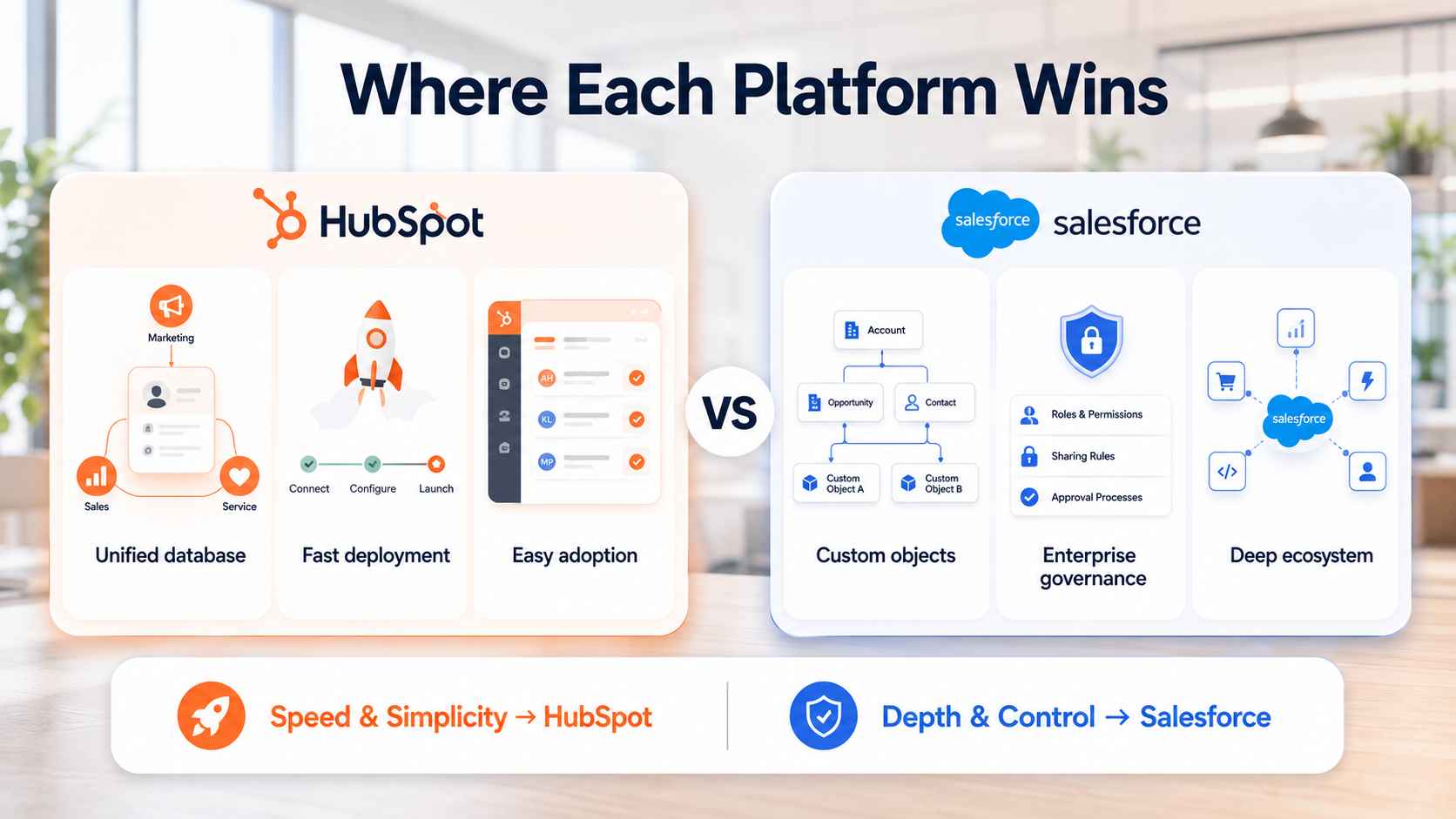
This is HubSpot's core advantage and it is real. A form fill becomes a contact, gets scored, routes to a rep, and shows up in attribution reporting without any integration work. Marketing Hub workflows, Content Hub pages, and Sales Hub sequences all read the same record.
Assembling that from separate tools means sync jobs, mismatched fields, and attribution debates. HubSpot removes the assembly.
Lifecycle stages are the underrated piece. Marketing and sales share one definition of a qualified lead, enforced by the platform. The MQL to SQL handoff stops being a meeting topic and becomes a field.
Time to value
HubSpot deploys in weeks. Most teams configure pipelines, import data, and onboard reps without a consultancy standing by. Usability scores across review platforms consistently favor HubSpot, and higher adoption is the quiet reason its implementations succeed more often.
The onboarding fee HubSpot requires on Professional and Enterprise tiers buys guided setup, not process design. Budget accordingly. Our HubSpot implementation guide covers what that fee does and does not include.
A working free tier and a gradual ramp
HubSpot still offers a genuine free CRM, trimmed in late 2024 but real. Starter tiers cost little. A growing operator can climb the ladder one hub at a time instead of signing an enterprise contract on day one.
Salesforce has entry editions too, but the product assumes you are heading toward Enterprise. HubSpot assumes you might stay small. That difference shows in the daily experience.
Where Salesforce genuinely wins
Custom objects and data model depth
If your business needs many-to-many relationships, product hierarchies, or data structures beyond contacts and deals, Salesforce is the correct tool. Custom objects are first-class citizens. HubSpot added custom objects at the Enterprise tier, but the modeling depth is not comparable.
Manufacturers, multi-entity operators, and companies with genuinely unusual processes hit HubSpot's ceiling. Salesforce has no practical ceiling. Record types split one object into governed variants. Approval chains route deals through real gates. When the process is the moat, this depth is the product.
Governance, security, and compliance
Field-level security. Permission sets. Sharing rules. Full audit trails. Approval processes with real teeth. Regulated operators in finance and healthcare need this control layer, and Salesforce delivers it as core product.
HubSpot's permissions have matured, but enterprise governance is Salesforce territory. When a regulator audits your CRM, this section decides the comparison. Sandbox environments seal it: changes get built and tested outside production, which is how regulated teams are required to work.
Ecosystem and talent
AppExchange carries thousands of applications. Certified Salesforce admins and developers are the largest CRM talent pool in the world. If your plan includes a growing internal CRM team, Salesforce gives you the deepest bench to hire from.
The same point cuts the other way at $10M-$50M scale. That talent is a payroll line. Buying the platform means funding the person who runs it.
The AI layer: Breeze vs Agentforce
Both vendors shipped production AI agents, and the architectures mirror the original bets.
Salesforce Agentforce is the platform play. Autonomous agents run multi-step workflows across Sales, Service, and Commerce, grounded in Data Cloud. By early 2026 it had scaled to thousands of customers running billions of monthly workflows. The power is real. So is the dependency: Data Cloud setup, admin expertise, and usage-based pricing on top of licenses.
HubSpot Breeze is the suite play. Agents for prospecting, support, and data quality ship embedded across every hub, including the free tier, and deploy in minutes rather than projects. HubSpot also shipped the first production MCP server among major CRMs, which lets outside AI tools read and write HubSpot data cleanly.
Same verdict as the platforms themselves. Deep autonomy with configuration overhead, or fast value with a customization ceiling. Match it to your team.
The cost structures nobody lines up honestly
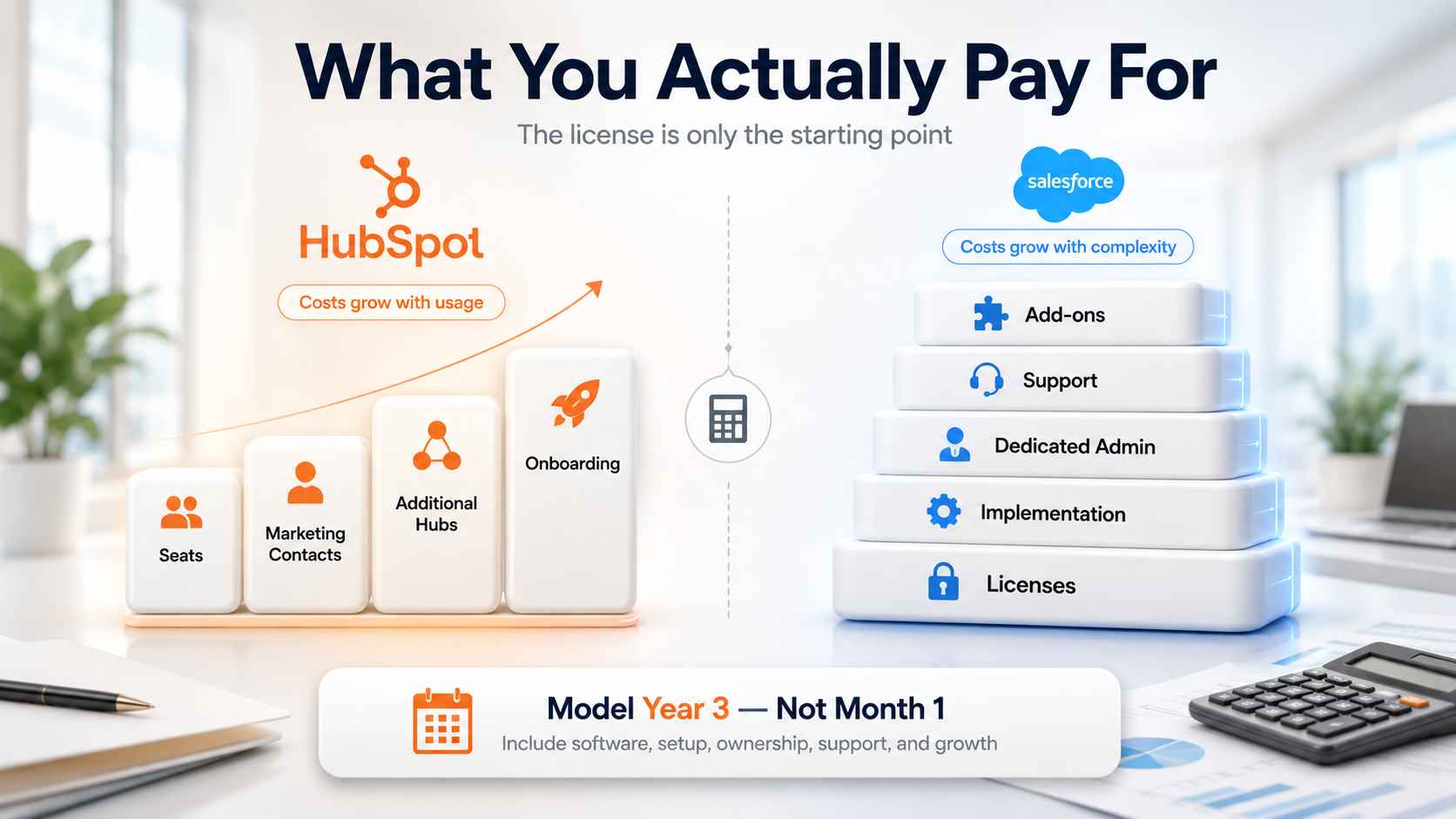
We publish no vendor prices. Prices change and date the content. Structures persist, and the structures differ sharply.
HubSpot: seats, contacts, and the compounding bill
HubSpot bills per seat and per marketing contact at the same time. HubSpot per-seat cost compounds painfully past 10 users, because sequences, forecasting, and serious reporting sit in Professional and above.
The marketing contacts trap catches operators who never budgeted for list growth: cross a contact threshold and the tier upgrades automatically, and it never downgrades automatically. Renewal pricing keys off your peak count.
Add the mandatory onboarding fee on Professional and Enterprise. Add hub attach. Three-year HubSpot cost routinely runs several multiples of the year-one sticker.
Salesforce: five spend lines, not one
Salesforce spend has five lines. Licenses. Implementation through a partner, a real engineering project measured in months. A dedicated admin, which is a salary. Premier Support, billed as a percentage of licenses. And add-ons, where Marketing Cloud, CPQ, and Data Cloud multiply the base.
The license quote is where spending starts, not where it ends. Model all five lines or the budget is fiction.
The three-year method
Compare the platforms the same way. Take your seat count and its growth. Take your contact list and its growth. Price year three, not month one. Then add the human line: HubSpot needs an owner, Salesforce needs an admin. Whichever total survives contact with your CFO is your answer.
Price the exit too. Leaving Salesforce is a migration project with schema translation. Leaving HubSpot means rebuilding marketing history, nurture flows, and attribution elsewhere. Both exits cost real money, and pretending otherwise is how three-year contracts get signed casually.
Running both: the pattern nobody mentions
Plenty of mid-market and enterprise teams run both on purpose. Marketing lives in HubSpot. Sales lives in Salesforce. A native sync moves contacts and lifecycle stages between them.
The pattern works when marketing genuinely needs HubSpot's tooling and sales genuinely needs Salesforce's depth. It costs two subscriptions and one integration to govern. Field mapping, sync conflicts, and duplicate rules need an owner. We build and maintain these syncs, and they are manageable with discipline. They are also a signal. If neither side uses its platform's depth, you are paying twice for one job.
When each is the right choice
Choose HubSpot when
Marketing drives your pipeline and needs real automation. You want marketing, sales, and service reporting on one database. You value weeks-to-live over infinite configurability. You have an owner for the system but not a full-time admin.
Choose Salesforce when
Your data model needs custom objects and complex relationships. You operate under regulatory governance. You run fifty-plus users across departments. You fund a dedicated admin. In that world, Salesforce earns its weight. Our Salesforce page and HubSpot page carry the platform detail.
When both are wrong
Here is the section no partner publishes. A meaningful share of $10M-$50M operators need neither.
Sales-led teams with straightforward pipelines get faster value from Pipedrive at a fraction of the cost. We compared both matchups in Pipedrive vs HubSpot and Pipedrive vs Salesforce. Teams that want a modern, flexible data model without platform weight should read our Attio Expert Partner assessment. And teams leaving Salesforce have a tested path in our migration playbook.
This gap exists because both vendors aim above and below the band. $10M-$50M operators are too big for starter tooling and too small to absorb enterprise overhead. The tools built for that middle get less marketing and more results.
The right CRM is the one your team uses without being told to. Sometimes that is neither of the two biggest names.
How ACS thinks about the choice
We start with the pipeline driver, not the product tour. Marketing-led or sales-led. Then the data model: can contacts, companies, and deals carry your business, or do you need custom objects. Then governance requirements. Then the human question: who owns the system after go-live.
Those four answers pick the platform in most engagements. Then we build it as a fixed-fee project with exit criteria on every stage, because most CRMs become glorified spreadsheets within twelve months when process design gets skipped. Every build ships with a runbook your team owns. Discovery itself ships a written audit, a ranked bottleneck list, and a recommended scope, refundable if the fit is wrong.
We have shipped 500+ workflows, reclaimed more than 10,000 hours, and saved clients over $2 million across seven industries. The proof sits in our case studies, the credentials on our partners page, and the engagement structure on pricing.
Frequently asked questions
Which is better for a mid-market B2B company, HubSpot or Salesforce?
HubSpot for marketing-led operators who want one database and fast deployment. Salesforce for process-heavy or regulated operators with a funded admin. Many $10M-$50M teams are better served by lighter platforms than either. Fit beats brand.
Is HubSpot cheaper than Salesforce?
At entry, yes. At scale, the gap narrows. HubSpot compounds through seats, marketing contacts, and hub attach. Salesforce compounds through implementation, admin salary, support, and add-ons. Model three-year totals with your real growth numbers before deciding.
Can HubSpot replace Salesforce?
For many mid-market teams, yes. Contacts, companies, deals, and strong automation cover the standard B2B motion. It cannot replace Salesforce where custom objects, complex approvals, or regulatory governance carry the requirement. Depth is the boundary.
Is Salesforce harder to use than HubSpot?
Yes, by every consistent usability benchmark. Salesforce trades ease for configurability. That trade pays off with a dedicated admin and fails without one. HubSpot's higher adoption rates are the practical result of its simpler design.
Do HubSpot and Salesforce integrate with each other?
Yes. A native integration syncs contacts, companies, deals, and lifecycle stages. Many teams run HubSpot for marketing and Salesforce for sales through that sync. It works with disciplined field mapping and a named owner for the integration.
Which has better AI, HubSpot Breeze or Salesforce Agentforce?
Different bets. Agentforce runs deeper autonomous workflows and demands configuration plus Data Cloud. Breeze deploys in minutes across every hub, including free tiers, with less customization depth. Fast value versus deep control. Pick the one your team can operate.
Do we need a HubSpot partner or Salesforce integrator to implement?
Not necessarily, and the badge is not the point. Partner tiers reward license revenue on both sides, which shapes the advice. Judge any implementer on process design, named deliverables, and a runbook at handoff. Neutral firms can tell you when the platform itself is wrong.
Should a $10M-$50M operator choose HubSpot, Salesforce, or neither?
Run the four-question test. What drives pipeline. What data model you need. What governance applies. Who owns the system. Marketing-led with standard data lands on HubSpot. Complex and governed lands on Salesforce. Sales-led and simple usually lands on Pipedrive or Attio instead.
Deciding between HubSpot and Salesforce?
Three ways to move.
Book a paid discovery. We run the four-question evaluation against your operation and recommend a platform. Refundable if neither fits. See pricing.
Read the side-by-side. Our HubSpot vs Salesforce comparison page breaks the decision down by scenario.
Review the proof. The case studies show shipped systems across seven industries.
Fit first. Platform second. No commissions anywhere.