

Automation Consulting Services sells operations automation retainers, so we have a direct interest in this answer. The section naming where a full-time hire genuinely wins is included anyway.
What the Decision Is Actually Between
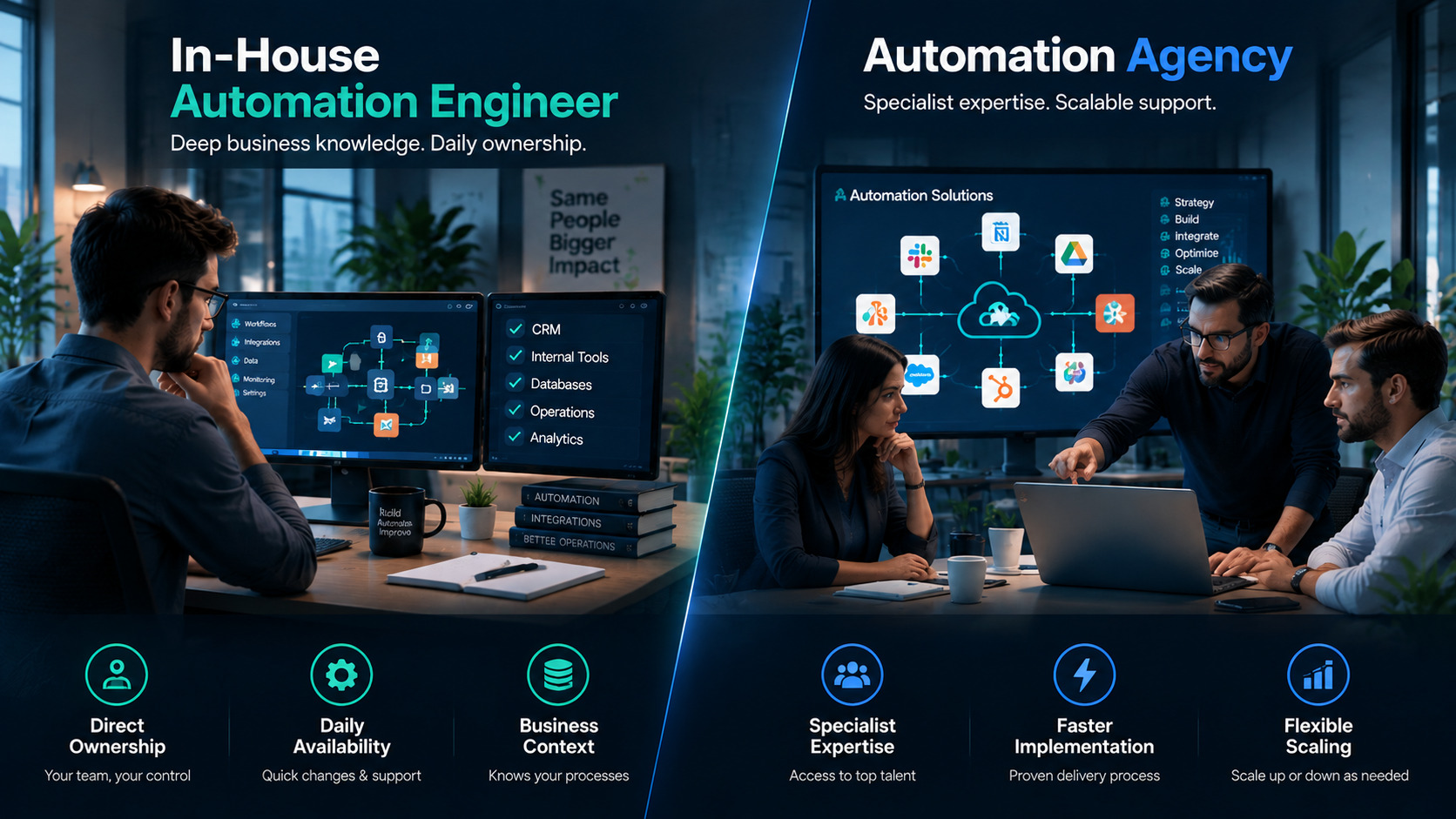
The choice is between three arrangements, not two, and the middle one is where most operators at this size land.
Automation work splits into two kinds that behave nothing alike. Build work arrives in bursts, needs depth across integrations and data handling, then goes quiet for months. Operate work arrives every week and needs availability far more than depth.
The three arrangements follow from that split:
External only: Somebody outside builds and maintains everything
An internal owner with external build capacity: Somebody inside runs the estate day to day, with depth available when a real build comes up
A full-time hire: One person inside does both
The usual error is adding both kinds of work together, producing a single total, and asking whether that total justifies a seat. Two unlike numbers, one answer, and it is almost always the wrong one.
Measure the Work Before You Price the Role
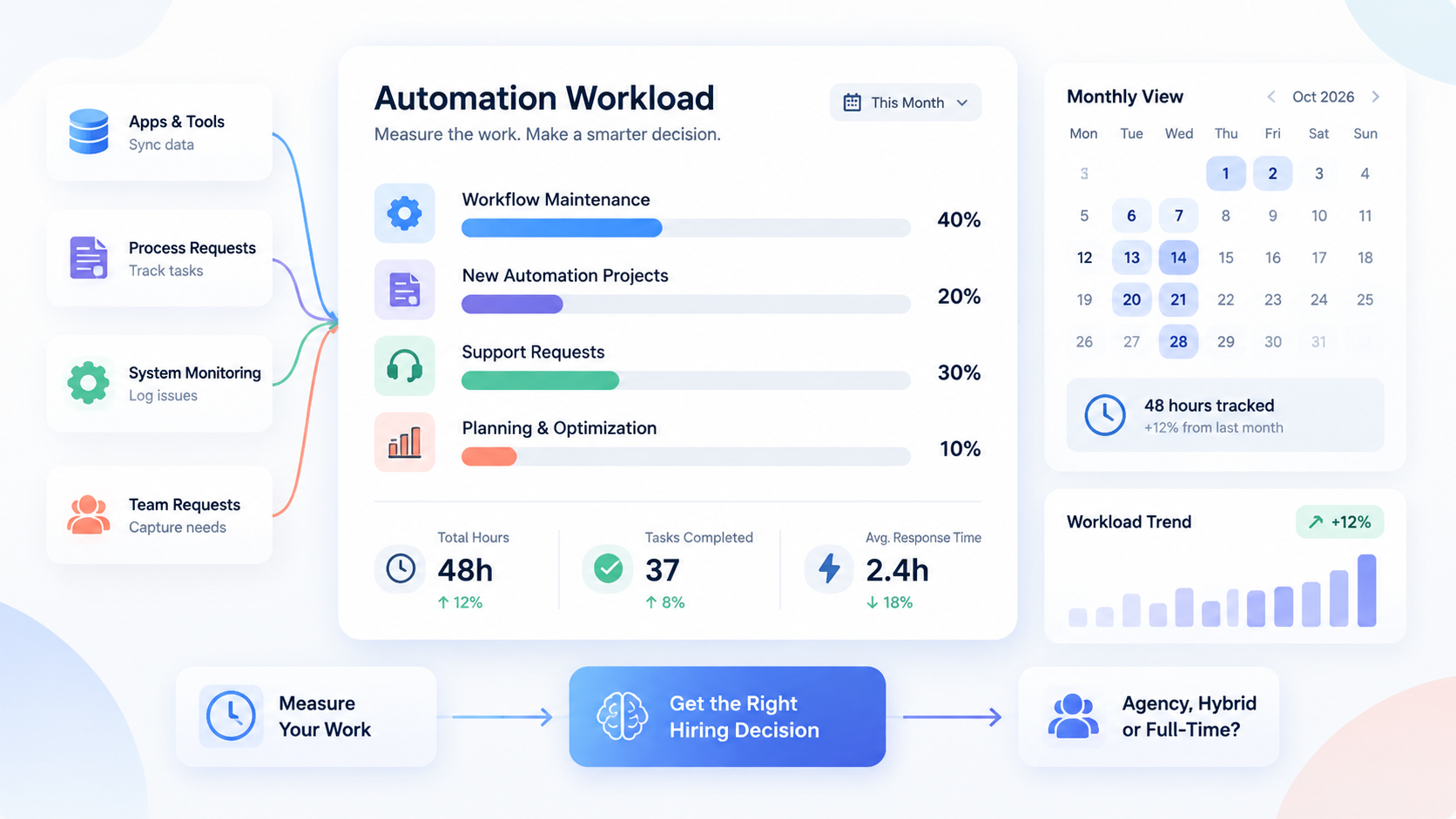
Before you compare a salary against anything, measure how many hours a month your automation work actually takes.
Nobody does this. Every comparison you will read asks whether the work is constant or intermittent, which is a judgement most operators get wrong, then answers the money half with a salary range.
What to Count
Total the operate work that recurs whether or not anybody builds anything new:
Fixing broken connections and reconnecting authorisations that expired
Checking run history for failures, and for workflows that stopped firing without erroring
Triaging what broke and deciding whether it needs a fix or an escalation
Making small changes to existing workflows
Taking new requests, scoping them, and holding a queue
Answering "why did this not fire" for whoever asked
Count a normal month, not your worst one. Then count a second month, because the first estimate is usually optimistic.
What Not to Count
Leave build work out of the total. A three-week project to connect two systems is real work, but it does not recur, and including it inflates the figure that decides whether you hire.
Count build work separately, as projects per year. If you are commissioning one or two a year, that is not a job either. It is a reason to keep depth available without employing it.
What the Number Means
We scope ongoing engagements in three tiers, at roughly one day, two and a half days, and five days a month. Those tiers came from delivery rather than from a survey, and most estates land in the first two.
Five days a month is a quarter of a role.
That is the arithmetic that reframes the whole decision. A reader who measures usually finds far less work than they assumed, which means the salary comparison so often gets made against a workload that does not exist.
You cannot answer the continuity question by feel. Any comparison asking you to is asking you to guess, then quoting a salary against the guess.
The Three Arrangements, Side by Side
The three arrangements differ on five things, and none of them are salary.
Fits when monthly work is: under a day for external only, one to three days for an internal owner with external build capacity, five days or more consistently for a full-time hire
Speed to first result: weeks for external only, weeks for an internal owner with external build capacity, months for a full-time hire once recruiting is done
Where knowledge sits: partly outside unless documented for external only, inside with depth available on call for an internal owner with external build capacity, inside and concentrated in one person for a full-time hire
When work slows: pause or reduce for external only, the owner returns to other duties for an internal owner with external build capacity, fixed cost continues for a full-time hire
Biggest risk: waiting on somebody else for small changes with external only, the owner getting absorbed elsewhere with an internal owner and external build capacity, being half-utilised and a single point of failure with a full-time hire
Read the middle column first, because that is where most operators between ten and fifty million in revenue actually belong. Then read the bottom row, which is the one people skip and the one that decides whether the arrangement survives its first busy quarter.
Notice that speed to first result is identical for the first two columns. Hiring buys ownership, not pace, and the months spent recruiting are months nothing ships.
What the Internal Owner Actually Does
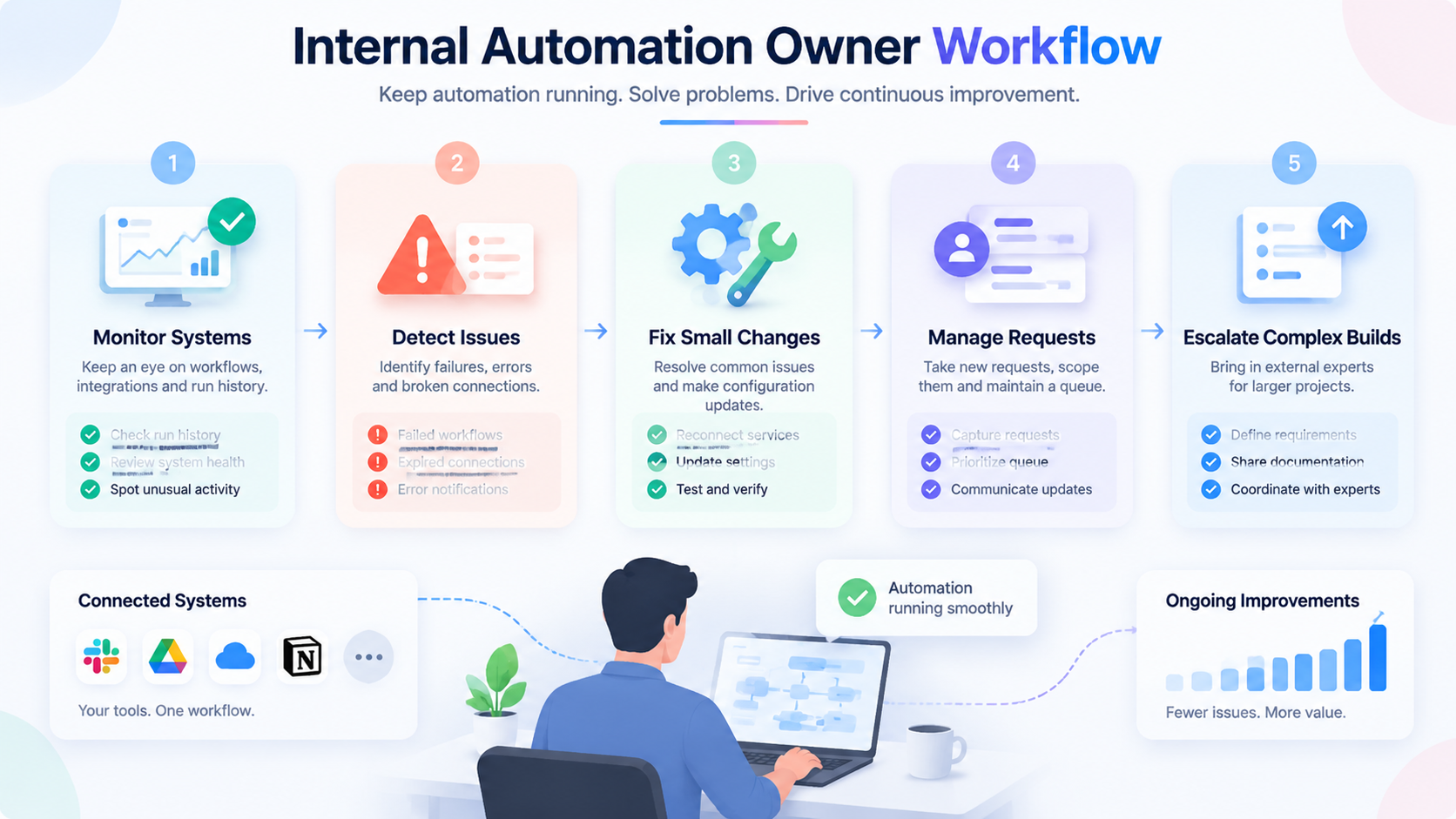
An internal automation owner is a defined role with a weekly job, not a name attached to a responsibility.
Most advice stops at "somebody on your team should own it." That is not a role, it is a hope, and it is why the arrangement fails so often.
Here is the job:
Rotating credentials and reconnecting authorisations before they expire
Watching run history for failures, and for workflows that quietly stopped running
Triaging what broke and deciding fix or escalate
Making small changes to existing workflows, inside a defined scope
Taking new automation requests, scoping them, and holding a queue rather than a pile
Keeping the inventory current whenever anything is added, changed, or retired
Knowing which problems sit outside their scope, and who to call
Two things follow. This person does not need to be an engineer, and at most businesses they already work there, usually in operations.
What makes the role work is a written boundary. The owner handles anything inside an existing workflow: a changed recipient, a new field, a broken connection, a filter that needs widening. Anything that creates a new workflow, touches a system nobody has integrated before, or changes what a workflow is for goes outside the boundary and gets scoped as a build.
Without that line, every request becomes a judgement call, and the owner either refuses work they should do or accepts work they cannot finish.
The role fails when it is assigned without hours protected for it. That failure has a predictable shape and a predictable month.
What Has to Be True Before You Hire
Hiring into an undocumented estate buys six months of archaeology at salary rates.
The standard advice is not to hire before you have working systems to maintain. The stronger version is that you should not hire before somebody can explain those systems without opening them.
Four things need to exist first:
A complete inventory, including the workflows running outside your main platform
A named owner recorded against every workflow
A written specification for anything the business cannot afford to lose
Credentials on accounts the business owns, not on somebody's personal login
If none of that exists yet, auditing the estate comes before the staffing conversation, not after it.
Document first, then decide, because the documentation changes the answer rather than just tidying it. Most of the upkeep hours in an undocumented estate are spent working out what something does before touching it.
An estate somebody can hand over needs far less of a person's week than one nobody can read, and the difference is often large enough to move you a whole band down the table above.
Working Out How Much Work You Actually Have
The number that settles this is hours a month, and most operators have never counted it. Everything else in the decision is downstream of that figure.
A paid discovery audit establishes what the estate contains, how much upkeep it genuinely needs, and what that implies for how you staff it.
The Month Four Failure
The common failure is not hiring too early. It is appointing an internal owner and then quietly taking the hours back.
The pattern repeats:
The operations person takes the role in month one and does it properly
A busy quarter arrives, automation upkeep is the flexible item on their list, and it slips
Nothing formally changes, so nobody reports it and no meeting covers it
By month four the estate is drifting, and the first anyone hears about it is a failure
The fix is structural rather than motivational. Protect the hours in the calendar, name a backup who can cover them, and hold a short monthly review that somebody other than the owner attends.
Nothing announces this failure. A missed build has a deadline and somebody chases it, while missed upkeep produces no artefact until a workflow fails, by which point the drift is months old.
An owner with no protected time is the same arrangement as no owner, with a name on it.
Where the Full-Time Hire Genuinely Wins
Three situations make the full-time hire the right answer, and none of them are cost.
Automation is the product, not support for it. If the systems are what customers buy, that capability belongs on your payroll
The measured work exceeds what one person can hold. At that point you are staffing a function rather than filling a seat, and the question changes entirely
Waiting costs more than the salary difference. In fast-moving operations, a two-day turnaround on a small change gets expensive quickly
Breadth and depth pull in different directions. A $25M contractor we run an ongoing engagement for has over one hundred workflows under active management and has not hired, because the estate is wide and shallow rather than narrow and deep.
Frequently Asked Questions
How Many Hours a Month of Automation Work Justifies a Hire?
Five days a month is roughly a quarter of a role, so a hire needs considerably more, sustained rather than seasonal. Under a day, an external arrangement wins. Between one and three days, an internal owner with external build capacity fits best.
What Does the Internal Automation Owner Do Each Week?
Credential upkeep, checking run history for silent failures, triaging what broke, making small in-scope changes, and holding the request queue. A few hours a week for most estates, which is exactly why it gets absorbed if nobody protects the time.
Should the Internal Owner Be an Engineer?
Usually not. Operate work rewards availability and business knowledge over build skill, and the person who fits is often already in your operations team.
What Has to Be Documented Before We Hire?
An inventory covering every workflow including those outside your main platform, a named owner against each, specifications for anything critical, and credentials on company accounts. Without those, a new hire spends months reconstructing what exists instead of improving it.