
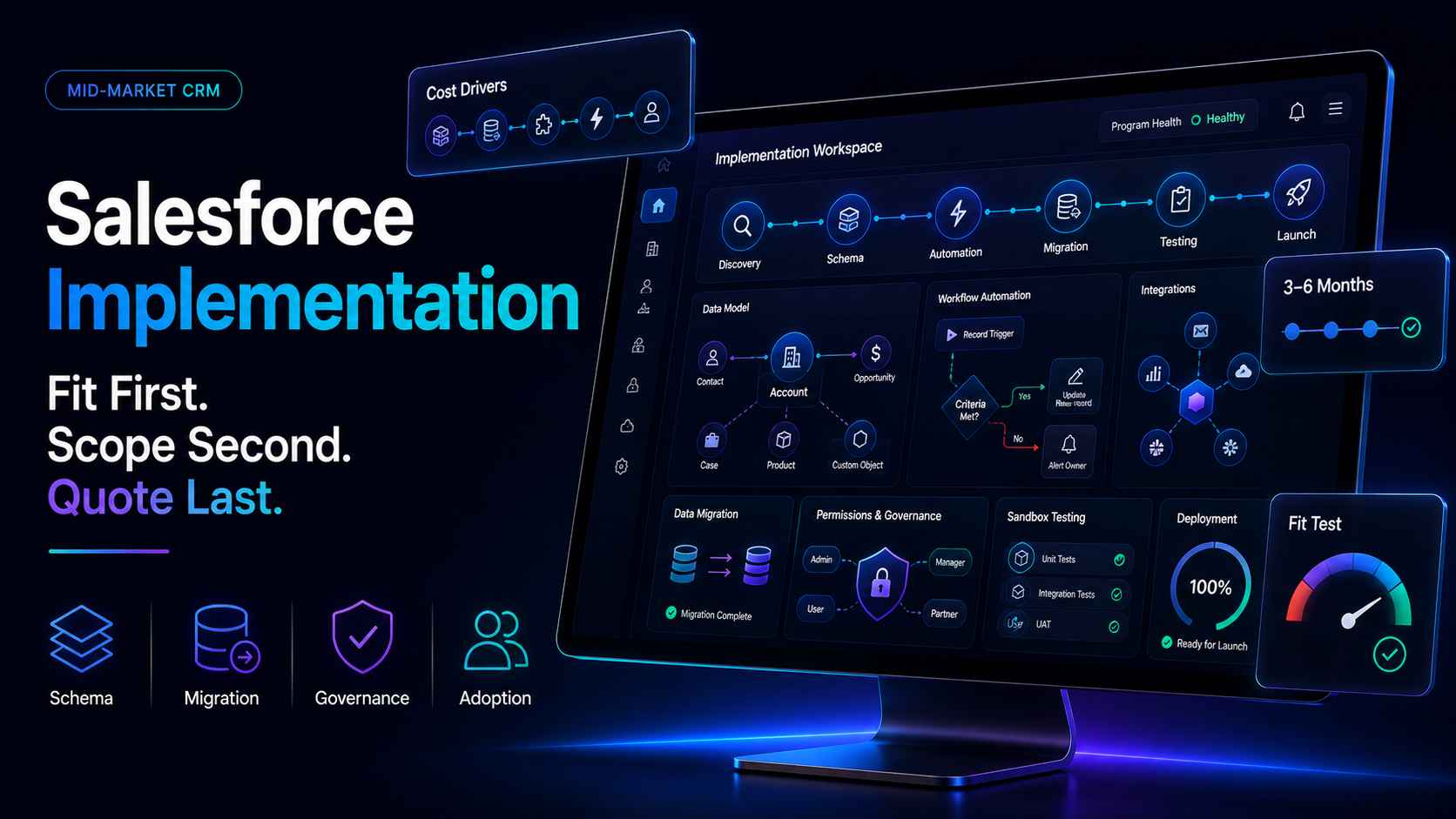
We build operations infrastructure with engineering discipline for $10M-$50M operators. We implement Salesforce. We are not a Salesforce partner, and we hold no integrator badge. Our verified credentials sit with Zapier and Attio.
That combination is rare in this topic. Every page ranking for these searches is written by a systems integrator whose revenue scales with your implementation's size.
Ours does not, so we can write the sentence they cannot: Salesforce is overkill for most $10M-$50M operators. This post covers the cost structure, the honest timeline, and the fit test, in that order of search intent and reverse order of importance.
The honest verdict
Salesforce is the most capable CRM platform ever built. Per IDC, it held 20.7% of the global CRM market in 2024, more than its four largest rivals put together. The capability is real. So is the weight.
For mid-market operators, the decision splits clean. Regulated industries, complex data models, and fifty-plus users across departments justify the platform, the partner, and the admin. Below those thresholds, most enterprise CRM implementations pay for capability the operator will not use until $25M+ in revenue, and sometimes not then.
Cost questions come second for a reason. If the fit is wrong, the cheapest implementation is still too expensive. Run the fit test below before requesting a single quote. Quotes anchor. A number in your head reshapes every later judgment, which is exactly why SIs offer them early. Sequence the decision: fit, then scope, then price.
What implementation cost actually is
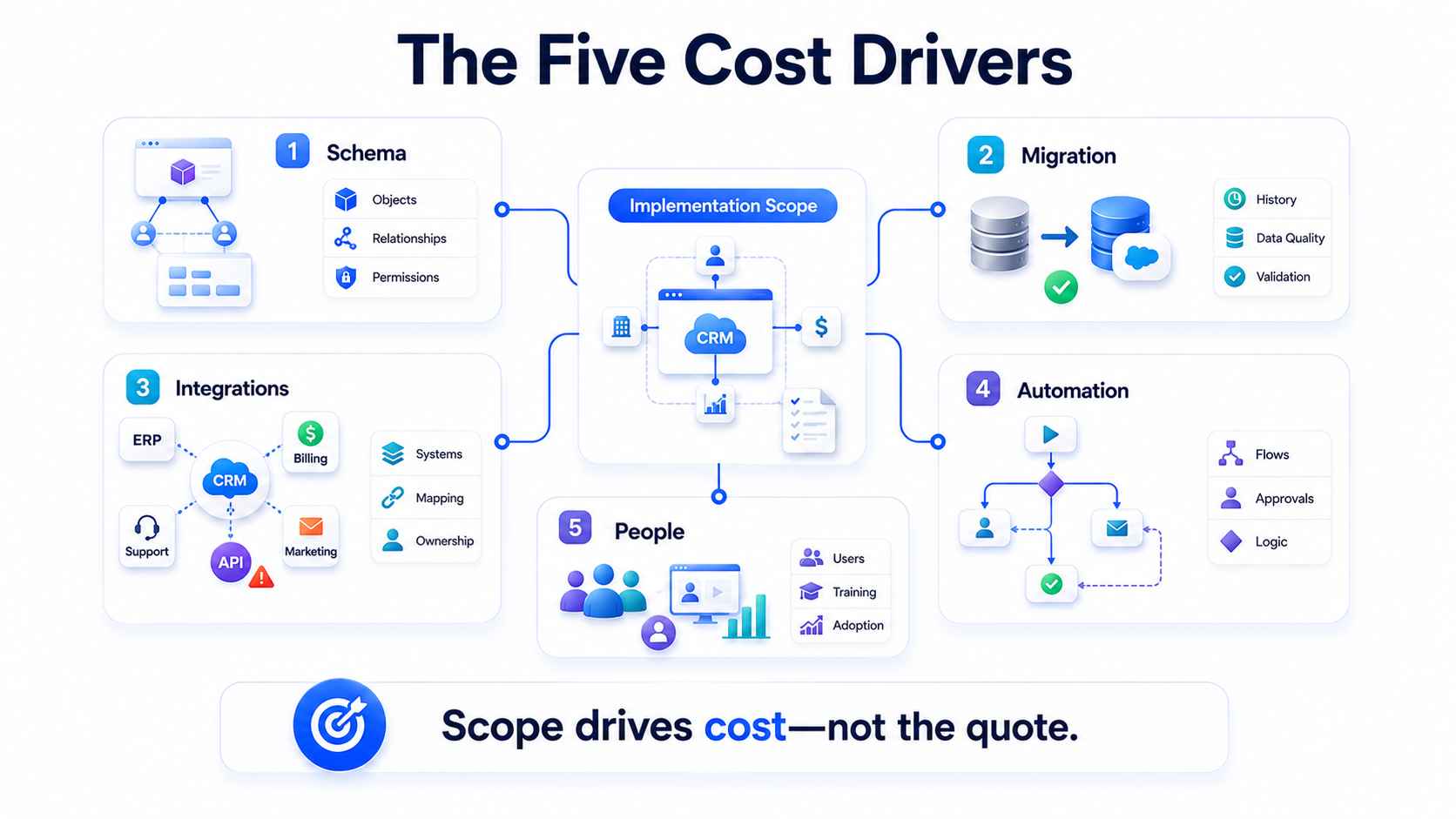
Nobody honest quotes a number before discovery. Implementation cost is a scope function, not a price tag, and anyone quoting before discovery is guessing or anchoring. Five drivers set the scope.
Driver one: schema complexity
Standard objects configured cost little. Custom objects, record types, and complex relationships cost engineering. Count your custom objects honestly at discovery. Each one carries page layouts, permissions, automation, and reports behind it.
Good discovery shrinks this driver. Half the custom objects in a first requirements list turn out to be a picklist or a record type when someone asks why. Ask why five times before approving any object. The cheapest object is the one never built.
Driver two: migration weight
Where the data lives now, how much history matters, and how dirty it is. A clean spreadsheet import is days. A decade of legacy CRM history with attachments and audit requirements is a project inside the project. Know the platform limits early: the built-in import wizard caps at fifty thousand records per run and skips core objects like opportunities, so real migrations run through Data Loader or the API.
The discipline stays constant across sources. Prune before moving. Preserve source record IDs in a custom field for rollback. Validate by counts, then by eyes. The playbook is published, and it works the same pointing into Salesforce as out of it.
Driver three: integration count
Every connected system multiplies scope. ERP, marketing platform, support desk, billing. Each integration needs mapping, error handling, and an owner. AppExchange packages cover common pairs. Custom needs run through the API, which is where our integration builds work usually enters. Sequence them read-only first, write access earned, with an alert on every sync. The rules are the same ones we publish for every platform pair.
Driver four: automation depth
Flow is powerful and Flow is scope. Simple assignment rules cost hours. Multi-stage approval chains, renewal automation, and cross-object logic cost weeks. The discipline that controls this driver: automate the process you have proven on paper, not the process someone imagines.
One example sizes it. A discount approval chain routing by deal size and margin, with escalation and audit trail, is a week of Flow work plus testing. Ten of those in a proposal is a quarter. Count them.
Driver five: people
User count sets training scope. Change resistance sets adoption scope. A fifty-user rollout across three departments needs role-based training, champions, and hypercare weeks that a ten-user rollout does not. Most CRMs become glorified spreadsheets within twelve months, and this driver decides which side of that line you land on.
Measure adoption by field completeness and stage currency, not logins. A pipeline updated within a day of reality is the success metric every other line item exists to buy.
The five budget lines the license quote hides
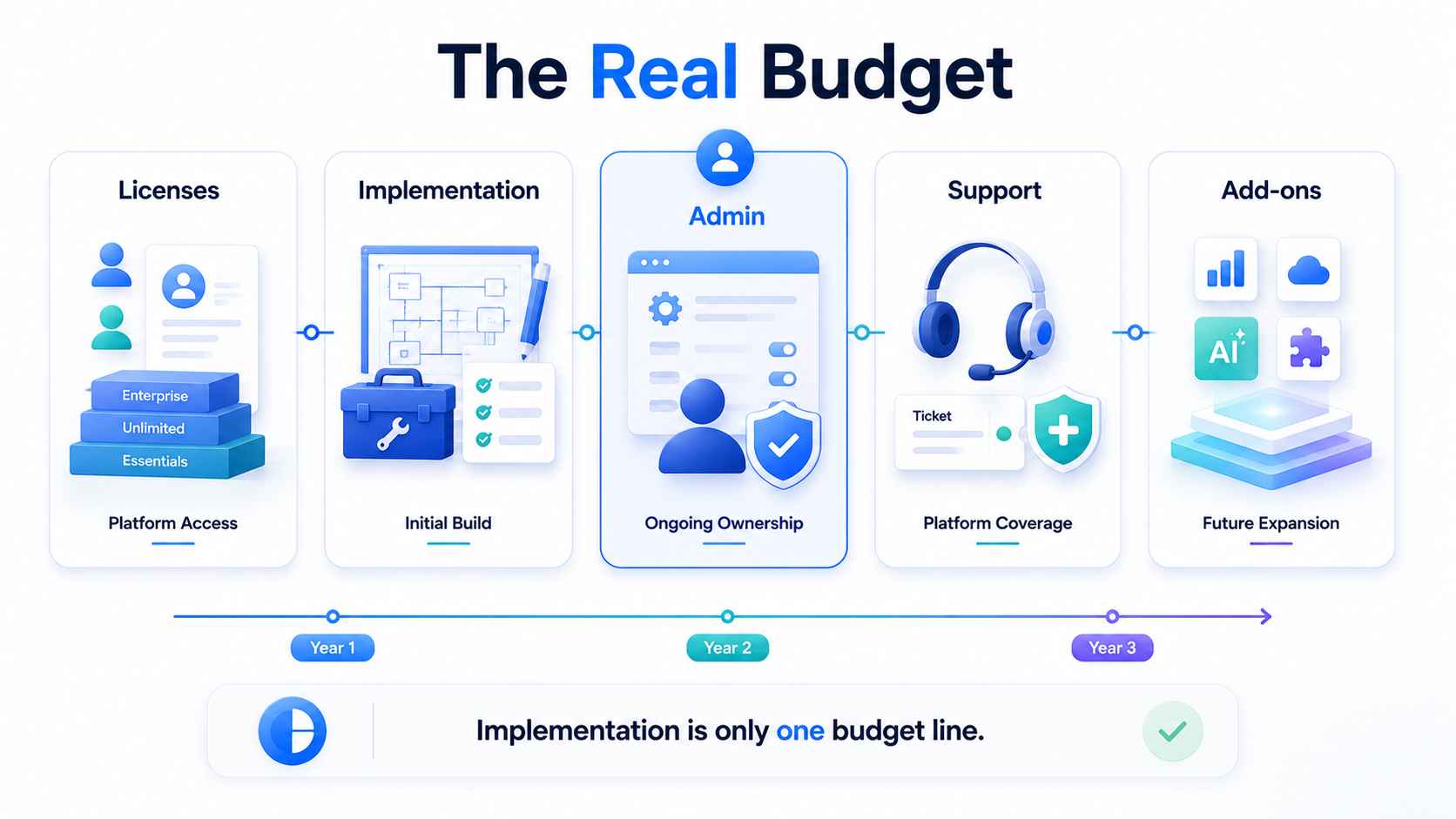
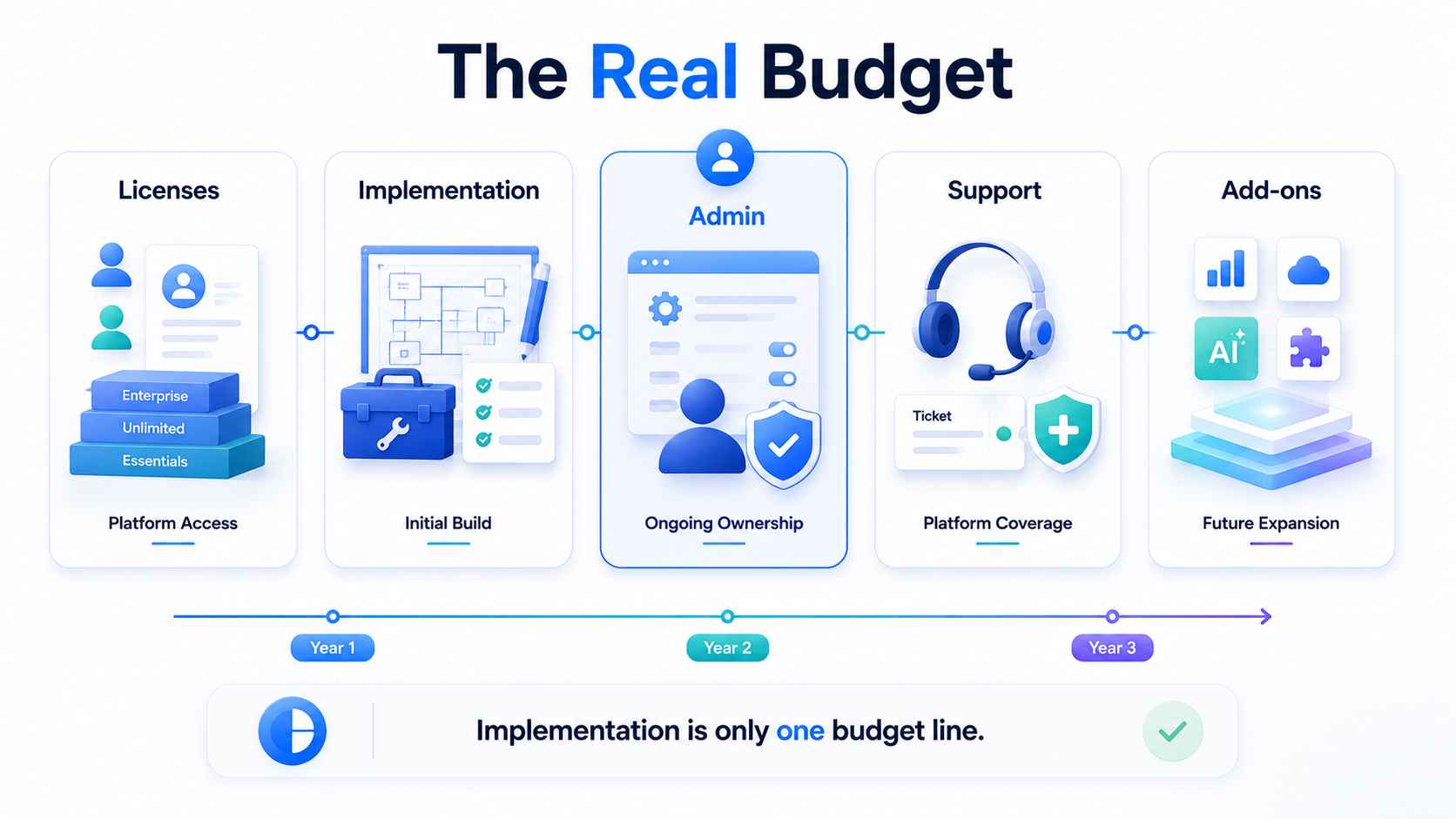
Implementation is one line in the real budget. Plan all five or the number is fiction.
Licenses, on the tier ladder from Starter through Enterprise and Unlimited, with an AI tier above. List prices moved up again in 2025, and multi-year terms lock the trajectory.
Implementation, the partner project this post covers.
The admin. Salesforce without an admin decays. Below roughly thirty users, fractional or partner-managed admin works. Past fifty, it is a salary. An implementation without an admin plan is a countdown, and the countdown ends at the first broken Flow nobody can fix. The decay is specific: fields multiply without governance, reports drift from definitions, and permissions rot until an audit finds them.
Support. Premier tiers bill as a percentage of license spend. Read the renewal terms before signing, not after.
Add-ons. CPQ, Marketing Cloud, Data Cloud, and industry clouds each carry their own line. The AI layer bills on usage above licenses. Scope what you actually need at year one, and write down what triggers year-two additions.
Model all five lines over three years, with your real user growth. Year one flatters every platform. Year three is where the totals separate, and it is the only number your CFO should sign against.
The honest timeline
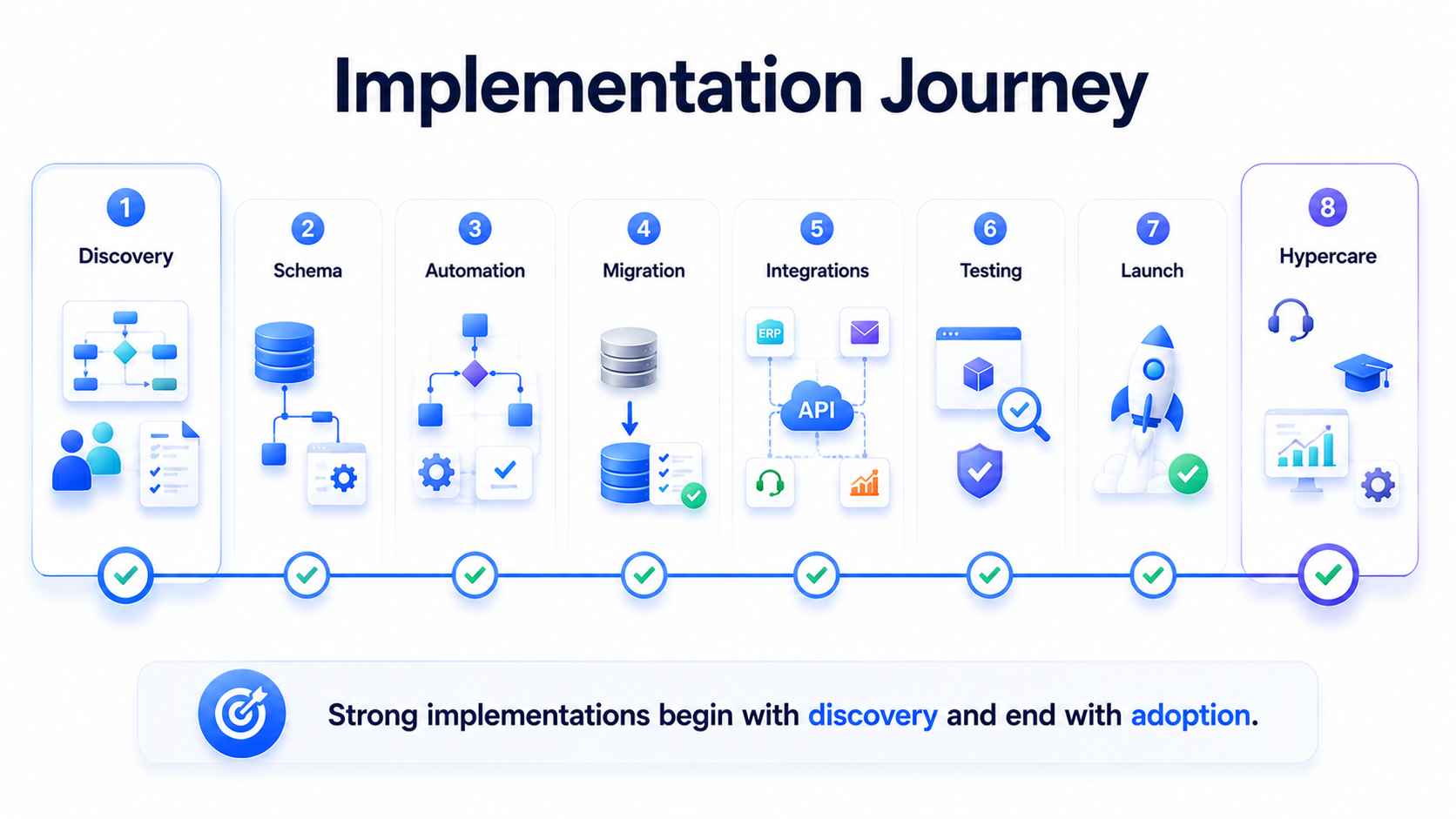
Mid-market Salesforce implementations run three to six months. Not weeks. Anyone promising weeks is scoping a demo, not a system.
The shape: discovery and process design first, then org setup and schema, then automation, then migration, then integrations, then sandbox testing and deployment, then training and hypercare. Sandboxes are not optional ceremony. Changes built and tested outside production are the difference between a deployment and a gamble.
Hypercare deserves definition, since proposals wave at it. Two to four weeks post-launch with the build team on call, fixing what real usage finds, tuning what training missed. Skipping it saves a line item and costs the adoption.
Name the comparison honestly. Pipedrive and Attio implementations run in weeks. Our Attio implementation guide shows the same trilogy of work compressed into a month. The Salesforce timeline buys depth. Confirm you need the depth before you buy the months, because months of build are also months of the old problem continuing.
The SI incentive problem
Here is the section no integrator publishes. The SI business model rewards complexity. Billable hours scale with scope, certifications bill by the seat, and change orders are a revenue line. None of that makes integrators dishonest people. All of it quietly shapes what gets recommended, and how the proposal reads.
Read proposals with the incentive in mind. Complexity that serves your process is worth paying for. Complexity that serves the invoice is not, and the difference shows in one place: the proposal's process design phase. A proposal that starts building in week one skipped the phase where your actual requirements would have shrunk the scope.
Protect yourself with structure. Fixed fee against named deliverables. Exit criteria per phase. A change-order process with your signature on it. And a runbook in the contract, because hourly billing pays consultants to think slowly, and undocumented systems pay them forever.
One tactic pays for itself every time. Get the scope priced by a firm with no integrator badge before signing an SI proposal. A neutral discovery costs a fraction of the first change order, and it tells you which complexity in the proposal is yours and which is theirs. Sometimes the neutral answer is that the SI scoped it right. That answer is worth having in writing too.
When Salesforce is overkill
The full treatment of the sentence integrators cannot write. Five signals, any two of which should stop the project.
Under thirty users on a single sales motion. The governance layer you are buying manages complexity you do not have.
No custom object requirement. If contacts, companies, and deals carry your business, the platform's core advantage sits unused.
No regulatory governance need. Field-level security and audit trails are the product. Unregulated operators pay for them anyway.
No admin budget. The platform decays without an owner. If the salary line is not approved, the decay is scheduled.
The forecast fits in a spreadsheet today. Teams managing twenty deals a month do not need territory management. They need a pipeline their reps update.
Two or more signals present, look downstream. Pipedrive for sales-led simplicity, Attio for modern data models, HubSpot when marketing drives pipeline. The comparisons are published: Pipedrive vs Salesforce, HubSpot vs Salesforce, and the Attio vs Salesforce page. Teams already on Salesforce and feeling the weight have a tested exit in the migration playbook.
Price the wrong choice honestly. An oversized platform costs the licenses, the implementation, the admin, and then the migration out. Four bills for one mistake. The fit test is the cheapest line item in this entire post.
When Salesforce is genuinely right
Fair witness cuts both ways. Four cases earn the platform.
Regulated operators. Finance, healthcare, and government-adjacent industries need the governance layer as core product, not add-on. Nothing else at scale matches it.
Complex data models. Multi-entity structures, product hierarchies, and many-to-many relationships that break simpler tools. Custom objects with record types and approval chains are the correct tool for genuinely complex process.
Fifty-plus users across departments. Sales, service, and operations on one platform with real permissions. The coordination value compounds with headcount.
A funded admin and a real roadmap. Teams that will build on the platform for years, with an owner, extract the value. The ecosystem helps here: the largest CRM talent pool and app marketplace in the world mean the hire and the extension are always available. The Salesforce page carries our platform detail, and our comparison page maps the boundary scenario by scenario.
How ACS runs Salesforce implementations
Fixed fee. Refundable discovery first: process mapping, schema draft, the five-driver scope assessment, and a written recommendation. When the recommendation is "not Salesforce," we say so and show the alternative, because no integrator badge punishes us for it.
This post closes our implementation series. Same discipline, three platforms, honestly compared: Salesforce for governed complexity, Attio for modern data models on the Expert Partner method, and the suite path covered across our HubSpot resources on the platform page. One method. Three destinations. The fit test picks between them.
Then the build in phases with exit criteria: schema, automation, migration with counts validated, integrations with error alerting, sandbox-tested deployment, and role-based training. Everything ships with a runbook your team owns, plus the admin plan in writing: who owns the org, at what fraction, growing to what.
The proof: 500+ workflows shipped, more than 10,000 hours reclaimed, over $2 million in client savings across seven industries. Credentials on the partners page, engagement structure on pricing, shipped systems in the case studies.
Frequently asked questions
How much does Salesforce implementation cost?
Cost follows five scope drivers: schema complexity, migration weight, integration count, automation depth, and user count. Mid-market projects span a wide range on those drivers, which is why honest firms quote after discovery, not before. Model the full five-line budget, not the implementation line alone.
How long does a Salesforce implementation take?
Three to six months for most mid-market builds. Discovery and process design set the foundation, sandbox testing and training close it out. Compressed timelines skip one of those ends, and both ends are where failures start.
Can we implement Salesforce ourselves?
Small teams on Starter tiers with standard objects can self-serve. Enterprise-tier builds with custom objects, integrations, and compliance requirements need experienced hands, internal or hired. The honest self-test: if nobody on staff has deployed through a sandbox, hire the discipline.
Do we need a full-time Salesforce admin?
Below roughly thirty users, fractional or managed admin coverage works. Past fifty users or heavy automation, it is a role. Budget it before go-live. The platform decays without an owner, and the decay starts in month one.
Is Salesforce worth it for a mid-market company?
When regulation, data model complexity, or fifty-plus users demand it, yes, fully. Below those thresholds most operators pay for capability they will not use for years. Run the five overkill signals before running an RFP.
What is included in a Salesforce implementation?
Process design, org and schema setup, automation build, data migration, integrations, sandbox-tested deployment, and training. Confirm every one appears in the proposal with an exit criterion. Missing phases become change orders later.
How do we decide between Salesforce and a simpler CRM?
Four questions: what drives pipeline, what data model you need, what governance applies, and who owns the system. Complex and governed lands on Salesforce. Sales-led and simple lands on Pipedrive or Attio. The published comparisons walk each boundary.
Should we get a second opinion on an SI proposal?
Yes, from a firm with no integrator badge and no stake in the scope. A neutral discovery prices the honest version of the project and flags complexity that serves the invoice. When the SI scoped it right, the second opinion confirms it in writing, which is worth having either way.
What are the signs an implementation is going wrong?
Change orders arriving before the first deliverable. No written exit criteria per phase. Configuration starting before process design finished. Timeline drift explained by scope you never approved. Any of those, pause the project and re-anchor the scope in writing.
Considering Salesforce?
Three ways to move.
Book a paid discovery. The five-driver scope assessment and a written platform recommendation. Refundable, including when the recommendation is not Salesforce. See pricing.
Test the fit first. The five overkill signals above cost nothing to run, and the comparison pages map every boundary.
Review the proof. The case studies show shipped systems across seven industries.
Fit first. Scope second. Quote last.