
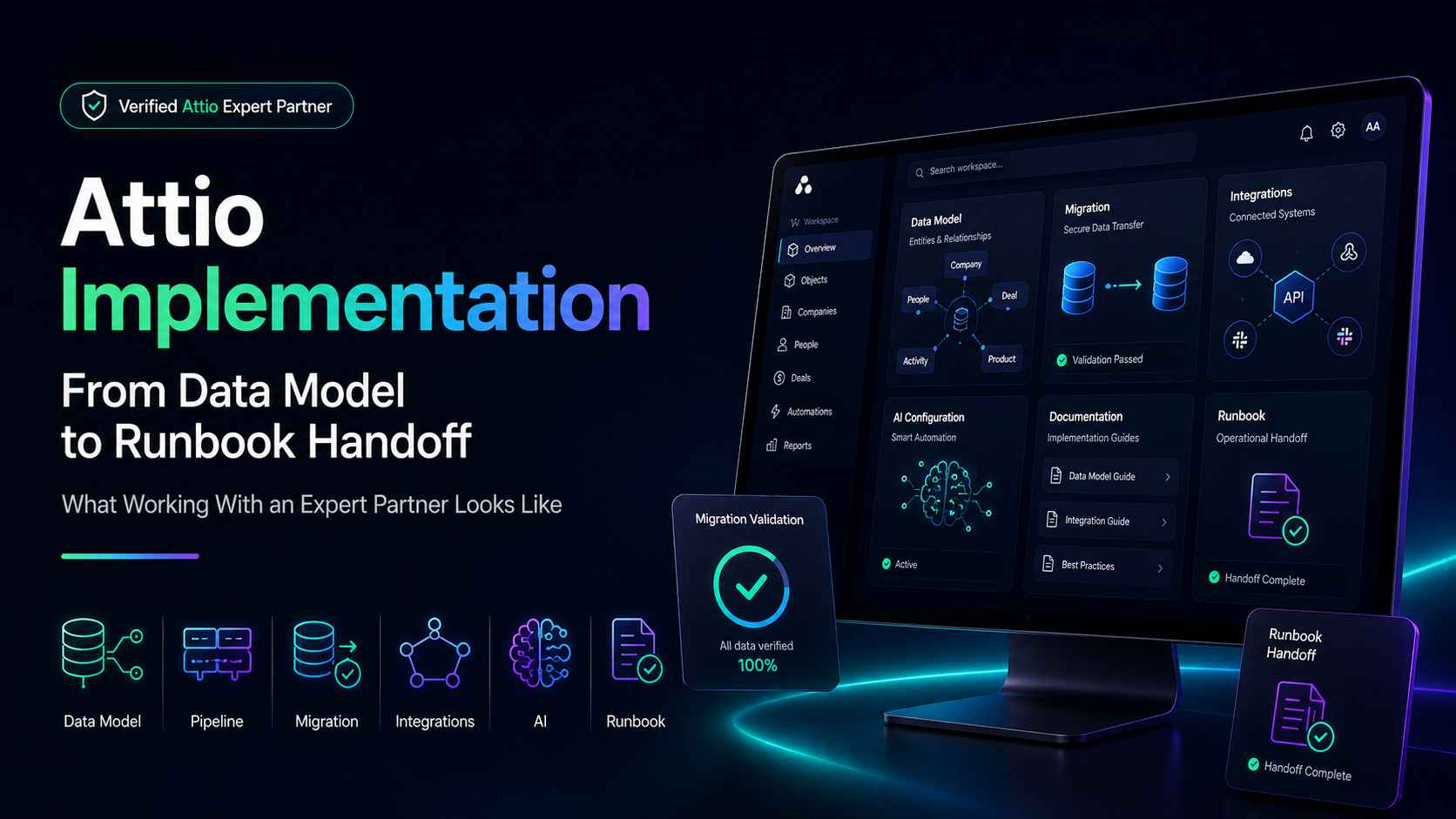
We build operations infrastructure with engineering discipline for $10M-$50M operators, and Attio implementation is core work inside that. We are a verified Attio Expert Partner, listed in Attio's public directory, alongside our Zapier Certified Solutions Partner credential.
This post answers the questions behind the searches: what the partner program actually is, what an implementation contains, what the certification means, and how to judge anyone you might hire. Including us.
One framing before the detail. An implementation is not a setup task. Setup is clicking through defaults. Implementation is designing the system your revenue runs on. The difference is the entire fee, and the entire outcome.
The honest verdict
Attio implementations run faster than legacy CRM projects, and the speed is real. Weeks, not months, for most mid-market builds. The risk moved rather than disappeared. Legacy CRM projects fail on configuration sprawl. Attio projects fail on data model design, because the platform hands you primitives instead of presets.
The failure looks different too. A bad Salesforce build is slow and visible. A bad Attio build is fast and quiet. The model is wrong, and nobody notices until the reports disagree with reality.
So the implementer question is really a modeling question. Hire for schema thinking, verify the credential in the public directory, and always demand a written runbook at handoff. Small teams with standard motions can skip the hire entirely, and we say so below.
The Expert Partner program, decoded
Three searches land here: attio consulting, attio certification, attio partner program. They are the same question wearing three phrasings. Who is verified to do this work, and by what standard?
What the program is
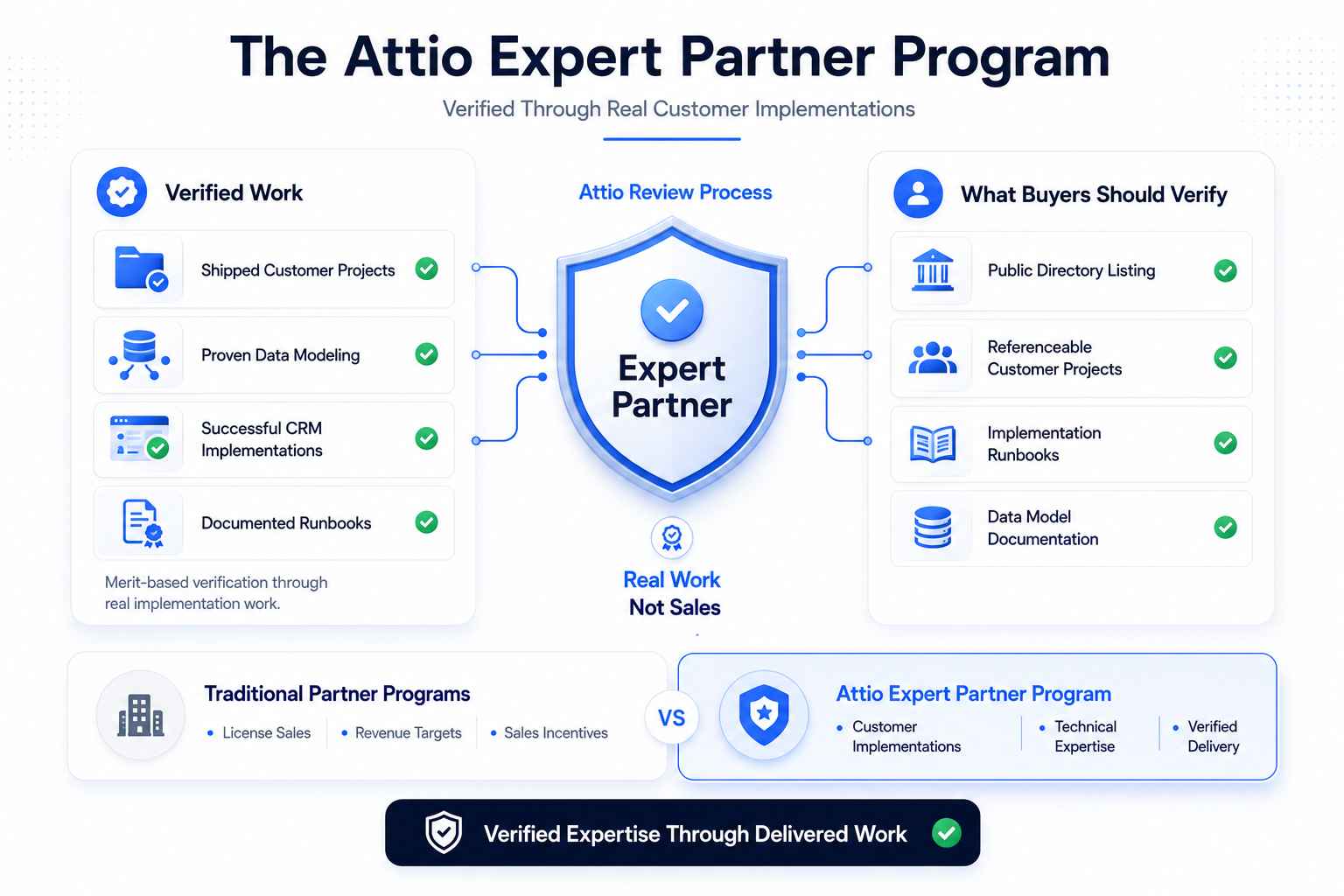
Attio runs a merit-based Expert Partner program with a public directory, launched in early 2025. Firms qualify by demonstrating real customer implementation work, and the program runs tiers from Core through Advanced to Elite. The population is small: roughly two dozen firms globally hold the credential as of this writing.
That scarcity is the point. The AI-native CRM category is real, and Attio defined it, but the services ecosystem around it is young. A short vetted list beats a long pay-to-play one.
It also makes verification fast. Open the directory. Search the firm. Done in thirty seconds. Legacy CRM directories list hundreds of firms across tiers bought with license volume. This one lists implementers Attio checked. Use that.
How it differs from legacy partner programs
Attio's partner program certifies work, not sales. That sentence carries the whole comparison.
HubSpot's partner tiers key off managed license revenue, with retention gates on top. Salesforce's integrator ecosystem scales with practice size and certifications sold by the seat. Both models reward moving licenses. Attio's model rewards shipped implementations, verified by the vendor, with no reseller margin in the loop.
The practical consequence for buyers: an Attio Expert Partner has no license commission shaping the advice. When we recommend against Attio for a given operator, nothing in the program punishes us for it.
Incentives write recommendations. A partner paid per seat recommends more seats. A partner paid per implementation recommends the right platform. Read every proposal with the payment model in mind.
The certification truth
There is no Attio exam. The verification is shipped customer work. Searchers hunting an "Attio certification" course will not find an individual credential like a Salesforce admin cert, because the program verifies firms on delivered implementations instead.
Judge implementers accordingly. Ask for the directory listing, then ask for the work behind it. A badge without referenceable builds is a logo on a slide.
Three questions do the vetting. Show me a data model document from a past build. Show me a runbook you handed off. Walk me through a build that went wrong. Good implementers answer all three without flinching. The third answer teaches you the most.
What an Attio implementation contains
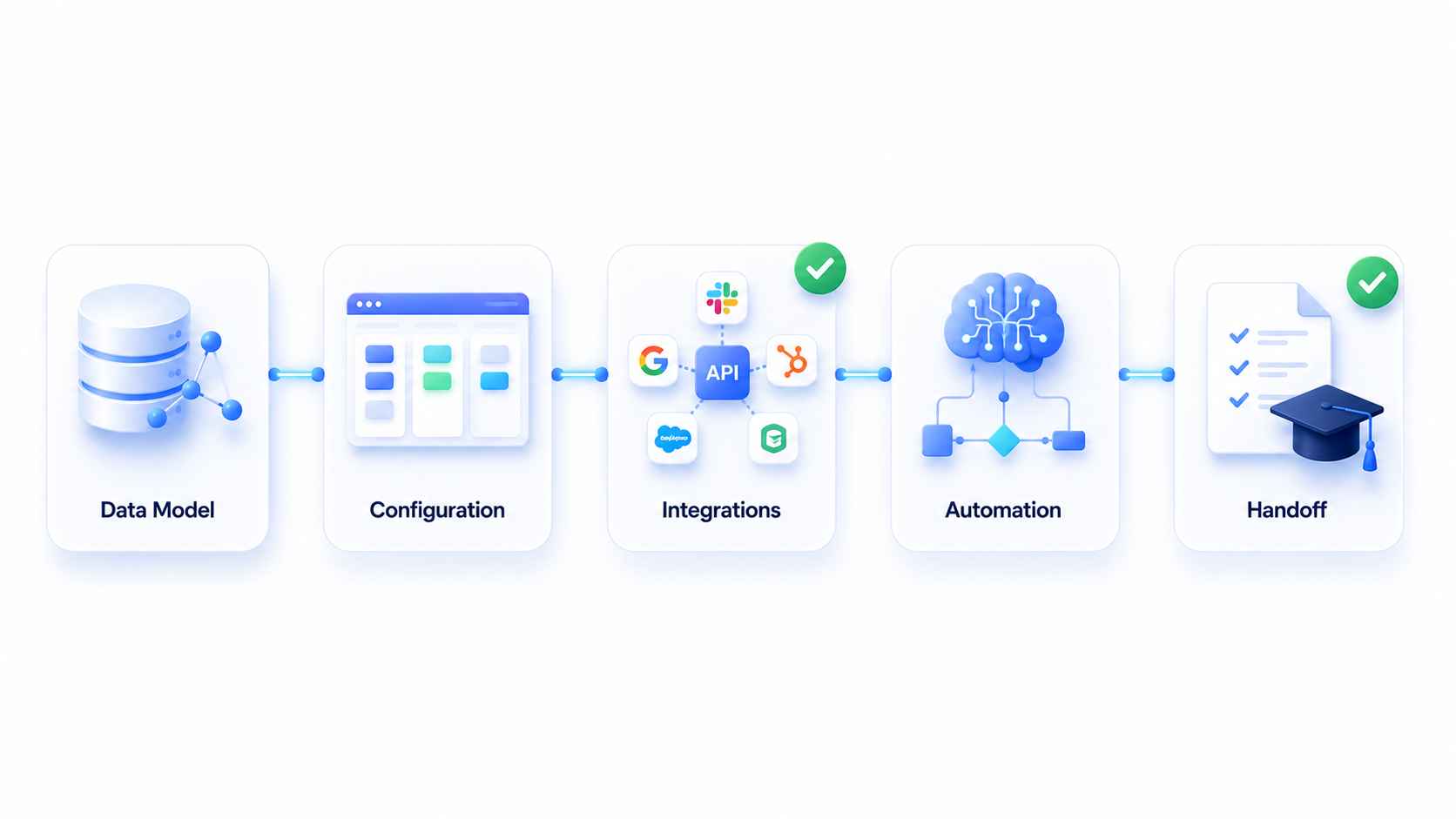
Six workstreams, in order. The order matters more than the list.
Data model design
The first workstream, and the one legacy CRM implementers skip, because legacy CRMs never offered it. Attio gives you four primitives: objects, attributes, records, and lists. The design session decides what your objects are, how they relate, and which attributes carry the business.
A services operator models engagements and partners. A fund models companies, rounds, and intros. A logistics operator models lanes and carriers. Photocopying your old schema into a flexible tool wastes the flexibility, so the session starts from your motion, not your export file.
The deliverable is a schema document. Object list. Attribute dictionary. Relationship map. One page per object, owned by you. The rule inside it: every attribute earns its place with a report or a workflow that reads it. Fields nobody reads become fields nobody fills.
Pipeline and process build
Stages with exit criteria written down. Lost reasons as a fixed list. Views and lists per team, so reps see their slice and managers see the whole. Most CRMs become glorified spreadsheets within twelve months, and this workstream is where that fate gets prevented or scheduled.
Reporting gets built here too. One dashboard per role. Rep, manager, owner. Each answers one question well. A forecast nobody disputes is the exit criterion for this workstream.
Migration
Data arrives from HubSpot, Salesforce, Pipedrive, or spreadsheets. The method is the same discipline we publish for every platform: prune first, map the schema, run a sample, validate by counts, cut over on a hard date. Associations and owners survive when the mapping is planned, and history lands where the model says it belongs.
Each source has one signature move. HubSpot lifecycle stages flatten into an Attio attribute. Salesforce record IDs ride along in a custom field for rollback. Pipedrive pipelines map stage by stage with probabilities checked. Spreadsheets get deduplicated before anything else happens. The full method lives in our published migration playbooks, applied here with Attio as the destination.
Integrations
Attio joins a stack through its API, MCP server, and app platform. Common builds: enrichment pairing with Clay, billing context from Stripe, support context from the helpdesk, and Slack alerts on pipeline events. This is where our integration builds practice and the Zapier credential do their work.
The build order is fixed. Read-only integrations first. Write access second, earned. Every sync gets an error alert and a named owner. Silent integration failure costs pipeline, so silence is designed out.
AI configuration
Attio's AI runs on trigger, which makes it governable. AI attributes research and classify records on schedule or event. Call intelligence extracts qualification data into fields using frameworks like MEDDPICC and BANT. Workflow AI steps classify and route inside automations.
Configuration means deciding what runs, when, and on which records, plus a credit usage plan so the AI line in the budget is a number instead of a surprise. Trigger-based AI is auditable AI, and the audit trail is part of the build.
Start small on purpose. One AI attribute on one object. Measure the credit burn for two weeks. Then expand. Teams that switch everything on at once meet their credit ceiling by Friday.
Enablement and the runbook
Most automation projects fail at handoff, not at build. The final workstream is documentation your team owns: the data model rationale, every workflow's purpose, the integration map, and the credit budget. Plus training sessions per role, because adoption is the metric that decides everything upstream.
Measure adoption honestly. Logins are vanity. Field completeness and stage currency are the signal. A pipeline updated within a day of reality is adoption. Anything else is theater.
Timeline and engagement shape
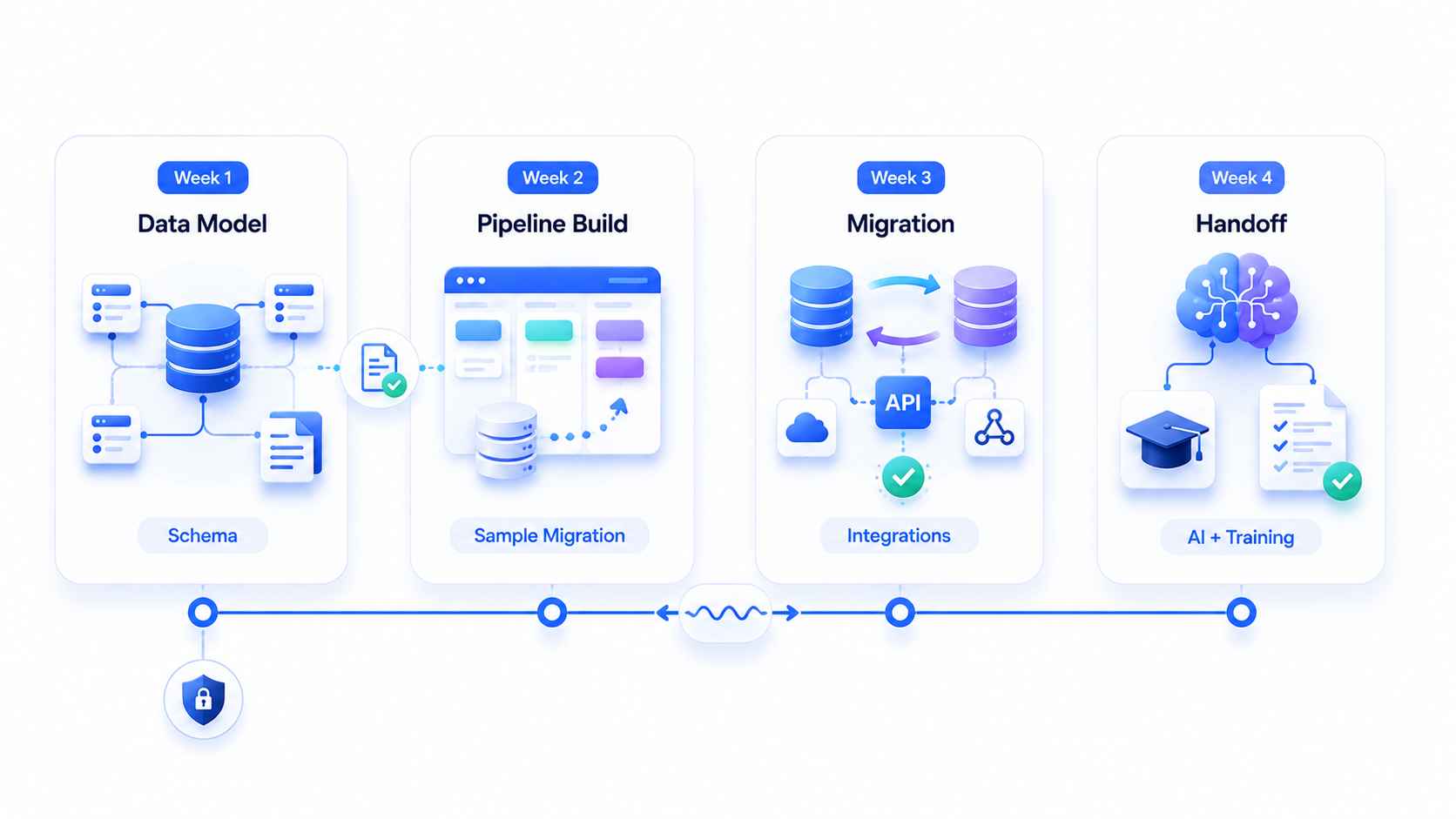
Mid-market Attio implementations run two to six weeks depending on migration weight and integration count. The data model session is the critical path. Everything downstream builds on it, and revisiting it after records land costs triple.
A typical four-week shape. Week one: model and schema document. Week two: pipeline build and sample migration. Week three: full migration and integrations. Week four: AI configuration, training, runbook. Heavier migrations stretch the middle. The ends stay fixed.
One scheduling rule protects everyone. Schema changes after week one go through a change request. Not because change is bad. Because silent scope drift is how four weeks becomes nine.
The engagement shape we recommend, from anyone you hire: fixed fee against named deliverables, a refundable discovery up front, and the runbook in the contract. Hourly billing pays consultants to think slowly, and modeling work is exactly where slow thinking bills longest.
Red flags when hiring for Attio
The implementer starts configuring before modeling. If workspace setup begins in week one with no schema document, the flexibility is about to be wasted.
The proposal ports your old CRM one to one. Your HubSpot properties or Salesforce objects were shaped by those platforms' limits. Rebuilding the limits inside Attio is paying twice for the same ceiling.
No AI usage plan. Attio meters AI by workspace credits, and heavy automation drains allocations faster than teams expect. An implementer with no credit budget has not run this in production.
No directory listing. The public directory exists so buyers can verify. Unverifiable expertise in a two-dozen-firm ecosystem is a choice.
One more test. Ask the implementer to explain objects, attributes, records, and lists in plain language. Anyone fluent in the four primitives has built here. Anyone reciting legacy CRM vocabulary has not.
Hourly with no cap, and no runbook in scope. Both mean the dependency is the product.
The honest DIY case
Some teams should not hire anyone, including us. Attio's free tier is genuinely usable, the templates cover standard motions, and the product's setup experience is the best in the category.
Self-serve confidently when the team is small, the motion is one pipeline with standard objects, there is no migration history worth preserving, and a technically minded founder owns the build. Start from a template, resist creating custom objects until a real limit appears, and write down stage exit criteria even if nobody makes you.
Know your graduation triggers too. A second pipeline appears. A custom object becomes unavoidable. An integration starts carrying revenue data. Any one of those is the moment to get help. Waiting past all three costs a rebuild.
Bring in a partner when custom objects enter, when migration history matters, when integrations carry revenue data, or when AI configuration needs governance. The line is complexity, not company size. Our full platform evaluation sits in the Attio Expert Partner assessment, and the category context in our Attio vs Clarify field guide.
How ACS runs Attio implementations
Fixed fee. Refundable discovery first: we map your motion, draft the data model, and scope the build in writing. The discovery ships three things. A draft schema. A ranked bottleneck list. A recommended scope with named deliverables. If Attio is the wrong platform for you, the discovery says so, and the comparison pages show our reasoning in public: Attio vs HubSpot, Attio vs Salesforce, and Attio vs Pipedrive.
Then the six workstreams above, in order, with the runbook and role-based training at the end. The proof: 500+ workflows shipped, more than 10,000 hours reclaimed, over $2 million in client savings across seven industries. Platform detail on the Attio page, the verifiable credential on the partners page, engagement structure on pricing, and shipped work in the case studies.
Frequently asked questions
What is an Attio Expert Partner?
A firm verified by Attio through its merit-based partner program, based on demonstrated customer implementation work, and listed in the public directory. Tiers run Core, Advanced, and Elite. Roughly two dozen firms hold the credential globally.
Is there an Attio certification course or exam?
No individual exam exists. Attio verifies firms on shipped implementations rather than certifying people on test scores. If you are evaluating an implementer, check the public directory listing and ask for referenceable builds behind it.
How long does an Attio implementation take?
Two to six weeks for most mid-market builds. The data model design session sets the critical path, migration weight and integration count set the rest. Attio moves faster than legacy CRM projects because configuration replaces customization code.
What does an Attio implementation cost?
Cost follows the model complexity, migration weight, and integration count, not the seat count. We price it as a fixed-fee project after a refundable discovery, with deliverables named in the scope. Structure is on the pricing page.
Can we implement Attio ourselves?
Often, yes. Small teams with one standard pipeline, no migration history, and a technical owner can self-serve on templates. Hire when custom objects, revenue-bearing integrations, or AI governance enter the build. Complexity, not company size, draws the line.
How do I verify an Attio partner?
Check Attio's public partner directory for the listing and tier. Then go past the badge: ask for the data model documents and runbooks from past builds. Verified plus referenceable is the standard.
Does ACS migrate from HubSpot or Salesforce to Attio?
Yes, both, plus Pipedrive and spreadsheets. The method is prune, map, sample, validate, cut over, with associations and owners preserved by plan. The loss list goes in writing at discovery so nothing surprises anyone at cutover.
Do Attio Expert Partners resell Attio licenses?
No reseller margin sits in the program. You buy Attio from Attio. Partners bill for implementation work only, which keeps the platform recommendation clean. Compare that with programs where the partner earns on every seat you add.
What is the Attio partner program?
Attio's channel for verified implementation firms: merit-based entry, a public directory, and tiers from Core to Elite. It certifies delivered work rather than license sales, which keeps partner advice free of reseller commission.
Implementing Attio?
Three ways to start.
Book a paid discovery. We map your motion, draft the data model, and scope the build. Refundable if Attio is the wrong call. See pricing.
Read the platform assessment. The Attio Expert Partner review covers the product end to end.
Verify us first. The partners page links the directory listing. Check the credential, then check the work.
Model first. Build second. Hand off always.