
We build operations infrastructure with engineering discipline for $10M-$50M operators. We are a Zapier Certified Solutions Partner and an Attio Expert Partner. Financial services firms sit inside our operator focus: advisories, brokerages, lending shops, accounting practices, and the businesses built around them.
These firms share one shape. Client relationships carry the revenue. Paperwork carries the hours. Software multiplied faster than process matured. That shape is exactly what firm-scale automation fixes.
One thing this guide is not: bank transformation advice. That market exists, it is real, and it is not ours. The sorting comes first, because most searchers here are shopping in the wrong aisle.
What is automation consulting for financial services?
Automation consulting for financial services replaces manual work inside financial businesses with systems that run on their own: client intake, document chasing, meeting notes, approvals, reporting, and the data movement between tools. The consultant maps the workflows, builds the automations, wires the error handling, and hands the system off documented.
The outcome is measurable on three lines. Hours reclaimed per week. Response times cut to minutes. And a record trail that answers questions before anyone asks them.
The definition covers two very different buyers, though. A regional bank automating loan origination on core banking systems is one project type. A fifty-person advisory firm automating client onboarding across a CRM, an e-signature tool, and a planning platform is another. Same words. Different scale, different tools, different consultants.
Almost everything published under this topic targets the first buyer. The second buyer, the firm, gets bank-scale advice that fits nothing they run. So let us sort the market properly, because the sort saves you a wasted quarter and a five-figure discovery invoice.
Banks vs firms: which market are you shopping in?
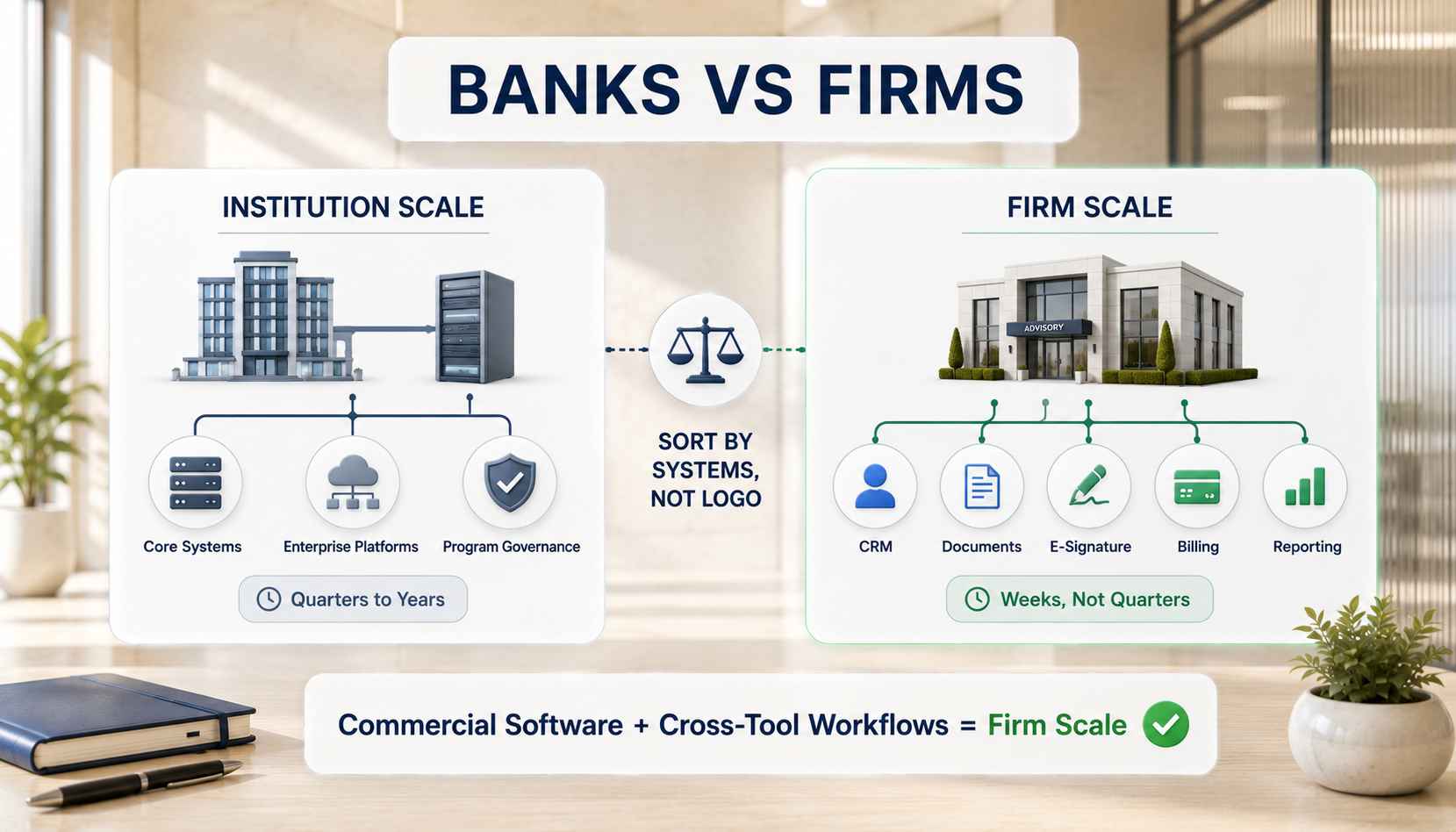
Institution-scale automation serves banks, credit unions, and insurers. The work runs on enterprise platforms: robotic process automation, intelligent document processing, core-system integration. The buyers are transformation offices.
The engagements run quarters to years, with governance programs attached. If your project touches core banking systems or regulated decision models, you belong in that market, and the large integrators and enterprise practices serve it well. This guide will not pretend to.
Firm-scale automation serves the financial services operator: the RIA, the insurance brokerage, the mortgage shop, the CPA practice, the fund administrator, the family office. Add the adjacent businesses too. Bookkeeping firms. Insurance MGAs. Lending brokers. Payroll and benefits shops.
The systems are commercial software: a CRM, a document tool, e-signature, billing, a planning or portfolio platform. The work is workflow engineering across those tools. Weeks, not quarters. Fixed fee, not program budgets.
The test is simple. Count your core systems and your headcount. Under a few hundred people, running commercial software, with workflows crossing five to ten tools: you are a firm. You are not a bank. Stop shopping like one, because bank-scale engagements will quote you bank-scale numbers for firm-scale problems.
The quotes themselves tell you which aisle you wandered into. Program language, phased roadmaps, and discovery measured in months: institution market. A workflow map, a fixed price, and a ship date: firm market. Match the quote shape to your problem shape.
What a financial services firm should automate first
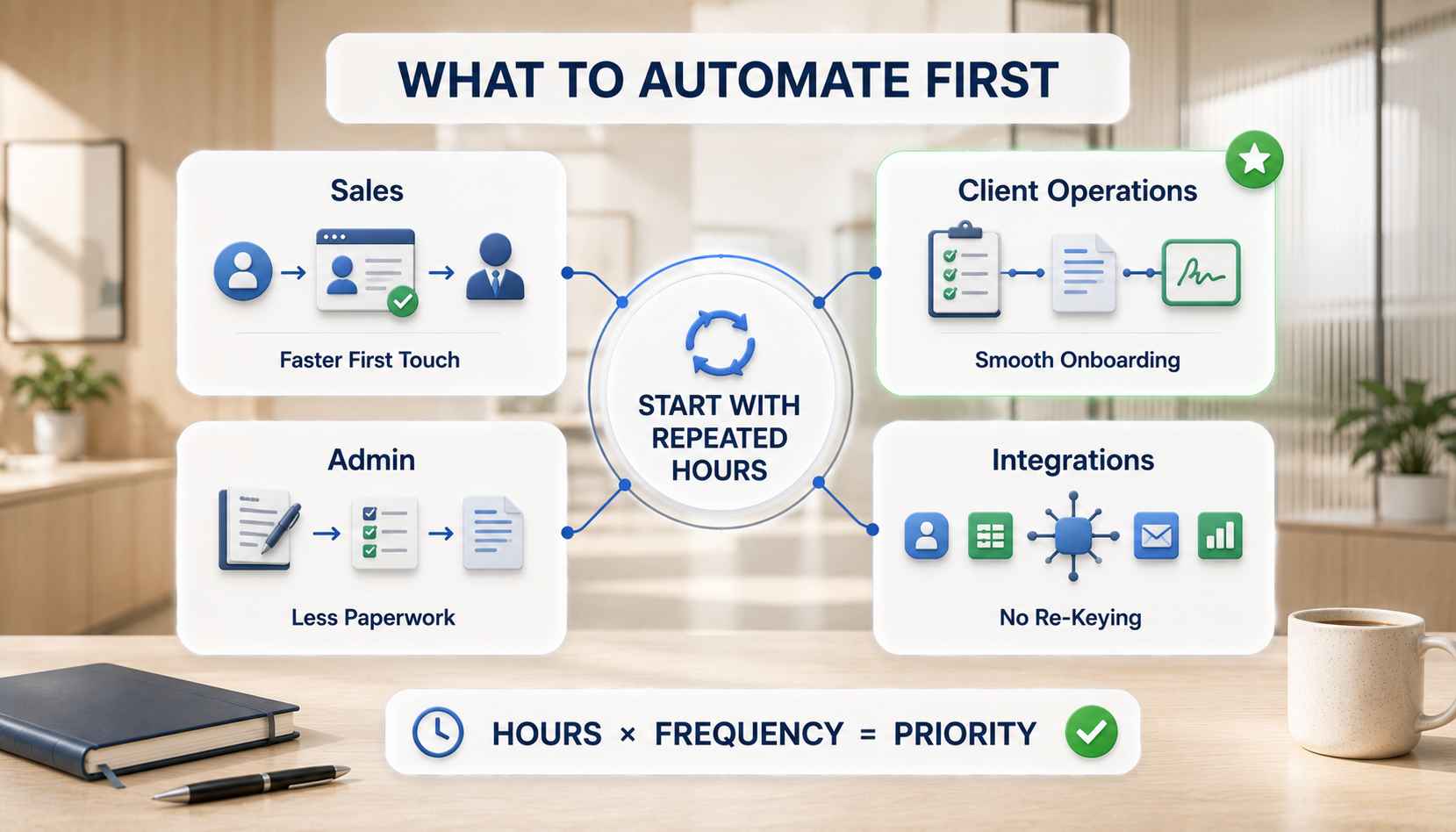
Firm-scale automation runs across four surfaces. Here is what each one holds in a financial business.
One rule sets the order. Rank every candidate by hours consumed times weekly frequency. Daily pain beats monthly pain. High volume beats high drama. The ranking makes the roadmap honest before any tool gets named.
Sales automation for advisories and brokerages
Referral and lead intake routed to the right advisor within minutes, not days. Prospect records enriched automatically before the first call. Proposal and quote generation from templates and rules instead of copy-paste. Follow-up sequences that fire on schedule with clean handoffs.
Referral partners deserve their own workflow. Track who sends what. Thank them automatically. Report the closed business back. Referral sources that feel seen keep sending. That loop runs itself once built.
Speed to first touch decides more revenue in referral-driven businesses than any other operational number. Measure it in minutes. The build lives in our sales automation practice.
Operations automation for the client lifecycle
Client onboarding is the classic. Agreement out for signature, accounts opened, checklist assigned, welcome sequence fired, and the CRM stage updated, all from one trigger. Then the recurring spine: renewal reminders, document collection chases, periodic review scheduling, and the monthly reporting pack that currently eats someone's Friday.
Document chasing deserves its own sentence. Firms burn astonishing hours requesting, tracking, and filing client paperwork. A chase workflow with automatic reminders and status visibility recovers most of them. This is operations automation territory.
The checklist trail carries a quiet bonus. Every completed onboarding step logs itself with a timestamp. When anyone asks what happened on an account, the answer already exists. And busy seasons stop breaking the process, because the workflow does not get tired in March or December.
Admin workflows for the paperwork layer
Meeting capture that turns client conversations into CRM notes and task lists automatically. Engagement letters, SOWs, and standard documents generated from templates. Exception approvals routed with visibility instead of living in inboxes. Executive rollups that assemble themselves from live data.
Meeting capture pulls double duty here. The notes serve the advisor today. The record serves the file forever. Complete, consistent notes on every client conversation is a standard most firms want and few sustain by hand.
A rollup example makes it concrete. Monday morning, one document arrives. New clients this week. Onboarding in flight. Revenue against plan. Nobody built it. It built itself overnight.
The pattern across all four: the paperwork layer is where financial firms hide their largest reclaimable hours. Details on the admin workflows page.
Integration builds for the stack
CRM to planning platform. E-signature to document storage. Billing to the books. Every seam between tools is a place someone currently re-keys data, and every re-key is an error waiting for a client to find it.
Reconciliation shows the stakes. Fees billed against fees collected, checked automatically, exceptions flagged to a human. The manual version happens quarterly and finds problems late. The automated version happens nightly and finds them small.
Unified dashboards ride on the same work: one screen showing pipeline, onboarding status, and revenue, pulled live from the systems that own each number. Every sync carries an error alert with a named owner. The connective work runs through integration builds.
The compliance-aware engineering layer
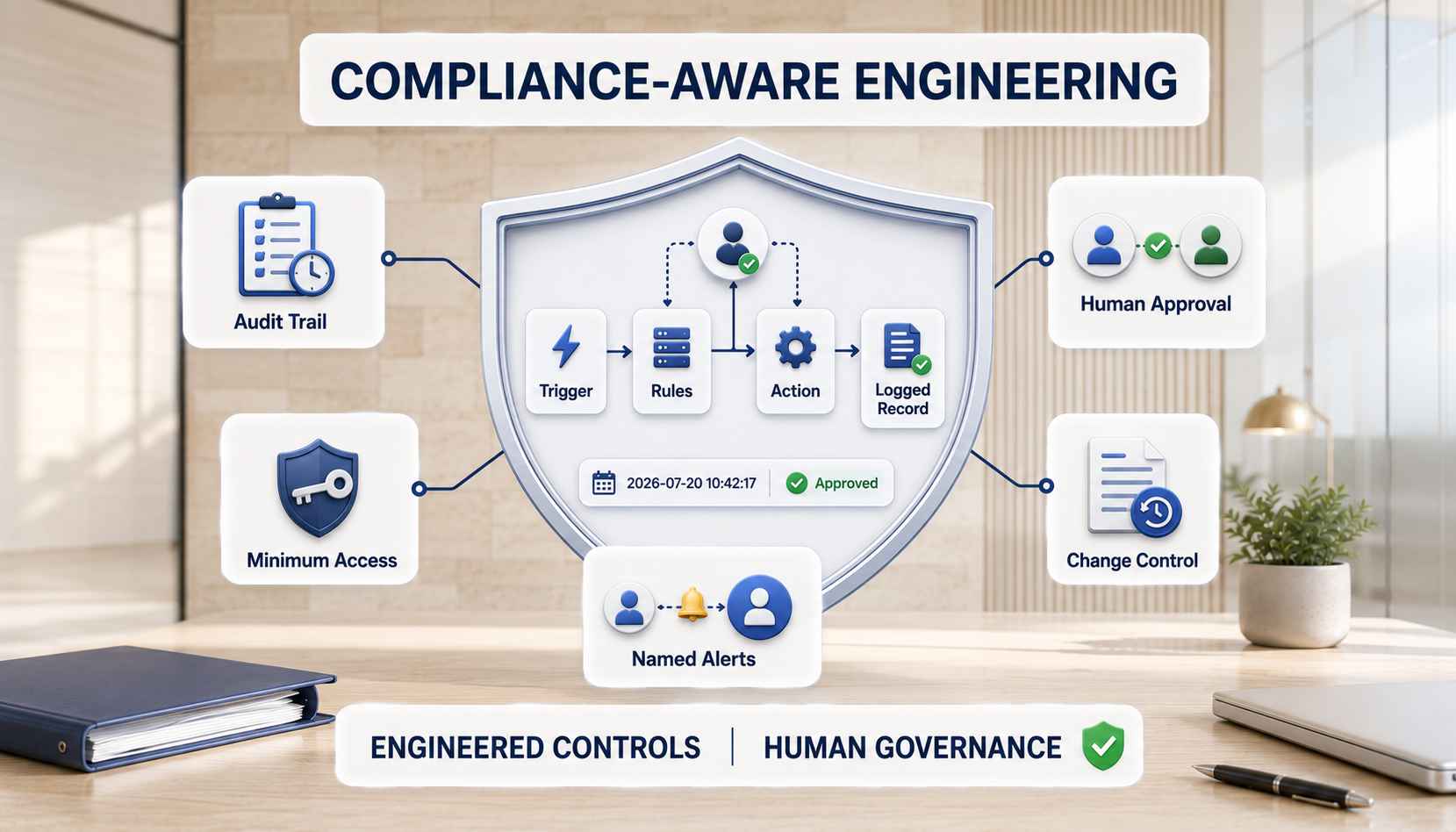
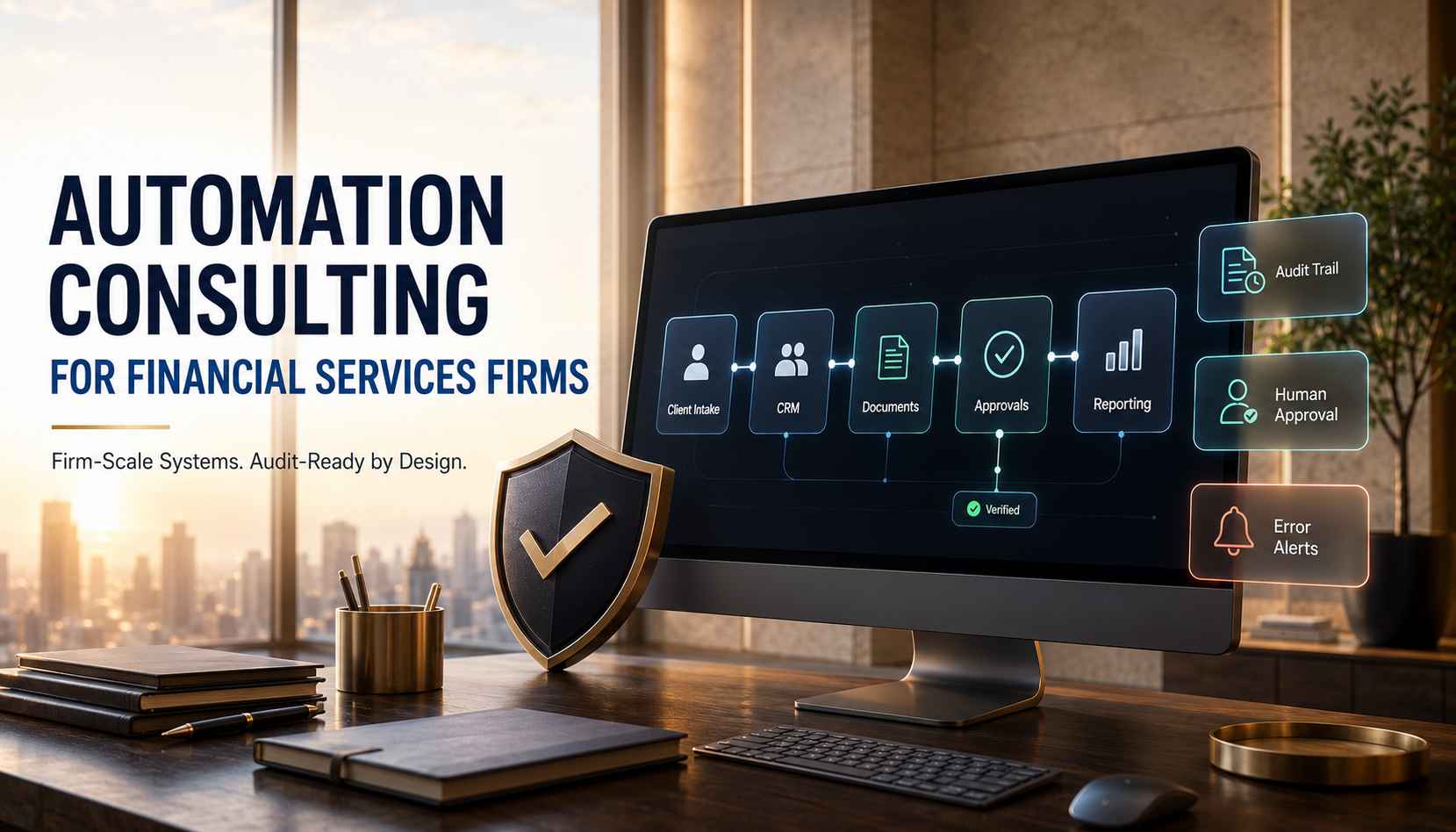
Financial businesses carry obligations most industries do not, so the engineering posture changes. Four defaults apply to every build we ship in this vertical.
Audit trails by design. Every automated action logs what ran, when, on which record, and why. Trigger-based automation is auditable automation, and auditability is the requirement underneath every other requirement in this industry.
Human-in-the-loop where judgment or regulation demands it. Automation prepares the work. A named person approves the regulated step. The system enforces that order instead of trusting memory to.
Access discipline. Workflows touch the minimum data they need, credentials stay scoped, and client information never routes through tools your firm has not approved. The approved-tools list comes from you, in writing, at discovery. Anything outside it stays outside the build.
Alerting with a named owner. A silent failure in a client-facing workflow is a compliance conversation waiting to happen. Every workflow alerts a human on failure, always.
Change control closes the set. Workflow edits get logged, versioned, and attributable. Who changed what, and when. Systems that touch client money and client records earn the same discipline as the code behind them.
And one boundary, stated plainly. We are engineers, not compliance advisors. We build the system with the controls above. Your compliance function reviews and governs the design. That division of labor is how it should work, and any consultant blurring it should worry you.
How is automation used in finance?
Across the whole industry, automation handles the repetitive and the rules-based. Institutions apply it to transaction monitoring, document processing, and reporting pipelines at massive volume. Firms apply it to intake, onboarding, document chasing, meeting notes, approvals, and the reporting layer.
A ladder makes it concrete. One workflow: leads routed in minutes. One process: onboarding start to finish. One function: the whole operations spine automated with a dashboard on top. Firms climb the ladder one proven rung at a time. Institutions buy the whole ladder as a program.
The mechanics rhyme at every scale: a trigger, a set of rules, actions across systems, and an audit trail. What changes is the platform class and the governance weight. The sections above cover the firm-scale version in full, and the operator overview covers the general practice behind it.
When the enterprise stack is the right answer
Fair witness cuts both ways. Some readers genuinely belong in the institution market.
Choose enterprise-scale automation when the workflow touches core banking or policy administration systems. When regulated decision models need formal governance and validation. When volume runs to millions of transactions. When your organization has a transformation office and the program budget to match.
That work needs the large practices and the enterprise platforms built for it, and pretending otherwise would waste your quarter. Firms feeling squeezed between the two markets usually are not. They are firms with one unusually heavy workflow, and the heavy workflow gets engineered accordingly, inside a firm-scale engagement.
The hybrid exists too. A department inside an institution, running commercial tools for its own workflows, buys firm-scale work legitimately. The sorting follows the systems touched, not the logo on the building.
How ACS works with financial services firms
Fixed fee, after a paid and refundable discovery. The discovery maps your client lifecycle, ranks the bottlenecks by reclaimable hours, and scopes the build in writing. If the fit is wrong, the fee comes back.
Every build ships with the compliance-aware defaults above, plus the anti-dependency standards we publish openly: accounts in your name, a runbook your team owns, training to a named owner, and final payment tied to the handoff. The defaults above were not invented for this page.
They came from shipping in industries where records matter and errors get found. The full hiring standard sits in our dependency-free hiring guide, and the market's cost models in the pricing breakdown.
The practice behind it: 500+ workflows shipped, more than 10,000 hours reclaimed, over $2 million in client savings across seven industries. The engagement structure is on pricing, credentials on the partners page, and shipped systems in the case studies.
Run the firm math once and the decision usually makes itself. A ten-person operations team losing two hours each per week to document chasing burns a thousand hours a year. One workflow closes most of that. The build costs once. The leak billed forever.
Frequently asked questions
What does an automation consultant do for a financial services firm?
Maps the client lifecycle, finds the manual seams, builds the workflows across your existing tools, and hands off a documented system with audit trails and alerts. The full role breakdown sits in our definitional guide.
How much does financial services automation consulting cost?
Firm-scale projects price on scope drivers: system count, workflow complexity, data quality, and handoff depth. Fixed fee protects the buyer on defined work. Market rates and every pricing model sit in the automation consulting cost guide.
Is it safe to automate workflows that touch client data?
With the right defaults, yes. Minimum-access credentials, approved tools only, audit logs on every action, and human approval on regulated steps. The design gets reviewed by your compliance function before launch. Safety is an engineering choice, made early. The riskier path is the manual one, where errors leave no log at all.
What are the best AI tools for financial services?
Judge categories, not brands. For firms: a CRM with trigger-based AI, middleware with error handling, document generation, and meeting capture. The governance test beats any feature list: can you audit what the AI did and why? Tools that fail that test fail the industry. Run the test before the demo, and half the vendor list excuses itself.
What is a finance automation consultant?
A consultant who automates workflows inside financial businesses: intake, onboarding, documents, approvals, reporting, and the integrations between systems. Firm-scale versions work on commercial software. Institution-scale versions work on enterprise platforms. Same title, two markets. Sort first, hire second.
What should a financial firm automate first?
Client onboarding or document chasing, almost always. Both are high-volume, rules-based, and painful, which makes payback fast and visible. One workflow, fixed fee, measured for thirty days. Expand from evidence, not enthusiasm. The second workflow always scopes easier than the first.
Do we need enterprise RPA?
Count your core systems. Firms running commercial software rarely do. Enterprise robotic process automation earns its weight on legacy core systems at institutional volume. Firm workflows run better on modern middleware and clean API integrations at a fraction of the cost.
Does this apply to banks and credit unions?
The principles, yes. The engagement, usually no. Core-system automation belongs with enterprise integrators and the governance programs around them. This guide, and our practice, serve the financial services firm running commercial software.
Can automation help with compliance itself?
It supports compliance without replacing it. Audit trails, enforced approval orders, and complete logs make reviews faster and findings rarer. Compliance judgment stays human. The system's job is making the judgment easy to apply and easy to prove.
Running a financial services firm on manual workflows?
Three ways to move.
Book a paid discovery. Client lifecycle mapped, bottlenecks ranked by reclaimable hours, one fixed price. Refundable if we are the wrong fit. See pricing.
Start with the standard. The hiring guide shows the ownership terms to demand from us or anyone.
Review the proof. The case studies show the engineering discipline across seven industries.
Firm-scale problems deserve firm-scale engineering. Priced like a project, shipped in weeks, documented fully, and owned by you from day one.