
We build operations infrastructure with engineering discipline for $10M-$50M operators. We are a Zapier Certified Solutions Partner and an Attio Expert Partner, and we sell exactly the service this guide teaches you to buy carefully.
That is the point. The cheapest consultant is the one who makes themselves unnecessary, and we would rather win clients on that standard than on lock-in. So here is the full playbook: what dependency actually is, how to vet for it, and the contract terms that keep you free.
How do you hire an automation consultant?
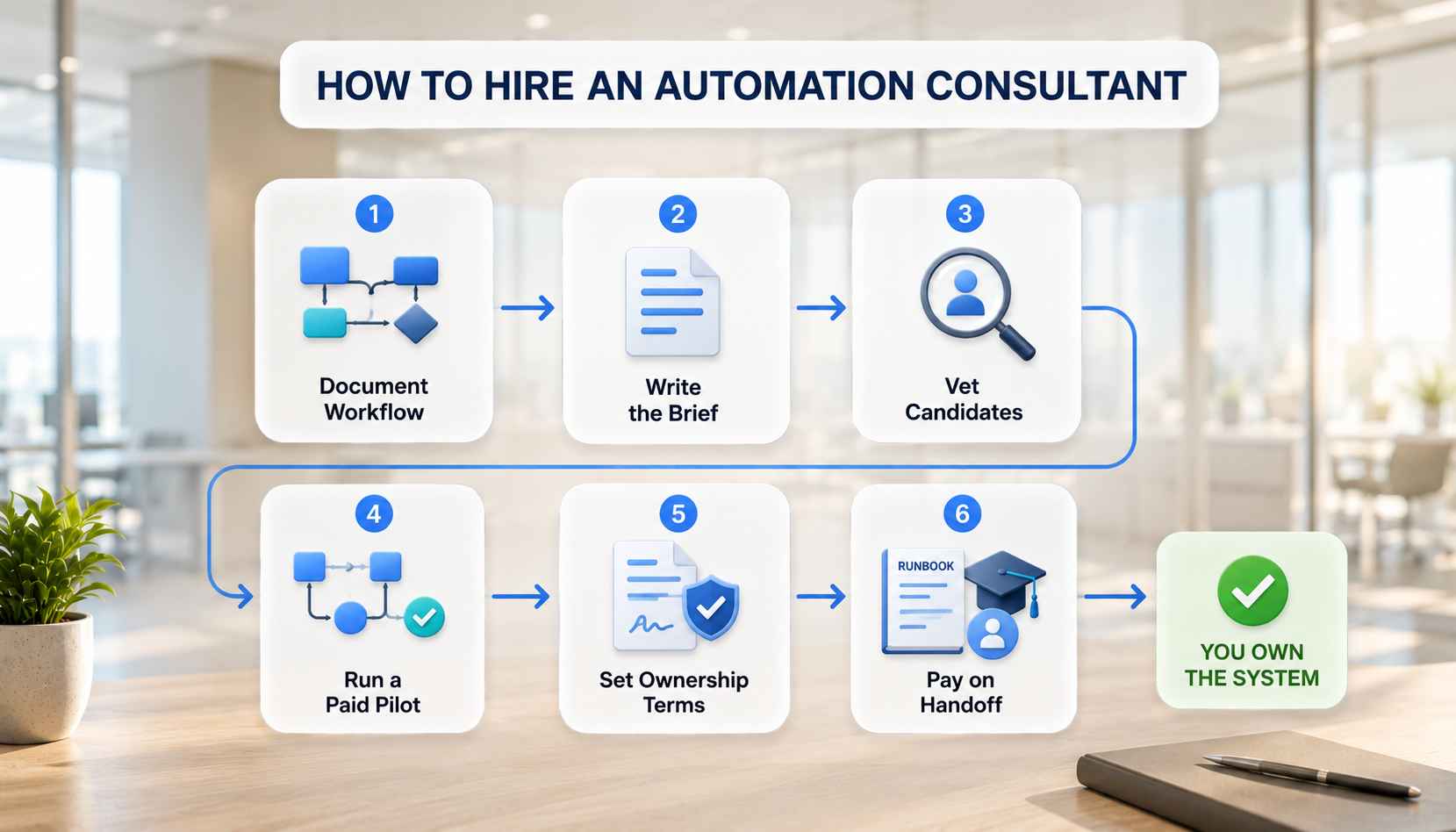
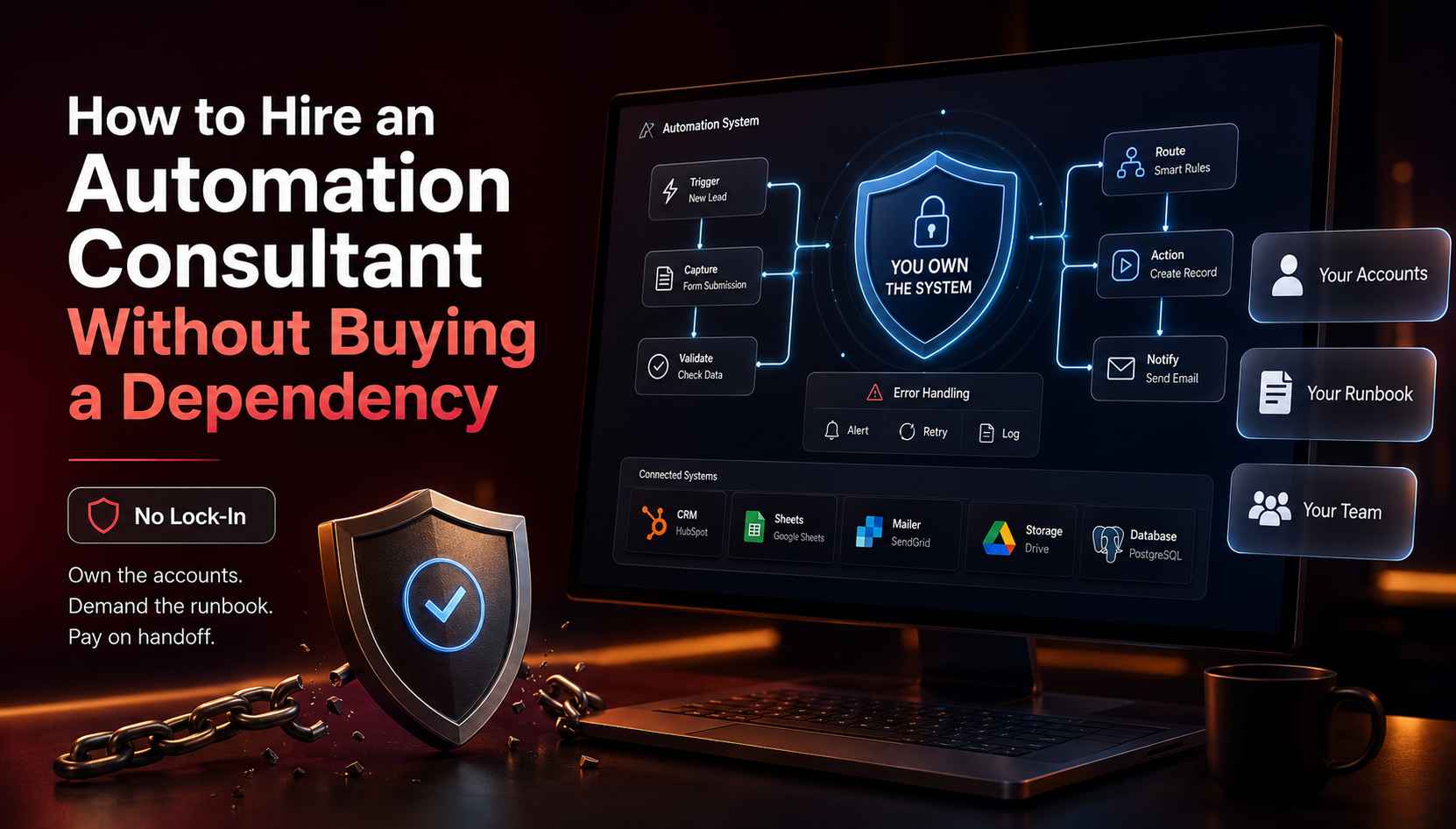
Hire in six moves. Document the workflow first. Write a one-page brief. Vet candidates on process thinking, not tool talk. Run a small paid pilot. Sign a fixed-fee contract with ownership terms in writing. Tie the final payment to the handoff, not the launch.
Each move exists to prevent one failure. Skipping the brief buys you mismatched proposals. Skipping the pilot buys you a mishire at full price. Skipping the contract terms buys you the dependency this guide is named after.
The whole sequence fits inside a month. A week for the brief and outreach. A week for vetting. Two to four weeks for the pilot. Then a clean decision with real evidence behind it.
The rest of this post walks each move. But first, the thing you are actually protecting against, defined precisely.
What a dependency actually is: the five lock-in vectors
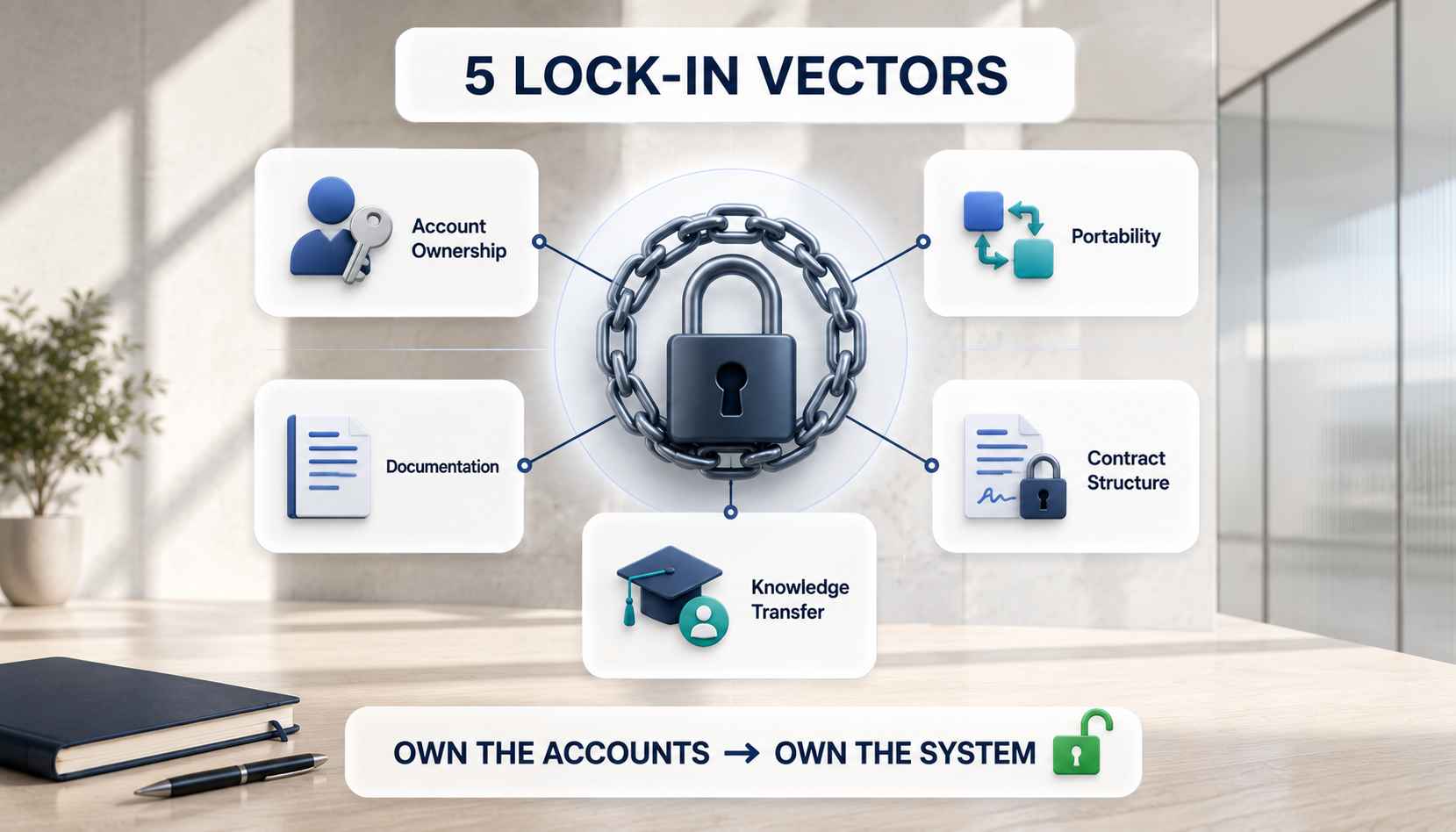
A dependency is any arrangement where leaving your consultant costs more than keeping them, regardless of performance. It hides in five places. Audit all five before any engagement. Every vector is invisible while the relationship is good, and every one gets priced the day it turns.
Account ownership. Who owns the logins? The workspaces, the connections, the API keys? If any automation lives in the consultant's accounts, your revenue infrastructure has a landlord.
Every account stays in your name, with the consultant invited in as a member. The subscriptions bill your card too. Tool payments routed through the consultant are one more thread to cut later.
Documentation. Where does the knowledge live? A runbook your team can follow, or one person's head? Undocumented systems make their builder permanent. The runbook is the single strongest anti-dependency asset in the entire engagement.
Portability. Can another competent builder take over tomorrow? Standard platforms help here, and so does clean custom code in your repository. The popular advice says avoid custom scripts. That advice misses the real mechanism.
Custom code is not the lock-in. Undocumented anything is. A commented script in your repo with a readme beats an undocumented no-code workflow in someone else's account, every time.
Contract structure. What do the papers say about IP, exit, and billing? Uncapped hourly, vague deliverables, and long lock-ins each convert a service into a subscription you cannot cancel.
Knowledge transfer. Did anyone on your team learn the system? Training is the transfer of power. A consultant who never trains anyone keeps the power by default. Schedule the training on the contract date, not on good intentions, or it slips forever.
Five vectors. Five negotiations. All winnable before signing, and nearly impossible to win after.
Before you contact anyone: write the one-page brief
Process first, vendors second. Document one workflow before any outreach: the trigger, the current manual steps, the tools involved, the people, the weekly volume, and the outcome you want with a number on it.
The number matters most. "We want faster lead follow-up" invites vague proposals. "Leads reach a rep within five minutes, measured for thirty days" invites honest scoping. Specific briefs filter for serious consultants automatically, because tool sellers avoid measurable targets.
Include the weekly volume too. Fifty runs a week and five thousand runs a week are different builds with different price tags. Volume decides the tooling, the error design, and half the quote.
One page is enough. If you cannot fill the page, the process is not ready for automation, and the right first hire might be nobody. Our guide on what an automation consultant does covers the stabilize-first rule in depth.
Where to find an automation implementation partner
Three channel types exist, and the vetting method below works on all of them.
Freelance marketplaces list individual builders at every skill level. Fast to start, heavy to screen, and quality varies by the listing. Verified partner directories list firms that a platform vendor has checked against real implementation work. The verification does part of your screening for you. Referrals from operators you trust carry the most signal per minute.
The channel matters less than one habit: verify the credential wherever you find the person. Certified claims should resolve to a public directory listing in thirty seconds. Ours resolve on the partners page, and any automation implementation partner worth hiring can show you the same.
When a referral comes in, ask the referrer one question. What was the handoff like? The answer separates a good build from a good engagement. Plenty of consultants build well and hand off nothing.
The vetting questions that expose dependency
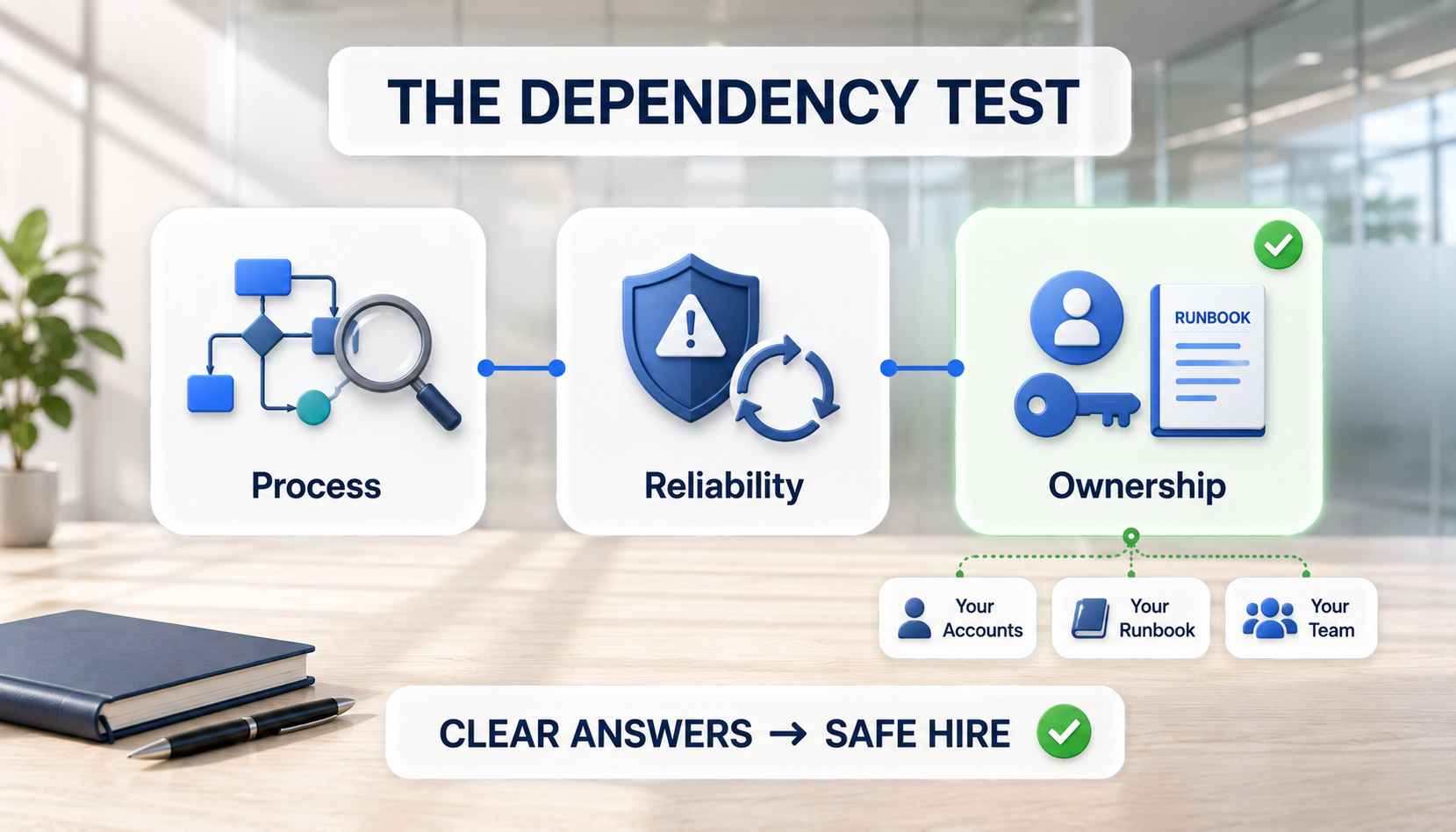
Interview for judgment, then for ownership. Three groups of questions do the work.
Process questions. How would you decide what not to automate here? What would you need before building anything? Walk me through a build that went wrong and what changed after. Practitioners answer with specifics. Tool operators answer with reassurance.
Reliability questions. What happens when this workflow fails on a Friday night? How do you handle rate limits and failed runs? Where do the error alerts go? Silence on failure design predicts silent failures in production.
Ownership questions. Whose accounts hold the builds? What does your runbook contain, and can I see one from a past project? Who on my team will be able to change this after you leave? These three questions are the Dependency Test. Any hesitation on any of them is your answer.
Run a paid pilot the right way
Before a large engagement, buy a small one. One real workflow, low stakes, your actual data, fixed price, two to four weeks.
Good pilot shapes: a lead router, an automated weekly report, or a single two-system connection. Small enough to finish, real enough to judge. Connection work makes an especially honest pilot, because error handling shows immediately. That category runs through our integration builds practice daily.
Judge the pilot on more than the build. Did the workflow ship with error handling? Did documentation arrive without being chased? Did your team get a walkthrough? Can someone internal pause or edit the automation today? A pilot that works but arrives naked told you exactly how the big engagement would end.
Pay for the pilot. Free work attracts volume players and creates soft obligations on both sides. A paid pilot is a clean transaction that either side can walk away from with the information they came for.
Contract terms that keep you free
Five clauses do most of the protection. None are exotic.
Fixed fee against named deliverables, because hourly billing pays consultants to think slowly, and uncapped hourly on defined work protects nobody. All accounts, workspaces, and code repositories in your name from day one.
The runbook and training listed as deliverables with acceptance criteria, not mentioned as intentions. Final payment tied to the handoff milestone, not the go-live date. And a clean exit clause: thirty days, with a current-state handoff document.
Read the change-request process too. New scope should get a new price with your signature. That clause protects both sides, and its absence is how fixed fees quietly become open meters. Add one more line while the lawyer is there: all work product transfers to you on payment.
Six words that end most ownership disputes before they start. Our own structure follows every clause above, published on the pricing page, with the market's cost models broken down in the pricing guide.
The handoff standard: what "done" must contain
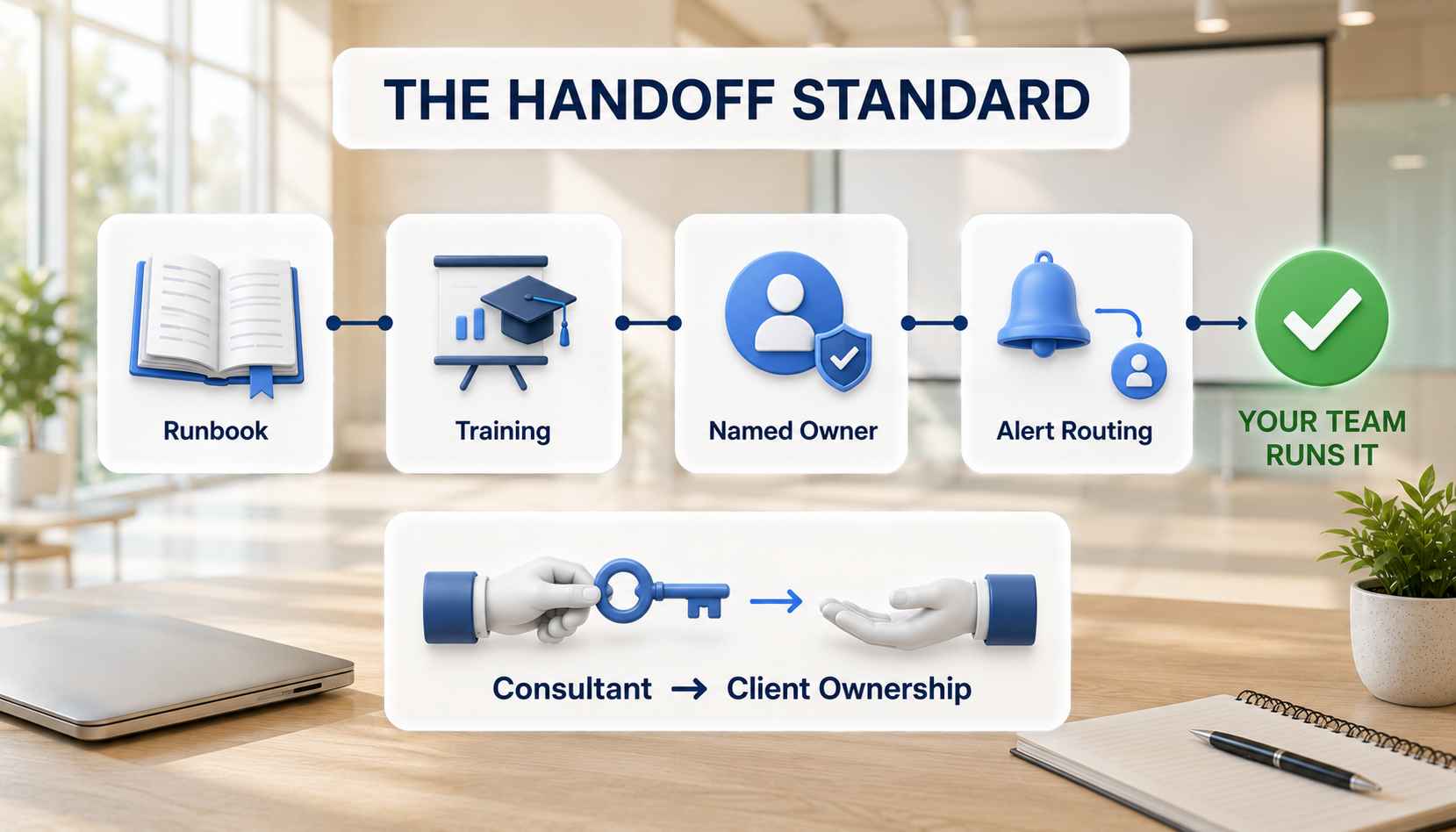
Most automation projects fail at handoff, not at build. So define the handoff before the build starts.
The runbook contains four things. What each workflow does and why it exists. How to pause, edit, and restart it safely. Where the error alerts go and what each alert means. And the map of every connection between systems, because the seams are where the breaks happen.
Training goes to a named owner on your team, live, with a recording kept. The alert routing points at that owner, not at the consultant. And a thirty-day support window covers what real usage finds. After that window, your team runs the system, and the consultant becomes optional. Optional is the goal.
Add one rehearsal to the training session. The owner performs a real edit live, with the consultant watching instead of driving. Ten minutes. It proves the transfer happened, or reveals that it did not, while the fix is still free.
Red flags that predict a dependency
The consultant builds in their own accounts and calls it standard practice. The proposal names tools before asking about your process. Documentation appears nowhere in the scope, or appears as "available on request." The billing is hourly with no cap and no estimate range. The pitch leans on proprietary systems only they can maintain.
One more, softer flag. Every question you ask about ownership gets answered with trust language instead of terms. Trust is earned by contracts that make trust unnecessary. The consultants most worth trusting are the ones who volunteer the ownership terms before you ask.
Demos are a flag of their own. A portfolio of demos with no production references means nothing has survived contact with real volume. Ask for one system still running a year later, and who runs it now.
Our platform-specific version of this list lives in the Zapier experts hiring guide, where the workspace ownership rule first appeared. It generalizes to every tool.
How ACS structures engagements
Everything above is our default, not our upsell. Fixed fee after a paid, refundable discovery. Accounts in your name. Runbook and role-based training in every scope. Error alerts routed to your named owner. Final milestone is the handoff. Exit terms in plain language.
The discovery itself ships three artifacts before any commitment. A workflow map. A ranked bottleneck list. A scoped recommendation with one price. You keep all three even if you hire someone else, which is the point. Deliverables you own are the anti-dependency model working from minute one.
The proof that the model works: 500+ workflows shipped, more than 10,000 hours reclaimed, over $2 million in client savings across seven industries, with the systems now run by the teams that own them. The builds sit in the case studies, the verifiable credentials on the partners page, and the broader case for the hire in the operators guide.
Frequently asked questions
How do you hire a consultant for automation work?
Document one workflow, write a one-page brief with a measurable outcome, vet candidates on process and ownership questions, run a small paid pilot, then sign fixed fee with the handoff as the final milestone. The sequence prevents the mishire and the lock-in both.
What does an automation consultant do?
Maps workflows, judges what deserves automation, designs and builds the systems, and hands them off documented. The full role breakdown, including the five responsibilities and the four service surfaces, lives in our definitional guide.
How much does hiring an automation consultant cost?
Cost follows scope, and the pricing model matters more than the rate. Fixed fee protects buyers on defined work. Market rates, retainer structures, and the full model comparison sit in the automation consulting cost guide.
Is there a free automation platform to start with?
Free tiers exist on major middleware and CRM platforms, and they are genuinely usable for simple workflows. The platform was never the real cost. The design, the error handling, and the ownership are. Free tools with no owner still fail silently.
Should I hire a freelancer, an agency, or a certified partner?
Judge the method, not the org chart. A freelancer, a business automation consultancy, and a certified implementation partner all pass or fail the same Dependency Test: accounts, runbook, training. Verified credentials shorten the screening. The questions finish it.
Is hiring from a marketplace safe?
Safe when the vetting is yours. Marketplaces screen for activity, not for handoff discipline. Apply the ownership questions, run the paid pilot, and keep the accounts in your name. The platform hosting the profile changes nothing about the method.
What should the runbook contain?
Four sections. Purpose and logic of each workflow. Safe procedures to pause, edit, and restart. Alert meanings and routing. A connection map across systems. If a stranger could operate the estate from the document, the runbook passes.
What is vendor lock-in in automation consulting?
Any arrangement where leaving costs more than staying, regardless of performance. It forms through consultant-owned accounts, missing documentation, untrained teams, and contracts without exit terms. Lock-in is preventable at signing and expensive at renewal. The five vectors above are the audit.
How do I become an automation consultant?
Different intent, honest answer. Learn process design before tools, build documented systems, and collect referenceable outcomes. The buyers reading this guide will test you on exactly the standards above. Meet them and the market is large.
What makes a consultant an automation implementation partner?
Implementation partners own outcomes end to end: mapping, build, integration, and handoff, often with vendor-verified credentials behind the title. The title matters less than the verification. Check the directory listing, then check the runbook. Both, always.
Ready to hire without the lock-in?
Three ways to move.
Book a paid discovery. Workflow map, ranked bottlenecks, one fixed price, ownership terms in writing. Refundable if we are the wrong fit. See pricing.
Run the Dependency Test on us. Ask the three ownership questions. The partners page answers the credential one before you ask.
Review the proof. The case studies show systems now owned and run by the teams that bought them.
Own the accounts. Demand the runbook. Pay on handoff.