

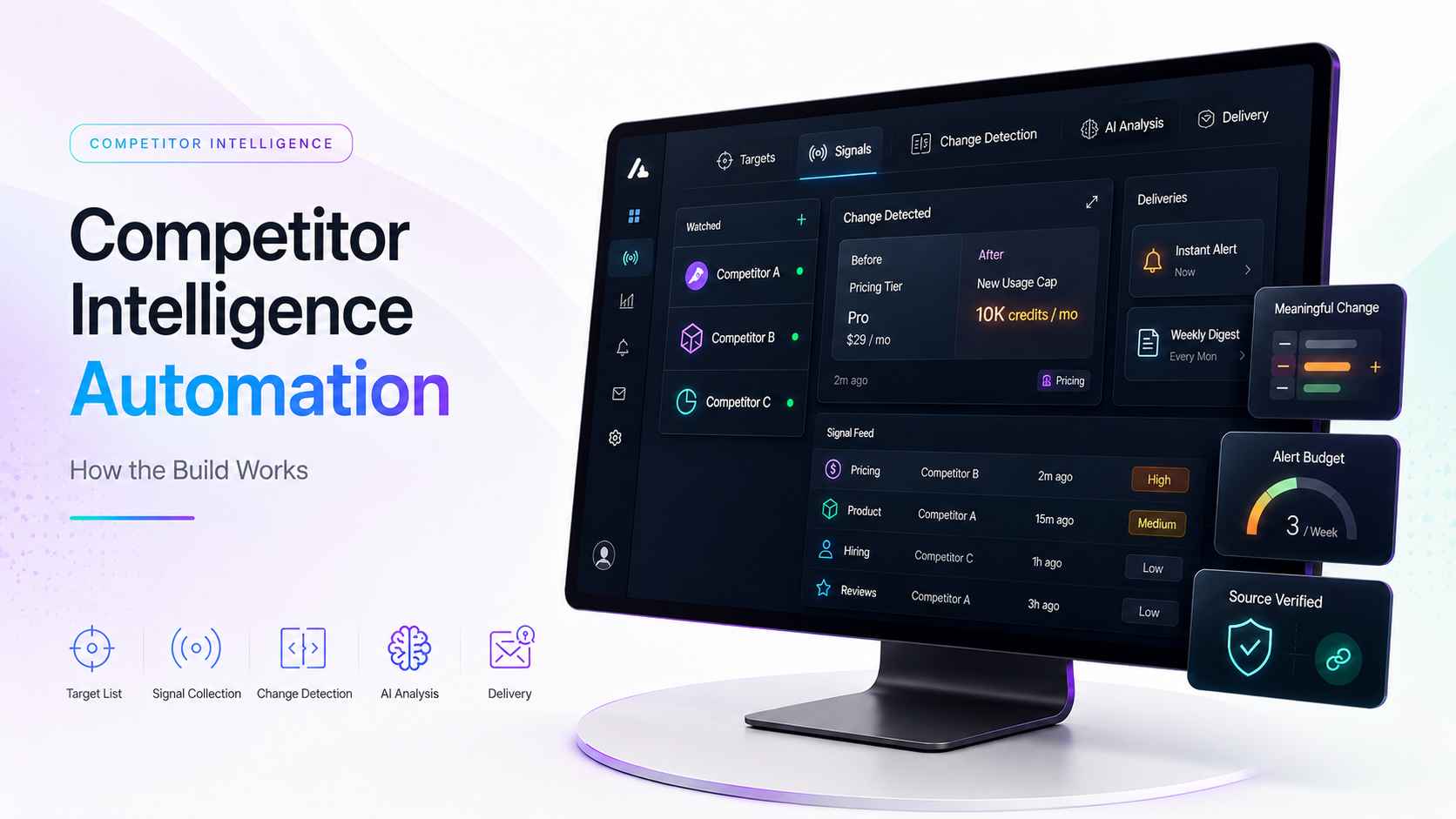
We build operations infrastructure with engineering discipline for $10M-$50M operators, and this build is not hypothetical. A competitor intelligence system we shipped runs in production today, and its case study ranks for the service's own name. This post opens the build.
What follows is the full pipeline: what gets watched, how changes surface, where AI belongs, and where the ethical line sits.
What is competitor intelligence automation?
Competitor intelligence automation is a system that tracks competitor signals continuously, detects meaningful changes, and delivers structured summaries to the people who act on them. No quarterly research project. No deck nobody opens. A pipeline that runs while you sell.
Define competitor intelligence first, because the term sprawls. It is the practice of collecting and analyzing public information about rivals to inform your own decisions: pricing moves, product launches, hiring shifts, customer sentiment. Management texts file it under strategic planning. Operators file it under Tuesday. Both are right, and the same pipeline serves both readers with the same digest.
The manual version is where the practice dies. Someone checks five websites once a quarter, builds a slide, and ships it to inboxes. The competitors ship weekly. The slide is stale before the meeting ends. Automation replaces the research-and-decay cycle with a feed.
What the feed powers is concrete. A pricing response decided the week a rival moves, not the quarter after. Battle cards that match what the prospect is actually seeing. A rep walking into a deal already briefed on last month's launch.
Monitoring vs discovery: the two jobs
The topic hides two different jobs, and honesty about the split saves you money.
Monitoring tracks known rivals for changes. You name the companies. The system watches them. This is the job most operators need, and the job the build below performs.
Discovery finds rivals you have not named: the startup that launched last quarter, the adjacent player moving into your lane. Discovery needs web-scale search and reasoning, and specialized research tooling serves it.
Run discovery as a periodic exercise. Ask sales who they lose to. Check review-site categories twice a year. Then feed new names into the monitoring pipeline.
Most teams need continuous monitoring and occasional discovery. Buying continuous discovery for a five-competitor market is paying for a telescope to watch the house across the street.
The discovery-lite routine costs one hour a quarter. Pull the last quarter's lost deals and list every rival named. Scan two review-site categories for new entrants. Any new name that appears twice joins the watch list. Cheap, regular, and enough for most operator markets.
The five-stage build
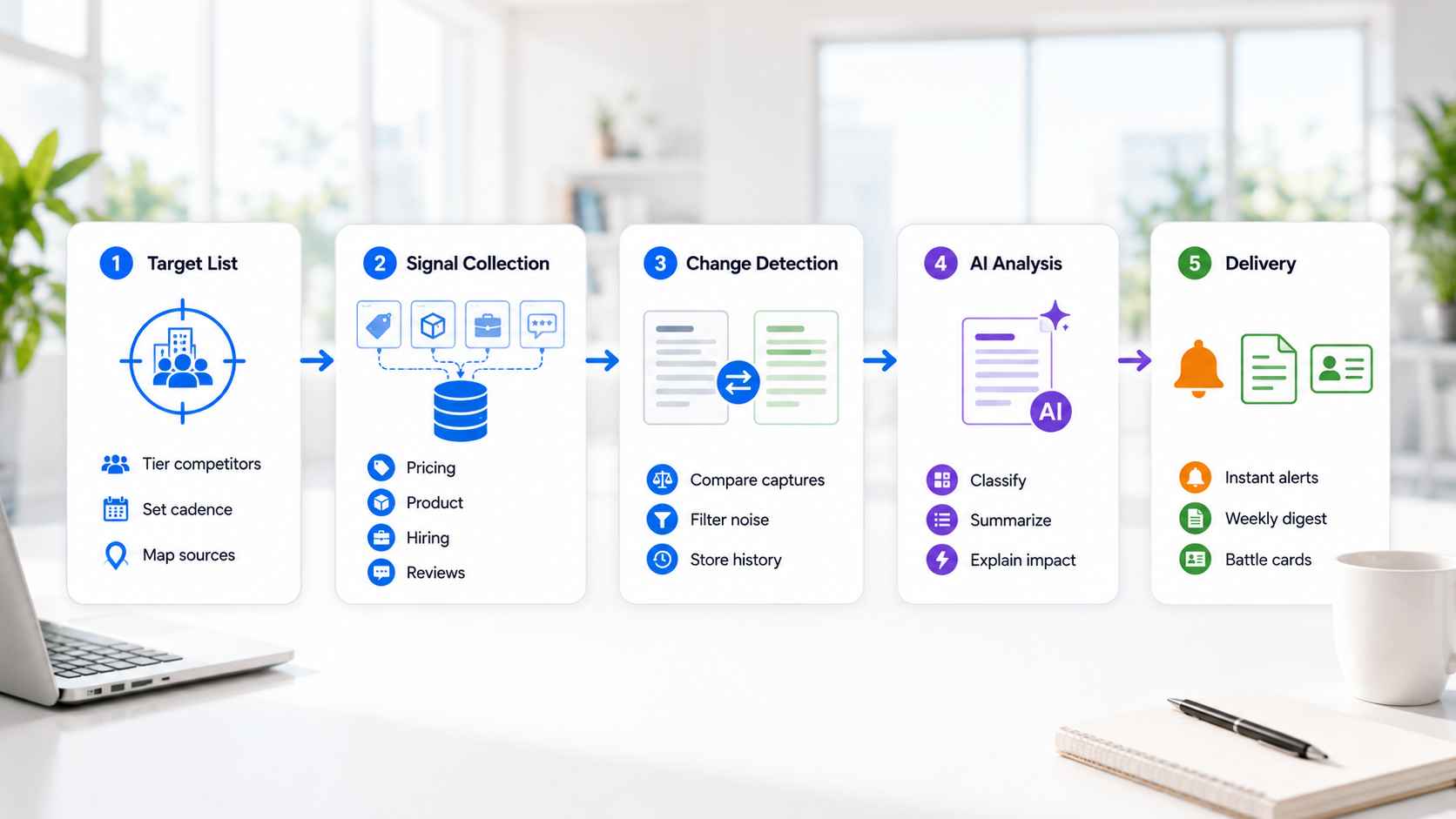
Every working competitor intelligence system has the same skeleton. Five stages. Each one has a job and a failure mode.
Stage one: the target list
Name the competitors and rank them. Direct rivals who appear in deals. Adjacent players worth a lighter watch. The list stays short on purpose. Five to ten names watched well beats forty names watched badly.
Tiering sets the depth. Tier one rivals get the full signal map at full cadence. Tier two gets pricing and launches only, monthly. New names earn promotion by showing up in lost deals. The tiers keep the system focused where revenue actually competes.
Each target gets a signal map: which pages, which sources, which cadence. The pricing page daily. The careers page weekly. The blog weekly. The map is the build's specification, written before anything runs, and reviewed each quarter as the market moves.
Stage two: signal collection
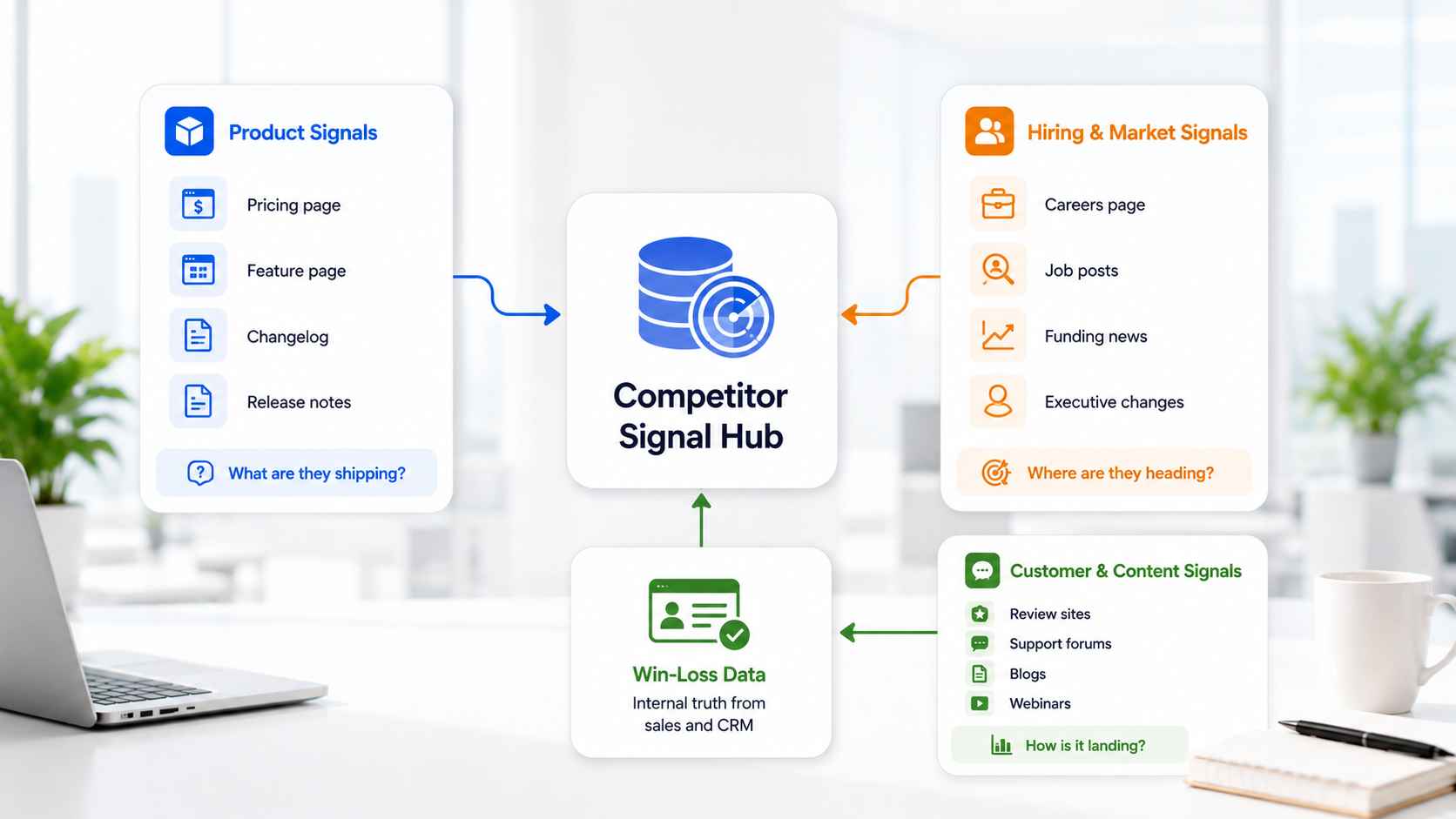
The system gathers the raw material on schedule. Signals group into families, and each family answers a different question.
Product signals
Pricing pages, feature pages, changelogs, release notes. These answer "what are they shipping." A new tier on the pricing page is strategy in public.
Changelogs are the most honest page a rival publishes, because engineering writes them and marketing forgets them. Collection here runs at the highest cadence, because product moves fastest.
Hiring and market signals
Careers pages, job boards, funding news, executive changes. These answer "where are they heading." Job posts tell the truth before press releases do. A rival hiring field technicians is expanding coverage.
A rival hiring enterprise reps is moving upmarket. The tools named inside job posts leak the roadmap too. Weekly cadence covers it.
Customer and content signals
Review sites, support forums, blogs, webinars. These answer "how is it landing." A pattern of complaints on a review site is a sales angle waiting for a battle card. A content push on one topic reveals where their marketing budget went. Weekly to monthly cadence.
One signal never gets scraped, and it is the richest one. Your own win-loss record. Why deals actually close against each rival lives in your CRM and your reps' heads, and the pipeline leaves a labeled slot for it rather than inventing it. Public signals plus internal truth beats either alone.
Stage three: change detection
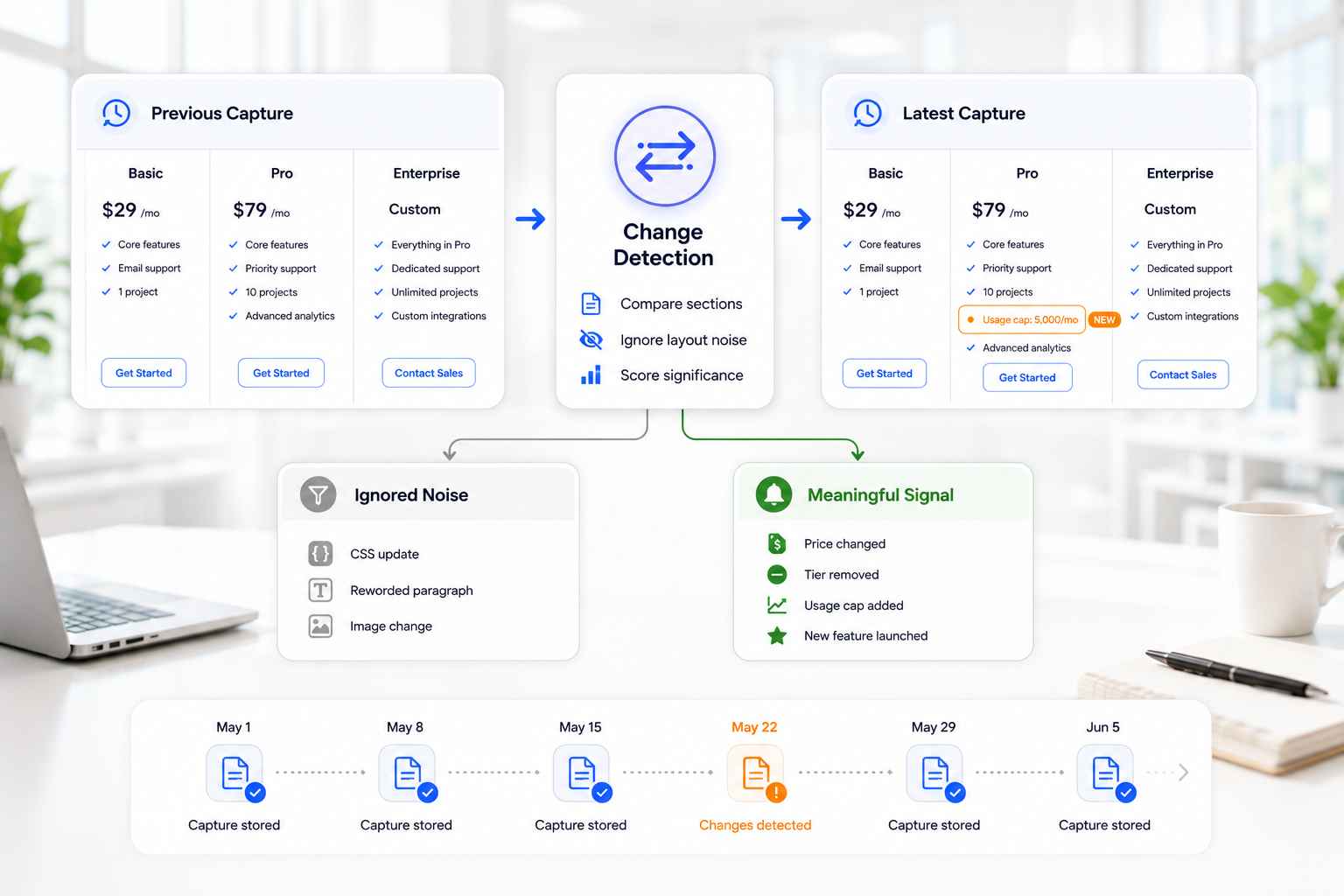
The stage that separates a system from a scraper. Raw pages arrive constantly. The system compares each capture against the last one and surfaces only the difference.
Monitor the delta, not the page. A reworded paragraph is noise. A removed pricing tier is signal. Detection rules filter by section and significance, so a CSS change never pings anyone and a price change always does.
Every detected change gets stored with a timestamp and the before-and-after. The history becomes an asset on its own. Six months of pricing-page diffs tells a strategy story no single snapshot can. One real example shape: a mid-tier plan quietly gaining a usage cap. The page looks the same at a glance. The diff catches the cap, and the cap is the story.
Stage four: the AI analysis layer
Detected changes flow to a language model with one job: explain the change against your context. What changed, why it plausibly matters, which of your deals or documents it touches. The model reads your positioning notes and drafts the implication.
Classification rides along. Each change gets a type: pricing, product, hiring, content, market. The type decides the route. Pricing changes head for the instant lane. Content changes wait for the digest. Rules route on the label the model applies.
The quote-the-source rule
One rule keeps the layer honest. Every claim in the summary quotes or links the source capture. The model summarizes what was found. It never speculates past it. Unverifiable analysis gets flagged, not shipped. AI reads and drafts here, and the same verification discipline from our enrichment architecture guide gates every output.
Stage five: delivery
Intelligence that stays in the pipeline is a diary. Delivery puts it where decisions happen.
The weekly digest carries the routine: one page, grouped by competitor, changes with implications. Instant alerts carry the exceptions: pricing moves and launches, pushed to the sales channel the moment detection confirms them.
Battle-card updates and CRM notes ride the same rails, so rep-facing material stays current without a quarterly rewrite project. The digest gets a named owner who prunes it, because a digest nobody edits grows until nobody reads it.
The alert budget
The anti-noise mechanism, and the part most builds skip. Ten alerts a day is zero alerts a day, because everyone mutes the channel by Friday. So the system carries a budget: a small number of instant alerts per week, reserved for changes that clear a significance bar. Everything else waits for the digest.
The budget forces the rules to earn each interruption. Attention is the scarcest resource in the whole pipeline. The budget spends it like money. Three instant alerts a week is a sane starting budget for most teams. Raise it only when the team asks for more, which almost never happens.
Platforms vs the build: which road fits
Two roads lead to automated competitor intelligence, and the sort is honest.
Dedicated competitive intelligence platforms serve product-marketing-led programs: battle-card libraries, win-loss frameworks, analyst layers, enterprise CRM integrations. Teams with a CI function and a rep enablement motion amortize them well.
The engineered build serves the operator. Your named competitors, your signal map, your delivery channels, running on middleware and AI tooling at integration cost. The pipeline lives in your accounts, documented, with an owner and an alert, per the standards in our hiring guide. It composes with a platform later if a CI function grows.
The four-question test from our enrichment guide adapts cleanly. How many competitors? Who consumes the output? Who maintains it? What does the intelligence serve? A five-rival market feeding a sales team points to the build. A forty-rival portfolio feeding a PMM org points to a platform. The hybrid exists too: a platform for the battle-card library, the build for the signals the platform misses.
The ethics line
The line is simple and bright. Public signals only.
Public pages, published prices, posted jobs, public reviews, filed announcements. All fair. Behind a login, out of bounds. No fake accounts, no pretexting, no scraping past terms that forbid it, no soliciting a rival's confidential material.
The line is the login screen, and the build respects robots and rate limits on the public side too. Watch rivals the way you would accept being watched. The standard is symmetrical, and it keeps the whole practice clean.
The rule is also practical. Intelligence you cannot cite is intelligence you cannot use in a deal. Public sourcing keeps every battle card defensible in front of a prospect who asks where a claim came from. Retention follows the same discipline: captures store what analysis needs, dated and sourced, nothing hoarded past its use.
What the system costs, structurally
Two cost shapes, no numbers, because numbers date and scopes differ.
Platforms bill annual subscriptions that scale with seats and competitor counts. The build bills once, fixed fee, plus modest running costs for the collection and AI tooling underneath. The build's meter stays small because the target list stays small. The running line has three parts: page monitoring, model calls, and delivery, all sized to a short list.
The payback math runs on deals. One deal saved by a timely pricing alert or a current battle card typically covers a build several times over. Run your own version: average deal size against the cost of being surprised.
How ACS ships it
The pipeline above is the productized version of a system running in production, documented in the competitor intelligence case study. The build sits inside our sales automation practice, with the cross-system engineering handled by integration builds.
Fixed fee, after a paid and refundable discovery. Discovery names the targets, writes the signal map, and sets the alert budget with your sales lead in the room. The build ships with change history, the quote-the-source rule enforced, and a runbook your team owns.
Thirty days of tuning follows launch, because the first month teaches the rules which changes actually matter to your team. Wider practice standards live in the consultant overview, engagement structure on pricing, and the full proof set in the case studies: 500+ workflows shipped, more than 10,000 hours reclaimed, over $2 million in client savings.
Frequently asked questions
How do you define competitor intelligence?
The collection and analysis of public information about rivals to inform your own pricing, product, and sales decisions. Automated versions run continuously: signals collected on schedule, changes detected, implications summarized, delivery routed to the people who act.
What are the 4 P's of competitor analysis?
Product, price, place, and promotion, borrowed from classic marketing. They map cleanly onto signal families: product and pricing pages, market coverage moves, and content signals. The framework organizes what to watch. The pipeline does the watching, and the diffs do the reporting.
How do you automate competitor analysis?
Five stages. Name the targets and map their signals. Collect on a cadence per signal family. Detect changes against prior captures. Summarize with AI under a quote-the-source rule. Deliver through a weekly digest plus budgeted instant alerts.
What is intelligent automation?
An enterprise umbrella term for combining rule-based automation with AI capabilities across processes. Competitor intelligence automation is one applied instance: rules run the collection and detection, AI runs the reading and drafting, humans keep the judgment. The division of labor is the whole design.
How much do competitive intelligence platforms cost?
Platform pricing runs custom annual subscriptions scaling with seats and tracked competitors, so current vendor pages give the real number. The engineered build prices once at fixed fee with small running costs. Match the cost shape to the size of your competitor set.
What is competitive intelligence in management?
The strategic-planning discipline of grounding decisions in rival behavior: market entry, pricing strategy, product roadmaps. The automated pipeline feeds it. Leadership reads the same digest sales reads, and the change history turns anecdotes into evidence.
How often should competitor intelligence update?
Match cadence to signal velocity. Pricing and product pages daily. Hiring and news weekly. Reviews and content monthly. The digest lands weekly regardless, and instant alerts fire on budget. Cadence per signal beats one cadence for everything.
Do we need a competitor intelligence tool or a system?
A system, which may or may not include a dedicated tool. Small competitor sets run well on an engineered pipeline inside your existing stack. Large portfolios with a CI function justify a platform. The five stages stay identical either way.
Is automated competitor monitoring legal?
Watching public information is standard practice. The line: public signals only, no logins crossed, no impersonation, terms and rate limits respected. Ask counsel for your jurisdiction's specifics. A pipeline built on public, citable sources stays on the safe side by design.
Getting surprised by competitor moves?
Three ways to move.
Book a paid discovery. Targets named, signal map written, alert budget set, one fixed price. Refundable if we are the wrong fit. See pricing.
Read the shipped build. The competitor intelligence case study shows the system in production.
See the practice. The sales automation page covers the wider build layer.
Watch the delta. Budget the alerts carefully. Never get surprised twice.