

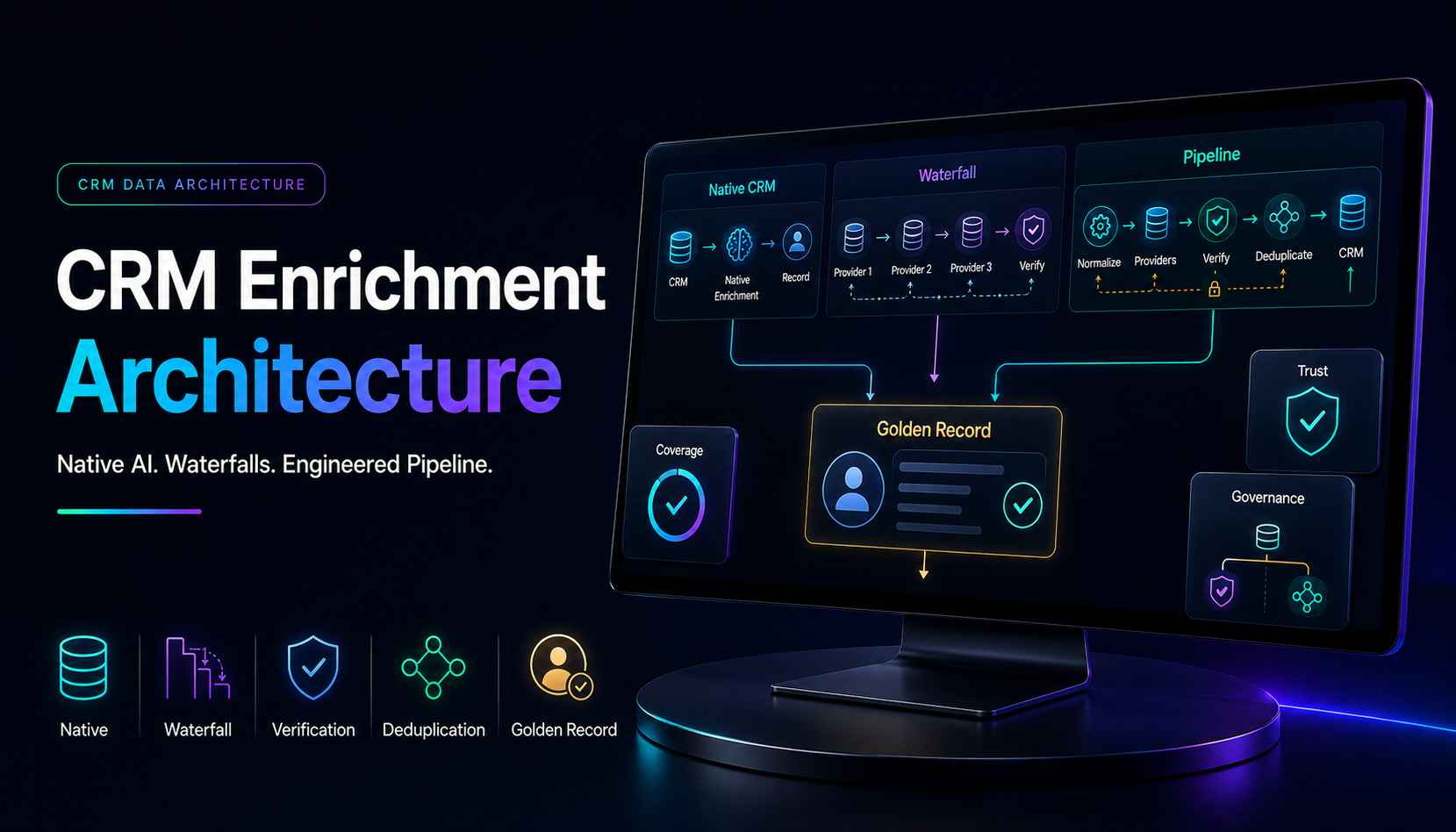
We build operations infrastructure with engineering discipline for $10M-$50M operators. Enrichment sits inside that work constantly, because routing, quoting, and reporting all read the fields enrichment fills.
We are an Attio Expert Partner and a Zapier Certified Solutions Partner. The first credential covers native CRM enrichment. The second covers the pipeline layer. No data vendor pays us, so the architecture comparison below has no thumb on the scale.
What is CRM enrichment architecture?
CRM enrichment architecture is the design of how customer records receive their data: which sources, in what order, verified how, synced where, and governed by whom. The architecture decides your coverage, your cost, and your data trust.
Most teams never choose an architecture. They buy a tool, and the tool's design becomes theirs by default. This guide reverses that order. Understand the three designs first. Then the tool question answers itself.
The default path has a familiar ending. A tool bought for one team spreads to three. Nobody owns the merge rules. Duplicates multiply quietly. Two years later, the CRM cleanup project costs more than the architecture decision would have.
The stakes are quiet but constant. Every routing rule, every quote, every report reads enriched fields. Empty fields break the rules downstream. Wrong fields break them silently, which is worse. A lead routed on a stale company size lands with the wrong rep, and nobody ever learns why the deal felt off.
What is waterfall enrichment?
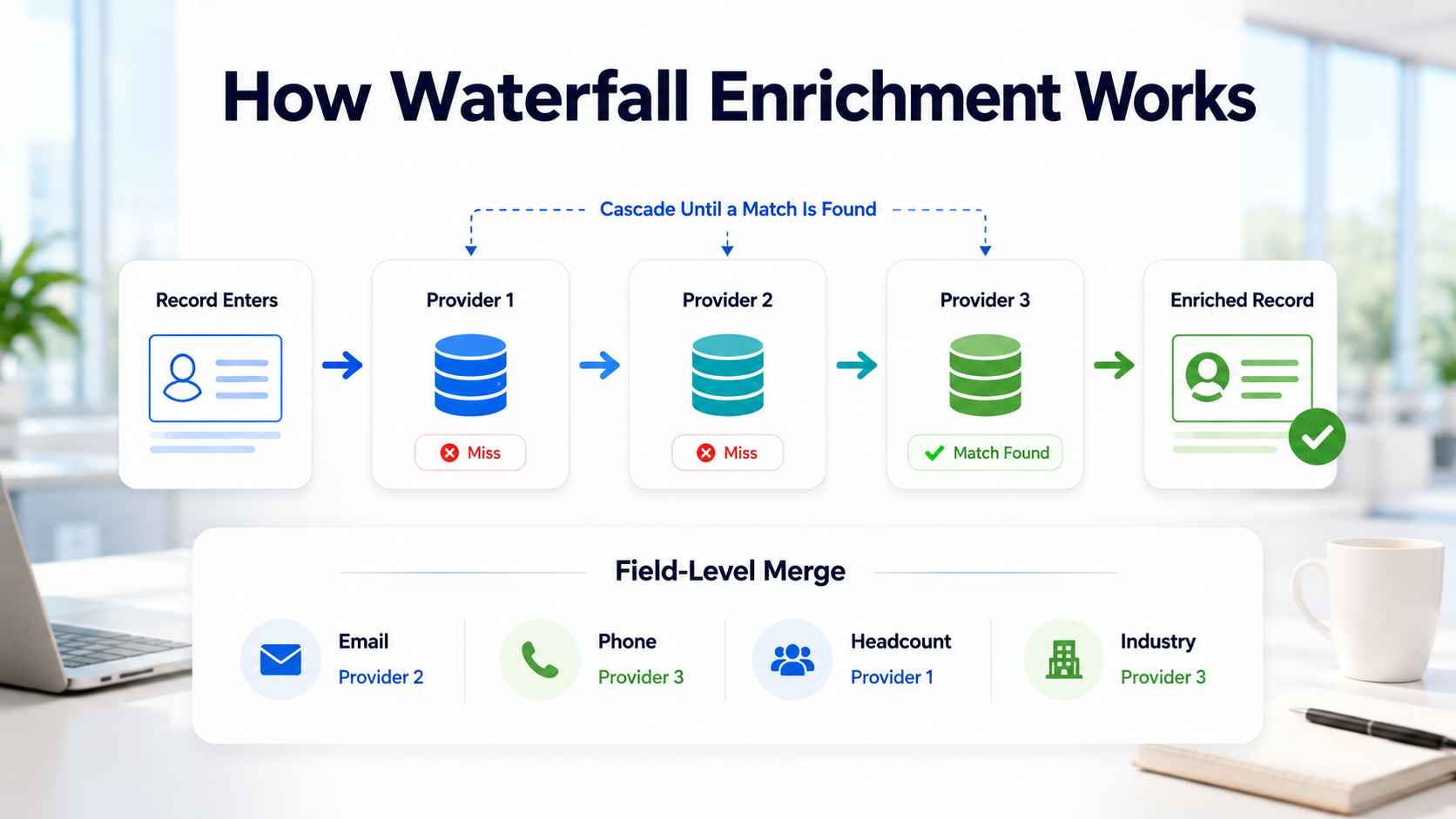
Waterfall enrichment queries multiple data providers in sequence. Provider one gets asked first. A miss cascades to provider two, then three, until a match lands or the list ends. The sequence stops on success, so credits spend only on hits.
The meaning behind the name is the mechanic. Data requests fall through providers like water down ledges. Each ledge catches what the one above missed.
The logic solves a real problem. No single database covers everyone. Every provider has blind spots, and the blind spots differ. Sequencing providers stacks their strengths. Vendors publish coverage claims north of ninety percent for stacked sequences, and those numbers are vendor claims. Your match rate on your own market is the only number that matters, and it gets measured, not quoted.
Mature waterfalls merge at the field level too. The email comes from one provider. The phone from another. The headcount from a third. Each field takes its best available value, and the merged result is one complete record instead of three partial ones.
One name, two products: the Clay confusion
A quick sort, because the search results mix two tools. Clay the GTM platform orchestrates waterfall enrichment and AI research across dozens of providers. Clay the personal CRM is a separate relationship app for individuals. Same name. Different products. Different buyers.
This guide covers enrichment architecture, where the first Clay defined a category. The naming collision explains half the confused reviews you have read.
The three enrichment architectures
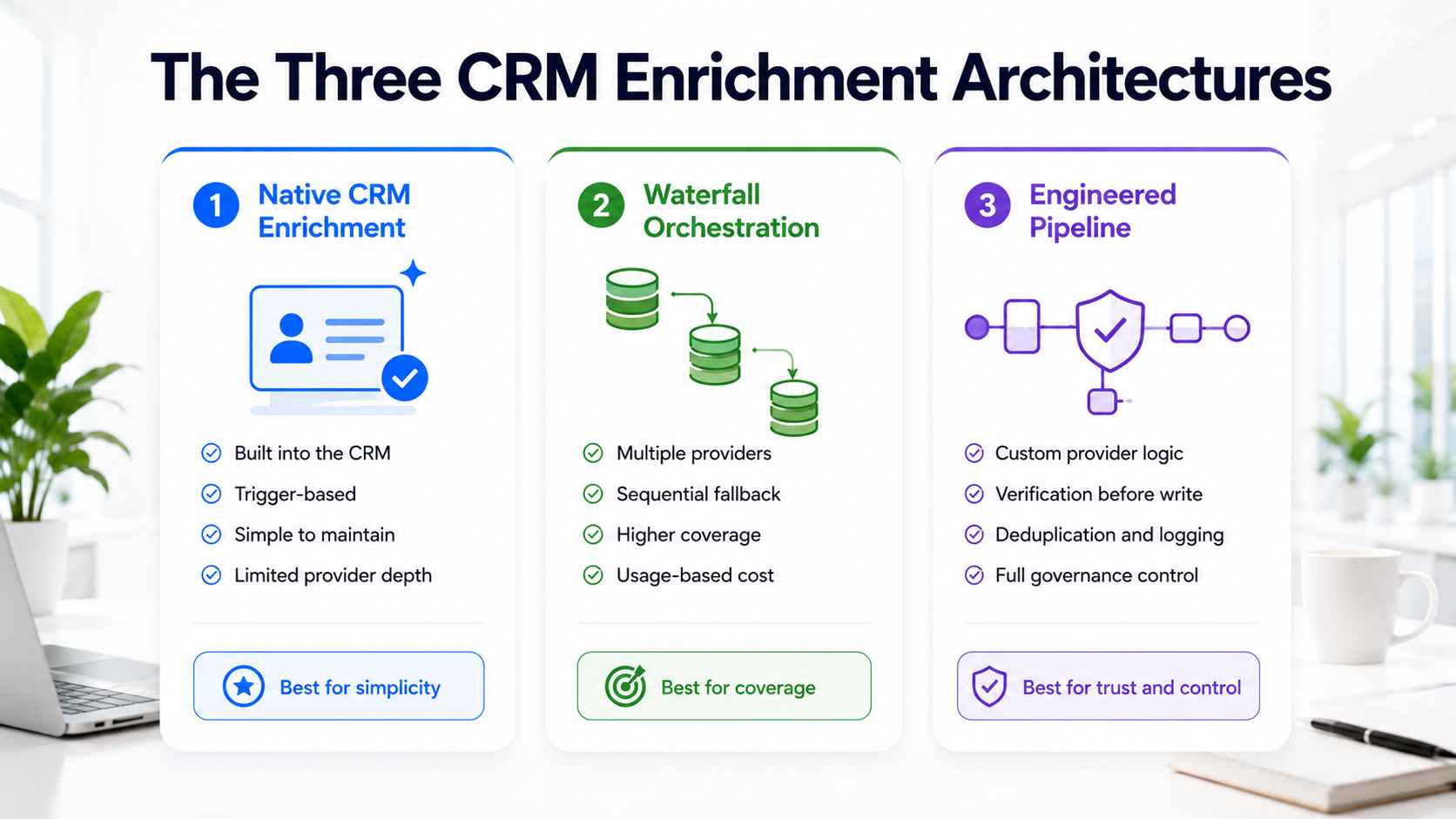
Every enrichment setup is one of three designs, or a hybrid of them. Each design has a home.
Architecture one: native CRM enrichment
The CRM enriches its own records. Modern platforms ship this built in. Attio runs native enrichment and AI research on records as they arrive, and other CRMs bundle similar layers.
Where native shines
Simplicity. One tool, one bill, zero integration work. New records complete themselves. Job changes surface on schedule. For teams whose enrichment need is "keep the CRM current," native covers the job with nothing to maintain. Our Attio implementation work configures exactly this layer.
Native runs trigger-based, which carries a quiet benefit. Every enrichment traces to a record event. Trigger-based enrichment is auditable enrichment, and audits get easier when the whole chain lives in one tool.
Where native stops
Provider depth. Native enrichment reads the providers the CRM chose, at the coverage the CRM negotiated. Niche markets, technical roles, and regional gaps stay gapped.
When native coverage disappoints on your specific market, the architecture question opens. Test before concluding, though. Run the bake-off on native first. Plenty of teams shop for orchestration before measuring what they already own.
Architecture two: waterfall orchestration platforms
A dedicated orchestration layer sequences many providers with conditional logic. Clay defined the category, connecting dozens of data sources plus AI research agents in configurable sequences.
The provider sequence
You choose the ledges. General databases first for the easy matches. Specialist scrapers for technical roles. Regional providers for compliance-heavy markets. Each layer runs only when the layer above missed, which controls the spend.
The ordering principle is simple. Broad and cheap first. Narrow and specialized later. The early ledges catch the common cases at the lowest cost, and the deep ledges earn their price on the hard remainder.
AI research agents
The newest ledge is not a database. AI agents research the open web for what no database indexed: team pages, filings, press mentions. Agents recover a slice of the leads every database missed. They also hallucinate without tight prompts, so verification stays mandatory.
The use cases go past contact data. An agent can read a prospect's site and flag qualitative signals: outdated stack mentions, hiring pages, expansion news. Signals feed qualification and personalization. Verification still gates every write.
The cost meter
Orchestration pricing stacks: a platform fee plus per-provider credits per attempt. Powerful and meterable. The meter rewards discipline and punishes curiosity. Teams running heavy outbound volume amortize it well. Teams enriching a modest CRM often pay orchestration prices for pipeline problems.
Discipline has a shape. Run conditions on every layer, so nothing queries twice. Segment caps, so experiments stay experiments. A monthly credit review with an owner. The meter behaves for teams that watch it.
Architecture three: the engineered pipeline
The middle path. Middleware or custom integration connects your chosen providers, a verification step, and your CRM, with the engineering layer wrapped around it: deduplication, error handling, sync logic, and logging.
What the build includes
One intake for enrichment requests. Two or three providers sequenced by simple conditions. Verification before write. Field-level merge rules deciding which source wins per field. Sync back to the CRM with dedup keys enforced. An owner and an alert, because enrichment fails silently like everything else.
Normalization runs before any provider gets asked. Company names cleaned of suffixes. URLs stripped to bare domains. Titles mapped to standard categories. Providers match on tidy inputs, and dirty inputs waste the entire sequence downstream.
When it wins
When the CRM is the point. Operators enriching to serve routing, quoting, and reporting need governed data more than maximal coverage. The pipeline delivers the sequence logic at integration cost, inside tools already owned.
This is integration builds work, and it composes with either other architecture later. Native keeps running underneath. An orchestration layer can plug in above when volume demands one. The pipeline is the design that never gets thrown away.
The governance layer every architecture needs
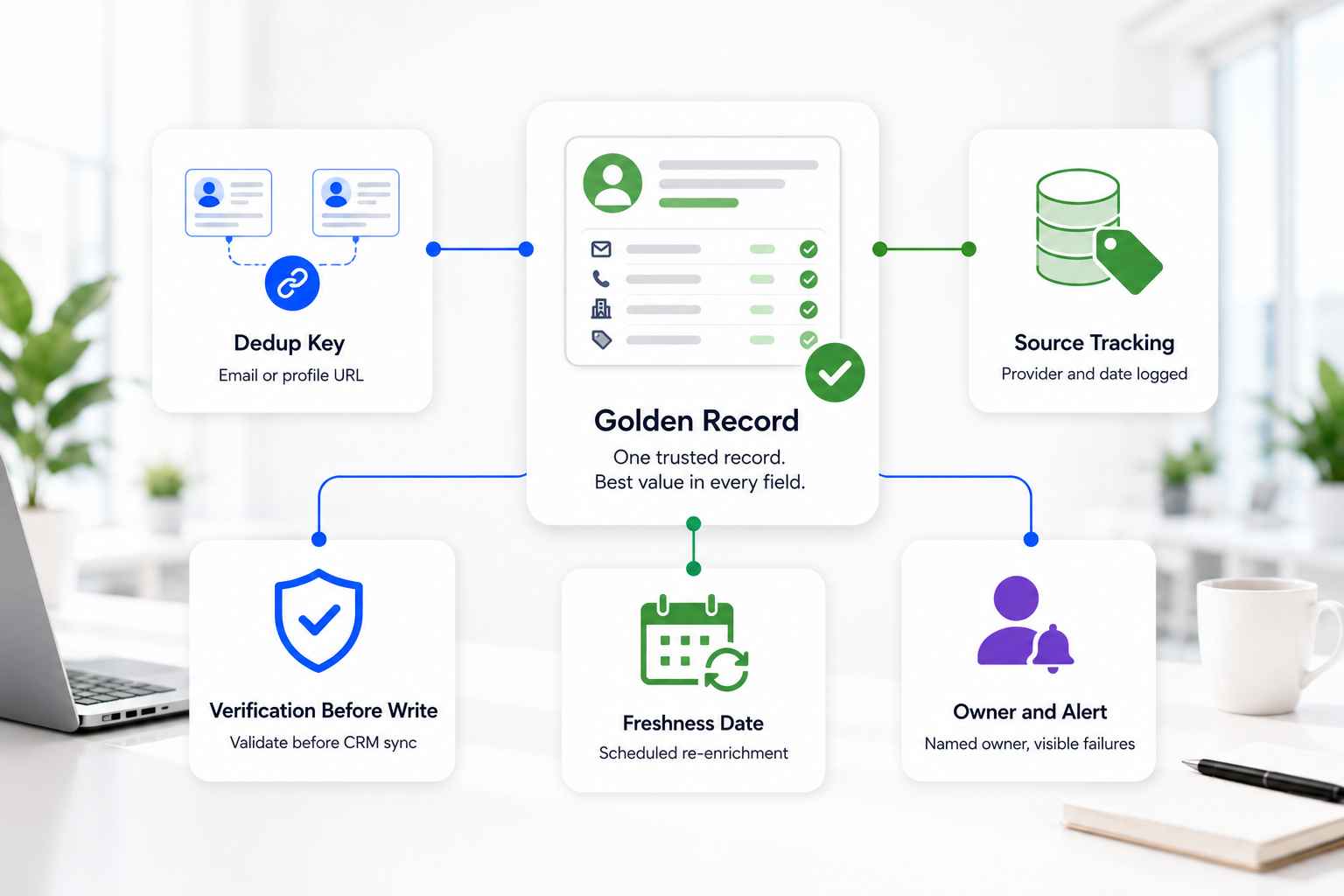
Architecture picks the plumbing. Governance keeps the water clean. Five rules apply to all three designs, and skipping them is how enrichment becomes expensive graffiti.
The goal has a name: the golden record. One record per person, best value in every field, source known, freshness dated. Every rule below exists to produce and protect it.
One dedup key, enforced. Email or profile URL identifies the record. Every write checks it. Enrichment that creates duplicates destroys more value than it adds.
A source field on every enriched value. Which provider filled this, when. The field costs nothing and answers every future data-quality argument.
A last-enriched date with a refresh cadence. Data decays. Titles change. Companies move. Records re-enrich on a schedule, not on complaints. Twice a year suits most markets. Fast-moving segments earn a quarterly pass.
Verification before the CRM. Unverified emails bounce, and bounces burn sender domains. The verification step sits between the providers and the record, always.
An owner and an alert. Every automation gets both. Enrichment included. A provider deprecating an endpoint should page a person, not surface in next quarter's bounce report.
Choosing your architecture: the four-question test
Four questions sort almost every team.
How many records per month? Hundreds favor native. Tens of thousands with outbound volume favor orchestration. The wide middle favors the pipeline.
Does your market sit in mainstream databases? Mainstream ICPs enrich anywhere. Niche and technical markets need sequencing depth, which pushes toward orchestration or a pipeline with specialist providers.
Who maintains it? Orchestration platforms reward a technical owner who tunes sequences. No such person, no such architecture. Native and pipeline carry lighter upkeep.
What does enrichment serve? Outbound volume points to orchestration. CRM trust points to native or pipeline. The answer usually names the architecture by itself.
Budget shape breaks remaining ties. Orchestration bills monthly and scales with usage. A pipeline costs once and runs on tools already paid for. Native rides the CRM bill. Match the spending shape to how your finance team prefers to pay.
Run one more step before any contract: a hundred-record bake-off on your own ICP. Same records, each candidate architecture, count the verified matches. An afternoon of testing beats every published coverage claim.
Enrichment and speed: the time budget
One design rule carries over from our lead routing playbook. Enrichment gets a time budget measured in seconds when it sits inside a routing path. A slow provider defers. The lead routes on what exists, and the rest backfills after.
The inbound case makes it concrete. A form fill fires a webhook. Enrichment runs its fast ledges. The lead routes enriched within the minute, and the deep research lands on the record afterward. Speed and depth, sequenced instead of traded.
Architecture affects the budget. Native enrichment runs inside the CRM's timing. Orchestration sequences add latency per ledge. Pipelines let you set the budget explicitly. Wherever enrichment lives, speed to lead outranks completeness of fields, every time.
The layer logic from our sales stack guide applies here too. Enrichment crossing three or more tools is build-layer work by definition, with build-layer engineering standards attached.
How ACS builds enrichment systems
Two credentials, two architectures, honestly sorted. As an Attio Expert Partner, we configure native enrichment to its real limits before recommending anything heavier.
As Zapier Certified builders, we engineer pipelines when governance and integration depth demand them. The wider record-layer thinking behind both sits across our CRM guides, platform by platform.
And the fair sort cuts the other way. Heavy outbound GTM teams with a technical owner should evaluate orchestration platforms directly. We say so in discovery when the volume math points there, because the wrong architecture billed monthly serves nobody.
Fixed fee, after a paid and refundable discovery that runs the four-question test on your actual stack and your actual market. Governance ships in every build: dedup keys, source fields, verification, alerts, and a runbook your team owns. The structure sits on pricing, the credentials on the partners page, and the shipped systems in the case studies: 500+ workflows, more than 10,000 hours reclaimed, over $2 million in client savings.
Frequently asked questions
Is Clay AI a CRM?
No. Clay the GTM platform is an enrichment and workflow orchestration layer that syncs into CRMs. A separate personal-CRM app shares the name, which fuels the confusion. Orchestration layers feed systems of record. They do not replace them.
What does waterfall enrichment mean?
Querying data providers in sequence: a miss at provider one cascades to provider two, until a match lands. The sequence stops on success, so spend follows hits. The design stacks provider strengths to cover any single database's blind spots.
Does Clay have a CRM?
The GTM platform syncs enriched data into CRMs rather than serving as one. Records live in your system of record. The orchestration layer fills their fields. Keeping that boundary clean is half of enrichment governance.
What does Clay AI pricing look like?
Structurally: a platform fee plus per-provider credits that spend per successful attempt. Totals scale with volume and sequence depth, so current pricing pages and your own volume math give the real answer. Meter discipline matters more than the rate card.
How many providers does a waterfall need?
Fewer than the maximum. Returns diminish after a handful of well-chosen ledges: one general source, one specialist for your market, one verifier. Depth beyond that earns its cost only at serious volume. Sequence quality beats sequence length.
Native enrichment or waterfall: which is better?
Neither, without your context. Native wins on simplicity for mainstream markets at modest volume. Waterfalls win on coverage for niche markets at outbound volume. The engineered pipeline holds the middle. The four-question test sorts it in minutes.
Is multi-provider enrichment compliant?
Compliance travels per provider. Each source in a sequence carries its own basis and jurisdiction posture, so regulated and European markets need providers selected for it. Your approved-tools list governs the sequence, in writing, before the build. One non-compliant ledge contaminates an otherwise careful stack.
What is a golden record in CRM enrichment?
One complete, trusted record per person or company: the best available value in every field, the source of each value logged, the freshness dated, duplicates merged away. Every enrichment architecture exists to produce golden records. Governance is what keeps them golden.
How do we test enrichment quality before buying?
A hundred-record bake-off. Pull real records from your ICP, run each candidate architecture, count verified matches per field. Coverage claims come from vendor benchmarks on vendor-friendly samples. Your market is the only benchmark that predicts your results, and the test costs one afternoon.
Enriching on defaults instead of design?
Three ways to move.
Book a paid discovery. The four-question test on your stack, a bake-off plan, and one fixed price. Refundable if we are the wrong fit. See pricing.
Start at the record layer. The Attio guide covers native enrichment done properly.
Review the proof. The case studies show governed data systems in production.
Three architectures. One afternoon of testing. Your market makes the decision for you.