

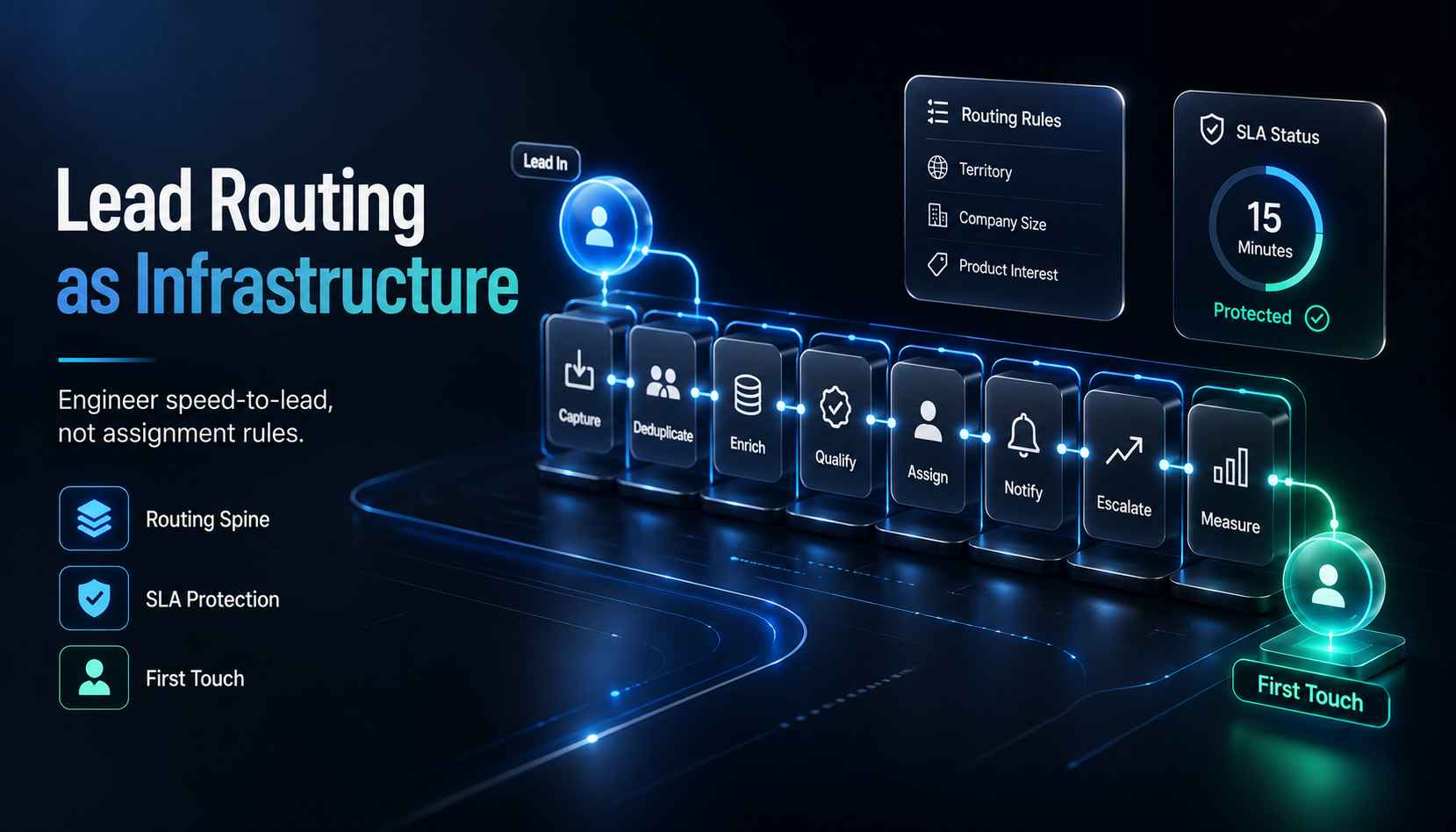
We build operations infrastructure with engineering discipline for $10M-$50M operators. Lead routing sits at the front of that work, because it decides which company a buyer hears from first. Routing builds run through our sales automation practice weekly.
We are a Zapier Certified Solutions Partner and an Attio Expert Partner. No routing-tool vendor pays us. The design below works on any stack.
What is lead routing?
Lead routing is the automatic assignment of incoming leads to the right salesperson, based on rules. A lead arrives. The system checks its attributes. Territory. Company size. Product interest. Rep availability. Then it assigns, notifies, and starts the clock.
The goal carries one number. Minutes from arrival to first human touch. Every component below exists to shrink that number and keep it small.
One quick sort for confused searchers. This is sales lead routing. Network routing moves data packets between machines, and lives in a different profession entirely. An infrastructure lead is a job title in engineering teams. Same words, three meanings. This guide covers the sales system.
Why routing is infrastructure, not a feature
Every CRM sells a routing feature. A toggle. A rule builder. The feature assigns leads on a sunny day, and that is where most teams stop.
Infrastructure asks harder questions. What happens when the assigned rep is on vacation? When nobody claims the lead for an hour? When the form tool disconnects at midnight? When the routing rule references a field that got renamed? Features have no answer. Infrastructure has a designed answer for each.
There is a second payoff past speed. Trust. Reps trust a fair rotation they can see. Managers trust a forecast fed by complete routing data. Buyers trust the company that answered first. One build, three trusts.
The stakes justify the engineering. Research on lead response has repeated one finding for years: the odds of qualifying a lead collapse within minutes of arrival, and the first responder wins a large share of deals.
Not percentages worth memorizing. A shape worth building for. Speed decides revenue, and routing decides speed. We introduced this diagnostic in our Pipedrive vs Close comparison. This post is the full playbook behind it.
The lead routing spine: eight components
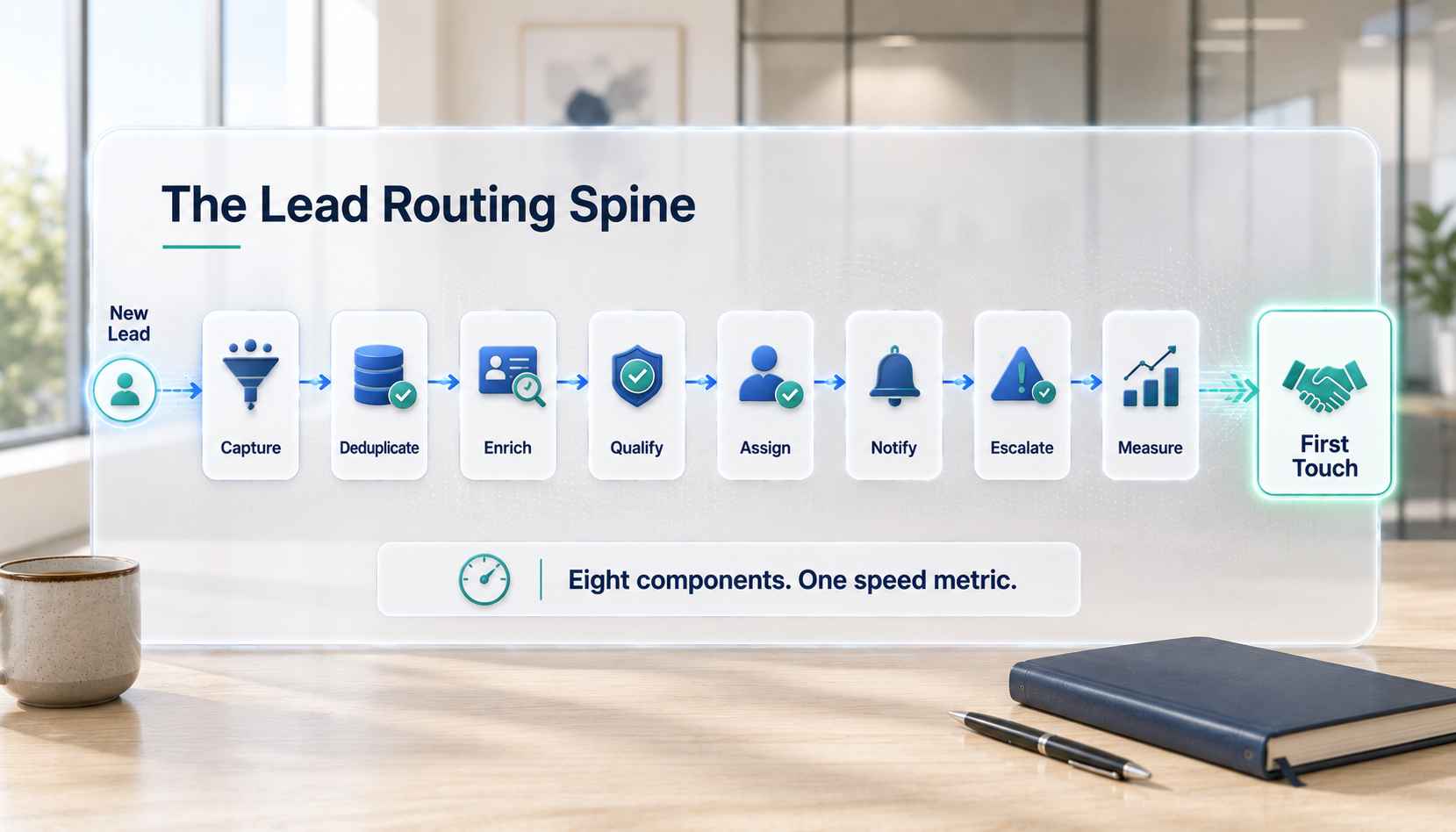
A complete routing system has eight parts. Each part has one job. Skip one, and leads leak there.
Capture and intake
Every lead source lands in one intake. Website forms. Chat. Phone. Referral emails. Purchased lists. Event scans. One funnel mouth, not six.
Scattered intake is the first leak. A source nobody wired is a source nobody routes. The intake inventory comes first in every build.
The inventory takes an hour. List every source. Count each one's monthly volume. Wire the highest volume first. The long tail waits its turn.
Deduplication and matching
The system checks each arrival against existing records. Match on email. Match companies on domain. A returning lead attaches to its history instead of spawning a twin.
Duplicates poison everything downstream. Two records means two owners, two sequences, and one confused buyer.
Normalize before matching. Lowercase the emails. Strip the plus-addressing. Map the domain aliases. Matching fails on formatting more often than on logic.
Enrichment before assignment
The lead gets its context before it gets its owner. Company size. Industry. Location. Technology signals. Enrichment fills the fields the routing rules will read.
Order matters here. Route first and enrich later, and the rules ran on empty fields. Enrichment feeds routing. Never the reverse.
Enrichment also gets a time budget. Seconds, not minutes. A slow provider defers: the lead routes on what exists, and the rest backfills after. Speed to lead outranks completeness of fields, every single time.
Qualification rules
Not every arrival deserves a rep. Rules sort real prospects from spam, students, and vendors. Qualified leads route to sales. The rest route to nurture or nowhere.
The qualification definition gets written down once, jointly. One sentence. Marketing and sales both sign it. That sentence prevents a hundred handoff arguments.
Disqualified does not mean deleted. Unready leads route to nurture. Spam routes to nowhere. Every disqualification logs its reason, so the rules stay auditable and improvable.
Assignment methods
The core decision. Who gets this lead, decided how. Three method families cover the field.
Rules-based routing
Attributes decide the owner. Territory maps to rep. Deal size maps to team. Product interest maps to specialist. Rules-based routing fits organized teams with clear ownership lines. The rules live in a document, not in someone's memory.
Round-robin and weighted distribution
Leads rotate through the team evenly. Weighting adjusts the rotation: senior reps carry more, ramping reps carry less. Round robin fits interchangeable pools where fairness and speed beat specialization. Fairness is measurable, so measure it.
Availability-aware assignment
The router checks who is present before assigning. Calendar status. Working hours. Capacity caps. Out-of-office flags. A lead assigned to an absent rep is a lead unassigned with extra steps. Availability logic turns assignment from a lottery into a guarantee.
Notification that gets claimed
Assignment without notification is a database update. The rep gets pinged where they actually live. Chat message. Mobile push. Task with a due time. The notification carries the context: who, from where, why routed here.
The payload earns the claim. Name, company, source, one enrichment highlight, and the suggested first move. A rep who opens the ping ready to dial claims faster than one who opens it confused.
Claiming closes the loop. The rep accepts the lead, and the clock records it. Unclaimed leads trigger the next component.
Escalation and fallbacks
The infrastructure differentiator. A router without an escalation path is a hope, not a system. Escalation is where feature toggles end and engineering begins, and it costs the least of any component here.
The SLA timer
Every assignment starts a timer. Fifteen minutes, thirty, whatever your motion demands. The timer watches the claim. Silence past the deadline fires the escalation.
After-hours needs its own rule. Queue for morning, or escalate around the clock. Both work. Choosing neither means weekend leads age silently, and Monday inherits the loss.
The unclaimed-lead path
Escalation reassigns automatically. Next rep in rotation. Team lead. Manager alert on the second miss. The lead never sits orphaned, because the system never assumes the first assignment worked.
Logging and measurement
Every hop gets a timestamp. Arrival. Enrichment done. Assigned. Notified. Claimed. First touch. The log turns routing from a belief into a report. Reports come later in this playbook. The logging that feeds them gets built now. Keep the log queryable, because next quarter's question is unknowable today.
The speed-to-lead metrics that matter

One metric leads. Four support it. Baseline all five before building anything.
Minutes to first touch
The number the whole system serves. Clock starts at lead arrival. Clock stops at the first genuine human contact. Not the auto-reply. The call, the personal email, the real message.
Measure the median and the worst decile. Averages hide the Friday afternoon leads that waited until Monday. The worst decile is where deals died quietly. Segment by source too. Paid leads and referrals often live in different speed worlds, and the segments name the fix.
The supporting four
Time to assignment shows the machine's share of the delay. Claim rate shows notification health. SLA compliance shows escalation health. Distribution fairness shows rotation health, and protects team trust in the system.
Five numbers. One dashboard. Reviewed weekly, by name.
The four failure modes to design for
Routing systems fail four ways. Design for all four on day one.
The unclaimed lead. The rep saw nothing, or ignored it. The SLA timer and escalation path exist for exactly this. Coverage: automatic.
The absent rep. Vacation, sick day, territory change. Availability-aware assignment plus a manual override switch. Ownership changes should take one click, not a rebuild.
The source outage. A form tool disconnects, and leads vanish upstream of the router. Volume monitoring catches it: zero leads on a Tuesday is a failure wearing a green checkmark. Alert on silence, not just on errors.
The silent breakage. A renamed field, an expired token, a changed stage. Every automation gets an owner and an error alert. Weekly counts compare sources against arrivals. Drift gets caught in days, not quarters.
Rules drift too, without breaking. Territories change. Teams reorganize. Products launch. Review the routing rules quarterly, on the calendar, before the org chart outruns the router.
Native routing vs the build layer
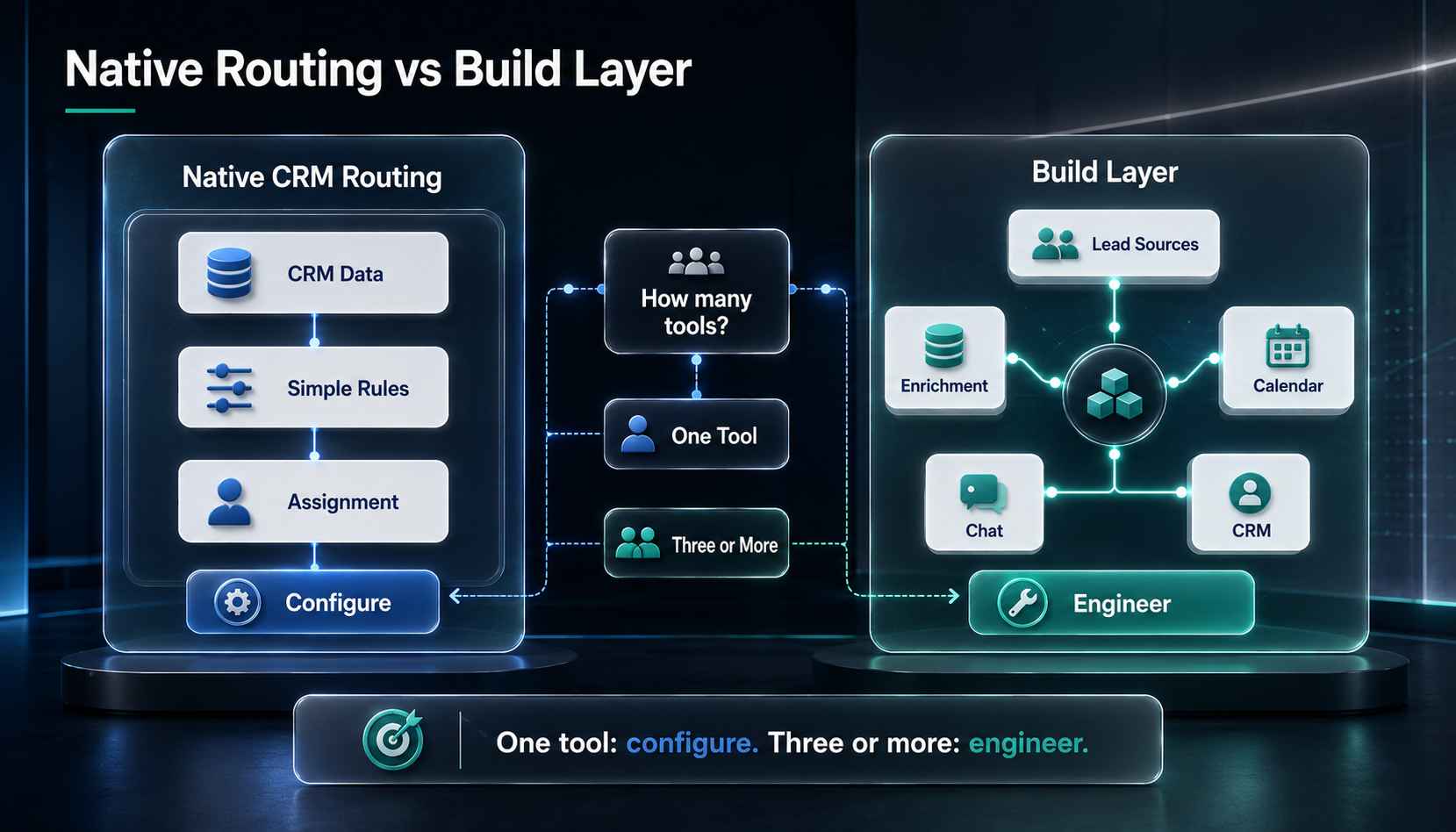
Where should routing live? The answer follows our three-layer model from the sales force automation guide.
Native CRM routing covers layer two. Simple territory rules. Basic round robin. One tool, its own data. If your leads arrive in the CRM already, start there. Configure before you build. Platform choice shapes what layer two includes, and our CRM guides compare the options.
The build layer starts where the stack does. Routing on enrichment data. Intake spanning six sources. Availability checks against calendars. SLA escalation across chat and mobile. Cross-tool routing is integration builds work: APIs, error handling, and a staging point the CRM never ships.
Count the tools in your routing path. One tool, configure. Three or more, engineer.
The Speed-to-Lead Playbook
Five steps. Run them in order.
Baseline. Two weeks of timestamps before any change. Minutes to first touch, median and worst decile. The baseline dates the decision and prices the win.
Design on paper. The eight components, drawn for your stack. Sources listed. Rules written. Escalation paths named. Paper is where design mistakes cost nothing. Walk one lead through the drawing, timestamp by timestamp. The walk finds the gaps the diagram hides.
Build with fallbacks first. The escalation path ships in version one, not version two. A router that launches without fallbacks launches broken, and discovers it on a weekend.
Guard with alerts. Error alerts to a named owner. Volume monitoring on every source. The silent failure modes get their tripwires before go-live.
Report weekly. Five metrics, one page, every Monday. The report keeps the system honest and keeps the wins visible. Infrastructure that nobody measures becomes a feature again. Give the page an owner by name, same as the alerts.
How ACS builds routing systems
Fixed fee, after a paid and refundable discovery. Discovery maps your sources, baselines your minutes to first touch, and designs the spine on paper with the rules written down. Then the build, fallbacks first, with error alerting wired before launch. Then thirty days of measurement against the baseline, so the win arrives as a number, not a feeling.
Handoff follows our published standard: accounts in your name, a runbook your team owns, training to a named owner. The hiring guide shows the full ownership terms, and the consultant overview shows where routing sits in the wider practice.
The proof: 500+ workflows shipped, more than 10,000 hours reclaimed, over $2 million in client savings. Routing builds appear across the case studies, and the engagement structure sits on pricing.
Frequently asked questions
What is the definition of lead routing?
Lead routing is the automatic assignment of incoming leads to the right salesperson based on rules: territory, size, interest, and availability. A complete system adds notification, SLA timers, escalation, and measurement. The definition is simple. The reliability is the engineering.
How does automated lead routing work?
A lead arrives at one intake. The system deduplicates, enriches, and qualifies it. Rules pick the owner. The rep gets notified and claims it. A timer watches the claim, and escalation reassigns on silence. Every step logs a timestamp. The whole chain runs in seconds when built right.
What is round-robin lead distribution?
Rotation. Leads assign to reps in turn, keeping the load even. Weighted round robin adjusts shares by capacity or seniority. It fits interchangeable teams where speed and fairness matter more than specialist matching. Measure the fairness monthly.
What is a good speed to lead?
Minutes, not hours. Inbound and referral motions should target first touch inside five to fifteen minutes during working hours, with the escalation path guarding the target. Baseline your current number first. Most teams discover hours where they assumed minutes. The gap between assumed and measured is the whole business case.
Should routing live in the CRM or across tools?
Start native when leads already land in the CRM and the rules read CRM fields only. Move to a cross-tool build when routing needs enrichment data, multi-source intake, calendar checks, or SLA escalation. Count the tools in the path. Three or more means engineering.
What are examples of lead routing rules?
Territory: west-coast leads to the west-coast rep. Size: enterprise domains to the senior team. Interest: product-line pages to the product specialist. Source: partner referrals to the partnership owner. Availability: skip anyone out of office. Rules compose. Simple rules compose best.
Do we need dedicated lead routing software?
Sometimes. Dedicated routing tools earn their seat at high volume with complex rules. Many operators get the full spine from their CRM plus middleware plus disciplined design. Buy the category after the design demands it, never before.
Does a small team need lead routing?
A two-rep team needs the timer more than the rules. Even simple rotation with an SLA and escalation beats a shared inbox. The spine scales down: fewer rules, same fallbacks, same measurement. Speed matters at every size.
Is this the same as network routing?
No. Network routing moves data packets between machines and belongs to network engineering. Lead routing moves sales inquiries to salespeople. The shared word confuses search results, and nothing else. This guide covers the sales system only.
Ready to shrink your minutes to first touch?
Three ways to move.
Book a paid discovery. Sources mapped, baseline measured, spine designed on paper with one fixed price. Refundable if we are the wrong fit. See pricing.
Read the service detail. The sales automation page covers the full build practice.
Review the proof. The case studies show shipped systems with the reclaimed hours counted.
Every lead. One intake. Minutes to first touch, guarded by design.