

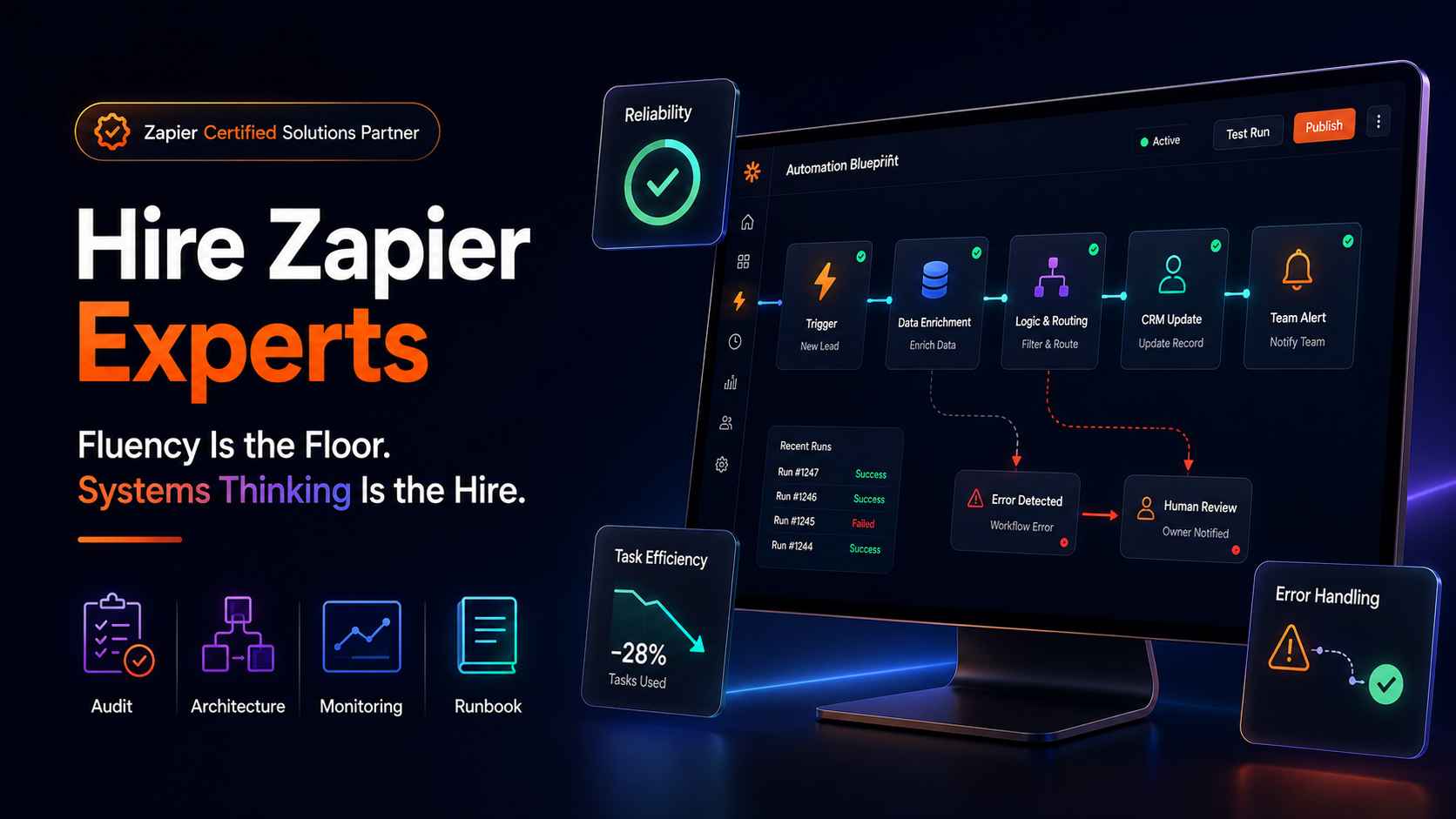
We build operations infrastructure with engineering discipline for $10M-$50M operators. We are a Zapier Certified Solutions Partner and an Attio Expert Partner, both verifiable in public directories.
This post decodes the Zapier credential the way we decoded Attio's. What the program is. What certification proves and what it cannot. What hiring should look like, what it should cost in structure, and the disclosure nobody else in the directory makes.
The honest verdict
The credential verifies tool fluency. Hire for systems thinking. Zapier's certification and vetting confirm someone can build well inside the platform. They do not confirm someone can decide what should be automated, in what order, with what error handling, at what cost.
That second skill set is the fee. Anyone can connect two apps. The judgment about which connections carry your revenue, and what happens when one fails at 2 a.m., is what you are actually buying.
One test cuts through every pitch. A good Zapier expert lowers your task bill. Reliability up, consumption down. Ask any candidate how they will do both, and listen for specifics. Vague answers predict vague builds.
The Solution Partner program, decoded
Three searches land here: zapier consultants, certified zapier expert, zapier solution partner directory. Same question, three phrasings. Who is verified, and by what standard?
What the program is
Zapier runs a Solution Partner program for consultants, freelancers, and agencies that implement automation for clients. The program was rebranded from the older Zapier Experts program in 2025, with a consolidated partner portal and a revised tier structure.
The rename mattered: Zapier's own framing shifted from tool experts to end-to-end solution providers, which matches how the work actually runs. Nobody hires a Zap builder. Operators hire someone to make systems cooperate.
Tiers start at Certified Zapier Expert and scale up through named levels. Advancement keys off three inputs: certifications earned, client outcomes delivered, and platform activity. Higher tiers bring better directory placement and direct access to Zapier's solution engineering teams.
The public directory lists vetted partners. Verification takes a minute: search the directory, find the listing, check the tier. Then go past the badge, because the directory is crowded and the pitches inside it vary wildly in substance.
For buyers, the tier means one thing. Higher tiers required more verified outcomes. Treat tier as a sorting signal, not a decision. A lower-tier specialist in your exact stack beats a higher-tier generalist in someone else's.
Filter the directory in three passes. Tier first. Industry or stack specialization second. Case detail third. A listing full of superlatives and empty of specifics tells you what the engagement will feel like.
What certification actually proves
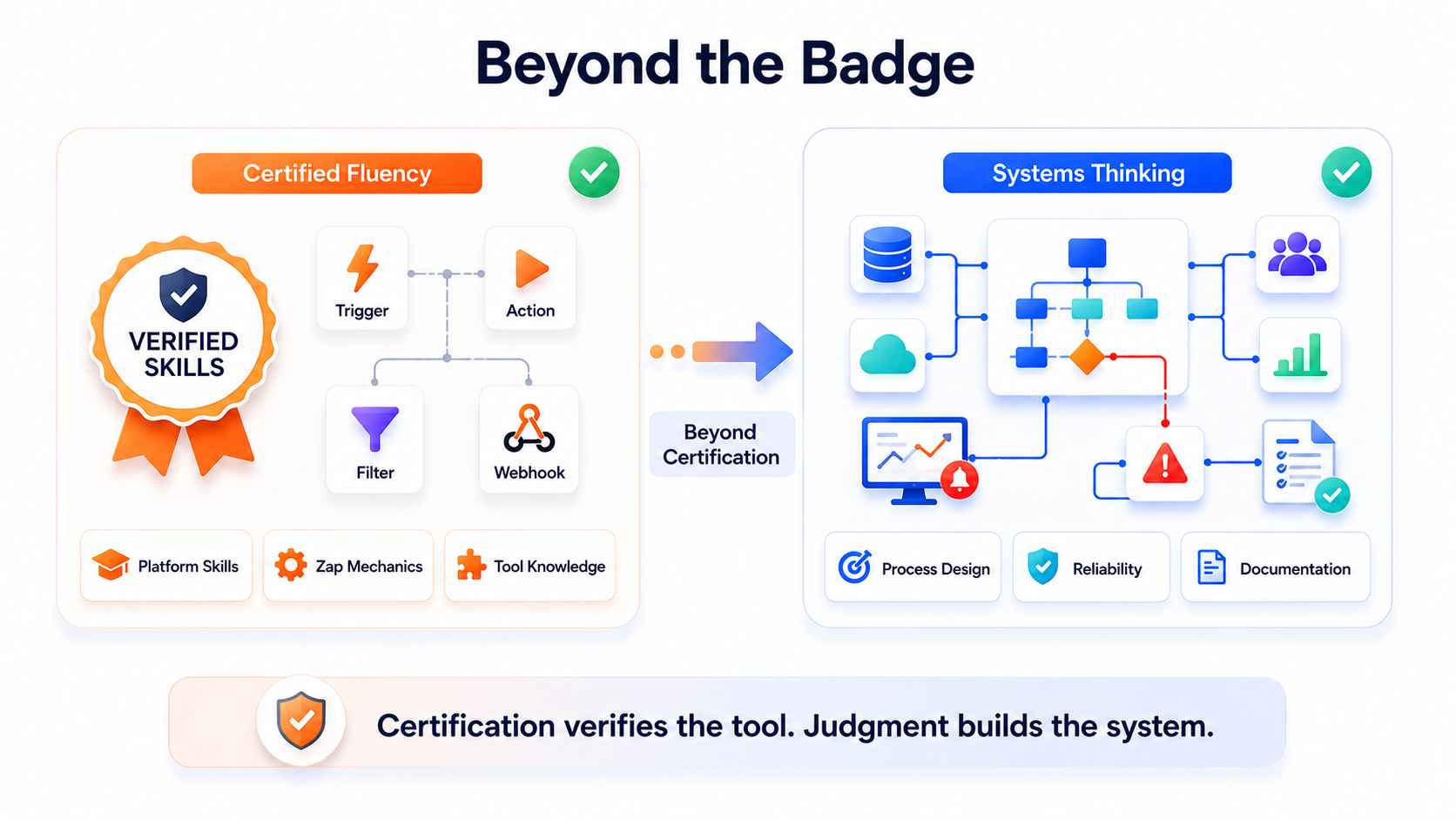
Zapier certification is a real credential with real requirements. It confirms platform mechanics: triggers, actions, paths, filters, formatting, webhooks, error basics. Passing it means the person will not build you something naive.
Here is the limit. Certification tests the tool, not the thinking. It cannot test process design, data integrity across systems, or the discipline to document. Interview for those separately. The badge is the floor, not the ceiling.
Three questions do the interviewing. Walk me through an error-handling design you shipped. Show me a case where you cut task consumption, with numbers. Tell me about a workflow you refused to build, and why. The third question finds the engineers.
Worth noting the contrast with our other credential: Attio verifies firms on shipped work with no exam, while Zapier runs formal certifications plus outcome vetting. Two programs, two philosophies. Both beat unverified claims.
The disclosure nobody makes
The Solution Partner program includes a referral benefit. Partners can earn commissions on net-new Zapier customers they bring to the platform. We disclose that here because you should read every partner's advice knowing it exists.
Our position: the referral line does not steer our recommendations, and the proof is on this site. We publish guidance that routes readers to Make, to n8n, and to custom code when those fit better. A partner who only ever recommends the platform paying them has answered your vetting question for you.
What Zapier experts actually do
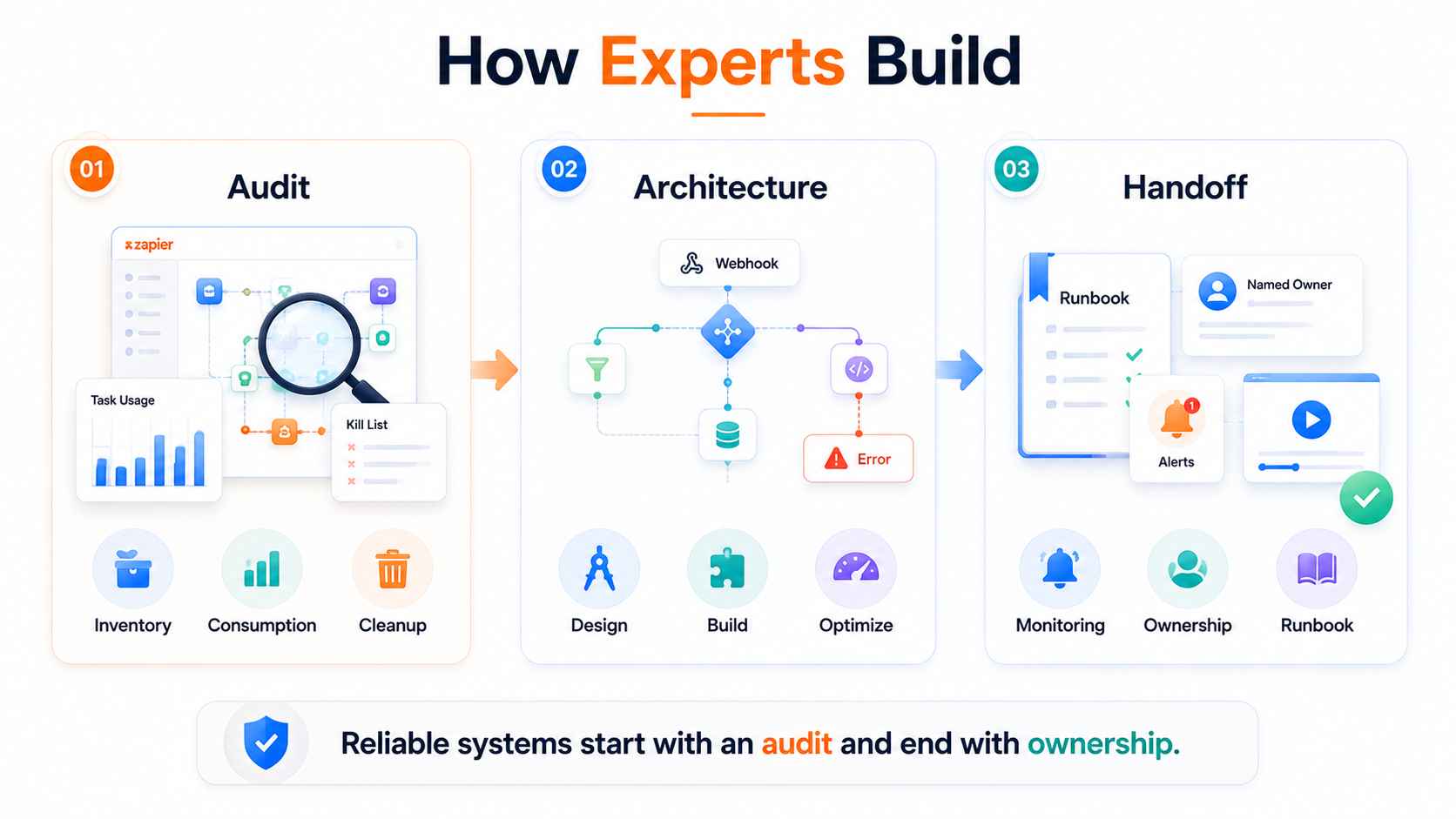
The work splits into three layers, and the third one is where projects live or die.
The audit
Good engagements start with an inventory. Every existing Zap, its purpose, its owner, its task consumption, its failure history. Most operators are shocked by their own list. Duplicates, zombie workflows firing into dead systems, and five-step builds doing what one formatter step could.
Zap sprawl is the technical debt of no-code. The audit prices it.
The audit ships three artifacts. An inventory sheet, every workflow named and owned. A consumption ranking, worst offenders first. And a kill list, workflows to retire before anything new gets built. Building on sprawl compounds it.
Architecture and build
Then the design work. Which workflows carry revenue and deserve engineering-grade care. Which systems own which data. Where a webhook beats a polling trigger. Where one well-built Zap replaces four fragile ones. Then the build itself, with naming conventions, folders, and version notes a stranger could navigate.
One shape recurs everywhere. A lead router: webhook in, enrichment lookup, branch by territory, CRM write, Slack alert, error path to a human. Five steps, engineered once, replacing a dozen ad hoc Zaps and a spreadsheet.
This is where our integration builds and sales automation work runs, across Zapier, Make, n8n, and custom code when the job demands it.
The unglamorous layer
Error handling. Alerting. Documentation. Every automation gets an owner and an error alert, because automations do not fail loudly. They fail silently, and silence costs pipeline.
Most automation projects fail at handoff, not at build. The runbook is the deliverable that outlives the engagement: what each workflow does, what its alerts mean, and how to pause it safely. No runbook in the proposal means the dependency is the product.
The alerting standard is specific. Every revenue-touching workflow alerts a named human on failure. A weekly check compares expected runs against actual runs, because a workflow that stopped firing looks identical to a quiet week until the forecast breaks.
When to hire, and when to build it yourself
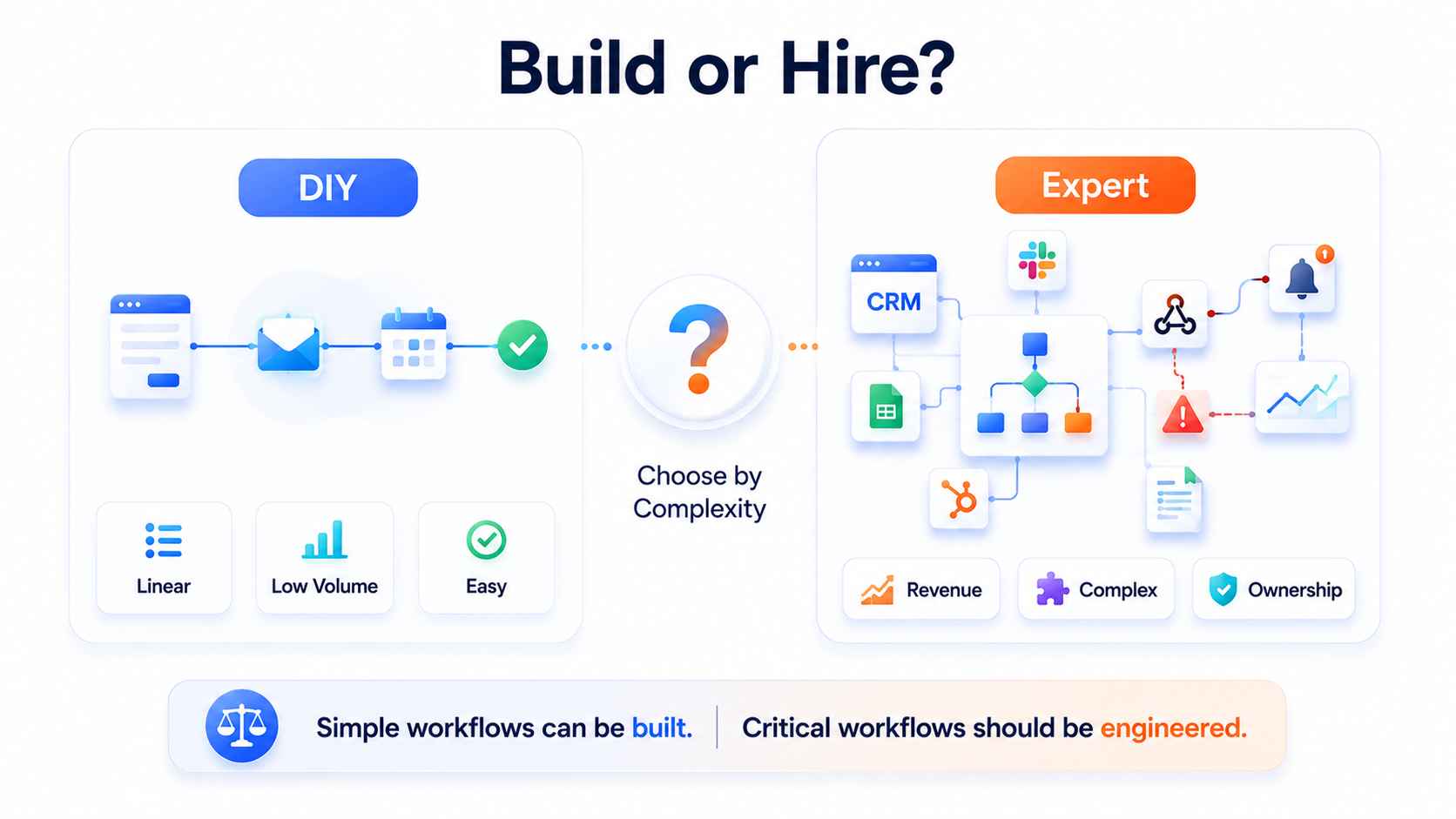
Zapier sells self-serve, and the pitch is honest. Experts exist for the day self-serve meets scale.
Build it yourself when the workflow is linear, the volume is low, and a failure costs an inconvenience. Lead notifications, form-to-sheet flows, calendar routines. The editor is friendly and the templates are good. Hiring for this wastes money.
Hire when any of four thresholds appear. The workflow touches revenue data, where a silent failure costs pipeline. The logic branches across systems with lookups and transforms. The task bill grows faster than the business, which signals inefficient builds. Or nobody owns the automations, and the person who built them left.
One warning applies to both paths. Automation amplifies the process it runs. Automating a broken process breaks things faster. Fix the process on paper first, then automate the fixed version. Experts worth hiring insist on this order.
Complexity draws the line, not company size. Our broader take on when operators need automation help lives in automation consulting for operators.
What hiring should cost
No dollar figures, structure only. Three engagement shapes exist, and the shape tells you more than the number.
Hourly with no cap is the shape to avoid. Hourly billing pays consultants to think slowly, and automation debugging is where slow thinking hides best.
Fixed-fee projects fit audits, builds, and migrations. Named deliverables, a runbook in scope, and an end date. This is how we work, and the structure sits on our pricing page.
Retainers fit ongoing ownership: monitoring, incident response, and iteration. Legitimate when the automation estate is large and changing. Ask what the retainer includes per month in writing, or it becomes insurance you cannot claim when it matters.
Whatever the shape, apply the test from the top. Reliability up, task consumption down. An expert who adds workflows without retiring any is decorating, not engineering.
The task economics deserve one plain paragraph. Zapier bills by task, and every action step in every run consumes one. Inefficient builds multiply consumption invisibly. A polling trigger checking every few minutes burns tasks finding nothing.
A loop processing rows one by one burns a task per row. Good architecture routinely cuts consumption by half without removing a single capability. That saving compounds monthly, which is why the audit pays for itself.
Red flags when hiring
The proposal has no audit phase. Building on top of sprawl compounds it.
No error handling in scope. Ask directly what happens when a Zap fails on a Friday night. Silence is the answer to walk away from.
No naming conventions or documentation. Fifty Zaps named "Copy of Copy of New Lead" is a real thing we have inherited. The cleanup costs more than doing it right did.
Platform monogamy. If every problem is a Zapier problem, you found a commission, not a consultant. The reverse also applies: anyone who dismisses Zapier entirely is selling their preferred complexity.
No verifiable listing. The directory exists. Thirty seconds. Use it, then interview past it.
One more, and it is the expensive one. The consultant builds in their own Zapier account. Your automations must live in a workspace you own, with the consultant invited in. Anything else makes your revenue infrastructure a hostage at contract renewal.
When Zapier is the wrong tool
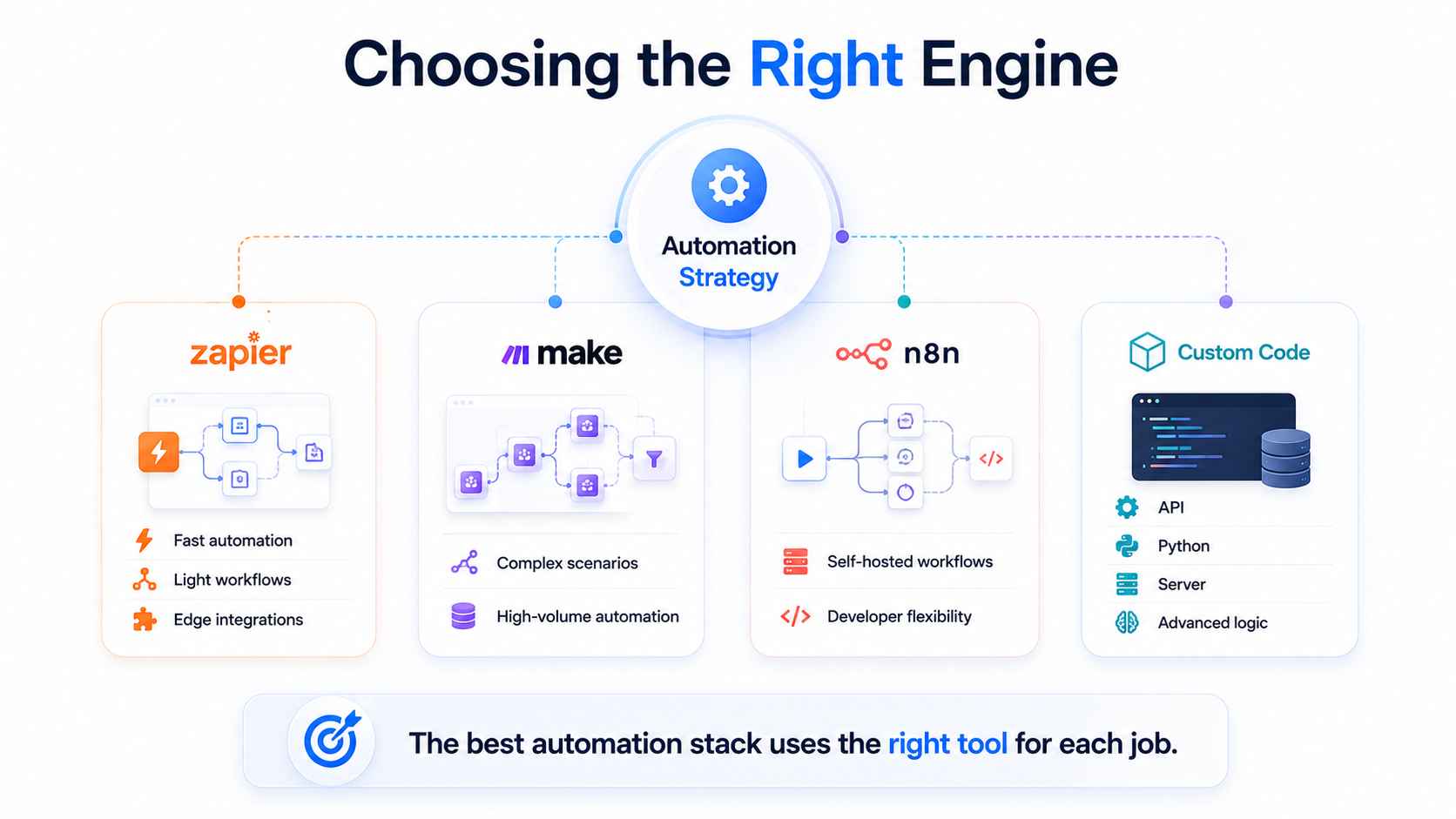
A certified Zapier partner telling you when to skip Zapier is the credibility test, so here it is.
High-volume data pipelines outgrow task-based pricing. Thousands of records daily belong in Make, n8n, or a small custom service, where the economics work differently. Complex branching with heavy transforms fights the Zap model past a certain depth. Self-hosting and data residency requirements point at n8n. And genuinely custom logic sometimes just wants fifty lines of Python behind a webhook.
The mature answer is usually hybrid. Zapier handles the edges, where speed of change matters. Heavier engines handle the core, where volume and control matter. Tool boundaries drawn on purpose beat platform loyalty in every audit we run.
Our own stack includes all of the above. The Pipedrive Salesforce integration guide shows how we weigh middleware against custom builds in practice. The tool serves the system. Never the reverse.
How ACS works
Fixed fee. Refundable discovery first: the automation audit, a ranked bottleneck list, and a scoped build plan. Then architecture, build, error alerting, and the runbook handoff with role-based training.
The credential is checkable: our Zapier Certified Solutions Partner listing and Attio Expert Partner verification both sit on the partners page with directory links. The sibling deep-dive on our other credential is the Attio Expert Partner assessment.
The two credentials work as a pair on purpose. Zapier verifies the connective layer, how systems talk. Attio verifies the system of record, where the data lives. Operations infrastructure needs both layers built well, and holding verified credentials on each keeps the whole stack inside one accountable engagement.
The proof: 500+ workflows shipped, more than 10,000 hours reclaimed, over $2 million in client savings across seven industries. The shipped systems live in the case studies.
Frequently asked questions
What is a Zapier Solution Partner?
A consultant, freelancer, or agency vetted through Zapier's partner program and listed in the public directory. The program replaced the older Zapier Experts branding. Tiers advance on certifications, client outcomes, and platform activity.
What does Certified Zapier Expert mean?
It is the entry tier of the Solution Partner program, backed by real certification requirements covering platform mechanics. It proves tool fluency. It does not prove systems thinking, so interview for architecture and error handling separately.
How do I verify a Zapier expert?
Search Zapier's partner directory for the listing and tier. Then ask three things: show me an audit document, show me a runbook you handed off, and tell me how you cut a client's task consumption. Verified plus specific is the standard.
What do Zapier consultants charge?
Structure varies more than rates. Fixed-fee projects with named deliverables fit most builds. Retainers fit large automation estates needing ongoing ownership. Avoid uncapped hourly. Whatever the model, the value test is reliability up and task spend down.
When should I hire instead of building it myself?
Hire when workflows touch revenue data, when logic branches across systems, when the task bill outgrows the business, or when nobody owns the estate. Simple linear workflows with low stakes are a solid DIY project. Complexity draws the line.
Do Zapier partners earn commissions?
The Solution Partner program includes a referral benefit on net-new Zapier customers. We disclose ours. Read every partner's platform advice with that incentive in mind, and weight advice from partners who demonstrably recommend other tools too.
Can a Zapier expert reduce my task costs?
A good one should. Consolidating redundant Zaps, replacing polling with webhooks, moving heavy loops out of task-based billing, and killing zombie workflows all cut consumption. Ask candidates for a specific example with numbers from past work.
Should the Zapier account be in our name or the consultant's?
Yours. Always. The consultant works as an invited member in a workspace you own and pay for. Ownership means you keep the automations, the history, and the connections when the engagement ends. Any other arrangement is a dependency dressed as a service.
What if Zapier is the wrong tool for us?
Then the right expert says so. High-volume pipelines, deep branching logic, and self-hosting requirements point at Make, n8n, or custom code. We build across all of them, which keeps the recommendation about your system instead of our badge.
Hiring automation help?
Three ways to start.
Book a paid discovery. The audit, the ranked bottleneck list, and a scoped plan. Refundable if we are the wrong fit. See pricing.
Verify the credential. The partners page links both directory listings. Check first, talk second.
Review the proof. The case studies show shipped automation systems with the hours and savings counted.
Fluency is the floor. Systems thinking is the hire.