

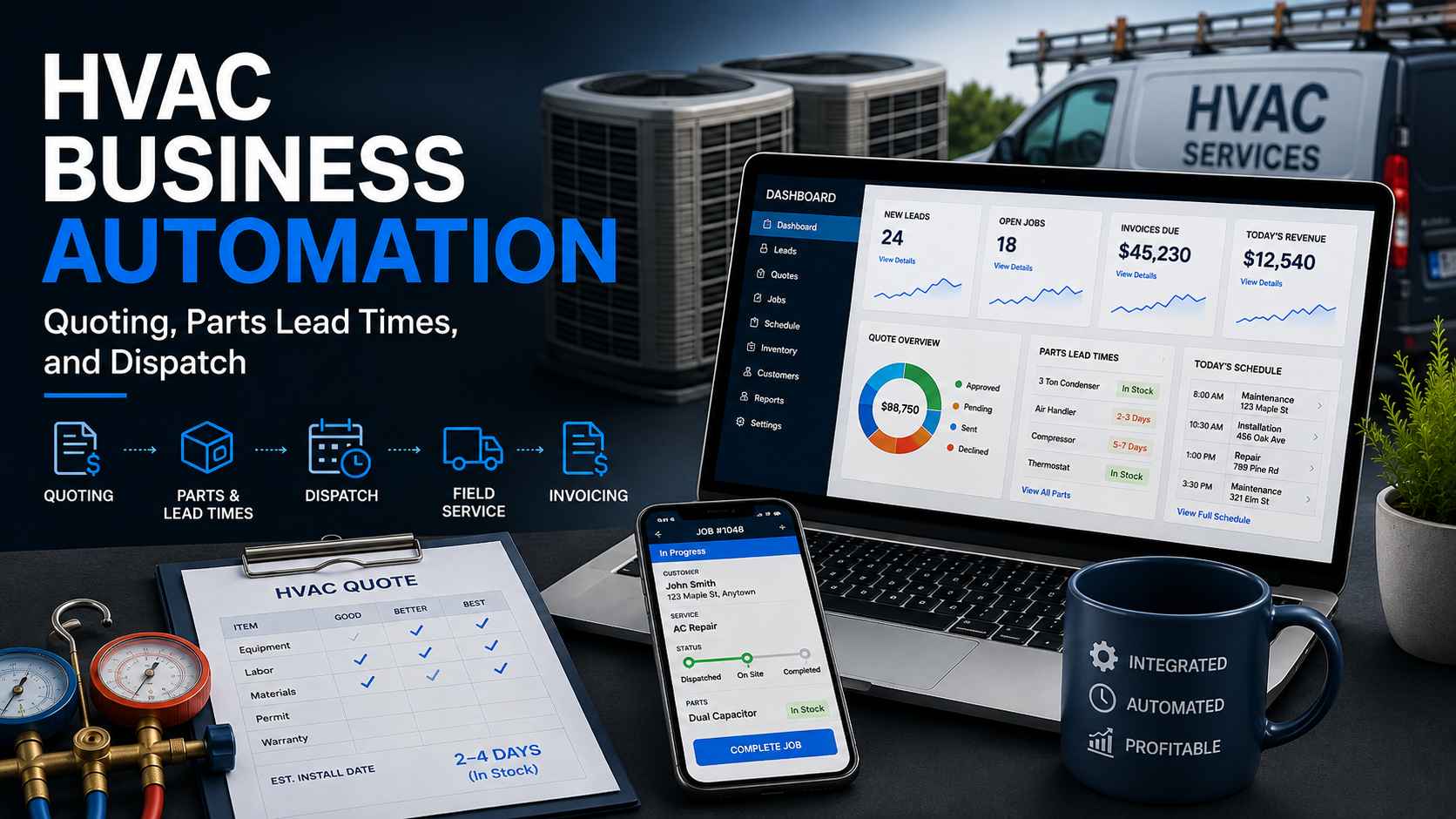
We build operations infrastructure with engineering discipline for $10M-$50M operators, and HVAC is where the practice runs deepest. The HVAC lead-time automation in our case studies is live in production today: distributor stock and supplier timelines pulled straight into quoting and scheduling.
Most of what ranks for this topic sells software subscriptions. This guide builds systems. Different product, and the difference is the whole post.
What is HVAC business automation?
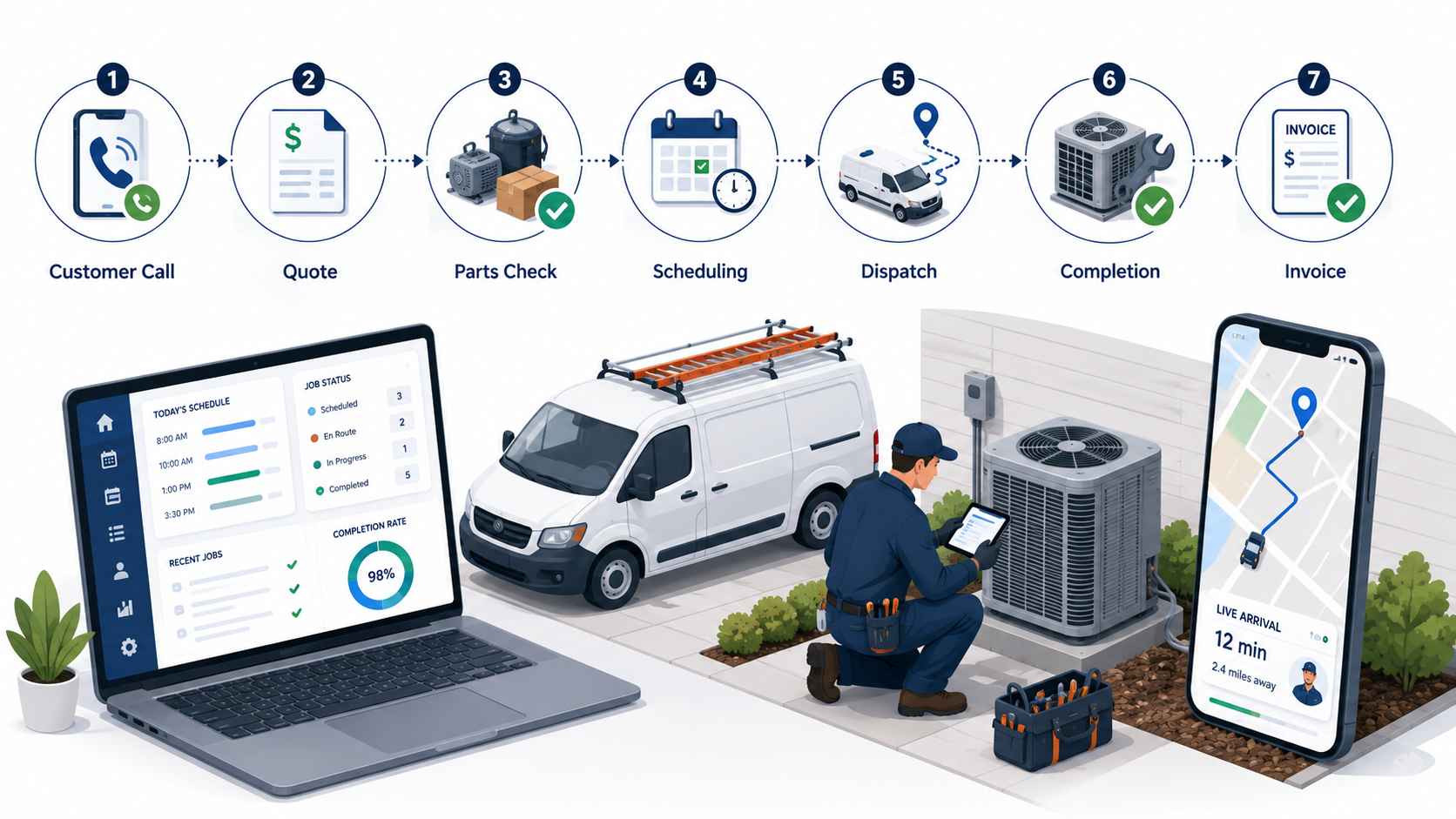
HVAC business automation is the connected workflow that runs an HVAC operation with minimal manual transport: calls become jobs, quotes price themselves from live data, parts commit before trucks roll, dispatch matches the right tech to the right call, and invoices fire on completion.
It is the general operations spine wearing an HVAC uniform. Same six links. HVAC adds two hard twists: parts availability decides schedules, and demand spikes with the weather. Both twists shape every design decision below.
The twists compound each other. A heat wave triples calls exactly when regional stock runs thin. Generic ops advice ignores that collision. HVAC automation is designed around it, or it fails in season, publicly, one apologetic phone call at a time.
The payoff is measured in trucks and hours. Fewer second trips. Faster quotes. Techs billable instead of waiting on parts. An office that handles exceptions instead of phone trees. And a customer who got a real date, a live arrival window, and an invoice before the truck left the driveway.
Contractors and distributors: two HVAC businesses, one spine
The search results treat HVAC as one business. It is two, and they automate differently.
HVAC contractors sell service and installs to homes and businesses. Their spine runs call to dispatch to completion to invoice. Their quoting is tiered replacement options and flat-rate service pricing. Their parts problem is truck stock and supplier availability.
HVAC distributors sell equipment and parts to those contractors. Their spine runs quote request to counter to delivery. Their quoting is line-item pricing at volume with availability attached.
Their parts problem IS the business. Counter automation matters here too: a contractor emailing a parts list gets a priced, availability-checked quote back in minutes, parsed and priced without a person retyping SKUs.
Both segments run through this guide, and the quote automation pipeline behind both is the same five stages. Contractors should read the dispatch sections hardest. Distributors should read the lead-time layer twice. Our shipped distributor build proves the harder case: when quoting and availability fuse, the whole spine speeds up.
HVAC quoting automation
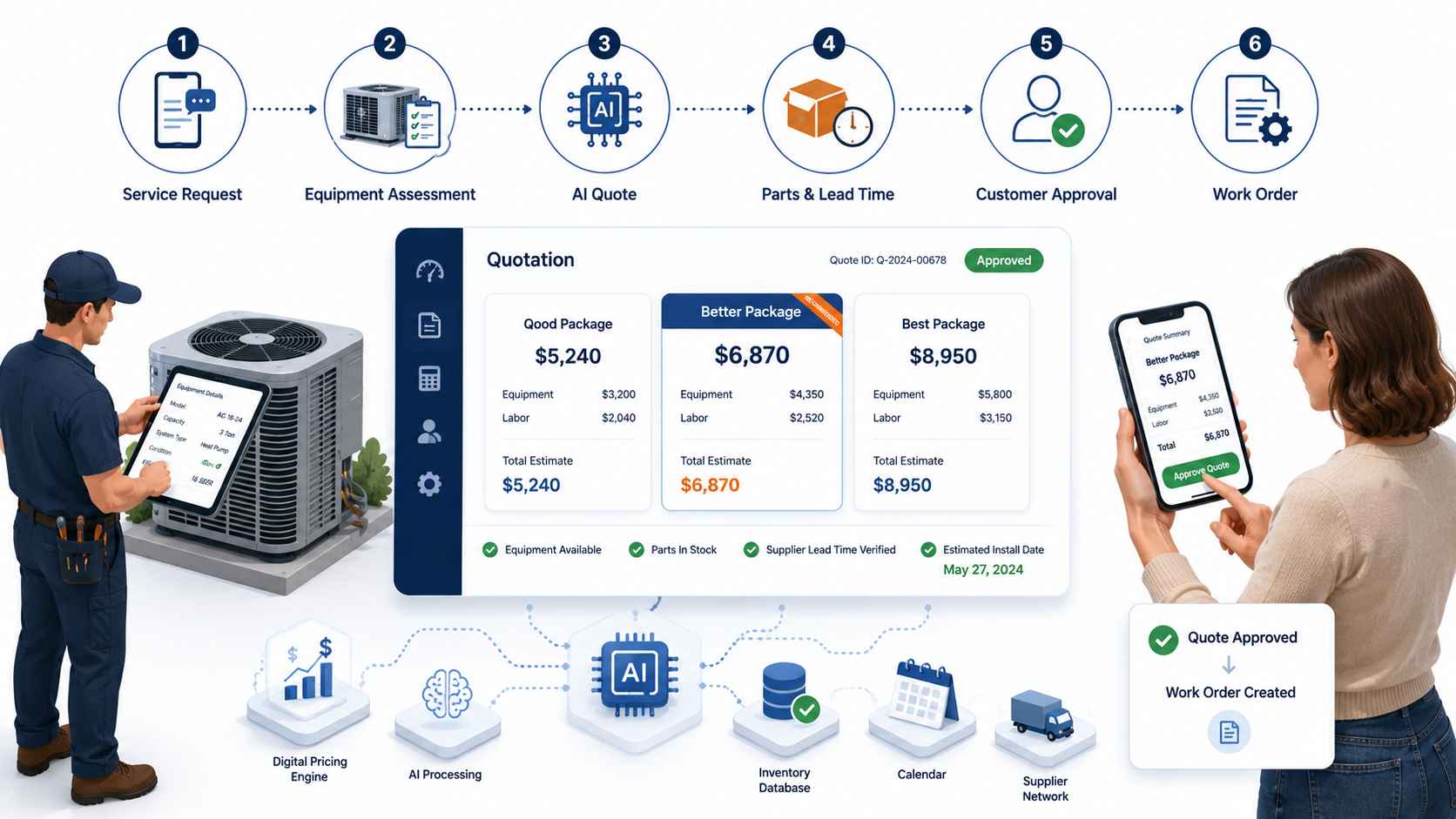
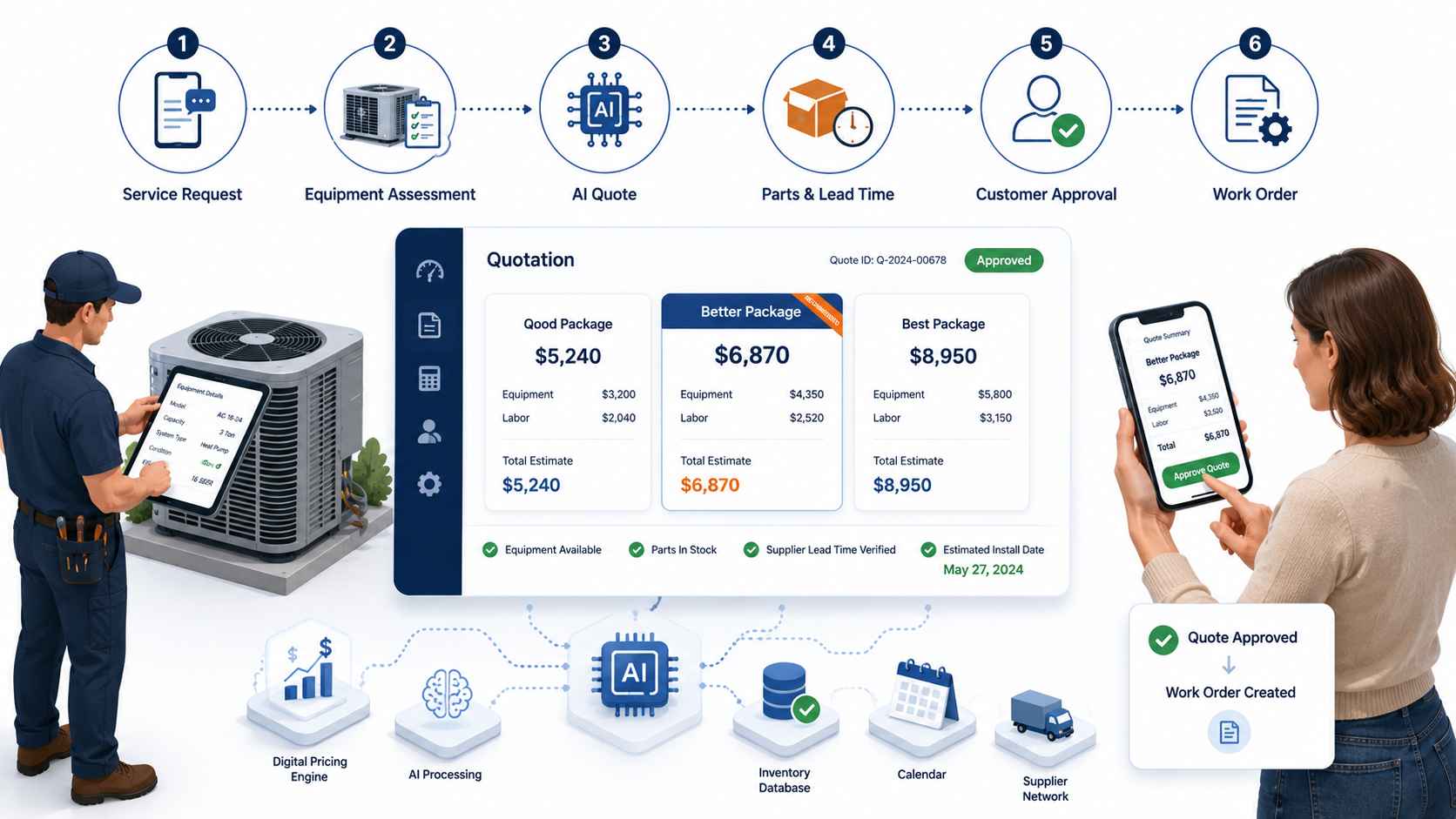
Quoting is where HVAC wins or loses the job, and speed decides more than price does.
Tiered replacement quotes without the pricebook math
Replacement quotes assemble from rules. Equipment tier, capacity, labor rates, refrigerant, and code items pull from governed tables. Good-better-best options toggle per quote instead of three rebuilds. The customer signs from a phone, and the deposit clears the same hour.
The engine logic follows the pipeline in our quoting guide. Rules write the numbers. Templates write the document. The tech presents options at the kitchen table instead of promising a call-back nobody wins.
Intake gets an AI assist that respects the split. Site photos and model-plate shots parse into specs automatically, feeding the engine clean inputs. AI reads the nameplate. Rules still price the job.
The lead-time truth layer
Here is the layer most quoting setups skip, and the one our shipped build proves.
Distributor stock in the quote
The quote checks what the supply house actually has before promising anything. In stock nearby means an install date this week. The quote says so, and the date sells.
Supplier lead times in the schedule
Out-of-stock equipment carries a real timeline, pulled live from supplier data. The quote shows an honest install window instead of a guess. The schedule books against the truth.
A quote without a lead time is a guess wearing a price. The install date sells the job as much as the price does, and the shop quoting real dates wins against the shop quoting hope.
The delay callback never happens, because the promise matched the supply chain on day one. The full build is documented in the HVAC lead-time case study.
Service quoting from the field
Diagnostic done, quote on the spot. Flat-rate repair options from the same governed tables, presented on the tech's phone, approved with a signature. No office round trip. No evening backlog. The job continues while the customer is still saying yes.
Maintenance agreements ride the same screen. The membership option attaches to every repair quote automatically, priced from the same tables. Recurring revenue stops depending on the tech remembering to mention it.
Parts and inventory automation for HVAC
Parts truth is schedule truth. The inventory layer feeds everything above it.
Committed versus on-hand, across trucks and warehouse
Ten condensers on the shelf means nothing when eight belong to next week's installs. The system counts both numbers: on-hand and committed. Trucks count as micro-warehouses, with usage scanned as parts leave the shelf on site.
The schedule reads the honest number. Jobs book against available, never against visible. That one rule kills most second trips before they get scheduled.
The trucks close their own loop. End of day, usage scans roll into a per-truck restock list. Morning starts with shelves matching tomorrow's jobs, not last week's guesses.
Supplier sync and reorder automation
Stock drops below threshold, the purchase order fires. Supplier confirmations flow back with dates attached, and those dates feed the quoting layer above. Refrigerant and fast-moving consumables run on standing reorder rules, so the shelf never surprises a Monday.
Second-source rules cover the slip. When the primary supplier's lead time crosses a limit, the system checks the alternate and flags the buyer with both options priced. One rule, and a regional stockout stops rewriting your install calendar.
The loop closes both directions. Suppliers feed availability in. Usage feeds reorders out. The integration builds work underneath keeps every sync alerted and owned, because a silent supplier-feed failure poisons every quote downstream.
HVAC dispatch and scheduling automation
Dispatch runs on the same routing logic as our speed-to-lead playbook: rules assign, timers guard, fallbacks catch.
Skill and certification matching
The no-cool call routes to the closest tech certified for the equipment. Commercial RTU work routes to the commercial crew. Rules read certifications, territory, and current load, and the dispatcher handles exceptions instead of playing calendar Tetris. Maintenance-agreement customers carry a priority flag, so the promise in the contract shows up in the queue.
The emergency lane
HVAC dispatch needs two lanes by design. Scheduled work fills the calendar by rules. Emergencies preempt it by rules too: a triage tier, a slot held per tech per day in season, and an escalation path when the day overruns. The emergency lane is designed in advance or improvised at 4 p.m. daily. There is no third option.
After hours, intake keeps working. Calls and web requests capture symptoms, triage against the emergency rules, and book the first morning slot or page the on-call tech. The 2 a.m. no-heat call gets an answer either way.
Customer updates that cut inbound calls
Booking confirmation. Day-before reminder. On-my-way text with a live window. Completion summary with the invoice attached. Each message fires from job status automatically, and the where-is-my-tech calls stop arriving, because the answer already did. The review request rides the completion message, timed while the fixed air is still blowing.
Where FSM software ends and the build begins
Honesty about the tooling, because the search results blur it.
Field service management platforms are the record layer for contractors: jobs, schedules, invoices, truck stock. Good ones cover several spine links natively. Configure yours to its real limits first. That advice costs us nothing and saves you plenty, and it is the same configure-before-build rule we publish on every surface we serve.
The build begins at the seams the platform leaves. Supplier lead times synced into quoting. Distributor pricing engines at volume. The FSM talking to accounting, supplier portals, and the CRM without re-keying. Multi-location inventory truth. These are cross-system builds with error handling and ownership attached, and no subscription ships them.
The sort is the same one that runs through all our work: configure what you own, engineer across what you own, and buy a new category only when the design demands it.
Run the seam inventory in one afternoon. List every place someone re-types data between two screens. Each entry is a seam, each seam is a build candidate, and the weekly minutes on each rank the list for you.
The July test: designing for peak season
Every HVAC system meets its real exam in a heat wave. Call volume triples. Techs run long. Parts vanish regionally. The office drowns.
Automation passes the test because rules do not get tired. Triage keeps emergencies ahead of maintenance. The emergency lane absorbs the surge it was sized for.
Customer updates keep sending while phones ring. Reorders fire while everyone is on a roof. The dispatcher runs a bigger board with less shouting, which is the whole point of the design.
Design for July in February. The system that survives peak season pays for itself in one of them, and the shops that automate in the off-season meet the surge with rails already laid. Northern markets run the same exam in January, wearing a no-heat uniform. Same design, opposite thermometer.
The numbers that prove it
Five metrics, baselined before the build, measured after. Two weeks of honest timestamps beats every vendor promise, and the baseline prices the win in your own numbers before anything gets built.
Quote turnaround, request to delivered. First-visit completion rate, the parts-truth metric, because completions rise when trucks roll with the right parts committed. Truck rolls per job. Days from completed to invoiced. Callback rate.
First-visit completion deserves the spotlight. It moves with inventory truth more than with tech skill, and every point of improvement deletes a second trip, a customer wait, and a truck's worth of cost. The spine shows up in that one number first. Watch it weekly by tech and by job type, because the laggard segment names the next fix, same as every metric in this practice.
How ACS builds HVAC automation
Fixed fee, after a paid and refundable discovery. Discovery walks one real job through your current spine, from call to cash, timestamps the touches, and ranks the leaks in writing. Contractor or distributor, the map fits the segment.
The proof runs live. The HVAC lead-time build fused supplier truth into quoting and scheduling for a distributor in production today. The wider practice sits on the operations automation page, the engagement structure on pricing, and the full record in the case studies: 500+ workflows shipped, more than 10,000 hours reclaimed, over $2 million in client savings across seven industries.
Frequently asked questions
How do I automate my HVAC business?
Walk one job from call to cash and timestamp every manual touch. Rank the leaks. Automate the biggest first, usually quoting or dispatch, on a fixed fee, measured for thirty days. Expand link by link as each build pays for the next. The off-season is the building season, so the surge meets rails instead of improvisation.
What is the best HVAC software?
Judge categories against your segment. Contractors need a field service record layer plus builds at the seams. Distributors need quoting engines fused with availability. No single subscription covers either spine completely, so the design comes before the shopping.
How does HVAC quoting automation work?
Rules and rate tables price the job. Templates build the document. Availability and lead times attach the honest install date. The customer approves from a phone. The pricing logic stays yours, governed in tables your team edits.
Do I need dispatch software for a small HVAC shop?
At two or three trucks, a shared calendar with routing rules and automated customer texts covers most of it. Dedicated dispatch earns its seat as trucks multiply and the emergency lane needs real design. Let the truck count decide, and let the missed-call count confirm it.
What does HVAC automation cost?
Cost follows scope: system count, workflow complexity, and integration depth. Builds price once at fixed fee. Platforms bill per tech monthly. Run the payback on second trips deleted and quotes accelerated, and the math usually closes inside a season.
What about HVAC distributor automation specifically?
Distributors live on quote speed at volume with availability attached. The build fuses pricing engines with live stock and supplier lead times, so the quote and the promise agree. Our shipped distributor build is the documented pattern, and email-to-quote parsing removes the counter bottleneck on top.
Does automation replace the dispatcher?
No. It replaces the dispatcher's phone tree. Rules handle routine assignment and updates. The dispatcher handles exceptions, escalations, and judgment, which is the actual job. One person runs a bigger board calmly.
Can AI answer HVAC service calls?
For intake, yes. AI captures symptoms, triages against your rules, and books slots after hours, which beats voicemail every night. Judgment stays human: pricing exceptions, angry customers, and edge cases route to people. AI takes the call. Rules run the triage. Humans keep the hard parts.
Where do parts lead times fit in quoting?
Inside the quote itself. Stock status sets the install date. Supplier timelines set the window for out-of-stock equipment. The customer sees an honest date, the schedule books against truth, and the callback about delays never happens.
Quoting on hope while competitors quote on truth?
Three ways to move.
Book a paid discovery. One job walked from call to cash, leaks ranked, one fixed price. Refundable if we are the wrong fit. See pricing.
See the shipped build. The HVAC lead-time case study shows supplier truth fused into quoting, live.
Read the practice. The operations automation page covers the full spine.
Real dates win the jobs. Committed parts finish them on the first visit. The spine does both, every day.