

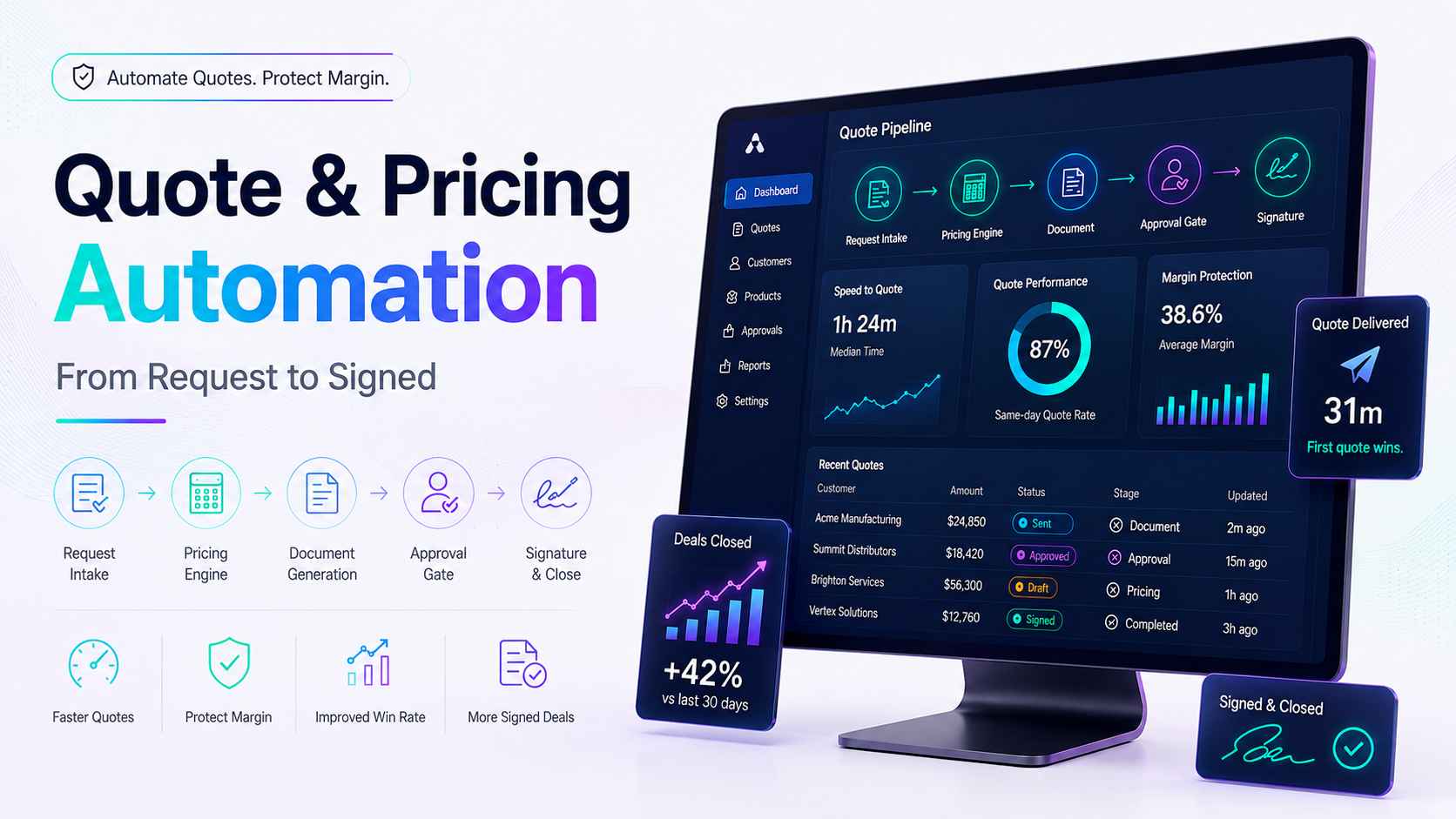
We build operations infrastructure with engineering discipline for $10M-$50M operators. Quoting systems are recurring work inside our sales automation practice, with shipped builds across supplements, HVAC distribution, and complex field services.
We are a Zapier Certified Solutions Partner and an Attio Expert Partner. No quoting-software vendor pays us. The pipeline below runs on whatever stack you already own.
What is quote and pricing automation?
Quote and pricing automation is a workflow that receives a request, calculates the price from rules, generates the document, routes any approval, and delivers it for signature. No manual math. No template hunting. No week of silence while the prospect shops elsewhere.
The unit of value is time. A quote that arrives in an hour competes on merit. A quote that arrives in a week competes on apology. The first quote in wins share the same way the first touch does, and we covered that speed law in the lead routing playbook. Slow quotes also invite the discount conversation, because a buyer who waited feels owed something. Speed protects the price twice.
The unit of safety is margin. Automated pricing applies the same rules every time. No forgotten surcharge. No accidental discount. No rep improvising a number at 6 p.m. on a Friday.
There is a third unit: rep hours. Every hour spent assembling quotes is an hour not spent selling. Quoting is the most automatable hour in the sales day, and the most commonly wasted one.
Quote automation vs CPQ vs dynamic pricing: the sort
Three terms tangle in this topic. Sort them before buying anything.
Quote automation is the outcome: request to signed, automatically. It runs on your CRM, a rules layer, document generation, and e-signature. Any stack can produce it.
CPQ is a product category: configure, price, quote suites built for complex product configuration at enterprise scale. Salesforce popularized the term, and its quote object anchors that world. CPQ is one road to the outcome.
It is the heaviest road, and most $10M-$50M operators need the outcome without the category. Our Salesforce implementation guide covers when that weight earns itself.
Dynamic pricing is a strategy: algorithmic price changes responding to demand, common in retail and travel. Different problem. Different math. A B2B quote workflow is not dynamic pricing wearing a suit.
This guide covers the first term, built with whichever tools fit.
The quote-to-signed pipeline: five stages
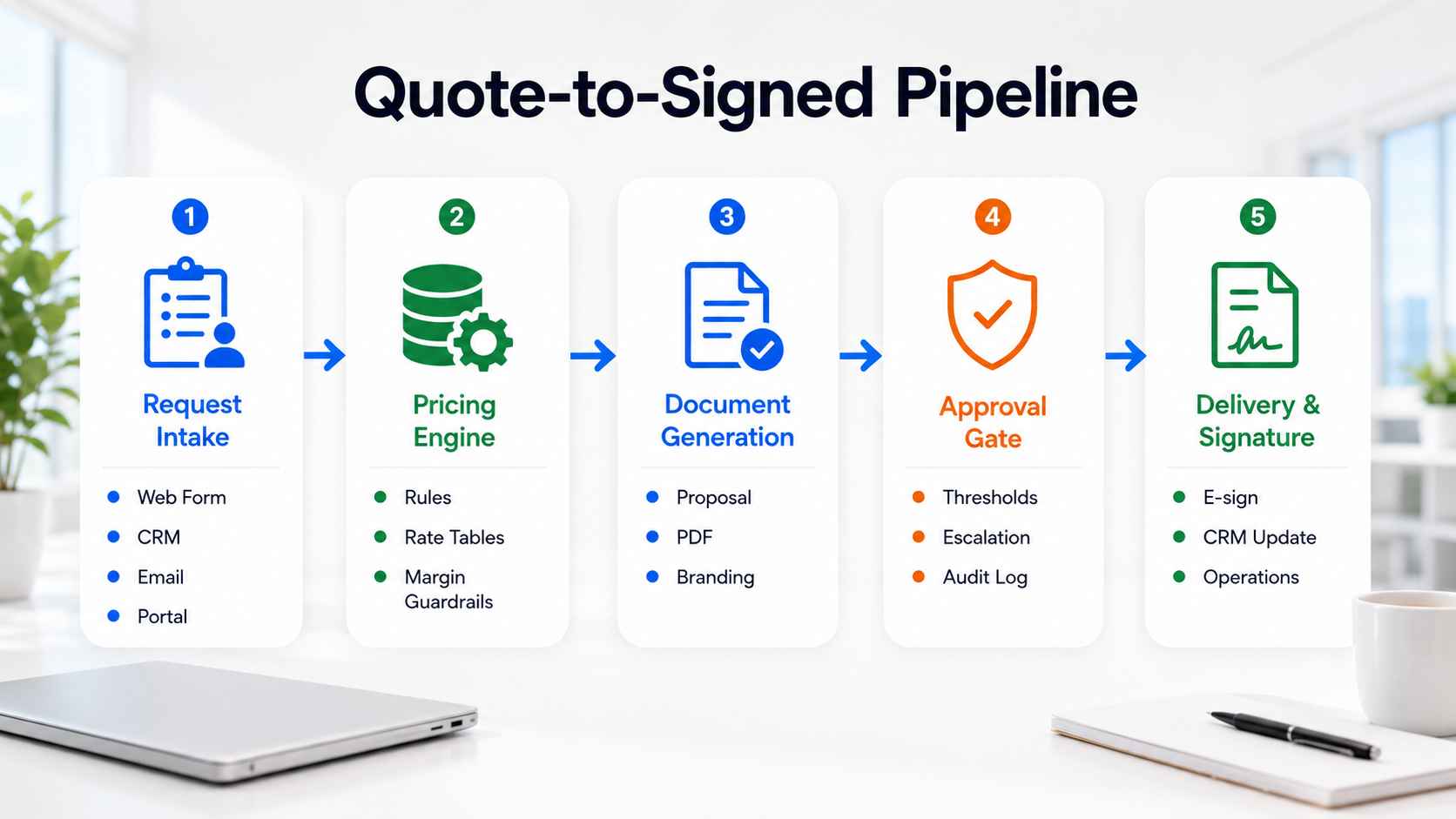
Every quoting system has the same skeleton. Five stages. Each stage has one job.
Stage one: request intake
Every quote request lands in one place. Web form. Email parse. Rep-initiated from the CRM. Portal submission. One intake, structured fields, no retyping.
Structure at intake decides everything downstream. The request captures what the engine needs: quantities, specs, location, timeline. A vague request produces a slow quote. The form does the interviewing.
Email requests join the same lane. A parser extracts the fields from inbound RFQs and files a structured request. And every arrival checks for duplicates first, because two quotes for one request means two prices for one buyer.
Stage two: the pricing engine
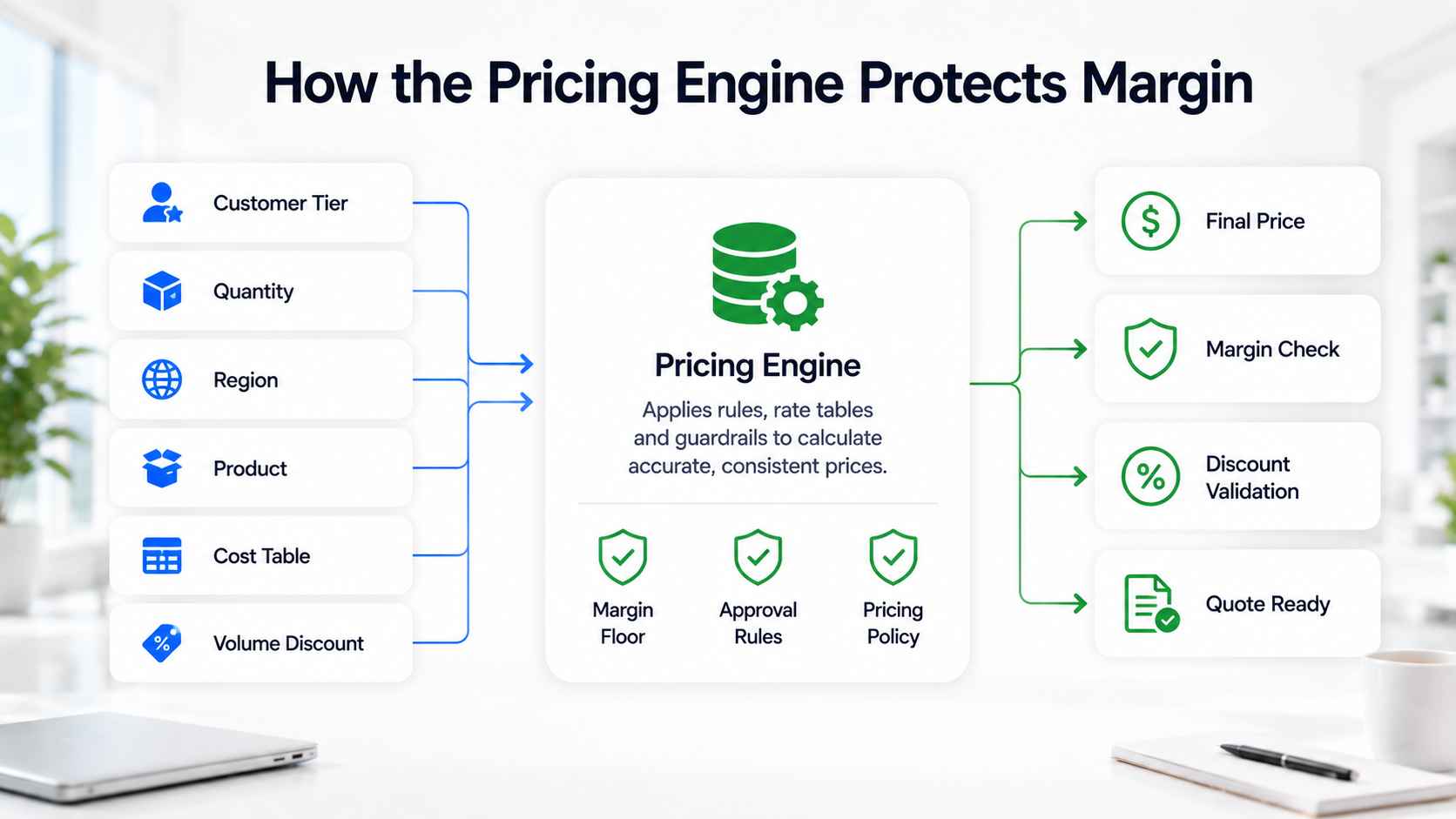
The heart of the system. Inputs go in. A price comes out. The logic lives in one governed place.
Rules and rate tables
Prices come from tables, not memory. Unit rates. Volume tiers. Customer-specific pricing. Regional adjustments. Cost-plus formulas. The engine reads the tables and applies the rules, identically, every time.
One example shows the shape. A returning customer at gold tier requests two hundred units. The engine finds the tier, applies the volume break, adds the regional factor, and prices in seconds. The rep never opened a calculator.
Complex services fit here too. Multi-variable calculations, dependent line items, and conditional charges are still rules. Harder rules. Same engine.
Margin floors and guardrails
Every price checks against a floor before it leaves. Below-floor outputs get blocked or routed for approval. A margin floor in the engine beats a margin plea in training, because the engine never has a bad quarter to hit.
Guardrails extend past margin. Maximum discounts. Expiration dates. Terms that match the customer tier. The rules encode the pricing policy nobody could enforce by memo.
The spreadsheet wearing an API
Here is the honest secret. Most mid-market pricing logic already lives in a spreadsheet someone trusts. The build does not replace that logic. It wraps it. The sheet becomes the engine's source, versioned and governed, and the workflow reads it through a connection instead of a copy-paste.
That approach keeps the pricing owner in control. Finance edits the table. The system inherits the edit. Nobody re-learns their own pricing inside a vendor's interface. Every table change gets versioned with a date and a name, so last quarter's quote can always explain itself.
Stage three: document generation
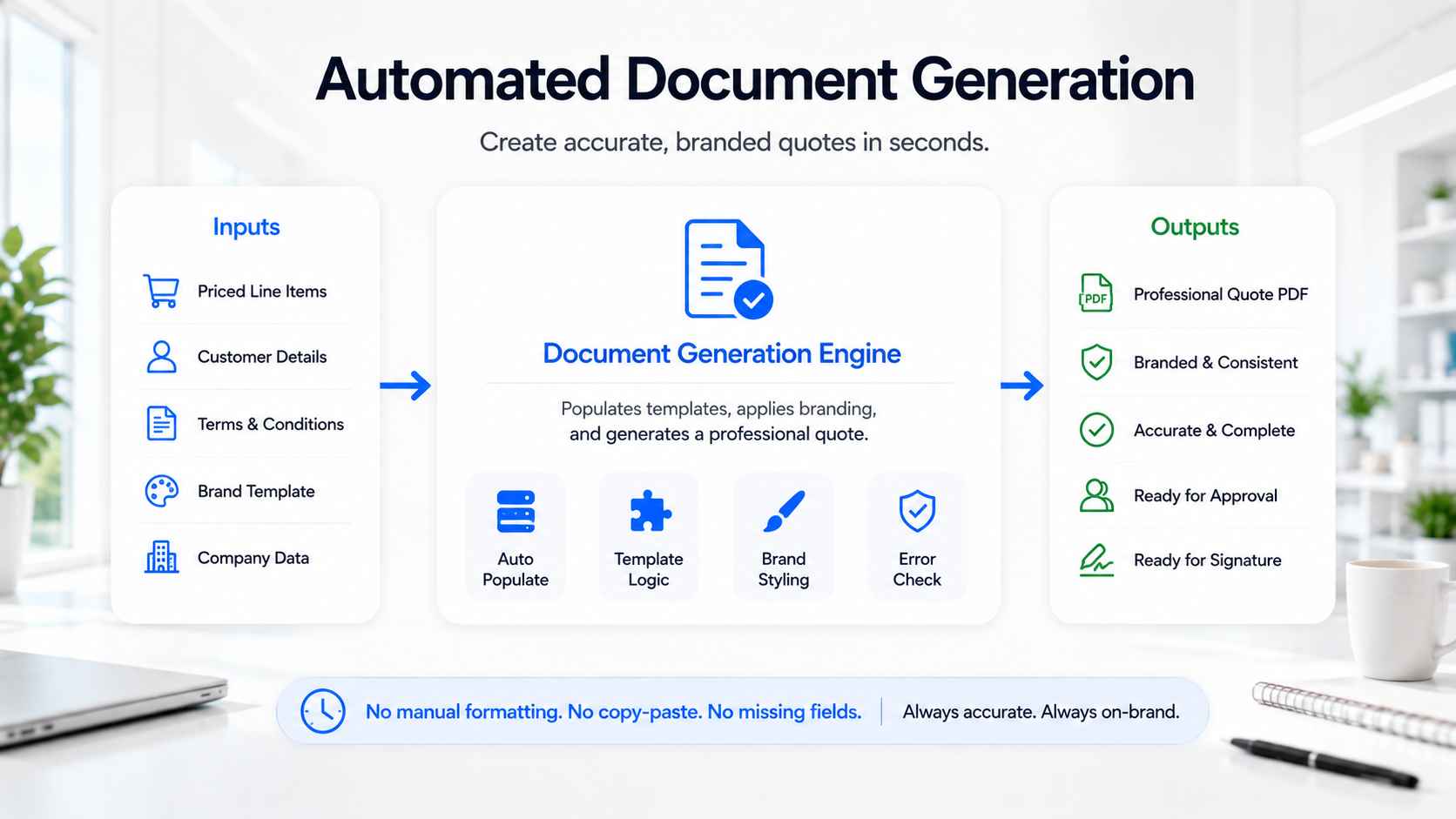
The price becomes a document automatically. Template filled. Line items listed. Terms attached. Branding correct. Version logged. Optional line items toggle per quote, so good-better-best goes out without three rebuilds. The output lands as a branded PDF and a signable link, both filed automatically.
Templates get one owner and one library. Ten rogue templates produce ten inconsistent promises. Document generation overlaps our admin workflows practice, because proposals, SOWs, and quotes share the same machinery.
Stage four: the approval gate
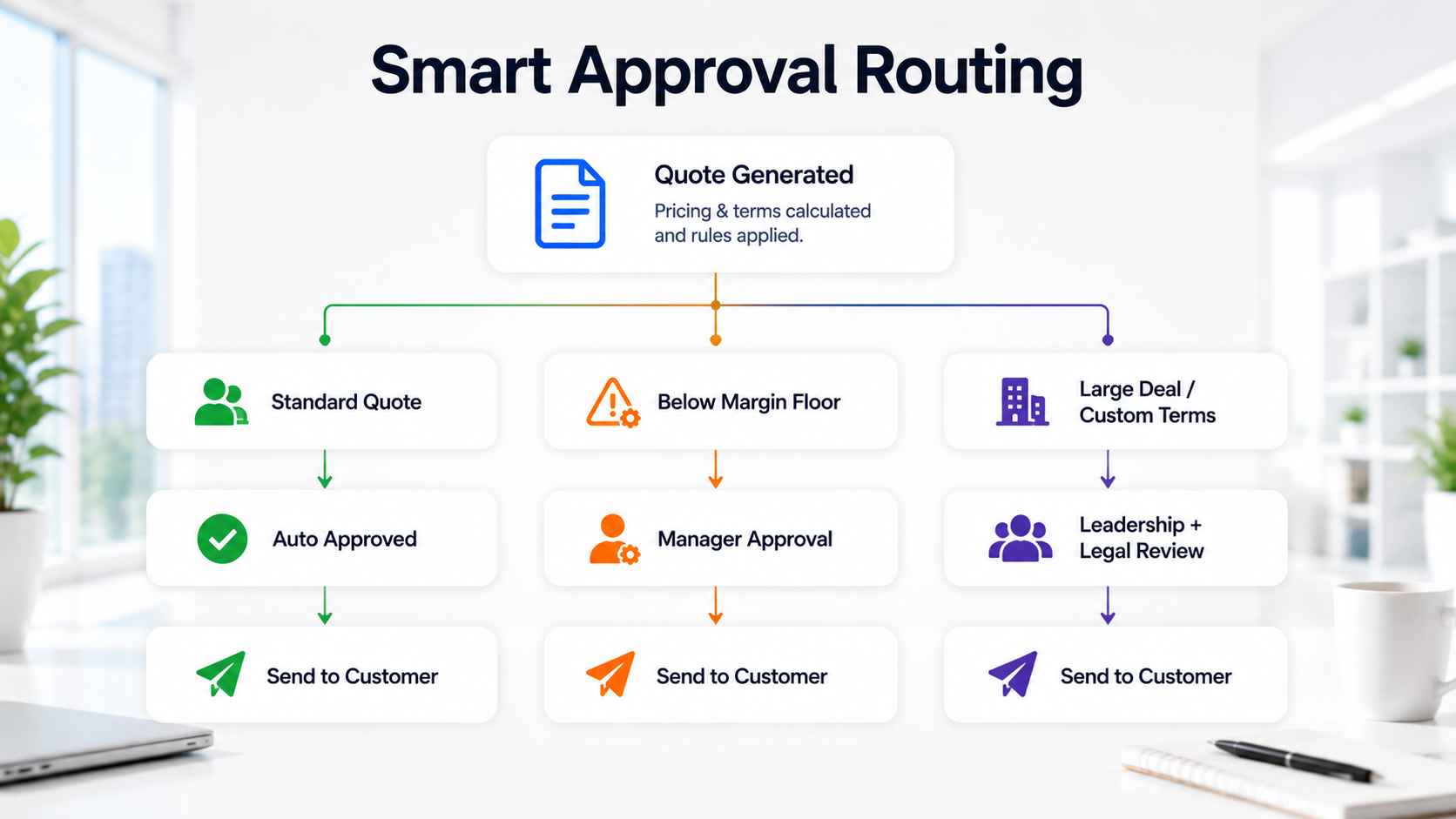
Some quotes need a human yes. The system knows which ones.
Thresholds that route themselves
Rules decide the route. Under the floor: manager approval. Above a deal size: leadership sign-off. Custom terms: legal look. Standard quotes skip the gate entirely and ship in minutes.
The gate carries a timer, same as lead routing. An approval sitting two days in an inbox erases the speed the engine bought. Escalation guards the gate. Every approval logs who, when, and why. Approvals happen from a phone in one tap, because the approver is at dinner and the deal is not waiting.
Stage five: delivery and signature
The quote reaches the buyer with a signature path attached. E-signature closes the loop. The signed document files itself. The CRM stage updates. The handoff to operations fires.
Silence gets a schedule too. No response in three days fires a nudge. The expiration date enforces itself, and expired quotes reprice instead of resurrecting old numbers.
The loop then feeds itself. Win, loss, and no-response outcomes attach to every quote. Pricing decisions improve on data instead of anecdotes. The pipeline ends where the next pricing review begins.
The metrics: speed to quote and friends
Four numbers judge a quoting system. Baseline all four before building.
Speed to quote. Request arrival to quote delivered. Median and worst decile, same discipline as speed to lead. Most teams discover days where they assumed hours.
Same-day quote rate. The share of requests answered before close of business. This number moves win rates and reputations together. Track it by rep and by product line, because the laggard segment names the next fix.
Quote accuracy. Reworks, corrections, and disputes per hundred quotes. The engine drives this toward zero, and zero has a dollar value in credibility.
Approval cycle time. The gate's share of the delay. When approvals eat the speed, the thresholds need tuning, not the engine.
Then run the analysis that ends every internal debate. Win rate by speed band. Same-day quotes against three-day quotes against week-old quotes, from your own history. The bands almost always slope one direction, and your own data makes the argument nobody can dismiss.
Where the wins came from: three shipped patterns
The pipeline above is not theoretical. Three patterns from our shipped work show its range.
Supplement quoting. High-SKU product quoting with tiered pricing, automated end to end. The pattern: catalog-driven rate tables plus instant document generation. The build is documented in our supplement quoting case study.
Distributor quoting with lead times. HVAC distribution, where the quote is only half the answer. Parts availability and lead times ride along with the price, pulled live. The pattern: pricing engine plus supplier data in one response. Documented in the HVAC lead-time case study.
Complex service pricing. Field services with multi-variable calculations: crew, equipment, duration, location factors. The pattern: the spreadsheet wearing an API, wrapped with guardrails and an approval gate. The calculation stayed the client's. The speed became the system's.
Three industries. One skeleton. The common thread: none of the three bought a quoting suite. Each build connected the tools already owned, wrapped the pricing logic already trusted, and added the speed. The case studies carry the wider set: 500+ workflows shipped, more than 10,000 hours reclaimed, over $2 million in client savings.
Do you need quoting software?
Sometimes. Judge the category after the design, never before.
Dedicated quoting tools earn a seat when configuration is genuinely complex, catalogs run huge, or guided selling matters. Manufacturing configurators are the classic case. Free tiers exist across the category, and they are honest starting points for simple, low-volume quoting.
Apply one test to any candidate: can it read your pricing table and write to your CRM without manual steps? A quoting tool that creates its own island creates its own re-keying.
Many operators need no new product at all. CRM, a governed pricing table, middleware, document generation, and e-signature already sit in the stack. The build connects them into the pipeline. The layer logic from our sales stack guide applies directly: configure what you own, engineer across what you own, and buy a category only when the design demands one.
AI in quoting: words versus numbers
The question arrives weekly now. Can AI write the quote?
Split the quote in two. The words and the numbers. AI drafts the words well: cover messages, scope descriptions, option explanations, tailored to the buyer. AI must not freelance the numbers. Language models approximate. Pricing engines calculate. An approximated price is a margin leak with confidence.
So the design rule stands. AI writes the words. Rules write the numbers. The engine produces the price, the model wraps it in language, and the guardrails check everything before it ships. That split gets you the speed and the polish without gambling the margin.
AI earns a second seat at intake. Parsing messy RFQ emails into structured fields is exactly what language models do well. Extraction feeds the engine. The engine still owns the math.
How ACS builds quote automation
Fixed fee, after a paid and refundable discovery. Discovery maps your request-to-signed path, baselines speed to quote, and captures the pricing logic from wherever it lives today. The pricing owner stays the pricing owner.
Then the build, stage by stage, guardrails first. Error alerting wired before launch. Handoff follows our published standard: accounts in your name, the runbook your team owns, training to a named owner, final payment on handoff. Thirty days of measurement closes the engagement with the delta in writing.
The engagement structure sits on pricing, the service detail on sales automation, and the proof in the case studies.
Frequently asked questions
What is an automated pricing strategy?
Two different things share the phrase. In retail, algorithmic price changes responding to demand. In B2B quoting, rules-based price calculation with margin guardrails, applied identically to every request. This guide covers the second: policy encoded as rules, executed by an engine.
What is the best quoting software?
The category question comes second. Map the five-stage pipeline first, then judge tools by fit: catalog size, configuration depth, and stack integration. Many operators reach the full outcome with the CRM, a governed pricing table, and document generation they already own.
Can ChatGPT make a quotation?
It can draft the language around one. It should never calculate the price. Language models approximate, and approximated prices leak margin. Let rules produce the number, let AI write the wrapper, and let guardrails check the result before sending. AI also parses inbound requests well, which speeds intake without touching the math.
What are the top automation tools for quoting?
Five categories, not five brands. A CRM holding the records. A governed pricing table or engine. Middleware moving the data. Document generation filling templates. E-signature closing the loop. Most stacks own four of five already. The build connects them.
Do we need Salesforce CPQ or the quote object?
Only inside a Salesforce-centered stack with genuinely complex configuration. CPQ is the heaviest road to quote automation, and its weight earns itself at enterprise configuration depth. Most mid-market operators reach the same outcome lighter. Our Salesforce guide maps that boundary.
How does quote automation work for a small business?
Same skeleton, lighter parts. One intake form. A pricing table with a margin floor. A document template. E-signature. Skip the approval gate until deal sizes demand one. The pipeline scales down cleanly, and the speed advantage scales down not at all.
What about quoting for manufacturing?
Manufacturing adds configuration: valid combinations, dependencies, and engineering checks. That is where dedicated configurators and CPQ earn their category. The pipeline stays identical around them. Intake, engine, document, approval, signature, measured.
What is price list automation?
Keeping the rate tables current automatically: supplier costs in, margins applied, customer tiers updated, changes versioned. It feeds stage two of the pipeline.
A stale price list makes every downstream automation confidently wrong, so the list gets an owner and a sync. Supplier price files land, margins recalculate, and the engine prices tomorrow on today's costs.
How long does a quote automation build take?
Simple pipelines ship in two to three weeks. Complex pricing engines with approval gates run four to six. Capturing the pricing logic is the critical path, because the rules must be written down before anything calculates. Discovery does exactly that.
Quoting by hand while competitors quote by system?
Three ways to move.
Book a paid discovery. Request-to-signed path mapped, speed baselined, pricing logic captured, one fixed price. Refundable if we are the wrong fit. See pricing.
See the shipped patterns. The supplement quoting and HVAC lead-time case studies show the pipeline in production.
Read the service detail. The sales automation page covers the full practice.
Rules write the numbers. Speed wins the share. Margin stays guarded.