

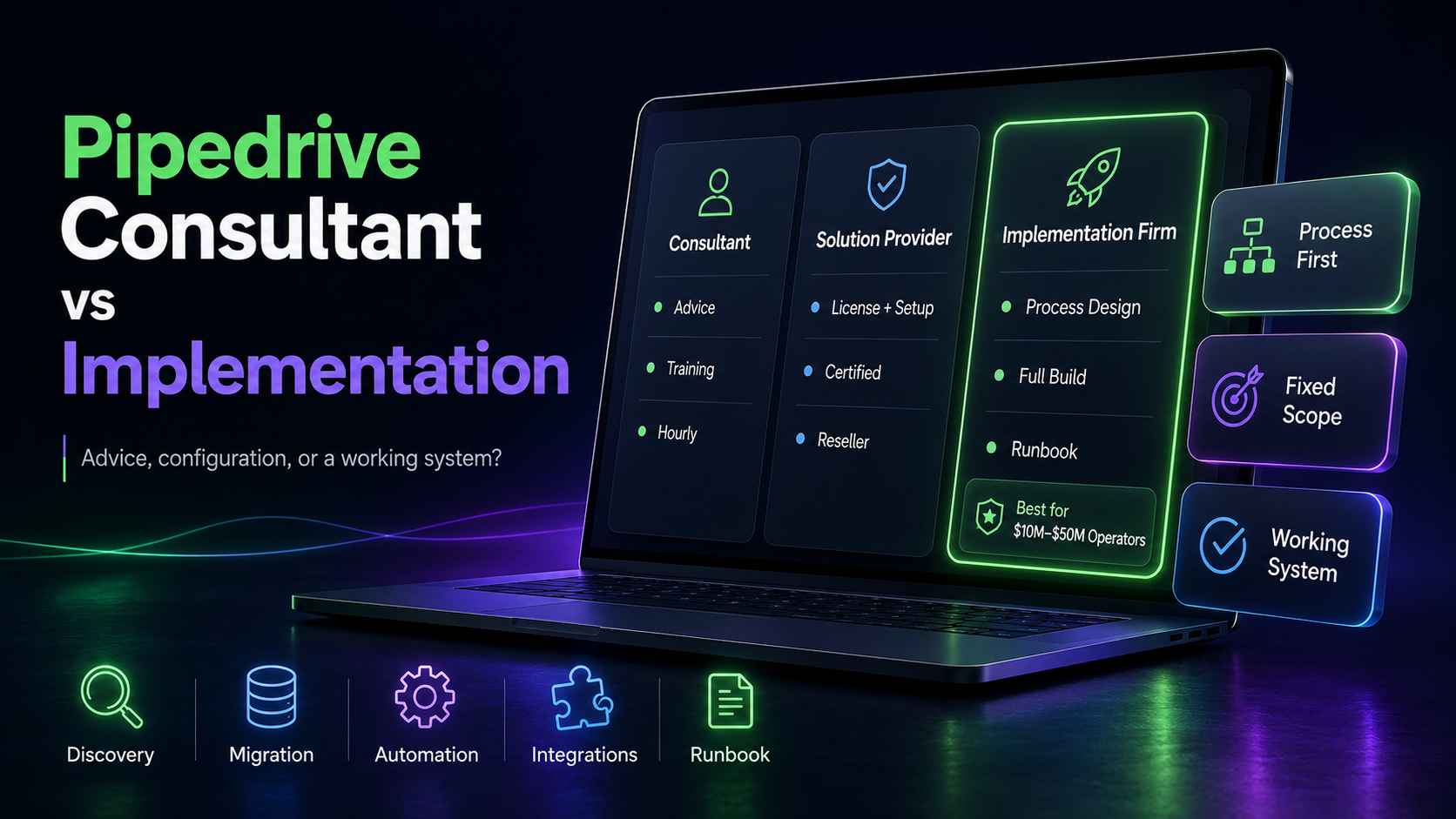
We build operations infrastructure with engineering discipline for $10M-$50M operators. Pipedrive sits in that work constantly. Teams ask us the same hiring question every week. Do we need a Pipedrive consultant, a certified partner, or a full implementation?
This post decodes the three labels. We are not a Pipedrive Solution Provider. We implement Pipedrive without reselling it. We are a Zapier Certified Solutions Partner and an Attio Expert Partner. That neutrality shapes everything below.
The honest verdict
Pipedrive is the most underrated CRM for transactional B2B. It is also genuinely easy to use. That combination confuses the hiring decision.
Here is the short answer. A five-seat team with one pipeline and clean data needs nobody. A $10M-$50M operator with integrations, a migration, and a sales team to move needs an implementation, not advice. The label on the vendor matters less than what ships at the end.
A consultant sells advice. An implementation firm owns the outcome. That single distinction should drive your hire.
Three labels, three different purchases
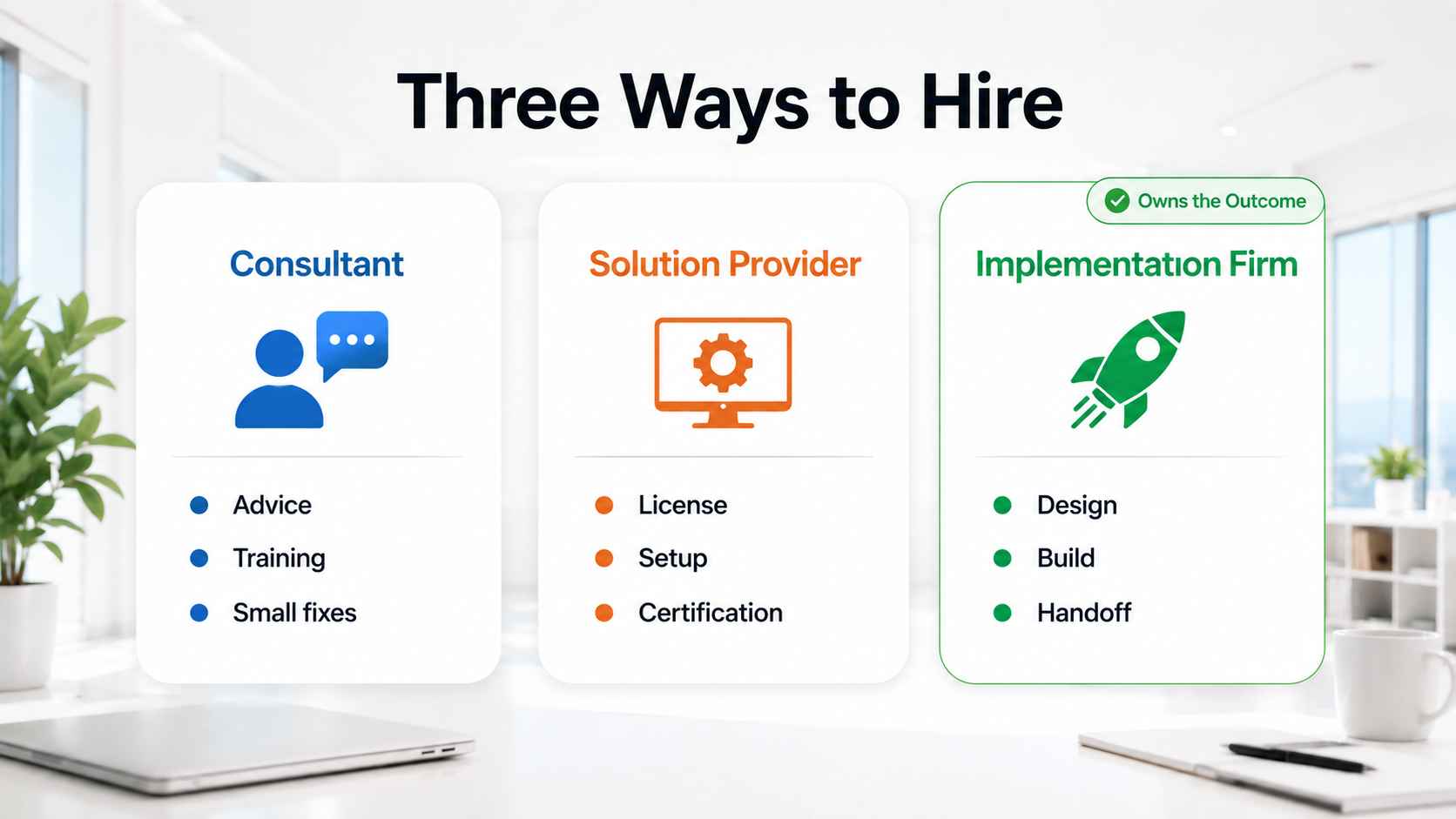
The market uses consultant, partner, and implementation firm as if they mean the same thing. They do not. Each label describes a different business model, and the business model predicts what you receive.
The Pipedrive consultant
A Pipedrive consultant advises. They audit your account, recommend settings, run training sessions, and answer questions. Most bill by the hour or in small blocks.
Consultants fit narrow problems. A broken automation. A messy filter setup. A team that needs training on features it already owns. The engagement is short and the deliverable is knowledge.
A typical consultant engagement runs a few sessions. An account audit with a findings list. A settings cleanup. A training block for reps or managers. Useful work, clearly bounded.
The limit is ownership. When the call ends, the work is yours. A consultant does not carry the project to a working system. For a defined question, that is fine. For a build, it is not enough.
The Pipedrive Solution Provider partner
Pipedrive runs a Solution Provider partnership program. Partners market and resell Pipedrive alongside services like onboarding, implementation, and customization. The program runs three tiers: Authorized, Gold, and Platinum. Tier names have shifted over the years, so older badges still appear in directories.
The badge tells you two real things. The firm knows the product. And the firm has sold enough Pipedrive to hold the tier.
It also tells you the incentive. A Solution Provider is paid to sell Pipedrive. Reselling is written into the program. That partner cannot tell you Pipedrive is the wrong fit, because the recommendation and the revenue point the same direction.
We are paid to make the system work, not to sell the license. When Pipedrive is wrong for an operator, we say so and point at the platform that fits. Our Pipedrive vs Salesforce breakdown and our Attio Expert Partner assessment exist because of that neutrality.
None of this makes partners bad. Many are excellent builders. It means the badge answers a different question than the one you are asking. You are asking who ships a working system. The badge answers who sells licenses well.
The implementation firm
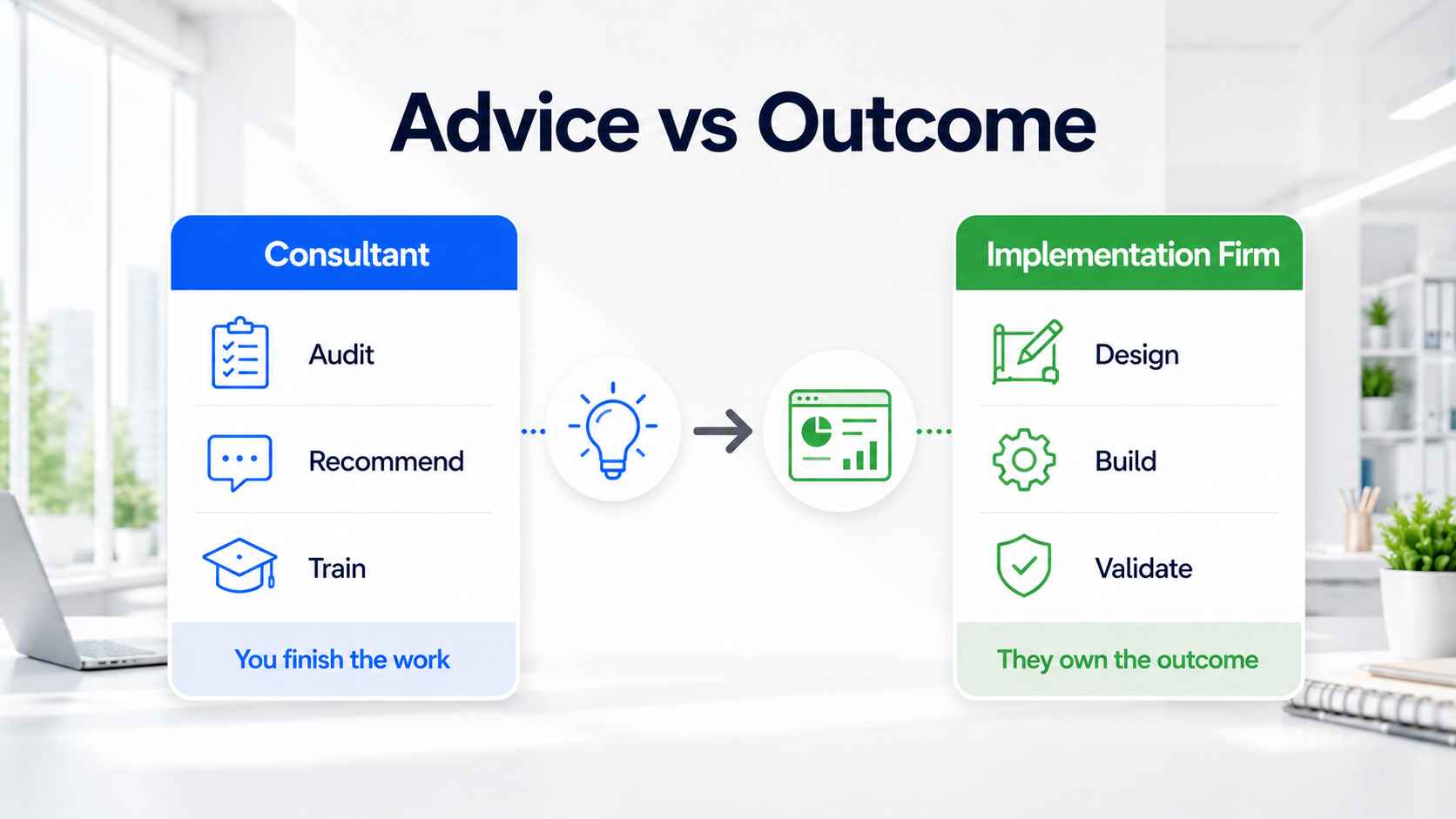
An implementation firm treats Pipedrive as an engineering project. It designs the sales process first, then configures the platform to match. It migrates the data, builds the automations, wires the integrations, and documents the system.
The deliverable is a working CRM your team runs without help. The engagement is fixed in scope and fixed in fee. The firm owns the outcome until the system passes validation.
This is the model $10M-$50M operators usually need and rarely get offered. We wrote the full category definition in our automation consulting guide.
Why easy software still fails
Pipedrive setup takes a weekend. That fact is true and it is the trap. Easy setup invites skipped process design. Teams import contacts, accept the default pipeline, and call it done.
Twelve months later the decay is visible. Most CRMs become glorified spreadsheets within twelve months. Stages hold deals that never move. Fields multiply without owners. The forecast means nothing because pipeline stages without exit criteria become forecasting fiction.
The software did not fail. The design step never happened. That is the specific gap a real implementation closes, and no amount of feature training closes it.
The second decay driver is ownership. Pipedrive rarely gets a named admin because it feels too simple to need one. Then nobody governs fields, nobody retires dead automations, and nobody watches the reports. Simple systems still need an owner. The owner just needs fewer hours.
What a real Pipedrive implementation includes
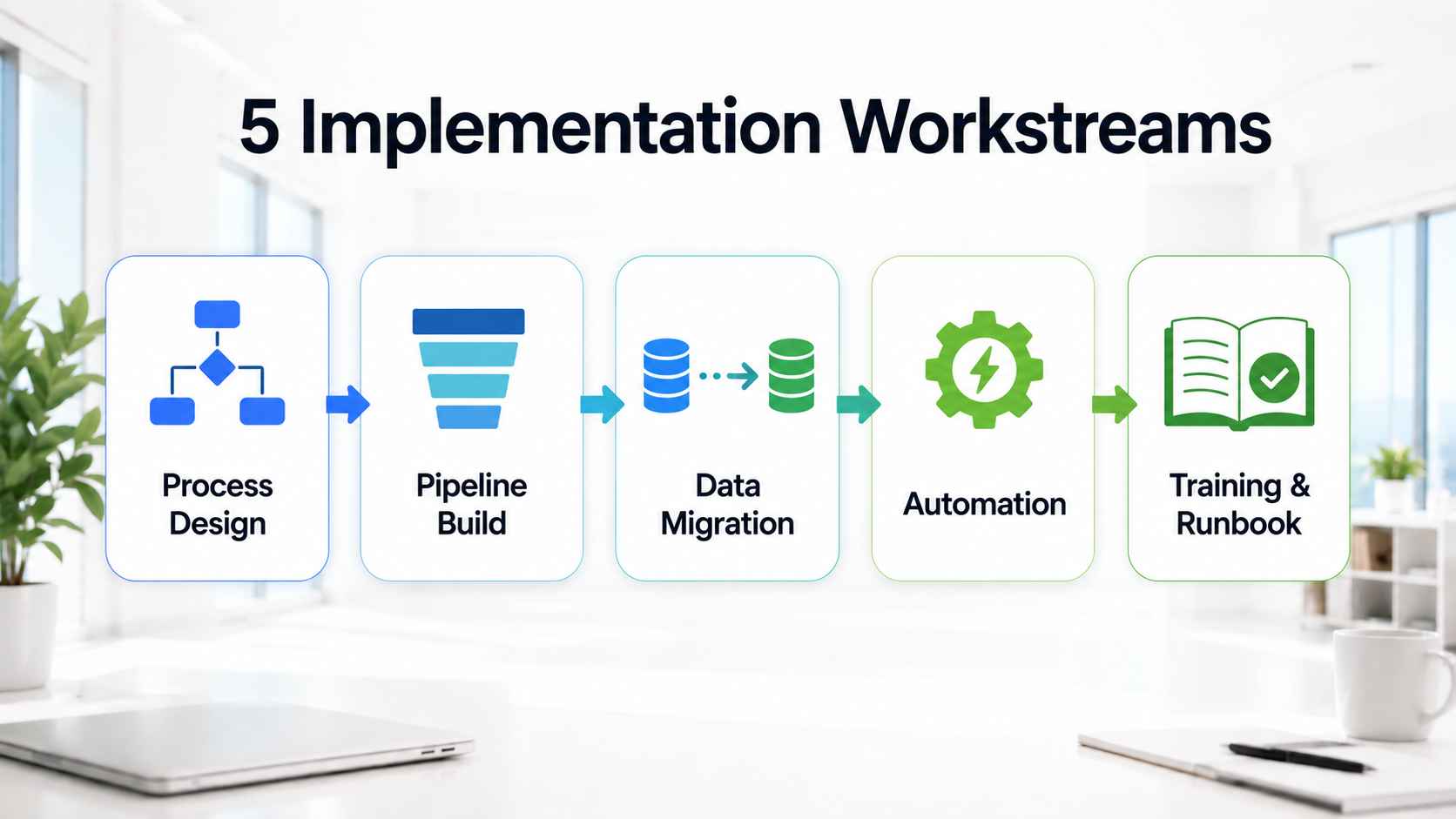
Five workstreams. A quote that covers two of them is a configuration, not an implementation.
Discovery and process design
Someone maps how you actually sell before touching settings. Real stages, real handoffs, real exceptions. The output is a documented sales process with exit criteria on every stage.
Each stage gets named after what the buyer did, not what the rep did. Five to seven stages fits most B2B motions. This step decides the forecast quality for the next three years.
Discovery also defines the handoffs. What turns a lead into a deal. Who owns the record at each step. What happens to deals that stall. The exceptions get documented, because exceptions are where reps abandon the system.
Pipeline and data model build
The designed process becomes pipelines, stages, custom fields, and permissions. Fields get created with documented purpose and naming conventions. Adding fields as needs arise creates a museum of dead fields, so the field list is designed once and governed after.
Multiple motions get separate pipelines. Record visibility gets set by role. Defaults get replaced, not accepted.
Lost reasons get defined as a fixed list, not free text. Clean lost reasons turn into the most honest report in the system. Activity types get configured to match how the team actually works: calls, demos, site visits, proposals. Default activity types measure nothing.
Data migration and cleanup
Existing data moves in clean or does not move at all. Duplicates get merged. Dead records get archived. Owners get assigned before import so records do not pile up under one admin. Every migrated record keeps a reference to its old system ID, which makes validation and rollback possible later.
Coming from Salesforce, the mapping work is its own project. We wrote the full playbook in our Salesforce to Pipedrive migration guide.
Automation and integration build
Routing, follow-up tasks, stage-change actions, and notifications get built in Pipedrive Automations. Anything heavier runs through Zapier, Make, or the API. Every automation gets an owner and an error alert.
The first automations to build are the boring ones. A task created on every stage change. An alert on deals sitting idle past a set number of days. Lead routing by territory or source. These three prevent more forecast damage than any advanced build.
Then the connected stack. Email sync, calendar, quoting, invoicing, marketing tools, and reporting all point at Pipedrive as the source of truth. This is where our integration builds and sales automation work lives.
Training, runbook, and handoff
Reps get trained on the workflow, not the feature list. Managers get trained on the reports. And the system ships with a runbook.
Watch one adoption signal in the first month: activity logging. Reps who log calls and meetings are using the system. Reps who only touch deals at close are not. Fix adoption in week two, not quarter two. Adoption problems compound quietly.
Runbook-as-deliverable is the difference between a system and a debt. The runbook documents the data model, every automation, and the troubleshooting steps. Most automation projects fail at handoff, not at build. The runbook is how yours does not.
What Pipedrive help actually costs
We will not quote figures. Numbers age. Structures do not. Here is what to model.
Consultants bill hourly or in blocks. Cost stays low per session and unbounded per outcome. Nobody caps the total because nobody owns the total.
Solution Providers often bundle setup with the license sale. The setup fee can look small because the license commission sits behind it. Ask what the firm earns on your subscription. The honest ones answer.
Implementation firms price the project. Fixed scope, fixed fee, defined deliverables. Hourly billing pays consultants to think slowly. Fixed fees put the estimation risk on the builder, where it belongs. Our structure is on the pricing page, starting with a paid discovery that refunds if we are the wrong fit.
For a $10M-$50M operator, a proper Pipedrive implementation lands in weeks, not months. Complex integration scopes run longer. The cost variable is data and integration complexity, not headcount.
Model the spend over three years, not one invoice. License cost stays predictable because Pipedrive bills per seat with no contact meters. Service cost is the variable. One properly built implementation costs less over three years than two cheap setups and a rescue.
Red flags when hiring Pipedrive help
No process work in the scope. A quote that jumps straight to configuration builds a pretty version of your current mess.
Template pipelines. Some vendors drop the same five stages into every client account. If the proposal never asks how you sell, the pipeline will not match how you sell.
Hourly billing with no cap. The meter rewards slow work. Demand a fixed fee or a hard ceiling.
No named deliverables. Ongoing support is not a deliverable. A documented pipeline with exit criteria is.
No runbook at handoff. Without documentation you are buying a dependency, not a system.
License commission behind the recommendation. Ask directly if the firm resells Pipedrive. Then weigh the advice accordingly.
No proof of shipped work. Certifications confirm product knowledge. Case studies confirm the firm can finish. Ask for both. Ours are on the case studies page.
When to hire nobody
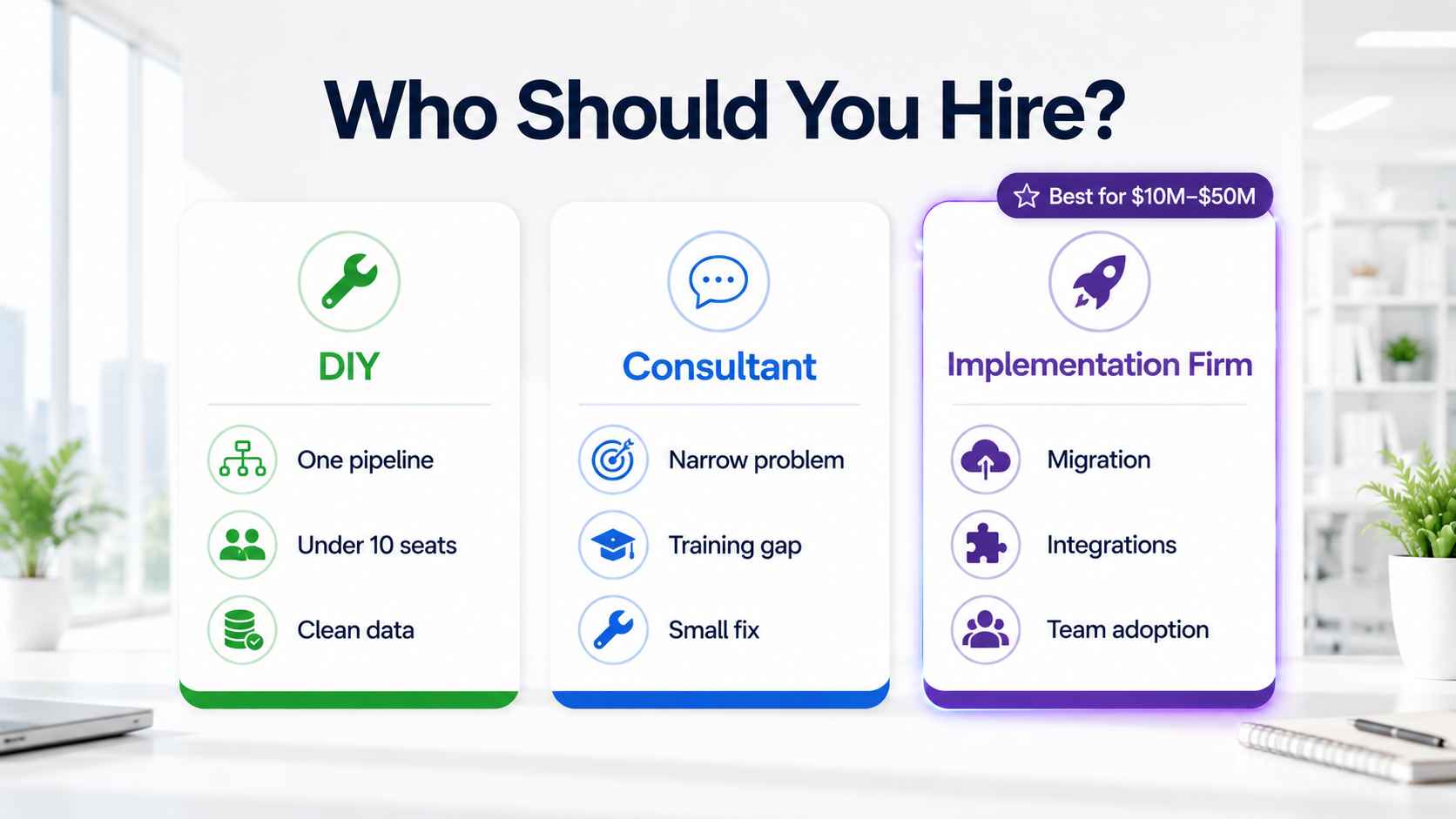
Some teams should do this themselves. Take the honest test.
Do it yourself when you run one pipeline, hold fewer than ten seats, and start from clean data. Pipedrive's academy and knowledge base cover that case well. Assign an internal owner and go.
Hire a consultant when you have a narrow, defined question. A broken report. A training gap. One automation that misfires.
Hire an implementation firm when a migration is involved, integrations matter, or the sales team has already rejected one CRM. Rebuilding trust in a system is harder than building it right once. The full decision logic sits in our Pipedrive vs HubSpot comparison and on our Pipedrive platform page.
The model that fits most $10M-$50M operators is hybrid. A firm designs and builds the system, then hands the runbook to an internal owner who runs it. You get the architecture from specialists and the ownership in-house. No permanent retainer required.
How ACS runs Pipedrive implementation
We run Pipedrive builds as fixed-scope engineering projects. Discovery first, paid and refundable. We map the sales process and produce the design document. Then the pipeline build with exit criteria on every stage. Then migration, automation, and integrations. Then training and the runbook.
Discovery ships three outputs: a written audit, a ranked bottleneck list, and a recommended scope. You keep all three either way, build or no build.
We do not resell Pipedrive. No license commission sits behind the recommendation. When the fit is wrong, we say so before the build starts, not after.
The proof stack: 500+ workflows shipped, more than 10,000 hours reclaimed, and over $2 million in client savings across seven industries. See the case studies and verify our credentials on the partners page. The right CRM is the one your team uses without being told to. Our job is building the version of Pipedrive your team actually uses.
Frequently asked questions
What does a Pipedrive consultant do?
A Pipedrive consultant advises. They audit accounts, recommend settings, fix narrow problems, and train teams. Most bill hourly. The deliverable is knowledge and configuration help, not a built system. For a defined question, a consultant fits. For a build, hire an implementation.
How much does Pipedrive implementation cost?
Cost follows structure. Consultants bill hourly with no cap. Partners often bundle setup with license resale. Implementation firms price a fixed scope. The honest comparison is total cost to a working system, not the hourly rate. Our fixed-fee structure is on the pricing page.
How long does a Pipedrive implementation take?
Most builds for a $10M-$50M operator land inside two to four weeks. Migrations from Salesforce add scope and run the same window when planned properly. Heavy integration builds run longer. Data complexity drives the timeline, not team size.
Do I need a certified Pipedrive partner?
No. The Solution Provider badge confirms product knowledge and license sales volume. It does not confirm process design or engineering depth. It also carries a reselling incentive. Judge any firm on shipped work, named deliverables, and a runbook at handoff.
Can I set up Pipedrive myself?
Yes, in the simple case. One pipeline, fewer than ten seats, clean data, and an internal owner. Pipedrive's own resources cover that setup well. Hire help when migration, integrations, or a skeptical sales team enter the picture.
What should a Pipedrive implementation include?
Five workstreams. Process design with stage exit criteria. Pipeline and field architecture. Data migration with cleanup. Automation and integration build. Training plus a runbook at handoff. A quote missing the first and last items is configuration, not implementation.
Should we hire a consultant or an implementation firm?
Match the hire to the problem. Narrow question, hire a consultant. Working system, hire an implementation firm. A consultant sells advice. An implementation firm owns the outcome. At $10M-$50M scale, the outcome is what you are actually buying.
Ready to build Pipedrive right?
Three ways to start.
Book a paid discovery. We map your sales process and scope the build. Refundable if Pipedrive or ACS is the wrong fit. See pricing.
Read the platform detail. Our Pipedrive page covers where it wins and where it does not.
Review the proof. The case studies show shipped systems for operators like you.
Process first. Platform second. Runbook always.