

Somewhere in your company right now, money is waiting for permission. A discount sits in a sales manager's inbox. A purchase order waits under someone's Tuesday. A contract ages in legal's queue. The requests are fine. The routing is the problem. And the waiting has a price nobody invoices.
We build operations infrastructure with engineering discipline for $10M-$50M operators, and approval gates run through every system we ship: quoting, procurement, finance workflows. This post turns the pattern into the pillar it deserves.
What Is Approval Routing Automation?
Approval routing automation is a system that moves requests to the right approver by policy. It enforces decision deadlines with escalation. It records every decision with its reason. It executes the outcome automatically. No forwarded emails. No hallway asks. No deals dying of inbox.
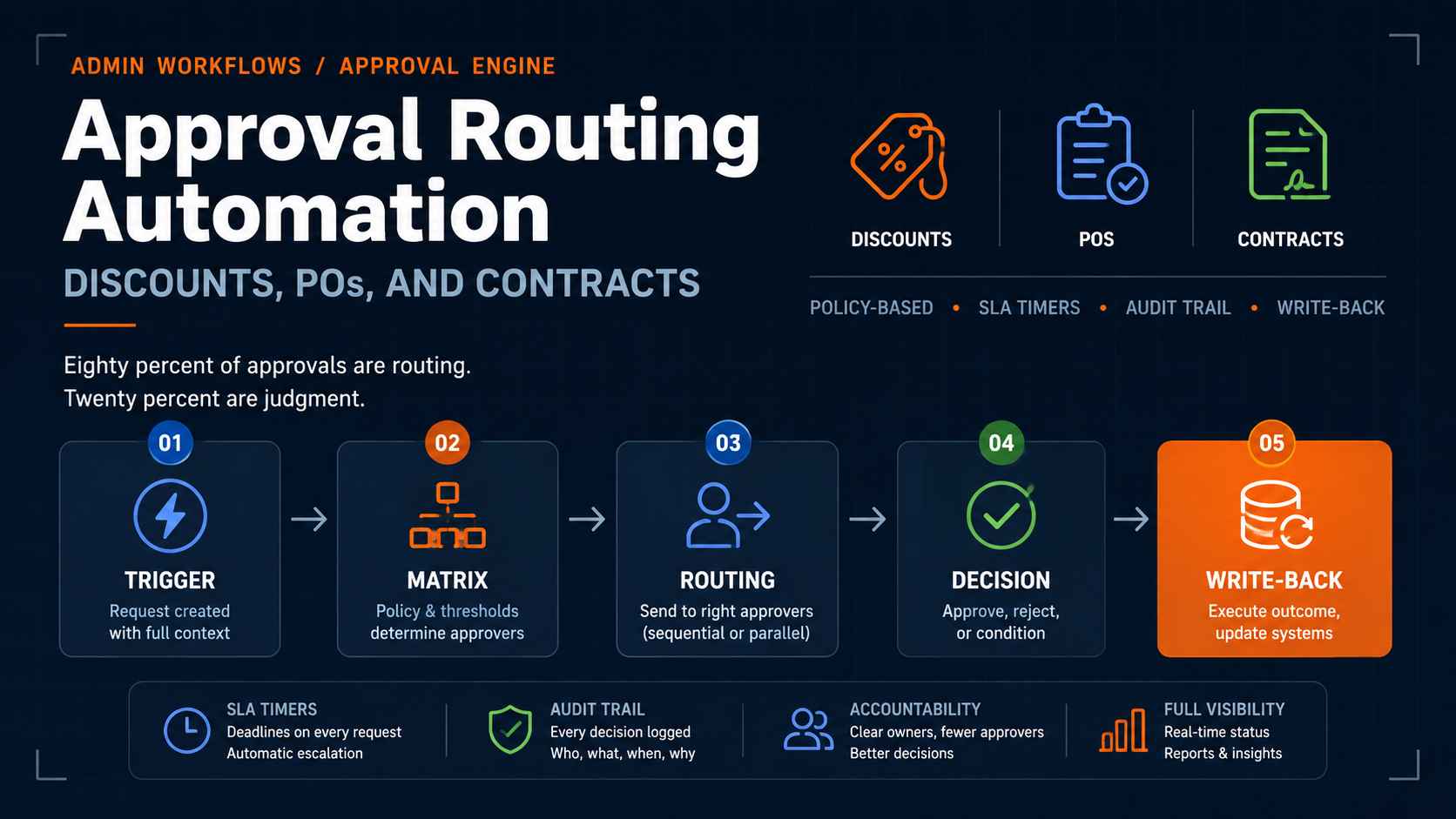
The insight that makes it buildable: most approvals contain almost no judgment. Eighty percent of the work is routing, checking a threshold, finding the right role, chasing a response. Twenty percent is a genuine decision. Automation handles the eighty so the twenty gets made fast, by the right person, with context attached.
Manual approvals fail two ways. The slow yes, where a good request dies of waiting. The unlogged yes, where nobody remembers who agreed to what. The engine below kills both.
How Does an Automated Approval Workflow Work? The Five-Part Engine
Every approval workflow, from a two-percent discount to a six-figure contract, runs the same five-part engine. Build it once, apply it everywhere. The lanes differ only in their numbers and their approver roles. The machinery never changes, which is why one build covers all three money approvals in the title.
Approval Triggers: Where Requests Enter the Workflow
Requests fire from the systems where work happens: the quote tool raises the discount request, procurement raises the PO, the contract tool raises the review. Nobody fills a separate form.
The request carries its context automatically: amount, customer, history, margin. An approver deciding without context asks questions, and questions are days.
The decision card is the deliverable here. One screen: what is asked, what it costs, what the rule says, one tap to decide. Approvals move at the speed of the card.
The Approval Policy Matrix: Who Approves What, at What Amount
The heart of the engine, and the part most companies never write down anywhere. The matrix maps request types and thresholds to approver roles. Roles, never names, because people leave and rules should not.
If the policy lives in someone's head, every approval is a meeting. Written into a matrix, every approval is a lookup. Writing yours takes one afternoon and one argument, and the argument was overdue anyway.
A Worked Example: The Three-Band Structure
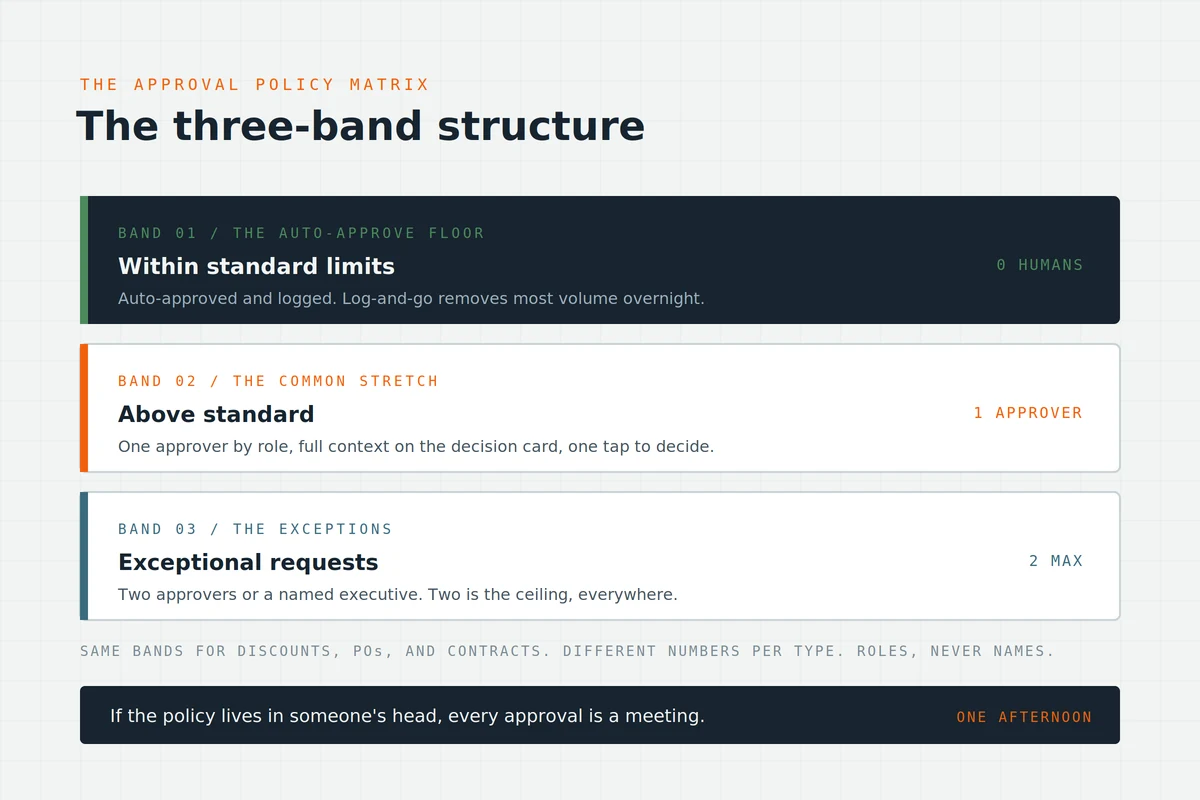
Bands beat single thresholds. Band one: within standard limits, auto-approved and logged. Band two: above standard, one approver by role. Band three: exceptional, two approvers or a named executive.
Three bands cover discounts, POs, and contracts alike, with different numbers per type. The auto-approve floor takes courage and pays fastest. Log-and-go below the line removes most volume overnight, and the log keeps everyone honest.
Delegation and Fallback Rules for Absent Approvers
Vacations kill deals in manual systems. The matrix carries fallbacks: out-of-office flips routing to the delegate automatically, and the delegation is logged like any decision. No request ever waits on a beach. One hop is the delegation limit. A delegate's delegate is nobody's decision.
Sequential vs Parallel Approval Routing: Which to Use
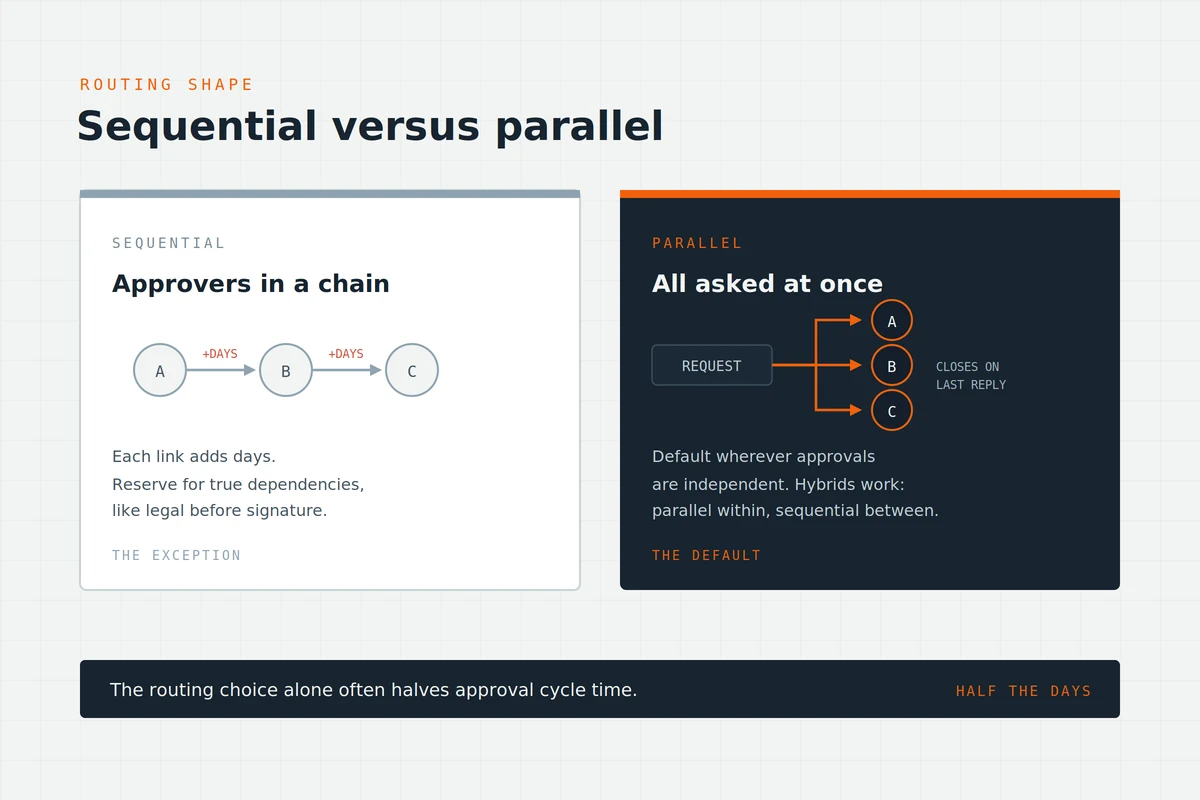
Sequential routing chains approvers in order, and each link adds days. Parallel routing asks all required approvers at once and closes on the last response. Default to parallel wherever approvals are independent.
Reserve sequential for genuine dependencies, like legal before signature. The routing choice alone often halves cycle time. Hybrids work too: parallel within a stage, sequential between stages.
Decision Capture: Approve, Reject, or Approve With Conditions
Every decision lands as one of three outcomes, timestamped, with a reason. Approved runs. Rejected returns to the requester with the reason attached, not a mystery. Conditional approves with a modification: a smaller discount, a different supplier, a clause change.
Conditions keep deals alive that binary systems kill. One-line reasons are enough. "Margin below floor for this segment" teaches the requester more than a week of silence ever did.
The Write-Back: What Happens After Approval
The decision executes without a human relay. The approved discount unlocks the quote. The approved PO transmits to the supplier. The approved contract moves to signature. Rejection notifies with reasons.
The write-back is where approval automation joins the operations spine, and skipping it leaves a fast decision stranded in a slow process. A one-hour approval followed by a two-day relay is a two-day approval wearing a good report.
Discount Approval Automation for Sales Teams
The highest-velocity approval in the company, and the one where hours cost revenue directly.
Discount Approval Thresholds That Protect Margin
The three bands wear sales clothing. Reps hold a floor they can apply without asking, which kills the noise traffic entirely. The manager band covers the common stretch cases, one approver, full context on margin impact. The executive band guards the exceptions.
Margin math rides the request: the approver sees deal size, current margin, and the discount's cost in one card. Most companies discover the floor absorbs the majority of former requests. The manager gets their Tuesdays back, and the rare escalations get real attention.
How Fast Should Discount Approvals Be?
Minutes, not days, and the target is worth writing down. A quote waiting on approval is a customer comparing alternatives, the same clock that runs through our quote automation guide.
Band-two discounts should close inside an hour during business hours. The timer and escalation below make the target real instead of aspirational. After hours, the rule still runs: the request queues with its timer paused, and the approver's morning starts with the card on top.
Purchase Order Approval Workflow Automation
The spend gate, where the matrix meets the budget.
PO Approval Limits by Amount and Category
Amount alone is a blunt rule. The matrix reads amount and category together: routine materials route light, new suppliers route heavier, capital spend routes to finance regardless of size. Category-aware limits stop the absurdity of a three-signature toner order and the risk of a one-signature new-vendor commitment.
Budget Checks Inside the PO Approval Process
The request checks its budget line before any human sees it. In budget, the matrix runs normally. Over budget, the request routes to the budget owner first with the variance shown.
The check turns a month-end surprise into a decision made at request time, and procurement stops discovering overruns in arrears. Approved POs commit against the budget immediately, so the next request reads the honest remainder.
Contract Approval Process Automation
The slowest approval lane, and the one with the most unnecessary waiting.
Routing Contracts to Legal Review Automatically
Contracts sort by risk, not by arrival order. Standard paper on your template routes light or skips review by policy. Modified terms route to legal with the modifications highlighted.
High-value or novel agreements route to senior review. The sort means legal reads what needs reading, and the routine stops queueing behind it. The prerequisite is template discipline: the more deals that start on your paper, the more of the queue disappears.
AI Contract Review: Flagging Clauses Before Legal Reads
A model reads the redline first and flags non-standard clauses against your playbook: liability caps, payment terms, termination rights. The flags land in the reviewer's card with excerpts attached.
AI reads and flags. Lawyers judge. The same division of labor as our meeting capture pipeline, applied to contracts, and review hours drop while nothing legal-shaped gets decided by a machine.
Approval Escalation Rules and SLA Timers
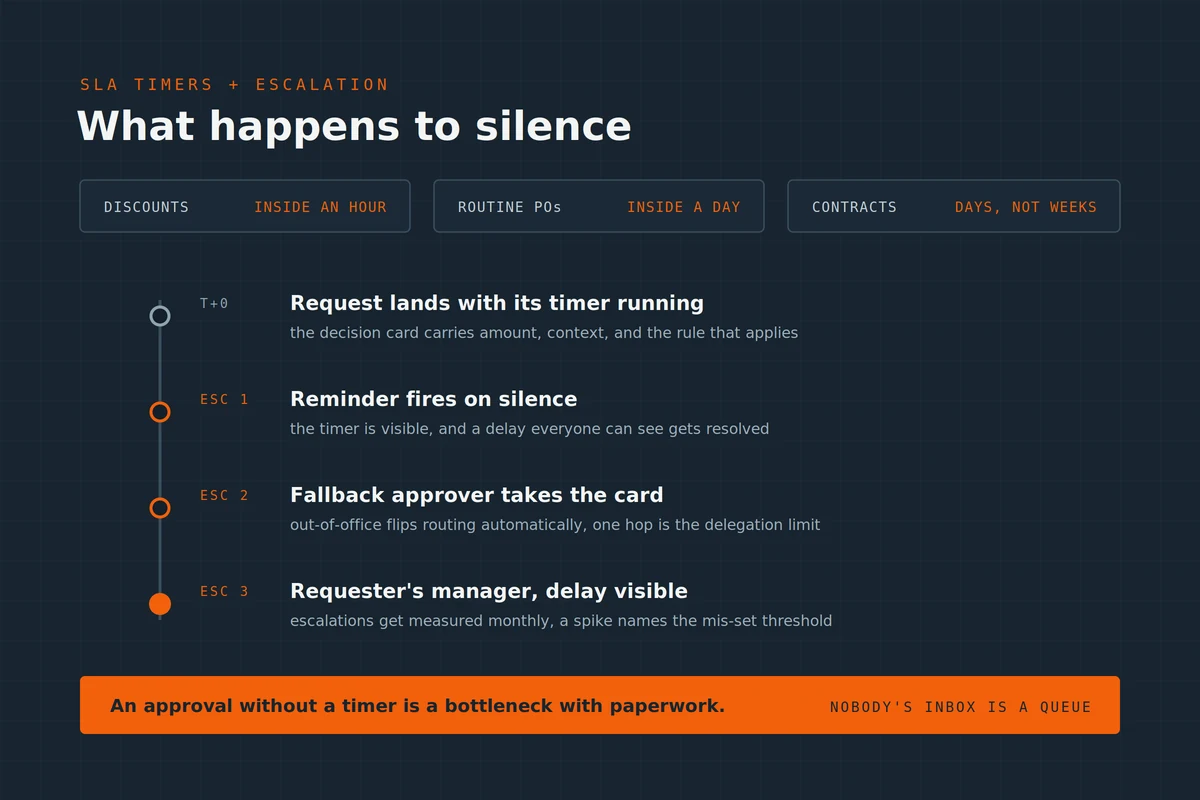
An approval without a timer is a bottleneck with paperwork.
Every request carries an SLA by band: hours for discounts, a day for routine POs, days for contracts. Silence past the timer escalates: reminder first, then the fallback approver, then the requester's manager with the delay visible. Nobody's inbox is a queue. The timer makes that a system property instead of a wish.
Escalations get measured, because they are the system's diagnostics. A spike in one lane names an overloaded approver or a threshold set wrong. The fix is a matrix edit, not a meeting series. Visibility does half the enforcement. A delay everyone can see gets resolved. A delay buried in an inbox gets explained later.
Approval Audit Trails for Compliance and Accountability
Every decision writes its own record: who approved what, when, at which threshold, with what reason. The approval log is the compliance story written as it happens, and audit season becomes an export instead of an archaeology project.
Regulated industries feel this hardest, and the pattern comes straight from our financial services work: gates enforced by rules, evidence produced as exhaust. The same trail settles internal arguments too.
The question "who approved this" gets an answer in seconds, with the reason attached. The trail changes behavior quietly as well. Decisions made on the record get made more carefully, and reasons written down get written honestly.
One honesty note the trail enforces: approval inflation is real. Every added approver subtracts accountability, because everyone assumes someone else read it. Two approvers is the practical ceiling for almost everything. The matrix should make approvals fewer and sharper, not more and softer.
Approval Workflow Software vs the Engineered Build
Approval features ship inside most platforms: CRMs approve discounts, procurement tools approve POs, contract tools route reviews. Configure what you own first, to its real limits. That advice is permanent.
The build begins where approvals cross systems. One matrix governs discounts in the CRM, POs in procurement, and contracts in the legal stack. One escalation engine.
One audit trail. Cross-system approval work is integration builds engineering. The constants apply: every step alerted, every failure owned, the matrix in version control like the policy document it is.
How ACS Builds Approval Routing Automation
Fixed fee, after a paid and refundable discovery. Discovery writes your approval matrix with the owners in the room, times your current cycle per lane from real requests, and sets the SLA targets.
The matrix document is yours either way, and most clients call it the most valuable afternoon of the engagement. The timing exercise usually shocks. Requests that feel like a day of waiting measure as three or four once the timestamps come out.
Builds ship lane by lane, discounts usually first because the velocity payoff lands in week one. The engine, the timers, and the trail ride our admin workflows practice with training to a named owner.
Engagement structure sits on pricing, the shipped record in the case studies: 500+ workflows, more than 10,000 hours reclaimed, over $2 million in client savings.
Frequently Asked Questions About Approval Automation
What is an automated approval process?
A workflow where requests route by a written policy matrix, decisions get captured with reasons and timestamps, timers escalate silence, and outcomes execute automatically. The routing, chasing, and recording run on rails. Only the judgment stays human.
How do you automate an approval workflow?
Write the policy matrix first: request types, thresholds, approver roles. Wire triggers from the systems where requests originate. Set SLA timers with escalation paths.
Capture decisions with reasons. Build the write-back so approvals execute. Ship one lane, measure, expand. The matrix afternoon comes before any software decision.
What is an approval matrix?
The written map of who approves what at which threshold: request types and amounts on one axis, approver roles on the other. Roles, never names. The matrix turns approvals from negotiations into lookups, and writing it takes one honest afternoon.
What is a good approval turnaround time?
By lane: band-two discounts inside an hour, routine purchase orders inside a day, standard contracts inside days not weeks. The number matters less than the timer. Set the SLA. Escalate on silence. Measure the escalations. The report finds the real bottlenecks faster than any survey.
Should approvals be sequential or parallel?
Parallel by default: all required approvers asked at once, closing on the last response. Sequential only for true dependencies, like legal review before signature. Chains add days per link. The routing choice alone often halves approval cycle time.
Can AI approve requests automatically?
Rules auto-approve inside band one, logged. AI assists above it: flagging contract clauses, summarizing context, drafting the decision card. The decision itself stays with a named human role. Automated routing plus human judgment is the design, at every band. The audit trail needs a person behind every yes.
How many approvers should a request need?
Fewer than it has now. One approver covers most bands. Two is the ceiling for exceptional cases. Beyond two, accountability dissolves into rubber stamps, because everyone assumes someone else read it carefully. Sharper thresholds beat longer chains.
How do you reduce approval bottlenecks?
Raise the auto-approve floor so routine volume stops arriving. Route parallel wherever approvals are independent. Put a timer on every request with escalation to a fallback. Then read the escalation report monthly, because it names the overloaded approver or the mis-set threshold every time.
What should an approval audit trail include?
Requester, request details, amount, the matrix rule applied, each approver, each decision with reason and timestamp, escalations triggered, and the executed outcome. Produced automatically as decisions happen. An export answers the auditor. Nobody reconstructs anything. The trail costs nothing to keep and everything to lack.
Money Still Waiting for Permission?
Three ways forward.
Book a paid discovery. Your approval matrix written, cycle times measured per lane, SLAs set, one fixed price. Refundable if the fit is wrong. Details on pricing.
Start with the fastest lane. The quote automation guide shows where discount approvals meet deal velocity.
Read the practice. The admin workflows page covers the surface this engine belongs to.
Write the matrix. Start the timers. Let the twenty percent get decided well, and let the eighty percent stop being anyone's job.