

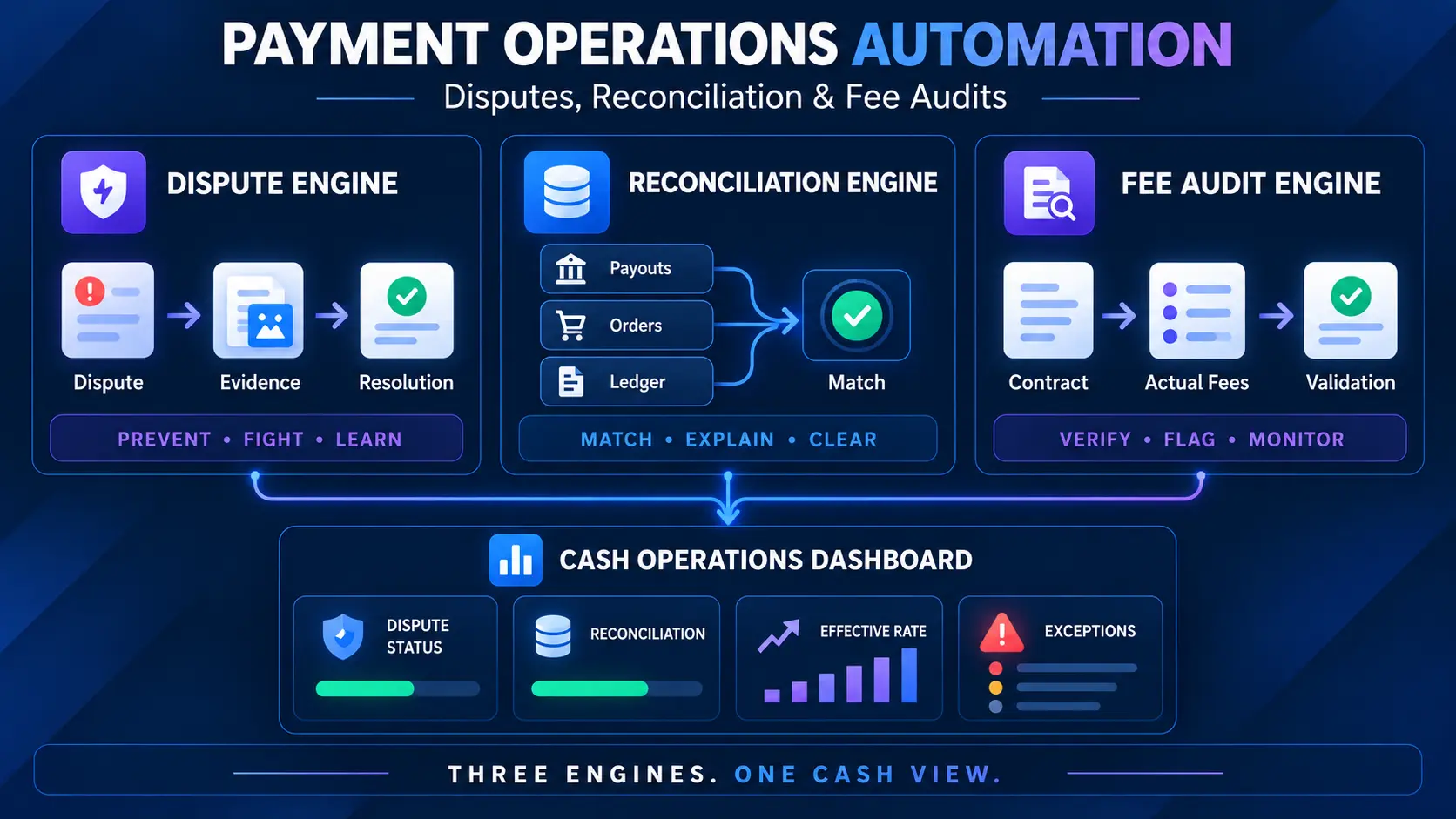
Four questions, answerable by end of day. What is your effective processing rate this month? Which dispute types are you losing, and why? Did yesterday's payout reconcile to the penny? Are you being billed exactly per your agreement?
Most operators answer none of them without a scramble. Not from neglect. From missing machinery. We build operations infrastructure with engineering discipline for $10M-$50M operators, and payment operations is the money leg of that work. This guide builds the three engines that make all four answers instant.
It also completes a set. Our fee-reduction guide covers the tactics. Our negotiation guide covers the ask. This is the operations layer underneath both, where the savings get kept. Tactics win money. Negotiation wins terms. Operations is what stops both from leaking back out.
What Is Payment Operations Automation?
Payment operations automation is the system layer that manages money movement after the sale. Disputes get prevented and fought with evidence. Payouts get reconciled against orders and books. Fees get audited against contract terms. All of it runs continuously, by rules.
It is the money leg of the operations spine. Revenue flows through it every day, and the leaks are quiet: disputes lost by deadline, payouts that never quite match, fee lines nobody reads. None of the leaks announce themselves. All of them compound.
A small leak on every transaction is a large leak wearing camouflage. The three engines below close them in order of pain. Disputes first, because they carry fees and rate risk. Reconciliation second, because unverified cash is unmanaged cash. Fee audits third, because they need the first two feeding them data.
How to Lower Your Stripe Dispute Rate
The dispute engine comes first because disputes cost three ways: the amount, the fee, and the rate itself. Card networks run monitoring programs with published thresholds. Crossing them brings extra fees and scrutiny. Check the current program terms yourself, because the figures change. Then treat distance from those lines as an asset you maintain, the way you maintain uptime.
The Three Dispute Types and Their Different Fixes
Disputes are not one problem. True fraud is a stolen card. The fix is fraud tooling and risk rules. Friendly fraud is a real customer disputing a real charge. The fix is recognition and evidence. Service disputes are unhappy customers using the bank instead of your support line. The fix is operations: clearer expectations, faster support, easier refunds.
Tag every dispute with its type, at intake, by rule where possible. The mix tells you which fix to fund. Most operators discover their problem is operational, not criminal, and operational problems are the cheap ones to solve. The tag takes ten seconds per dispute. The mix report writes the roadmap.
Dispute Prevention: The Operational Levers
Prevention is cheaper than winning. The levers are unglamorous and they work. A billing descriptor customers recognize, because mystery charges get disputed on sight. Receipts that arrive instantly, with support contact visible. Delivery confirmation captured on every physical order.
Clear cancellation paths, because a customer who cannot find the cancel button finds the dispute button. For subscriptions, renewal reminders before the charge, not after. Each lever is a workflow, built once, running forever. None requires a meeting to approve. All of them beat fighting.
Automated Dispute Evidence: Winning the Ones You Fight
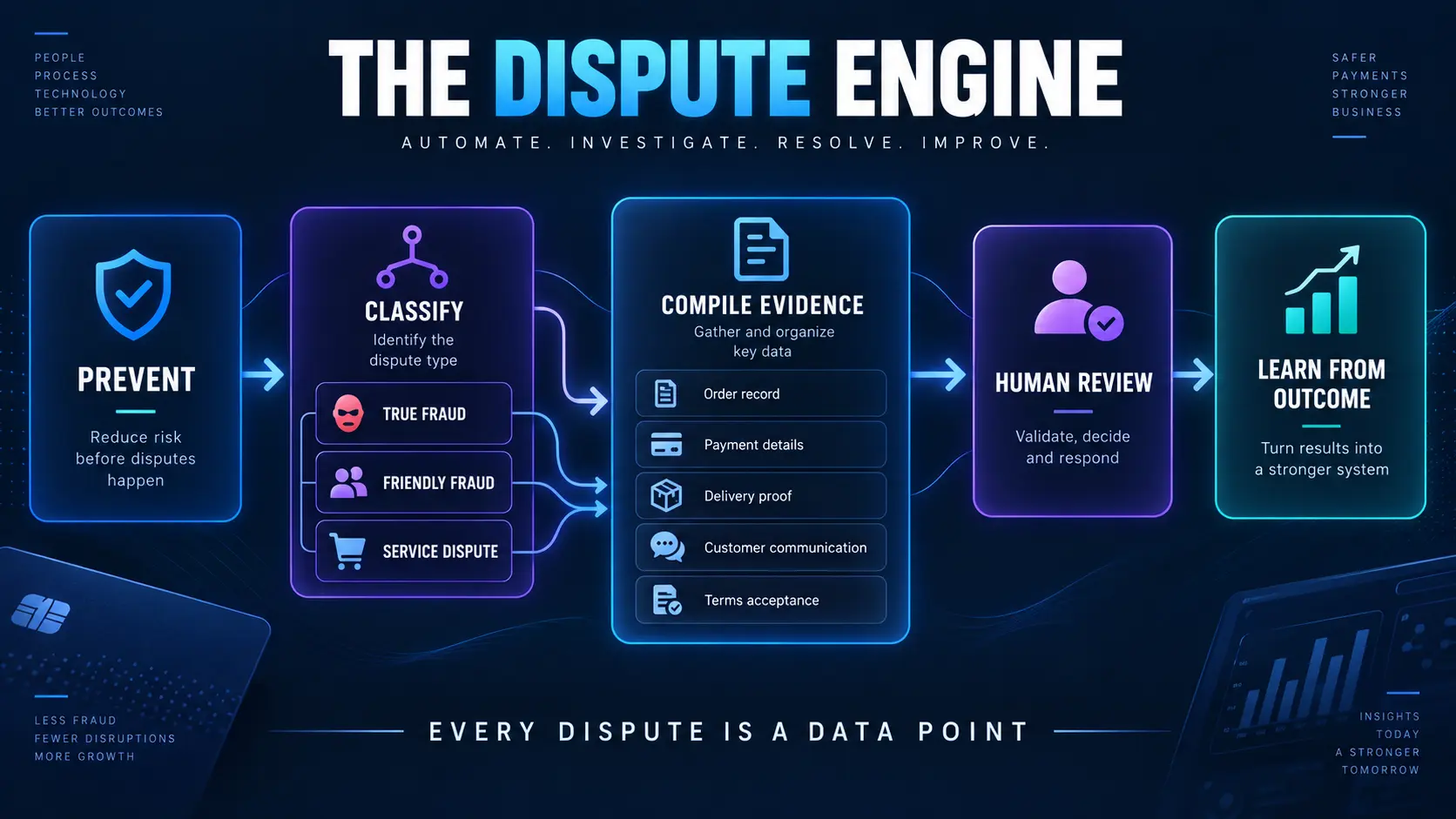
Disputes run on deadlines, and evidence submitted late loses by default. The evidence engine compiles the packet automatically the moment a dispute lands. Order record. Payment details. Delivery confirmation. Customer communications. Terms acceptance. A human reviews and submits inside a day, instead of excavating five systems inside a week. The clock stops being the enemy.
Every outcome feeds back. Won disputes teach which evidence persuades. Lost ones teach which sales to flag earlier. Every dispute is a data point wearing a fee, and the engine is what reads the data. Fight the winnable ones fast. Learn from every one of them.
The Refund-First Policy and Its Approval Band
Some fights cost more than the refund. A written policy names the line. Below a threshold you set, service disputes get refunded fast, logged, and analyzed rather than fought. The threshold lives in an approval matrix band: auto-approved below the line with a log, routed above it.
Speed here prevents the dispute entirely, which is the cheapest outcome on the board. The log keeps the policy honest, because a refund pattern is a product signal wearing a cost. Review the pattern monthly, and let it point at the product or process behind the refunds.
Payment Reconciliation Automation: Payouts to the Penny
The second engine answers the question finance quietly dreads: does the money that arrived match the money we earned?
The Payment Three-Way Match
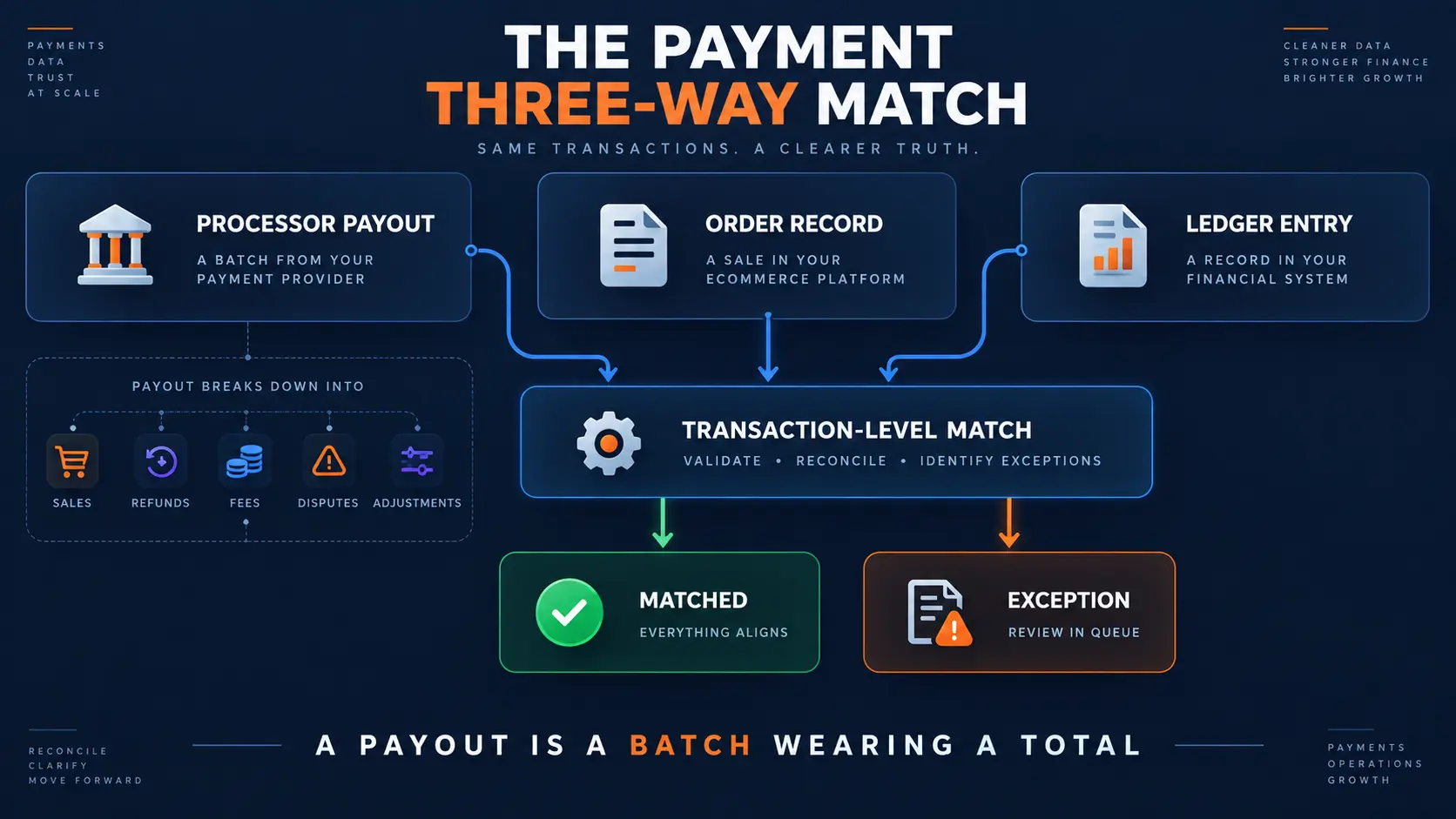
Reconciliation matches three records. What the processor paid out. What your orders say you sold. What your books recorded. Two-way matches hide errors. The three-way match surfaces them. Each pair of records checks the third, and nothing gets to grade its own homework.
Decomposing the Payout
A payout is a batch wearing a total. Inside it: sales, refunds, fees, disputes, adjustments, sometimes across days. The engine pulls transaction-level detail through the processor's reporting APIs. Every payout explodes into its parts. Match at the transaction level, and the total takes care of itself.
The Match Keys
Every transaction carries identifiers linking it to an order and a ledger entry. The build enforces those keys at creation time, because reconciliation is won upstream. An order ID stamped on every charge makes matching mechanical. Missing keys make it archaeology. The stamping rule costs one integration hour. The archaeology costs one analyst forever.
Timing Differences and Currency: The Honest Hard Parts
Two things make payment reconciliation genuinely hard, and pretending otherwise breaks builds.
Timing first. A sale today lands in a payout days later. Batches cross month boundaries. So the engine matches on transaction identity, never on date proximity. The month-end close reads the matched state, not the calendar.
Currency second. Multi-currency sales settle through conversion. The engine records both sides of every conversion and reconciles in both currencies. One number in, one number out, and the difference explained on every transaction. Handle these two structurally, and the rest is bookkeeping.
The Exception Queue That Replaces the Spreadsheet
Matched transactions clear silently, which is most of them. The unmatched land in an exception queue with an owner, a reason guess, and an age timer. The queue is the whole job: a dozen exceptions reviewed daily instead of a thousand rows hunted monthly.
Age carries a hard rule too. Nothing sits past a week without escalation, because old exceptions calcify into write-offs. The queue's age report is the health metric that matters most. Reconcile daily in minutes or monthly in days. Same work, different lives.
Fee Validation Automation: Auditing Every Payout Against Your Contract
The third engine keeps what the first two protect. It is also the build our negotiation guide promised, because a negotiated rate unverified is a press release. You fought for the rate. This is how you keep it.
Contract Terms as Rules
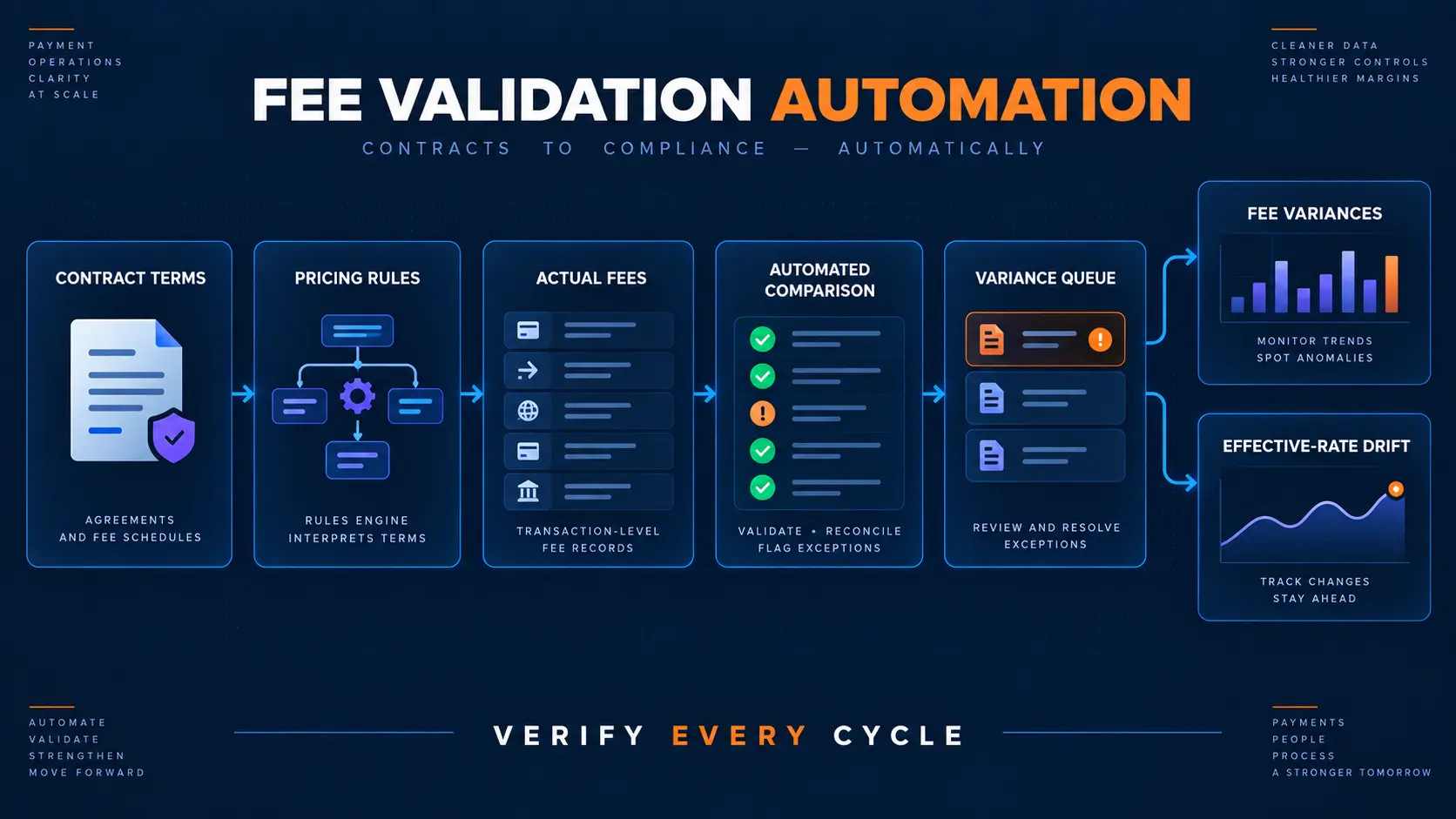
Your pricing agreement becomes machine-readable rules. Rates by category. Fixed components. Fee lines and their conditions. Every payout's fees check against the rules automatically. Variances flag to a named owner with the transaction attached.
Billing errors and misapplied lines happen in every complex billing system on earth, processor dashboards included. The businesses that catch them are the ones that look, every cycle, by machine. The review takes minutes. The looking never sleeps. New agreement, new rules, same engine, which is why the build outlives any single contract.
Effective-Rate Drift and Downgrade Detection
Two quiet leaks the engine watches.
Drift: your mix changes, new products launch, and the effective rate wanders while the contract sits still. So the monthly rate lands on a dashboard next to its trailing history. Movement gets a reason or gets a review.
Downgrades: transactions settling at worse card-cost categories than they should, often from missing data fields at charge time. A fixable cause, once detected. Run your current rate through the fee calculator, then let the engine keep the number honest forever.
The Payment Operations Dashboard
The three engines emit one view, assembled per our reporting stack: dispute rate and mix, trailing effective rate, reconciliation status with exception age, and the cash timeline. It is the cash view every operator wants, fed by systems instead of by someone's Friday. Four widgets. Four questions. All of them answered before coffee.
The processor's dashboard is their view. The build is yours. Both are useful. Only one answers your questions in your terms, joined to your orders and your books.
Payment Operations Tools vs the Build
Honesty about the landscape. Processors ship real capabilities: fraud tooling, dispute evidence flows, reporting APIs, and they improve constantly. Configure what you already pay for first, to its limits. Category tools exist too, for chargeback management and reconciliation, priced per seat or per dispute. They fit teams wanting speed over ownership.
The engineered build earns its place where our clients live. Multi-system reality. Contract-specific fee rules. Exception routing into your own queues. A dashboard that joins payments to operations. That is integration engineering with the usual constants, and the same architecture our financial services practice runs under heavier compliance.
How ACS Builds Payment Operations
Engine by engine, worst leak first. Fixed fee, after a paid and refundable discovery. Discovery baselines all four diagnostic numbers from your actual payout data: dispute rate and mix, effective rate, reconciliation gap, fee variances found.
The baseline document is yours either way, and it usually pays for the discovery by itself. Operators rarely know which leak is worst before the baseline. The data settles the argument, and the build order follows the data.
Builds carry the constants: every sync alerted, every exception owned, documentation your team keeps, accounts in your name. Engagement structure sits on pricing. The record sits in the case studies: 500+ workflows shipped, more than 10,000 hours reclaimed, over $2 million in client savings.
Frequently Asked Questions About Payment Operations
What is payment operations automation?
The system layer managing money after the sale: disputes prevented and fought with compiled evidence, payouts reconciled three ways to the penny, fees audited against contract terms every cycle. Three engines, one dashboard, four questions answered instantly. It sits downstream of checkout and upstream of the books, which is exactly where the leaks live.
How do I lower my Stripe dispute rate?
Tag disputes by type, then fund the matching fix: fraud tooling for true fraud, evidence for friendly fraud, operations for service disputes. Add the prevention levers: recognizable descriptors, instant receipts, delivery proof, easy cancellation. Most rates drop on operations alone. The tagging costs nothing and pays first, because it turns a scary number into a fixable list.
What is a good dispute rate?
Below the card networks' monitoring thresholds, with room to spare. The networks publish program terms, and they change, so check current figures rather than trusting any article's number, including this one. Treat distance from the line as an asset. The operational answer matters more than the numeric one: a falling rate with a known cause beats a low rate nobody can explain.
How do I automate payment reconciliation?
Pull transaction-level payout data through the processor's APIs, enforce order IDs on every charge, match three ways at the transaction level, and route the unmatched into an owned exception queue. Daily cadence. The spreadsheet retires the same week. The upstream key enforcement matters most, because clean keys make everything downstream mechanical.
Why do my Stripe payouts never match my bank deposits?
Because a payout is a batch: sales minus refunds minus fees minus disputes plus adjustments, often across days. Decompose to transaction level and the mystery dissolves. Match on identity, never on amounts alone, and month boundaries stop mattering. The confusion is structural, not a mistake, and structure is what fixes it.
What is fee validation automation?
Your pricing agreement expressed as rules, checked against every payout's actual fees automatically, with variances flagged to an owner. It catches billing errors, misapplied lines, downgrades, and drift. Negotiated rates need it most, because a won rate unverified is a press release. The build outlasts every future negotiation too, since new terms just become new rules.
Do payment processors really make billing errors?
Every complex billing system produces errors and edge cases, processors included, and the direction is not always against you. The point is not accusation. It is verification. Machines check machines, and the variances get reviewed by a human with the contract open. Trust the relationship. Verify the math.
Does this only work with Stripe?
No. The architecture is processor-agnostic: transaction feeds in, rules applied, exceptions routed, dashboard out. Stripe's APIs make it especially buildable, which is why the examples live there. Multi-processor operators run one engine across all of them, and the cross-processor view is where the comparison gets interesting.
How fast does payment operations automation pay back?
Compute it from your own leaks: disputes lost to deadlines, hours spent reconciling, and whatever the first fee audit finds. The discovery baselines all three from real data. Most operators find the payback argument written in their own payouts. The reconciliation hours alone usually justify that engine, and the other two ride the same data feeds.
Ready to Answer All Four Questions?
Three ways forward.
Run your effective rate now. The fee calculator answers question one in minutes, from numbers already sitting in your dashboard.
Read the siblings. The fee-reduction tactics and the negotiation playbook complete the money picture from every side.
Book a paid discovery. All four numbers baselined from your payout data, the worst leak named, one fixed price, refundable if the fit is wrong. Details on pricing.
Three engines. One dashboard. Four answers by end of day, every day. The money already moves through your systems. This is what makes it report for duty.