

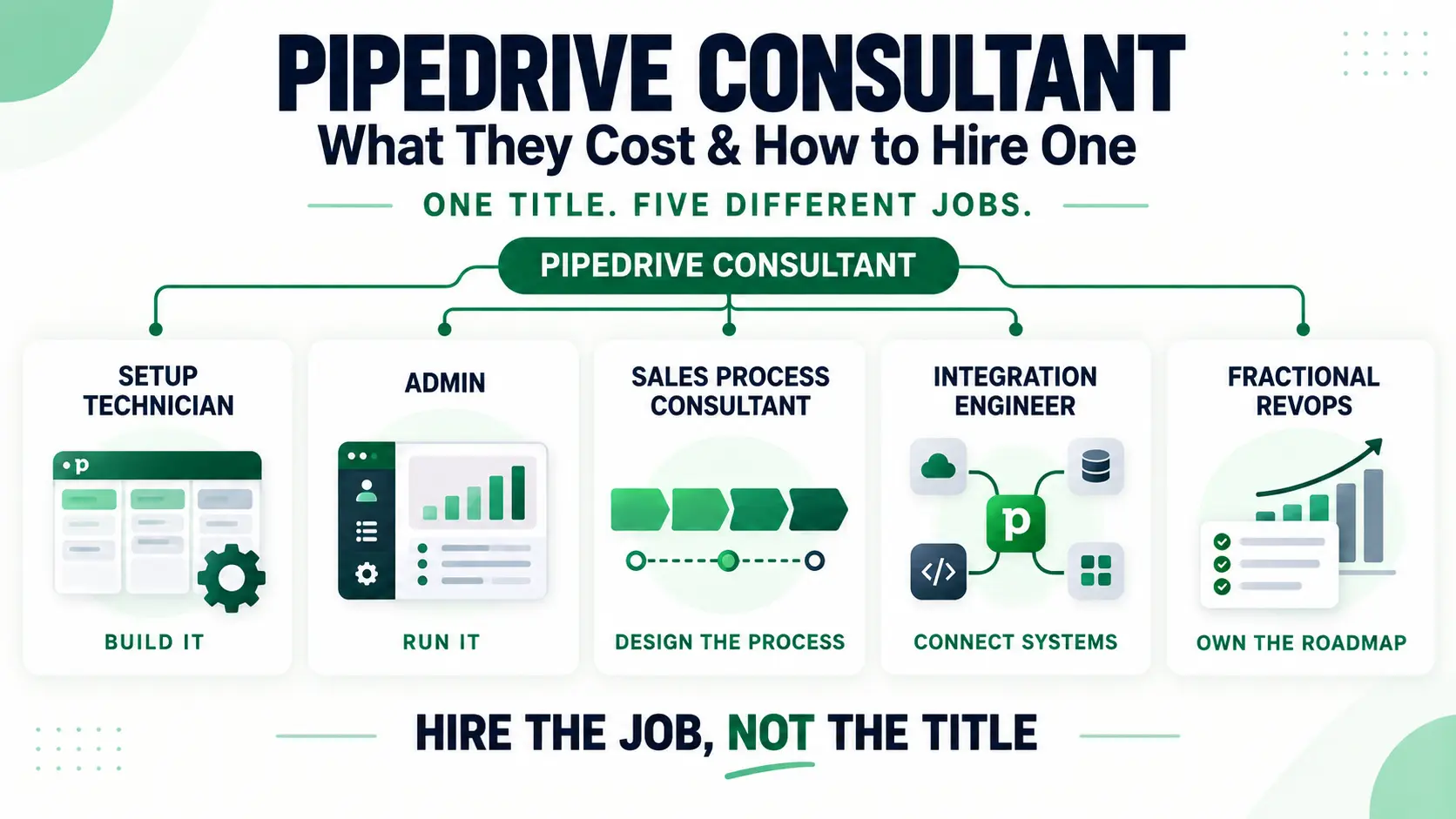
Here is the problem with hiring a Pipedrive consultant. The title describes five different jobs, and the person you interview rarely says which one they actually do. You need a process fixed. You hire a setup technician. Everyone is competent, and the engagement still fails. The title matched. The job did not.
We build operations infrastructure with engineering discipline for $10M-$50M operators, and Pipedrive work runs through our Pipedrive practice constantly. This guide decodes the five roles.
It matches each to the symptom it cures. It prices the engagement models honestly, and it hands you the evaluation checklist. No rate figures, because rates change and scope decides. The structures are the durable part.
What Does a Pipedrive Consultant Actually Do? The Five Roles
One title, five jobs. Every candidate you meet is mostly one of these, whatever the profile says. Read the five, and the interviews start making sense.
The Setup Technician
Builds the portal: pipelines, stages, custom fields, users, permissions, basic automations. Fast, affordable, and exactly right when your process is already clear and just needs building. The deliverable is a working portal in days, not weeks.
The limit is the mirror problem: a technician builds the process you describe, including its flaws. Garbage process in, tidy garbage out. Bring a clear process, and this role is the best value on the list.
The Pipedrive Admin for Hire
Ongoing hands: field cleanups, report tweaks, user questions, small automations, monthly maintenance. The right hire when the portal works and nobody internal owns it. The risk is drift: an admin keeps the lights on, and lights-on is not the same as improving. A quarterly review against the roadmap keeps the role honest. No roadmap, no review, slow decay.
The Sales Process Consultant
Works upstream of the tool: pipeline design, stage definitions, qualification rules, handoffs, the operating rhythm. The portal work is downstream of the thinking.
Right when deals stall, stages mean different things to different reps, or the forecast keeps lying. The deliverable is a process document the whole team can read. The tell: they talk about your sales motion before they touch a setting.
The Integration Engineer
Connects Pipedrive to everything else: accounting, marketing, fulfillment, proposal tools, phone systems. Native connections first, middleware through the platforms we compared second, custom integration builds at the hard edges.
Right when data lives in five systems and reps re-key between them. This role prices like the engineering it is, and the standards travel with it: every sync alerted, every failure owned.
The Fractional RevOps Partner
The standing relationship: process, portal, integrations, reporting, and the roadmap, owned continuously at a fraction of a full-time hire. Right for operators scaling past what ad-hoc fixes can carry.
The rhythm is monthly at minimum: roadmap reviewed, metrics read, next builds sequenced. The mistake is buying this tier for a one-time setup, or buying a technician when you needed this.
Which Pipedrive Consultant Do You Need? Match by Symptom
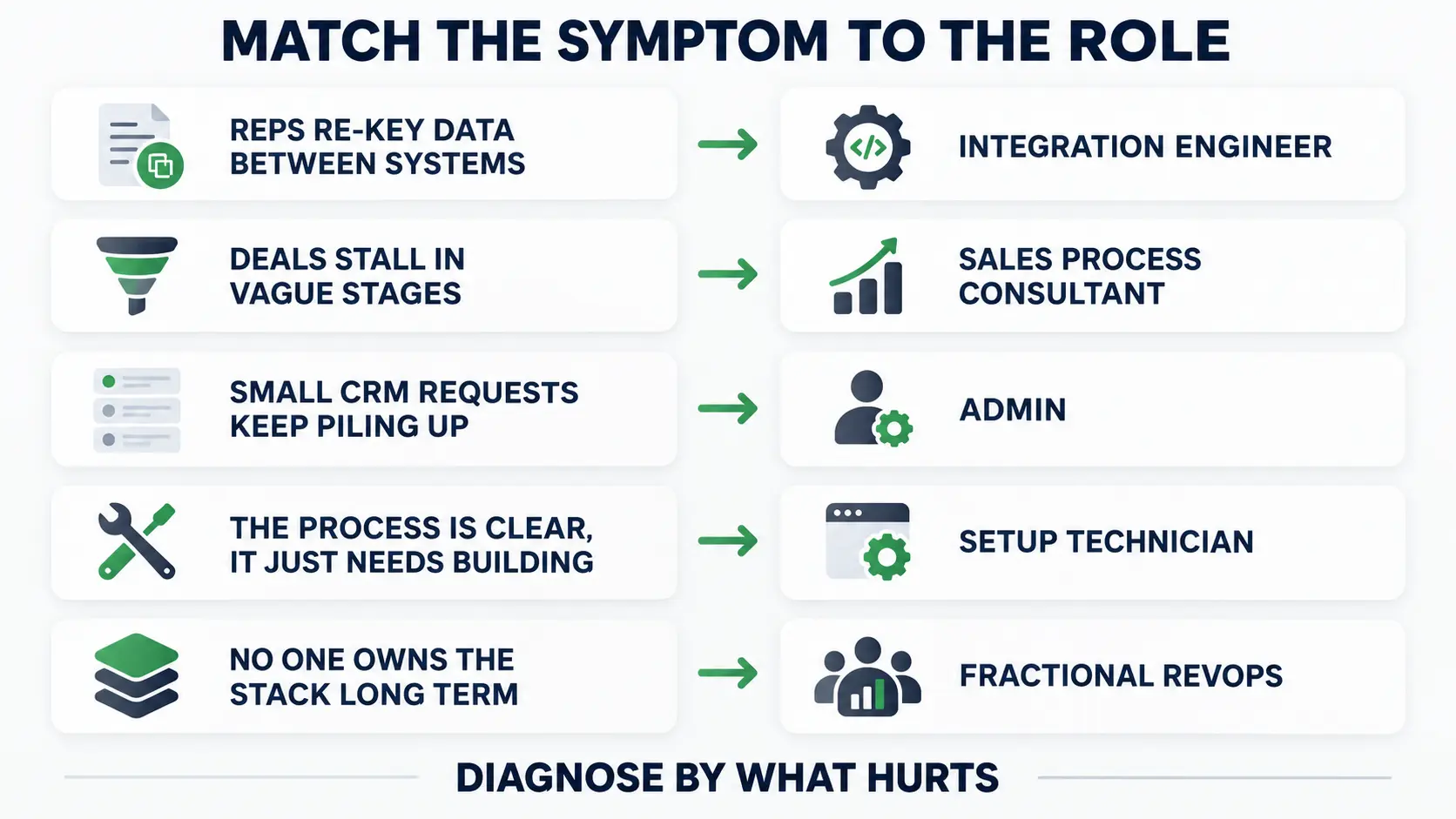
Diagnose by what hurts, not by what titles are available. The symptom names the role faster than any interview.
Reps re-key data between systems: integration engineer. The pipeline exists but deals rot in vague stages: process consultant. The portal is fine and small requests pile up: admin for hire. You know your process cold and need it built this month: setup technician. Everything above, recurring, plus nobody owns the stack: fractional RevOps.
Two symptoms usually coexist, and the sequence matters. Process before portal, portal before integrations, always. An integration wired to a broken process automates the breakage. The role you hire first is the one furthest upstream of your pain.
The whiteboard test settles ambiguous cases. Draw your pipeline from memory, stages and rules included. Drawn cleanly in two minutes: skip the process consultant. Drawn with arguments: start there.
Pipedrive Consultant Cost: The Pricing Models
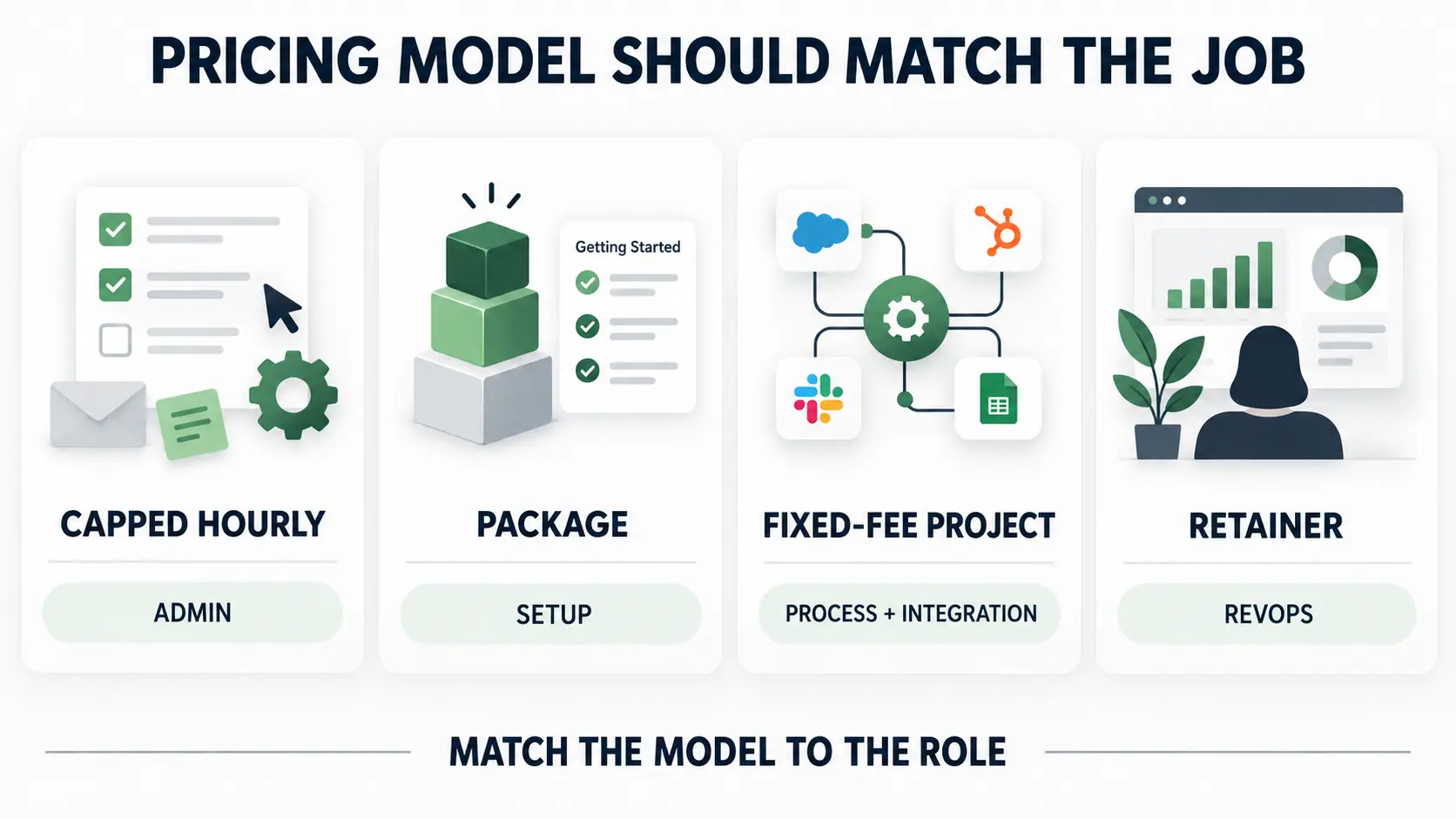
Models, not figures, because figures without your scope are theater. Four shapes cover the market, and each one rewards a different kind of work.
Hourly suits small, defined tasks and admin work, and it deserves a cap. A cap means a written ceiling with a check-in before crossing it. Open-ended hourly makes the meter the business model, which is the incentive problem our cost guide dissects.
Packages bundle common setups at fixed prices: clean for standard scopes, tight for unusual ones, so read what the package excludes. Fixed-fee projects price the outcome after a discovery. That is the model we run, because it puts the scoping risk on the builder who can control it. Retainers price the fractional relationship monthly, and they earn their fee only while the roadmap stays ambitious.
Match the model to the role. Admins fit hourly or light retainers. Technicians fit packages. Process and integration work fit fixed-fee. RevOps fits the retainer. A mismatch between model and role predicts friction before the first invoice.
Where to Find a Pipedrive Consultant
Three channels, honestly weighed.
Pipedrive maintains a public partner directory of vetted firms and consultants, searchable by region and service. A real starting point, with one structural note. Partner programs commonly include referral economics. Ask any partner plainly how they are compensated, and expect a plain answer. Compensation disclosed is a non-issue. Compensation dodged is your answer.
Freelance marketplaces carry the widest range and the widest variance. The five-role decoder matters most here, because marketplace titles inflate hardest. Filter by the questions candidates ask in the first message, and the shortlist builds itself.
Independent firms and consultancies, found through content, referrals, and communities, sit between: senior hands, visible track records, less brand than agencies. Wherever you look, the evaluation below outranks the channel. A great consultant from a mediocre channel beats the reverse every time.
How to Evaluate a Pipedrive Consultant Before Hiring
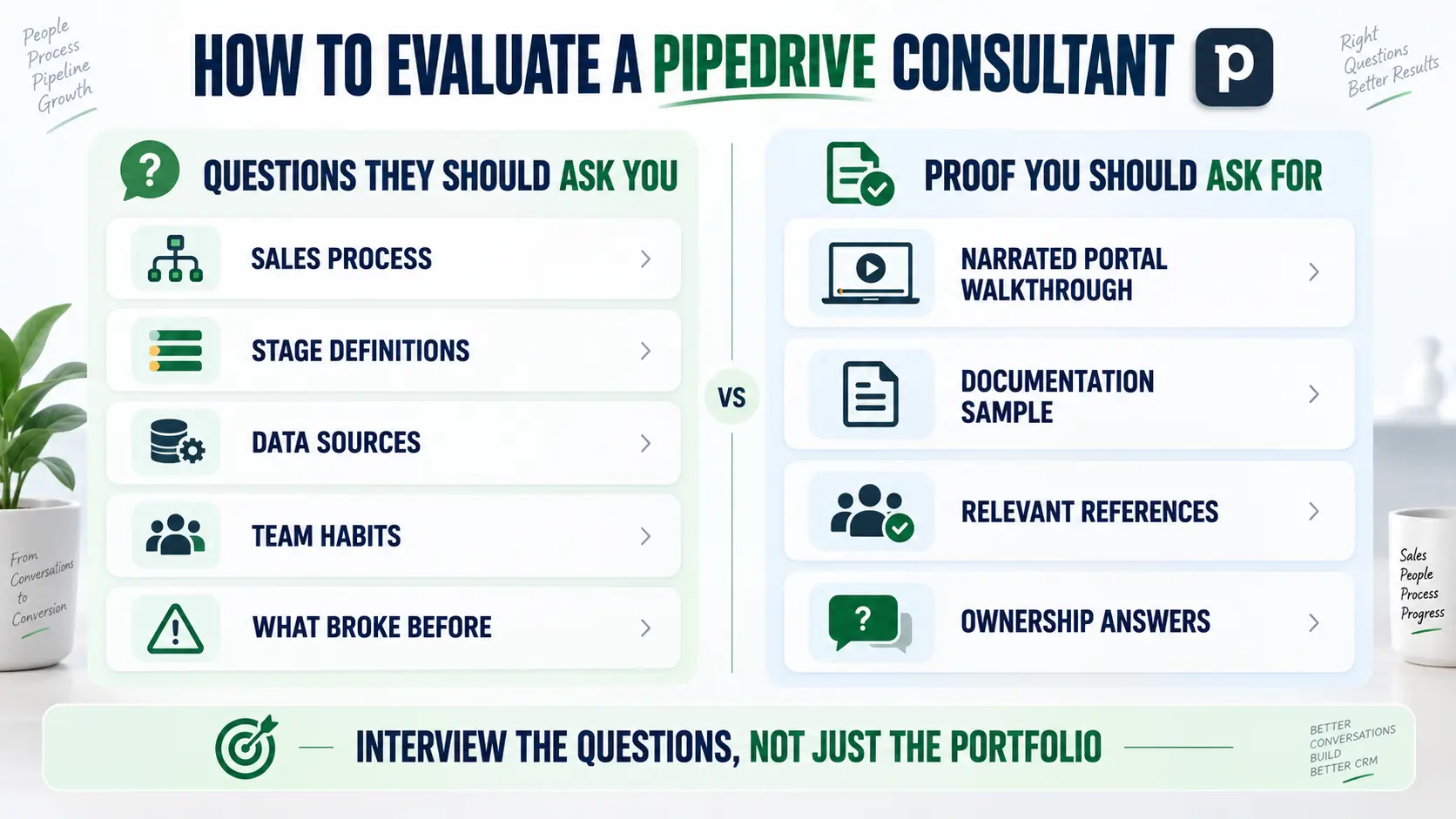
Two lists decide it, and the first one surprises people. The interview runs both directions, and the direction they lead tells you who they are.
The Questions They Should Ask You
The candidate's questions predict the build better than their portfolio. A serious consultant asks about your sales motion, your stage definitions, your data sources, your team's habits, and what broke before. A weak one asks which plan you are on and when to start. Interview the questions. Count them if it helps. Five real ones about your business beats fifty screenshots of theirs.
The Proof You Should Ask Them
A walkthrough of a portal they built, with the reasoning narrated. A documentation sample, because the documentation they show is the documentation you will get. Two references from engagements shaped like yours.
And the ownership answers from our hiring guide: accounts in whose name, documentation kept where, what happens when they leave. Clean answers are quick. Muddy answers are the answer. Twenty minutes of this filters harder than any rating score.
Pipedrive Consultant Red Flags
Five patterns that reliably predict regret.
Configuration talk with zero process questions, because they are building your flaws faster. Open-ended hourly with no cap and no milestones. No documentation or training line in the proposal. Reseller economics steering advice, undisclosed. And portfolio-only proof with no walkthrough, because screenshots are not reasoning.
Any one is a question. Two is a pattern. Three is a different candidate. The pattern behind all five is the same one everywhere: incentives pulling away from your outcome. Aligned incentives read clean at every step.
Do You Even Need a Pipedrive Consultant? The DIY Honesty
Sometimes no, and saying so is the point of choosing Pipedrive. The tool's simplicity is its pitch. A small team, a clean process, modest data, and no integrations can self-implement in focused days using Pipedrive's own guides.
Do that, and spend the savings on selling. Write the process down first, even for a DIY build. The one-page pipeline doc costs an hour and prevents most self-implementation regret.
The triggers that change the answer: a migration with history worth keeping. Integrations beyond the native catalog. Automation depth past basic workflows. A team big enough that training is a project. Or a process nobody can draw on a whiteboard. One trigger, consider help. Two, get it. The consultant's job is the complexity, not the clicking.
Consultant vs Implementation Partner: Which Engagement Fits
Short version: consulting advises, implementation builds, and many engagements blend both. The distinction changes pricing, deliverables, and accountability, and it deserves its own decision.
Our consultant vs implementation guide walks the full comparison, so read it before signing either shape. The one-line preview: buy advice when you will build, buy the build when you will not, and put the blend in writing when you buy both.
The Mid-Market Pipedrive Build: What $10M-$50M Engagements Involve
Our own lane, described plainly. Mid-market Pipedrive work is rarely a fresh portal. It is a working sales team, existing data with history, at least one migration in the story, per our Salesforce-to-Pipedrive guide, and integrations into accounting and operations systems that already run the company. Nothing pauses for the project. The build happens around a live sales floor, which is a constraint and a design input at once.
That profile needs the process consultant and the integration engineer in the same engagement, sequenced correctly. It is also where Pipedrive's simplicity pays best, because a clean tool with engineered connections beats a heavy platform half-configured. The portal stays readable. The engineering hides in the pipes, where it belongs.
How ACS Works as Your Pipedrive Consultant
All five roles, sequenced by your symptoms, priced as fixed-fee builds after a paid and refundable discovery. Discovery maps your process, data, and integration reality, and the document is yours either way.
It also names which of the five roles your situation actually needs, in writing, with the sequence. Shop the document to anyone. It converges every quote you gather, including ours.
Builds carry the constants: documentation your team keeps, training to named roles, accounts in your name, error-alerted integrations, and the month-eighteen test applied to ourselves.
The practice lives on the Pipedrive page, engagement structure on pricing, and the record in the case studies: 500+ workflows shipped, more than 10,000 hours reclaimed, over $2 million in client savings.
Frequently Asked Questions About Pipedrive Consultants
What does a Pipedrive consultant do?
One of five jobs: portal setup, ongoing admin, sales process design, integration engineering, or fractional RevOps ownership. Most candidates are strongest at one. Match the role to your symptom before comparing anyone, because the mismatch is what fails. The decoder in this guide sorts it in minutes.
How much does a Pipedrive consultant cost?
By model, honestly: capped hourly for small tasks, packages for standard setups, fixed-fee projects for process and integration work, retainers for ongoing ownership. Figures follow scope, so scope first. Any quote before discovery is a guess with confidence. Match the model to the role, and half the pricing questions answer themselves.
Is Pipedrive easy to set up yourself?
For a small team with a clear process and no integrations, yes, in focused days. Migrations, integrations, automation depth, and team size change the answer. Count your triggers from this guide, and let the count decide. The honest DIY move: write the process down first, build second.
Do I need a consultant for Pipedrive?
Run the trigger count. Zero triggers: self-implement and spend the savings on selling. One: consider help for that piece alone. Two or more: get help, sequenced upstream-first. The question is never the tool's difficulty. It is your situation's complexity.
How long does Pipedrive implementation take?
Scope decides, and Pipedrive runs faster than heavier platforms. Clean single-team setups land in days. Migrations and integrations stretch the calendar into weeks, with the data work carrying most of it. Phase the launch: core pipeline first, connections second, and the team starts selling on day one of the portal, not day one of the project.
How do I find a good Pipedrive consultant?
Start with the partner directory, marketplaces, and independent firms, then let evaluation outrank channel. Judge the questions they ask you, demand a narrated portal walkthrough, check documentation samples, and verify the ownership answers. The channel finds candidates. The checklist finds consultants.
What is a Pipedrive partner?
A firm or consultant listed in Pipedrive's public partner directory, typically vetted for platform competence. Partner programs commonly include referral economics, so ask how any partner is compensated. Good partners answer plainly, and the answer costs nothing to hear.
Should I hire a consultant or an agency for Pipedrive?
Agencies bring teams and bandwidth with overhead priced in. Independents bring senior hands leaner. Pipedrive's scope rarely demands agency machinery, so mid-market operators usually do best with a strong independent or small firm. Evaluate both against the same checklist, and let the checklist decide.
Can a Pipedrive consultant help with automations?
Yes, across two layers: native Pipedrive workflow automation inside the portal, and cross-system automation through middleware or custom integration work. Name which layer your need lives in, because the two price and staff differently. Portal automations are technician work. Cross-system pipelines are engineering.
Can a consultant migrate my data from another CRM?
The right one can, and migration is where help earns most. Record volume, source mess, and history depth drive the work. Clean data before the move, migrate a sample first, and demand a rollback plan in writing. A migration without a rollback plan is a bet, not a project.
Ready to Hire the Right Role?
Three ways forward.
Diagnose first. Match your loudest symptom to its role using the decoder above. Five minutes that prevents the mismatch most bad hires start with, and the cheapest consulting you will ever receive.
Read the engagement guide. The consultant vs implementation comparison settles which shape of help fits.
Book a paid discovery. Process, data, and integration reality mapped, the role sequence recommended, one fixed price, refundable if the fit is wrong. Details on pricing.
Five jobs, one title. Hire the job, not the title, and the engagement works the way the profile promised it would.