

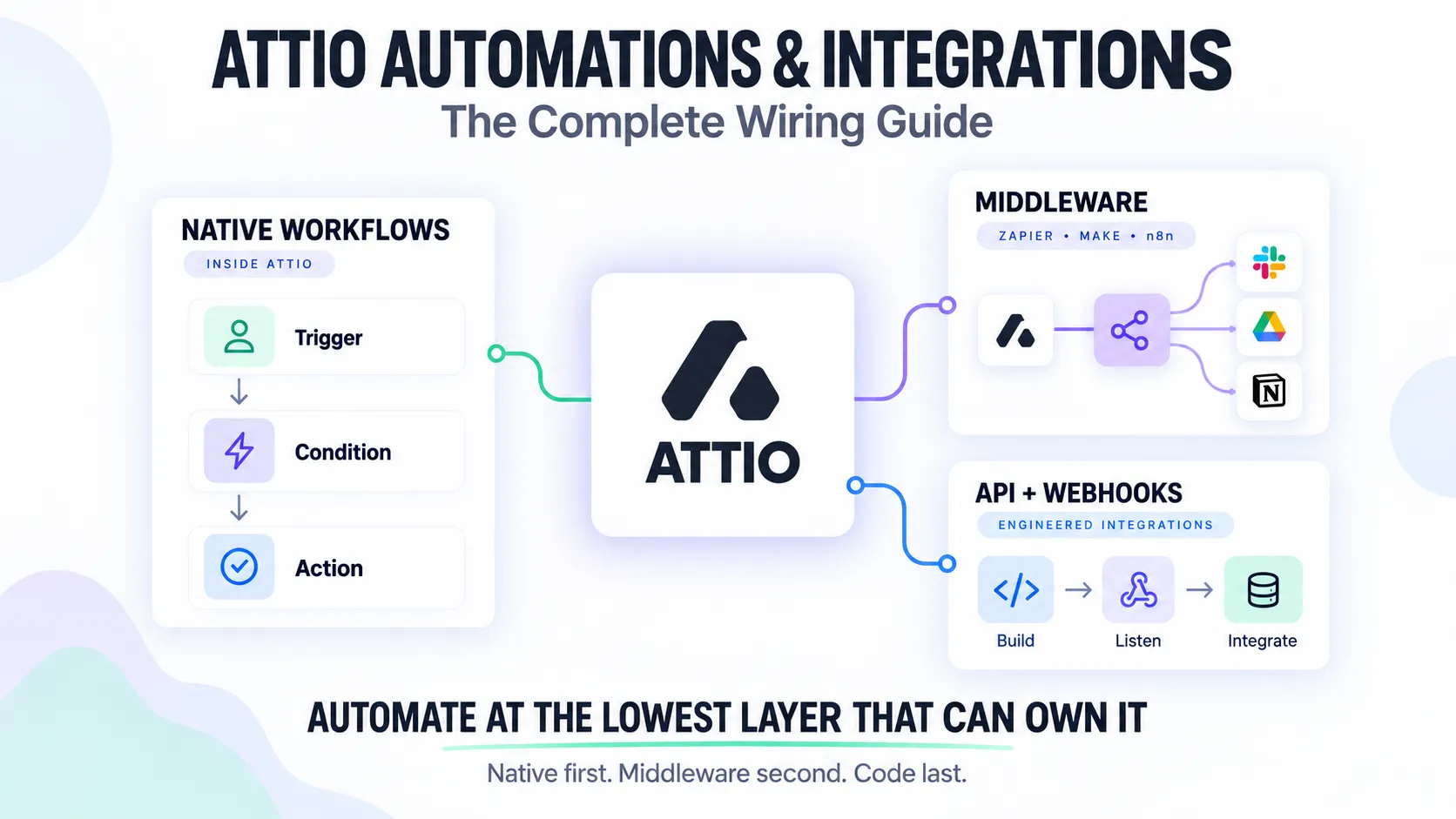
Attio maintains its own records, per the AI-native architecture, and that changes what automation means. You are not wiring a data-entry machine. You are wiring a system that already feeds itself, into the rest of your stack. Less patch-up automation. More actual plumbing, the kind that moves the business.
We build operations infrastructure with engineering discipline for $10M-$50M operators, and Attio wiring runs through our practice weekly. This guide maps the three layers. It hands you the placement rule. It walks the five builds nearly every operator wants first.
Capabilities on a young platform move quarterly, so treat specifics as a snapshot and verify the current release. The architecture below is the durable part. Layers, rule, and builds will outlive any changelog.
What Attio Automations Can Do
Inside the platform, automation means workflows triggered by record events. A stage changes. A field updates. A record arrives. Actions follow, in order, every time. Assignments route. Fields update. Notifications fire. Sequences of steps run without a human touching them.
The native layer's job is motion and hygiene: keeping records assigned, stages honest, and the team informed. It is deliberately not a middleware platform, and the boundary is healthy.
A CRM that tried to be your middleware would do both jobs worse, and several have proven it. Know what the current release ships by checking the changelog, because the surface grows fast. Then place every automation by the rule below.
The Three Layers of Attio Automation
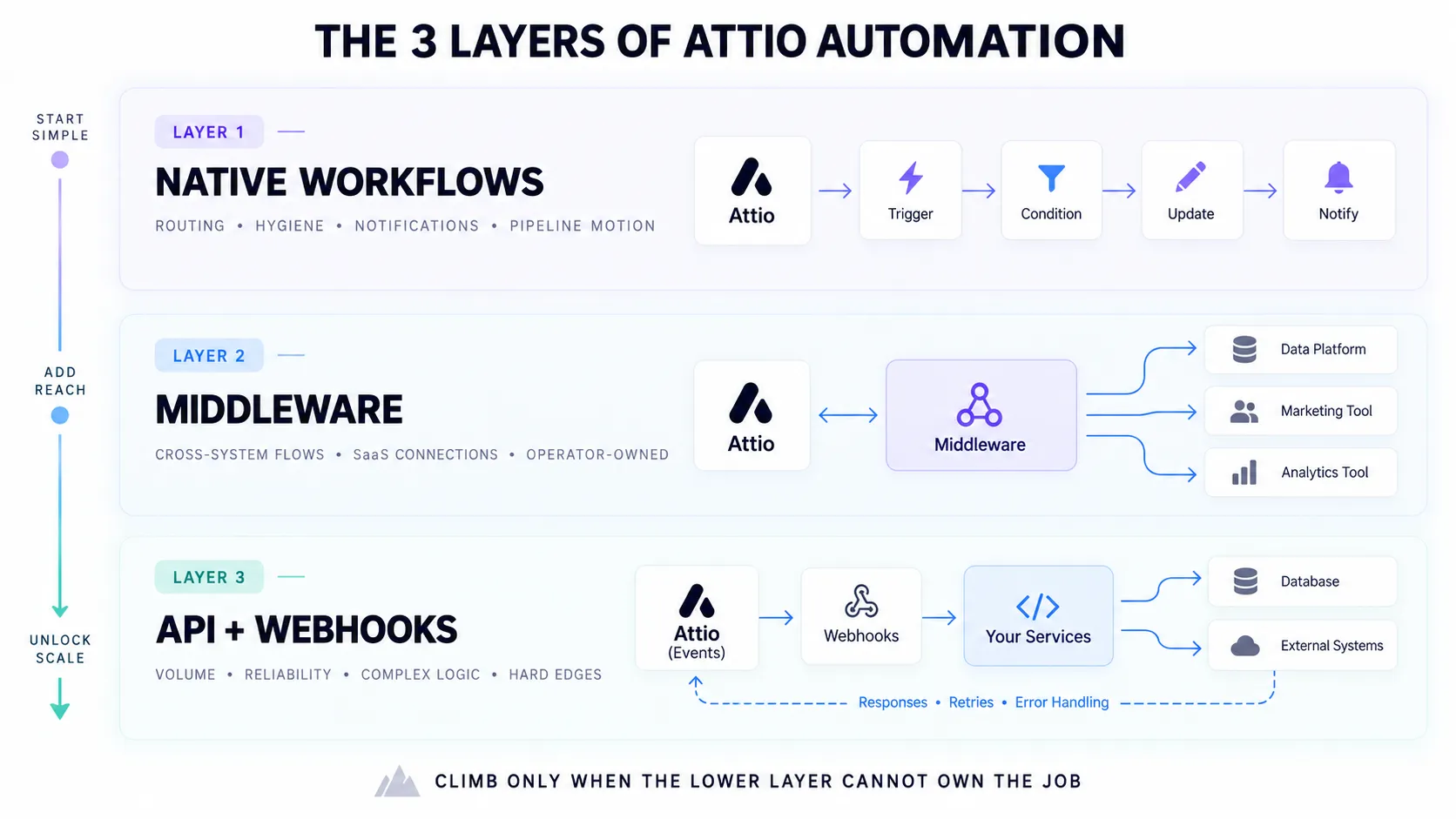
Every automation you will ever want lives on one of three layers, and choosing the layer is most of the design. Get placement right, and the build is half done. Nobody has opened a tool yet.
Layer 1: Native Workflows
Automation inside Attio itself. No external dependency, no middleware bill, no extra maintainer. Right for record hygiene, routing, notifications, and pipeline motion. The limit is reach. Native automation touches what lives in Attio, and your business runs on more systems than one. Exhaust this layer first. Free reliability is the best reliability, and it never invoices you.
Layer 2: Middleware
Zapier, Make, or n8n connecting Attio to the rest of the stack. Fast to build, visual to maintain, priced by usage shape. Right for cross-system flows a non-engineer will own. Form tools. Messaging. Documents. The long tail of SaaS. The layer's superpower is speed.
Its tax is a bill that grows with activity and a dependency someone must watch. Fair trade, when the maintainer is real and named before the first flow ships. The platform comparison picks among the three, and the month-eighteen maintainer test decides more than any feature does.
Layer 3: API and Webhooks
Engineered integration against Attio's API, with webhooks pushing events out in real time. Right for the hard edges. Billing systems. ERPs. Data warehouses. Any flow where volume, reliability, or logic outgrows middleware.
This is integration engineering, and built pipes fit tighter than installed ones. The layer costs the most per flow and the least per incident. Production revenue pipes belong on this layer for exactly that reason.
The Placement Rule
Automate at the lowest layer that can own it. Native before middleware. Middleware before code. Always, and in that order. Every layer you climb adds a dependency, a failure surface, and a maintainer.
Climb only when the lower layer genuinely cannot carry the job, and write down why you climbed. The written reason stops the next person from climbing out of habit.
The Five Builds Every Attio Operator Wants First
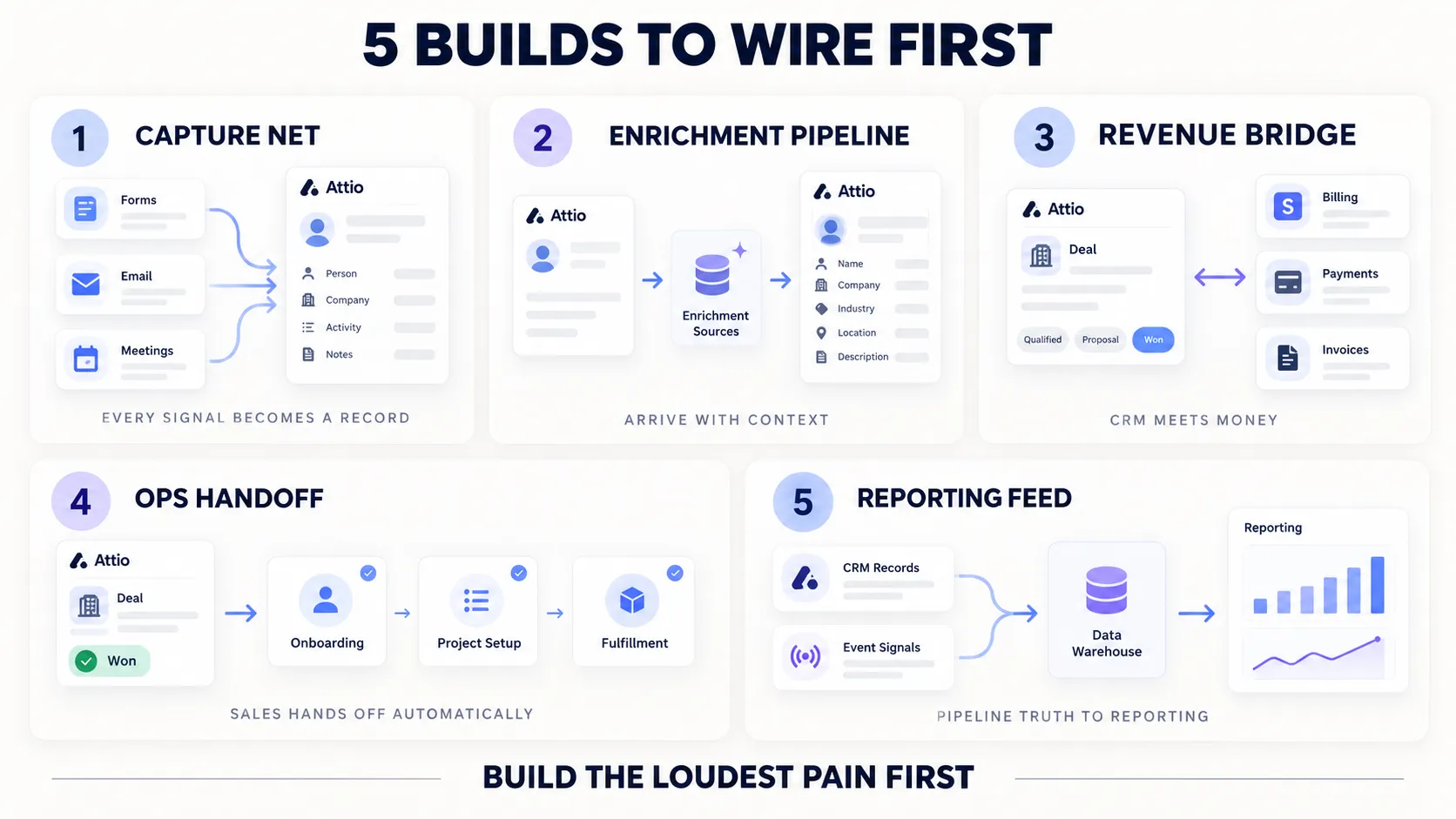
A pattern library, drawn straight from client work. Build these in the order of your own loudest pain. Each one stands alone. Each one makes the next cheaper, because they share pipes and discipline.
Build 1: The Capture Net
Every inbound signal becomes a record without a human typing. Website forms. Inbound email. Calendar events. Meeting capture. All land as records with context attached. Attio's native capture covers email and calendar.
The net extends it to every door your leads walk through. Forms through middleware. Events through webhooks. Nothing typed twice, anywhere. The test is simple. A new lead at 2 a.m. exists as a full record by 2:01. Unassisted. Source logged on the record itself.
Build 2: The Enrichment Pipeline
New records arrive complete. Firmographics, roles, and signals fill from enrichment sources, the work tools like Clay industrialized. The data flows into Attio through middleware or the API.
The rule that keeps it honest: enrich on arrival, re-enrich on a schedule, and log the source of every filled field. Sourced fields can be trusted, audited, and refreshed. Mystery fields rot quietly until a rep quotes one to a customer. An empty record is a to-do. An enriched one is a starting point.
Build 3: The Revenue Bridge
Attio talks to money. Deals sync to invoicing. Payments confirm back to records. Subscription events update customer status automatically. Wire it with the same discipline as our payment operations builds: match keys on every transaction, alerts on every failure.
Revenue data that reconciles to the CRM ends the whose-number-is-right meeting, permanently. That meeting alone, retired, justifies the build.
Build 4: The Ops Handoff
Closed-won triggers the business. Project records spawn. Fulfillment kicks off. Onboarding sequences start on time. The operations spine picks up where sales stopped. The handoff is where deals go quiet in most companies.
The signed customer waits while sales celebrates and ops has not heard yet. Automated, the gap closes to minutes, and the customer experience actually begins where it should, at the signature.
Build 5: The Reporting Feed
Attio feeds your numbers. Records and events flow to the warehouse or straight into dashboards, per our reporting stack. Pipeline truth and revenue truth share one screen.
Self-maintaining records make this feed unusually honest, because the report inherits the data quality upstream. Garbage-free in, garbage-free out, for once in the history of reporting.
Attio with Zapier, Make, or n8n: Choosing the Middleware
The compressed answer, with the full comparison one click away. Zapier for the widest catalog and non-technical maintainers. Make for visual complexity at operator price shapes. n8n for engineering teams wanting control and self-hosting.
Same three, same tests, Attio changes nothing about the choice. The routing rule holds in Attio stacks like everywhere else: a new workflow lands where its maintainer lives. And the month-eighteen question decides the platform: who fixes this when it breaks, named, not hoped. Answer with a name, a real one on your payroll, and half the tooling debate ends.
The Attio API and Webhooks: What Builders Get
The builder's view, kept structural. A modern API covers records, objects, and lists. The documentation reads like engineers wrote it for engineers. Webhooks pushing events out as they happen, so integrations react instead of polling.
Together they make Attio unusually pleasant to engineer against, which is half the reason layer three costs less here than on legacy platforms. Clean APIs compress engineering estimates, and estimates are where integration budgets are won or quietly lost.
Events Worth Listening To
Record created. Record updated. Stage changed. List membership changed. Those four events carry nearly every integration on this page. Subscribe narrowly, process idempotently, and log everything, because event streams reward discipline and punish optimism. Idempotent means safe to receive twice. Build for twice, because twice will happen, usually during a retry storm.
The Alerting Constant
Every sync alerted, every failure owned, no exceptions. An automation without an alert is a silent failure generator, and silent failures in revenue systems get expensive before they get noticed. The alert is not overhead. It is the product working, visibly, on the one day visibility matters.
Automation Discipline: The Rules That Keep Builds Alive
Five rules, each learned expensively so you do not have to. None of them is about tools. All of them are about ownership, which is why they survive every platform migration.
Every automation gets a named owner, because unowned automations always rot. Every automation gets documentation your team keeps, not the builder's notes. Every failure alerts a human, per the constant above.
Every quarter, a review kills what nobody uses, because dead automations confuse live ones. And accounts stay in your name, always, so no departure takes the wiring with it. Five rules, one sentence each, and they outlast every tool choice on this page.
When to Automate Nothing Yet
The honest gate, stated once. If the data model is still wrong, stop. Automating a wrong model automates the wrongness, faster and at scale. The implementation sequence holds: model first, capture second, wiring third.
A week of model work saves a quarter of rewiring, and the builds above all land cleaner on a model that matches the business. Wiring is patient. It will still be here after the model workshop, and it will land better for the wait.
How ACS Builds Attio Automations and Integrations
All three layers, placed by the rule, shipped with the constants. Engagements run fixed fee after a paid and refundable discovery. Discovery maps your stack. It names the five builds in your priority order.
It places each on its correct layer with a maintainer named. Layer placement in writing ends most future debates before they start, and it keeps developer hours where they earn. The document is yours either way.
Builds carry the constants: documentation your team keeps, training to named roles, accounts in your name, error-alerted integrations. Engagement structure sits on pricing. The record sits in the case studies: 500+ workflows shipped, more than 10,000 hours reclaimed, over $2 million in client savings.
Frequently Asked Questions About Attio Automations and Integrations
Does Attio have built-in automations?
Yes. Native workflows trigger on record events, handling routing, field updates, notifications, and sequences inside the platform. The surface grows quarterly, so check the current release rather than any article's snapshot. Native covers motion and hygiene inside the platform. Cross-system work climbs to middleware or the API, by the placement rule, one layer at a time.
Does Attio integrate with Zapier, Make, and n8n?
Yes, all three, natively or near it, and the choice follows your maintainer more than the catalog. Widest reach and easiest hands: Zapier. Visual complexity: Make. Engineering control: n8n. The month-eighteen maintainer test picks better than any feature grid, in Attio stacks and everywhere else.
Does Attio have an API?
Yes, a modern one, with documentation engineers respect, and webhooks push events in real time alongside it. It makes custom integration genuinely pleasant to build, which lowers the cost of the hard edges. Verify current endpoints in the developer docs at build time, because young platforms ship fast and snapshots age.
How do I connect Attio to Stripe or my billing system?
Through the revenue bridge pattern: deals and customers synced to billing, payment events confirmed back to records, match keys on every transaction, alerts on every failure. Middleware carries light versions well.
The API carries production ones. Reconciliation discipline applies either way, because money flows deserve engineering respect at any volume, starting with the first invoice.
Can Attio replace my middleware entirely?
No, and it does not try. Native automation handles what lives inside Attio. Cross-system flows still want middleware or engineered pipes. The win is needing less middleware overall, because a platform that maintains its own records generates fewer patch-up automations. Smaller middleware bills follow smaller patch lists, quarter after quarter.
What should I automate first in Attio?
Your loudest pain among the five builds: capture, enrichment, revenue bridge, ops handoff, reporting feed. For most operators, capture first, because every later build inherits its data quality. Then enrichment. Then the bridge your revenue motion needs most, revenue or ops. One build per sprint beats five at once, every time we have watched it tried.
Does Attio have webhooks?
Yes, pushing record and list events as they happen, so integrations react instead of polling. Subscribe narrowly. Process idempotently. Log everything. Alert every failure. Webhooks are the difference between a live integration and a nightly guess, and revenue systems deserve live.
How do I sync Attio to a data warehouse or dashboard?
The reporting feed pattern: records and events flowing to your warehouse or dashboard layer on a schedule or by webhook. Keep the transformation logic outside the CRM, in the warehouse where it belongs, and let the dashboard inherit Attio's self-maintained data quality. The feed is boring plumbing. Boring plumbing is the goal, because exciting plumbing means something leaked.
How do I keep Attio automations from breaking silently?
Alerts on every failure. Routed to a named owner. The error and the record attached. Add a weekly heartbeat check on critical flows, because dead webhooks fail silently by design. Silence should mean healthy, and only the alerting constant makes that true. Unmonitored automation is scheduled surprise, and the schedule is always a launch week.
Do I need a developer for Attio integrations?
For layers one and two, no: native workflows and middleware suit capable operators. For layer three, yes, or a partner, because APIs and webhooks reward engineering discipline. The placement rule keeps developer time reserved for the edges that earn it, which is how integration budgets stay sane.
Ready to Wire It?
Three ways forward.
Pick your first build. Five patterns above. Your loudest pain names it, and capture is the default pick when nothing shouts, because every later build inherits its data.
Read the layer beneath. The implementation guide covers the model work that makes every automation land cleaner, and the model always comes first.
Book a paid discovery. Your stack mapped, the five builds sequenced for your situation, every automation placed on its correct layer with a maintainer named in writing. One fixed price, refundable if the fit is wrong. Details on pricing.
Three layers. One placement rule. Five builds, in your order. The platform already feeds itself. The wiring makes it feed everything else, and that is exactly where the compounding advantage lives.