
Disclosure first: we implement both platforms. We build operations infrastructure with engineering discipline for $10M-$50M operators. Attio and Salesforce engagements both run through that practice. We win either way, which is what lets the verdicts below be honest instead of convenient.
One more honesty before the comparison: these two rarely compete for the same buyer on the same day. The search is real, but it is three different questions wearing one query. This guide answers all three, separately, because a merged answer would fail every asker. So find your question first. Your verdict is shorter than the page, and it sits under your buyer's heading below.
Attio vs Salesforce: The Short Answer
For a $10M-$50M operator choosing a serious CRM without enterprise requirements on paper: Attio. For a team considering leaving Salesforce: leave only through an exit-reason diagnosis. The depth you resent may be depth someone upstairs requires.
For a scaling company asking when Salesforce becomes necessary: at four specific triggers, listed below, and not before. Anyone answering this comparison without asking which buyer you are is answering someone else. Three verdicts follow, one per buyer, each standing alone.
The Real Difference: Self-Maintaining Records vs Governed Depth
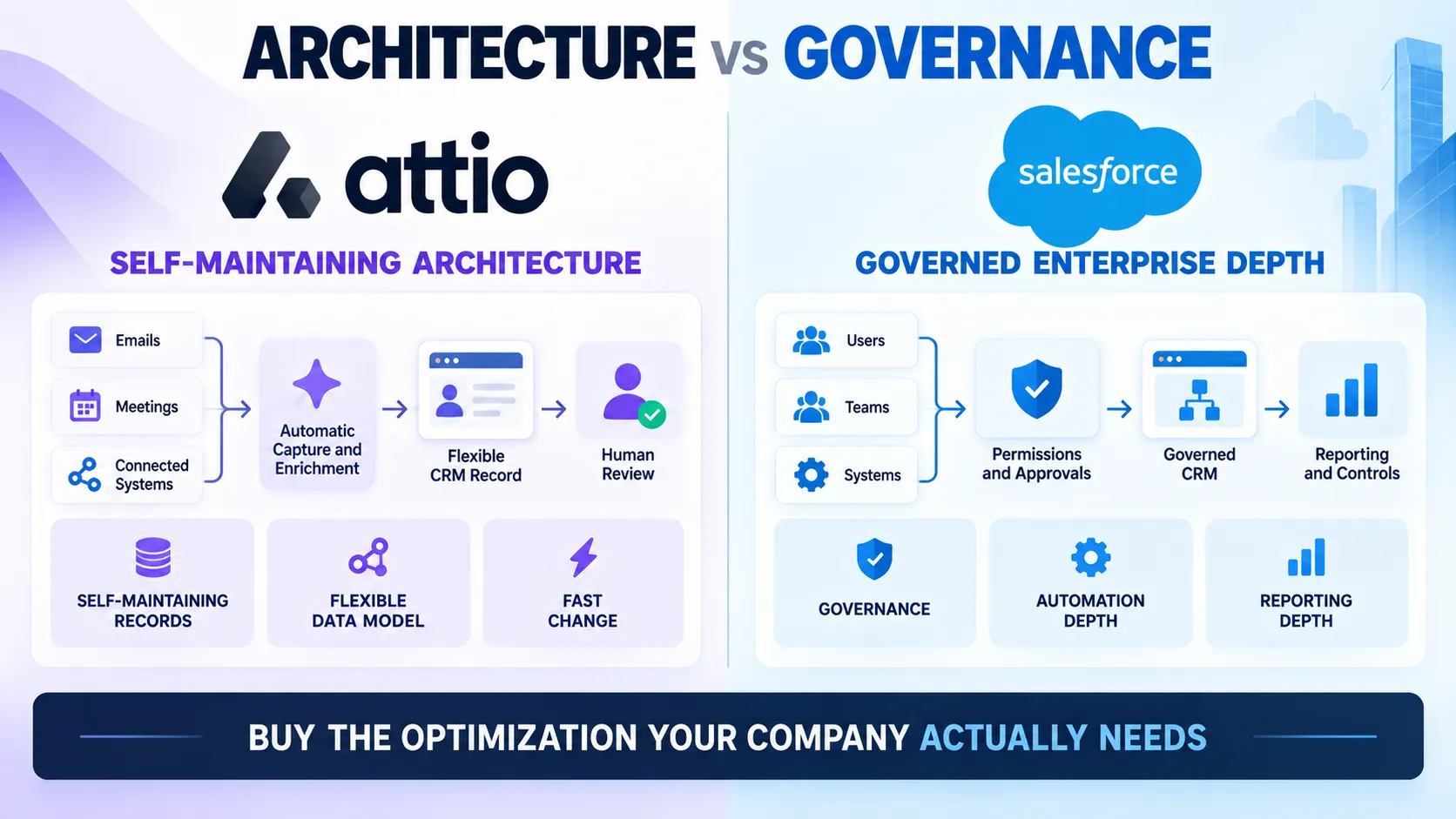
The axis, from our AI-native CRM guide. Attio is AI-native: the system captures, enriches, and maintains records itself on a flexible data model, and the AI is the product. Salesforce is the governed enterprise platform. Human-and-admin-fed at its core, with AI features layered on and improving. Depth in governance, automation, and reporting that nothing in the lighter class matches.
Neither description insults either tool. Attio optimizes for the operator's daily texture. Salesforce optimizes for the enterprise's control requirements. The question is which optimization your company is actually buying. Buy texture you live in, or buy control someone requires. Buying both at once is how shelfware happens.
Buyer 1: The Mid-Market Operator Choosing a Serious CRM
You outgrew the starter tools. Someone said "just get Salesforce, it is what real companies use." Pause on that sentence, because it is doing weight-class laundering. Real companies use what their requirements require. Yours are on paper or they are vibes. Check which, before the demo calendar fills.
What Attio Gives This Buyer
Self-maintaining records from week one, no admin required. A data model that shapes to your entities without a translator in the loop. Speed to value measured in days, per our implementation guide.
And a bill shape that stays legible: seats, with the AI in the plan. The five tests from the AI-native guide all pass, live, in one demo, which is the fastest evaluation in this market.
What Salesforce Costs This Buyer
Not just the license. Salesforce assumes an administrator, in-house or contracted, and that assumption is the real price line most mid-market buyers miss. Configuration surface arrives by the acre.
Depth you will not use for years still gets implemented, or sits as menus your team learns to ignore. Ignored menus still renew, annually, at full price. That is the quiet arithmetic of overweight tooling. Our mid-market Salesforce guide prices this path honestly for the teams who genuinely need it.
The Verdict for Buyer 1
Attio, unless enterprise requirements already exist on paper. Not on a roadmap, not in an aspiration. On paper: a compliance mandate, a partner requirement, a procurement checklist. Buying enterprise machinery for status is the most expensive form of insecurity in the CRM market. Serious is what your records look like, not what your vendor logo signals.
Buyer 2: The Team Considering Leaving Salesforce
You are here because the platform feels heavier than the company. Sometimes that feeling is right. Sometimes it is a bad build talking. The two feel identical from the inside, which is why diagnosis comes before demos.
Why Teams Look for the Salesforce Exit
Three patterns dominate, and they compound each other. Admin dependency: every change queues behind one person or one contractor, and the queue is measured in weeks. Unused depth: the team lives in one screen of a platform priced for fifty.
And data rot with ceremony: the same stale records as everywhere else, wearing enterprise permissions. Enterprise weight does not fix data discipline. It just audits the rot beautifully.
What Survives the Move and What Does Not
Honesty in both columns. Leaving gains self-maintaining records, speed, legibility, and a team that opens Attio voluntarily, some for the first CRM in their careers. Leaving loses real things: governance machinery, approval chains, territory and quota depth, mature compliance artifacts, and the largest app ecosystem in the category.
If any of those losses lands on a requirement, the exit fails before it starts. List the losses. Walk each one to its owner. Unclaimed losses are safe to leave behind.
One composite scene from client work, shared with permission of the pattern. A twelve-seat sales team, four years into Salesforce, one contractor admin, a change backlog older than two reps' tenure.
The audit found one load-bearing feature: an approval chain finance actually used, weekly, with consequences. The rest was weight. The approval chain rebuilt in a day on lighter rails. The relief was not the new tool. It was the missing queue. Changes shipped the same afternoon they were asked for.
The Verdict for Buyer 2
Run the exit-reason logic from our alternatives methodology, aimed upmarket. Diagnose the cause: bad build, unused weight, or genuine mismatch. Fix the build if the cause is the build, because a rebuilt org costs a fraction of a migration and keeps every requirement intact.
Leave for Attio when the cause is weight your company never ordered, and confirm in writing that nobody upstairs ordered it either. That written confirmation is the entire safety mechanism here.
Buyer 3: When Does Salesforce Become Necessary?
The question growing companies should ask instead of the comparison. The answer is triggers, not revenue milestones. Revenue never required a platform. Requirements do, and requirements have signatures on them.
The Four Triggers That Require Salesforce
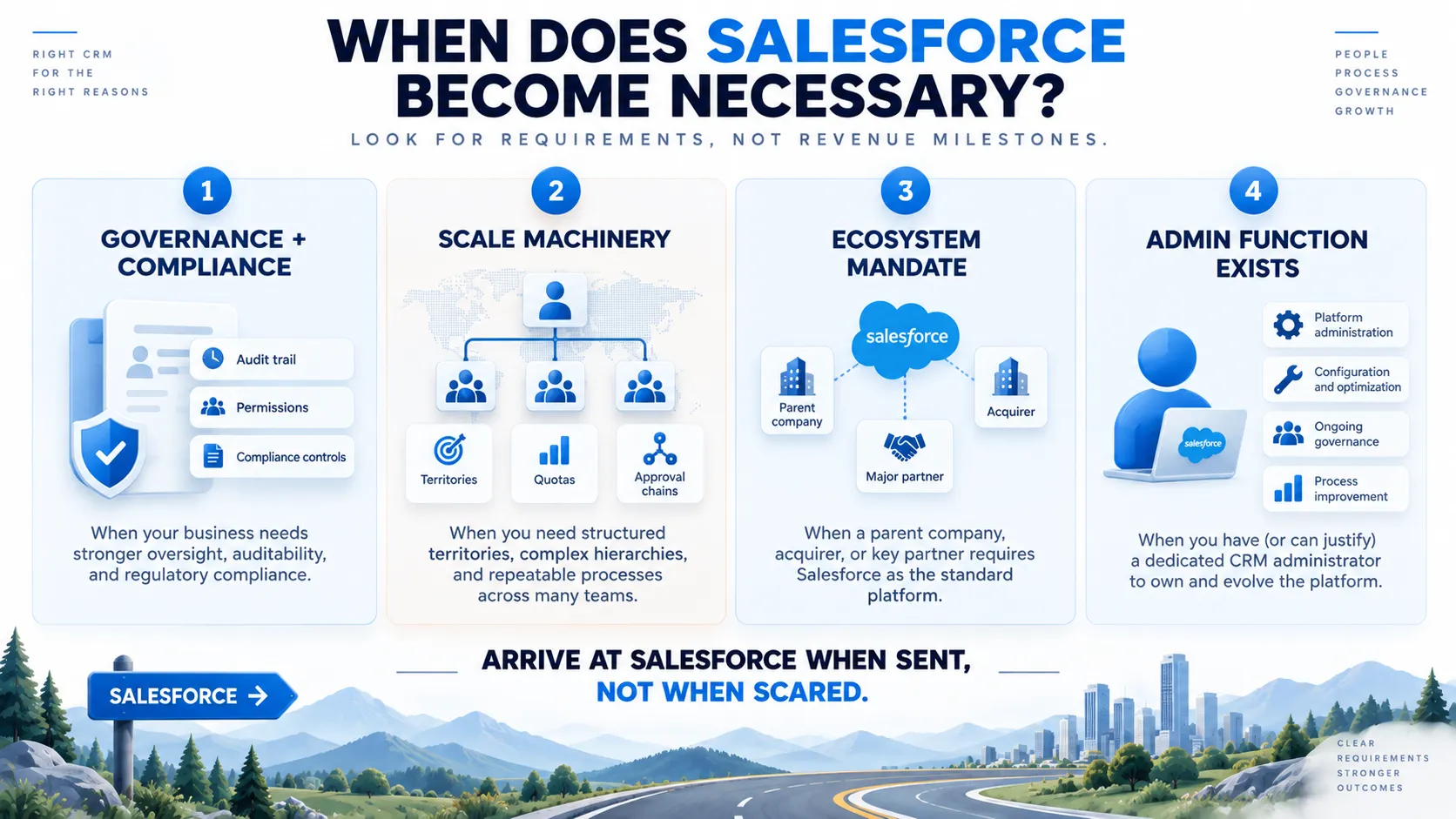
Governance and compliance mandates. Audit trails, granular permissions, and artifacts that procurement and regulators demand by name, on letterhead. Machinery for scale. Territories, quotas, complex approval chains, and forecast governance across teams of teams, once teams have teams.
Ecosystem mandates: an acquirer, parent, or major partner standardizes your stack for you, and the memo is not a debate. And an admin function that already exists: the person is hired or budgeted, because the platform assumes the role.
One trigger, start planning. Two or more, the move is legitimate and the implementation deserves respect. Write the triggers into the project charter. They become the scope, and scope written from requirements implements clean.
The Verdict for Buyer 3
Arrive at Salesforce when sent, not when scared. Companies that migrate on triggers implement well, because the requirements write the scope. Companies that migrate on status implement menus. Sent-not-scared also times the admin hire correctly, which saves the first year from becoming a very expensive tutorial.
Feature Reality Check: Where Each Platform Wins
Fast and honest, category by category. No sweeps here either, because the platforms are optimized for different owners. Attio is built for the team that lives in it. Salesforce is built for the organization that governs it. Both succeed fully at their own brief.
Data entry and record maintenance: Attio, cleanly, by architecture. Reps correct instead of type, and the Friday cleanup ritual retires. Data model: both flexible, differently. Attio's objects move fast and light. The team that uses them builds them, same afternoon.
Salesforce's are deep and governed, powerful in admin hands, slower to change by design. Automation: Salesforce's native depth wins inside the platform. Attio pairs with the middleware class and engineered integrations, which closes most gaps for build-minded teams. Reporting: Salesforce, for depth and enterprise rollups.
Attio's is cleaner and sits on data that maintains itself, the honest technicality from our HubSpot comparison. Ecosystem: Salesforce, by a wide margin, and it is not a close margin.
How Each Bill Grows
The Salesforce Bill
Editions, seats, and add-ons, plus the admin line: the platform assumes administrative capacity, so price the person, not just the seats. Implementation carries enterprise gravity, and the gravity is the point. For trigger-sent buyers, every line buys required control. For status buyers, the same lines buy menus.
The Attio Bill
Seats on a simple ladder, AI in the plan, marketing and specialty tools paired separately. Legible at budget time, and legibility compounds. Total the stack both ways at your real seat count, this year and next. The Attio line usually reads smaller. The paired-tools total is the honest comparison.
Migration Reality: Both Directions
Salesforce-to-Attio moves relationship history into a lighter, self-maintaining model, and the data model workshop decides the next five years. Object sprawl does not have to survive the trip. Attio-to-Salesforce happens when triggers arrive, and it inherits enterprise implementation scope, admin hire included. Either direction runs the same discipline as our migration playbook.
Export everything. Clean first. Map to the new model. Sample-migrate. Keep match keys. Run parallel until the numbers reconcile. Weight-class changes make the parallel run longer, not optional, and the automation rebuild bills separately in both directions.
How ACS Implements Both
Platform-agnostic and disclosed throughout: the recommendation follows your triggers and your operating model, not our margin. Engagements run fixed fee after a paid and refundable discovery.
Discovery identifies your buyer number, checks the four triggers against your actual requirements, and puts the verdict in writing with reasons. The document is yours either way, and it retires this comparison for your company permanently.
Builds carry the constants: documentation your team keeps, training to named roles, accounts in your name, error-alerted integrations. Engagement structure sits on pricing. The record sits in the case studies: 500+ workflows shipped, more than 10,000 hours reclaimed, over $2 million in client savings.
Frequently Asked Questions About Attio vs Salesforce
Is Attio better than Salesforce?
For self-maintaining records, speed, and legibility at mid-market scale, yes. For governance, enterprise automation depth, and ecosystem breadth, no. Better is buyer-shaped: identify which of the three buyers you are, and the answer follows. Rankings that skip the buyer are ads with citations.
Can Attio replace Salesforce?
For teams carrying weight nobody ordered, yes, and the relief is immediate. For teams with live governance, compliance, or scale machinery in use, no, and the exit fails at requirements. Audit what is actually load-bearing before any migration math. The audit takes a week and saves a quarter.
Is Attio enterprise ready?
Maturing fast, honestly not everywhere. Governance depth, compliance artifacts, and marketplace breadth still favor Salesforce at large-enterprise scale. Mid-market operators sit in Attio's sweet spot today, which is exactly our lane. Check the current state at evaluation time, because the roadmap moves quarterly on both sides.
When do I actually need Salesforce?
At the four triggers: compliance mandates on paper, scale machinery like territories and complex approvals, an ecosystem mandate from an acquirer or partner, or an admin function already budgeted. Short of a trigger, lighter architecture serves growth better. Triggers arrive in writing, signed. Fear arrives in meetings, loud. Only one of them belongs in a platform decision.
Is Salesforce overkill for mid-market companies?
Often, and not always. Overkill is buying depth without a trigger. A mid-market company with a compliance mandate or acquisition-driven standardization has a trigger, and for them the depth is the product. Triggers decide, revenue does not, and neither does what your competitor bought.
What does Salesforce cost compared to Attio?
Shapes, since figures change. Salesforce grows by edition, seats, and add-ons, plus the admin capacity the platform assumes. Attio grows by seats with AI in the plan, plus paired tools. Total both stacks at your real numbers, admin line included, because the admin line is where the comparisons usually cheat.
How hard is migrating from Salesforce to Attio?
The data moves with discipline: full export, cleaning, mapping into the new model, sample migration, match keys, parallel run. The redesign is the value, because the old object sprawl does not have to survive the trip. Budget the automation rebuild separately, since workflows never export. Budget calendar time for the parallel run too.
Does Attio match Salesforce's automation depth?
Not natively, and it does not claim to. Salesforce's in-platform automation is the deepest in the category, admin-shaped and governed. Attio's pattern is lighter native workflows plus middleware and engineered integrations, which covers most mid-market needs and stays maintainable by mortals. Depth you cannot maintain is depth you do not have. Score automation by your maintainer, not by the ceiling.
Can I run Attio and Salesforce together?
Rarely worth it, honestly. The run-both pattern from our HubSpot comparison works when the second platform owns a distinct function like marketing. Two systems of record for the same relationships is a sync problem wearing a strategy costume, billed monthly. Pick one owner for the record, or pick one platform. Transition periods are the exception, timed and short.
Which should a startup choose?
Almost never Salesforce first, absent an inherited mandate. Start light, let records maintain themselves, and arrive at enterprise machinery when a trigger sends you. The trigger list above works at every stage, and it never expires.
Ready to Find Your Buyer Number?
Three ways forward.
Name your buyer. Chooser, leaver, or scaler. One minute, and the whole comparison collapses into your one verdict, which is the only one that was ever yours.
Check the triggers. Four of them, on paper or not, checked in an afternoon. The mid-market Salesforce guide covers the path when they fire.
Book a paid discovery. Your triggers audited against real requirements, your buyer verdict in writing with reasons, one fixed price, refundable if the fit is wrong. Details on pricing.
Architecture or governance. The company that knows which one it is buying never regrets this choice, in either direction. The one that buys on fear regrets it in renewal season.