

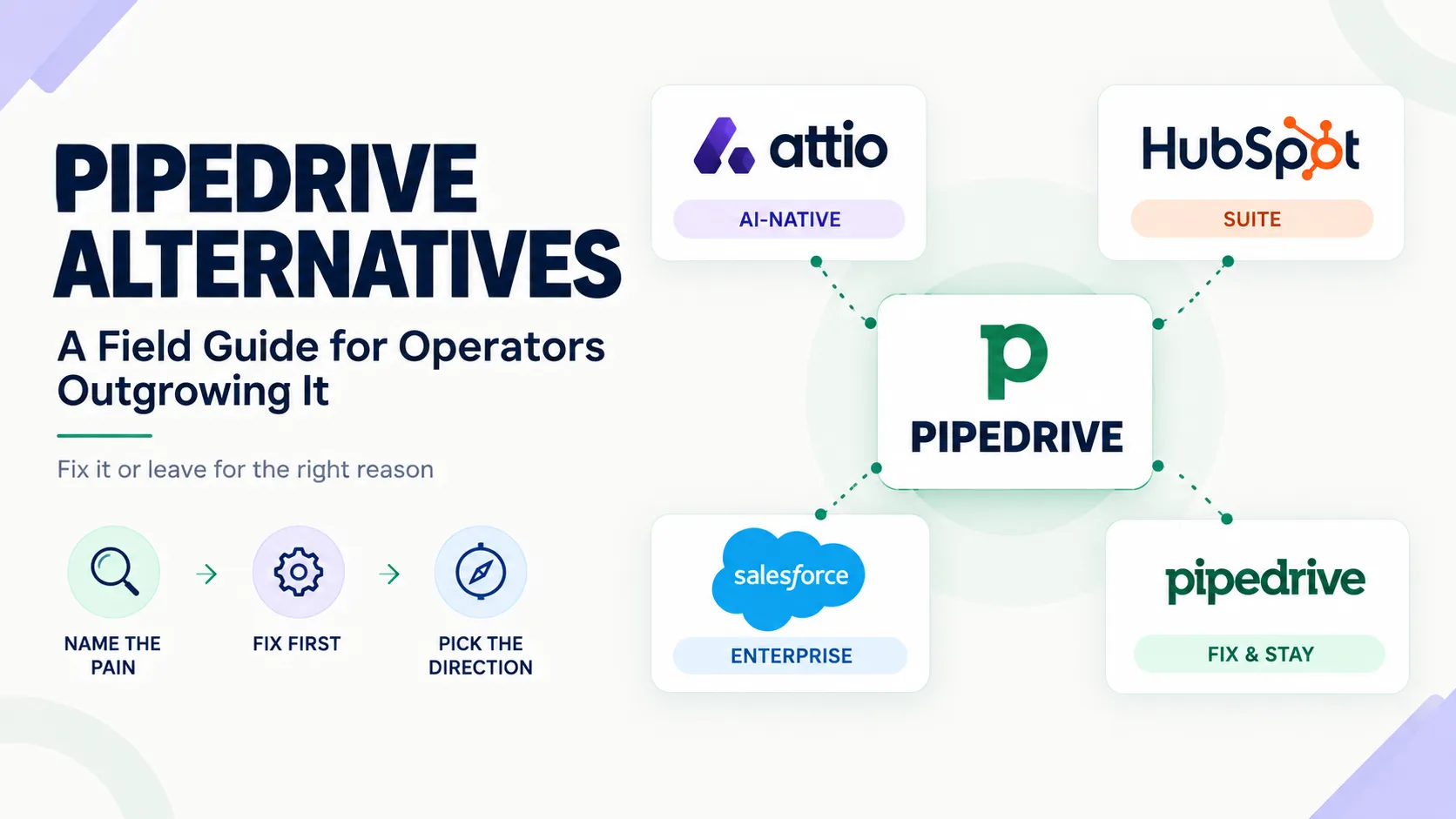
Disclosure first, because it changes how you should read this. We implement Pipedrive. We also implement the platforms people leave it for. We build operations infrastructure with engineering discipline for $10M-$50M operators. Our Pipedrive practice runs alongside our Attio, HubSpot, and Salesforce work. We profit if you stay and if you go, so this guide can be honest in both directions.
Here is the honesty: most "Pipedrive alternatives" searches are symptoms, not decisions. The symptom has a cause. The cause has a verdict. Run the exit interview before the exit, and half of you will close this tab keeping the tool you have.
Before You Switch: The Pipedrive Exit Interview
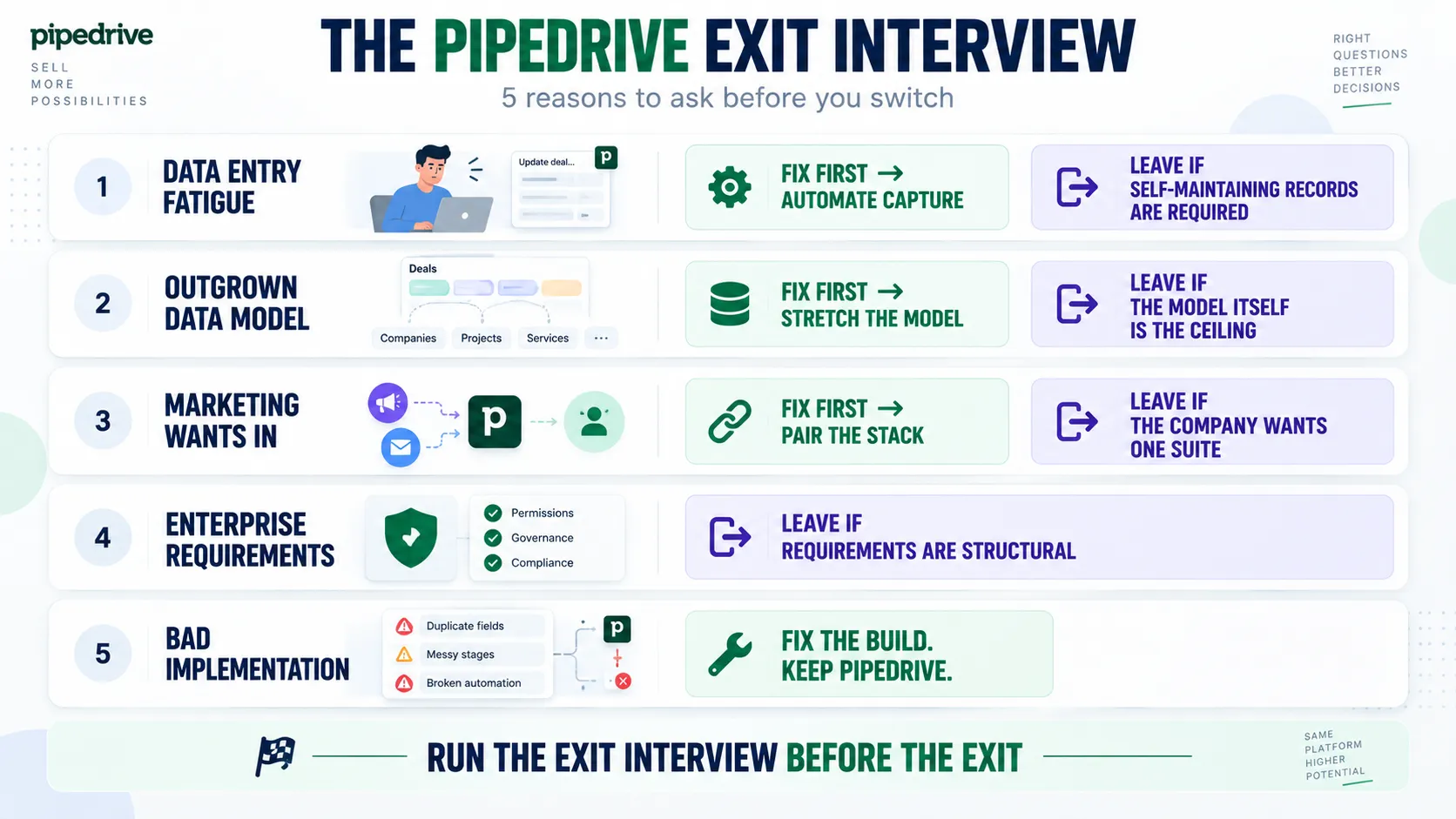
Every switching search starts with a pain. The pain has a cause, and the cause decides everything. Some causes leave with you. Some causes stay fixed. Some causes were never Pipedrive's fault. The exit interview is five questions, one per exit reason below.
Each ends in a verdict: fix inside, or leave in a named direction. Verdicts beat vibes, and this page deals only in verdicts.
Skipping the interview is how companies migrate every eighteen months. The tool changes. The unexamined cause rides along, unpacks its boxes, and starts the same complaints in a new accent.
Why Operators Leave Pipedrive: The Five Exit Reasons
Five reasons cover nearly every real departure. Find yours, then read its verdict. Two or more reasons at once is common. Sequence them by pain, and let the loudest one pick the direction. Ties break toward the cheaper fix.
Exit Reason 1: Data Entry Fatigue
The symptom: reps stopped updating records, pipeline reviews argue about data quality, and the Friday cleanup ritual returned. Pipedrive stays admirably simple, and simple still expects humans to feed it. The tool is not broken. The deal is: typing for insight, and the typing lost.
The fix-first move: capture automations. Email sync tightened, forms wired in, enrichment added through engineered integrations. Real relief, honestly partial. The core stays human-fed, because that is the architecture.
The leave verdict: if self-maintaining records are the requirement, that is architecture, and architecture does not patch in. The AI-native direction exists for exactly this exit reason. Attio is the platform we build there, and the data-entry test settles it in one demo.
Exit Reason 2: The Business Outgrew the Pipeline Model
The symptom: your revenue runs on entities a deal pipeline cannot hold. Properties, projects, partnerships, assets, multi-party relationships. Workarounds multiplied, and the workarounds now have workarounds. Reports stopped meaning things. Everyone keeps a side spreadsheet and apologizes for it.
The fix-first move: creative modeling with custom fields and parallel pipelines carries some businesses further than expected. A strong implementer can stretch the model honestly, and will tell you where it stops. Ask for the ceiling in writing. Good implementers name it without flinching, because they have hit it before with someone else's business.
The leave verdict: when the model itself is the ceiling, flexible-object platforms are the direction. Attio treats custom objects and relationships as first-class citizens, which is the durable answer to this specific pain.
Exit Reason 3: Marketing Wants In
The symptom: the marketing team needs campaigns, landing pages, attribution, and automation, and Pipedrive is a sales tool by design. The request usually arrives as a consolidation pitch. One platform, one login, one invoice.
The fix-first move: pair Pipedrive with a dedicated marketing platform and sync the handoff. Many operators run this stack happily for years. Total the stack cost honestly, both tools plus the sync you must own. Pairing is a strategy, not a compromise.
The leave verdict: when the company votes for one suite, the HubSpot direction is the mature move, priced per our implementation cost guide. Suite depth is real. So is the bill shape that comes with it, and the vote should see both.
Exit Reason 4: Enterprise Requirements Arrived
The symptom: procurement wants governance artifacts, compliance machinery, territory management, and admin depth that a lean sales tool never promised. Sometimes a new enterprise customer triggers it. Sometimes an acquisition does.
The fix-first move: rare. Requirements of this kind arrive from outside the sales team, and they do not negotiate. Procurement checklists beat feature demos every time, and arguing with a checklist is a poor use of a quarter.
The leave verdict: Salesforce is the enterprise direction, and it earns the reputation both ways: unmatched depth, real implementation weight. Migrations in both directions run through the same discipline as our Salesforce-to-Pipedrive guide, reversed.
Exit Reason 5: It Was Never Implemented Right
The symptom: vague stages, duplicate fields, dead automations, no documentation, and a team that quietly went back to spreadsheets. The most common exit reason in our client work, and the one that is not an exit reason at all.
The verdict: fix, do not flee. A proper implementation costs a fraction of a migration and keeps the simplicity you originally bought. Switching platforms to escape a bad build just ships the bad habits to a new address, with moving fees. The new tool gets six honeymoon months. Then the vague stages return, wearing new field names.
The Three Named Directions, and the Categories Beyond
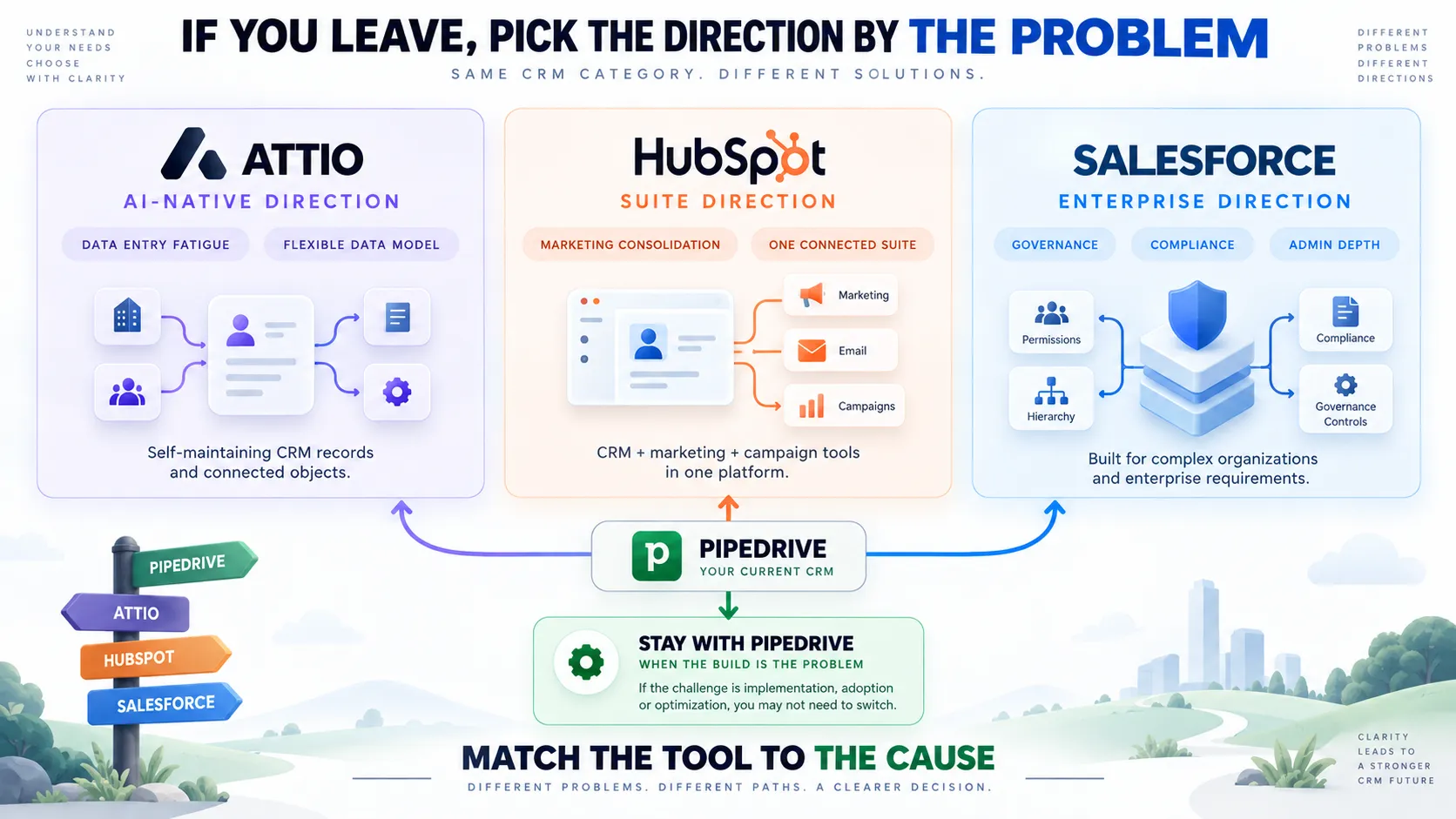
We name only platforms we build, so the recommendations carry accountability. If one of these fails you, we implemented it, and you know where we live.
The AI-Native Direction: Attio
For data entry fatigue and outgrown models. The system maintains its own records on a flexible data model, per the five tests. The trade: a younger ecosystem, and marketing tools stay separate. Ops-led teams feel the upgrade in the first week. The tell is silence, right where the nagging used to be.
The Suite Direction: HubSpot
For marketing-led motions wanting one platform. The deepest mid-market suite, with the hub-and-tier bill shape and the implementation line items that come with depth. Buy the hubs your first year configures, and the direction pays.
The Enterprise Direction: Salesforce
For governance, compliance, and scale requirements. Maximum depth, maximum configuration surface, and an implementation that deserves enterprise respect. Nobody drifts into Salesforce. You arrive because the requirements sent you, with a budget to match the depth.
The Categories We Leave Unnamed
Lightweight sales-only tools and all-in-one small-business suites both exist in numbers, and some are good. We keep recommendations to platforms we implement, because a recommendation without build accountability is just a listicle.
Evaluate any of them with the same exit-reason logic: match the tool to your cause, not to a roundup's ranking. The exit reason travels to any vendor page. The ranking does not survive contact with your business.
When Staying With Pipedrive Wins
The retention case, stated plainly. We sell it, and it also happens to be true, which is the best kind of pitch. Pipedrive's simplicity is a feature that compounds. Fast adoption. Clean pipelines. A bill shape teams understand.
A tool your reps actually open without being chased. For a sales-led team with a clear process, modest entities, and marketing running elsewhere, staying is often the strongest verdict on this page. Boring verdicts save the most money, and this is the boring verdict done proudly.
The pattern we see: operators who fix exit reason five discover reasons one through four were noise. A well-built Pipedrive with engineered integrations covers more mid-market ground than the switching industry admits. The switching industry is not neutral. It bills by the move.
The Switching Cost Nobody Prices
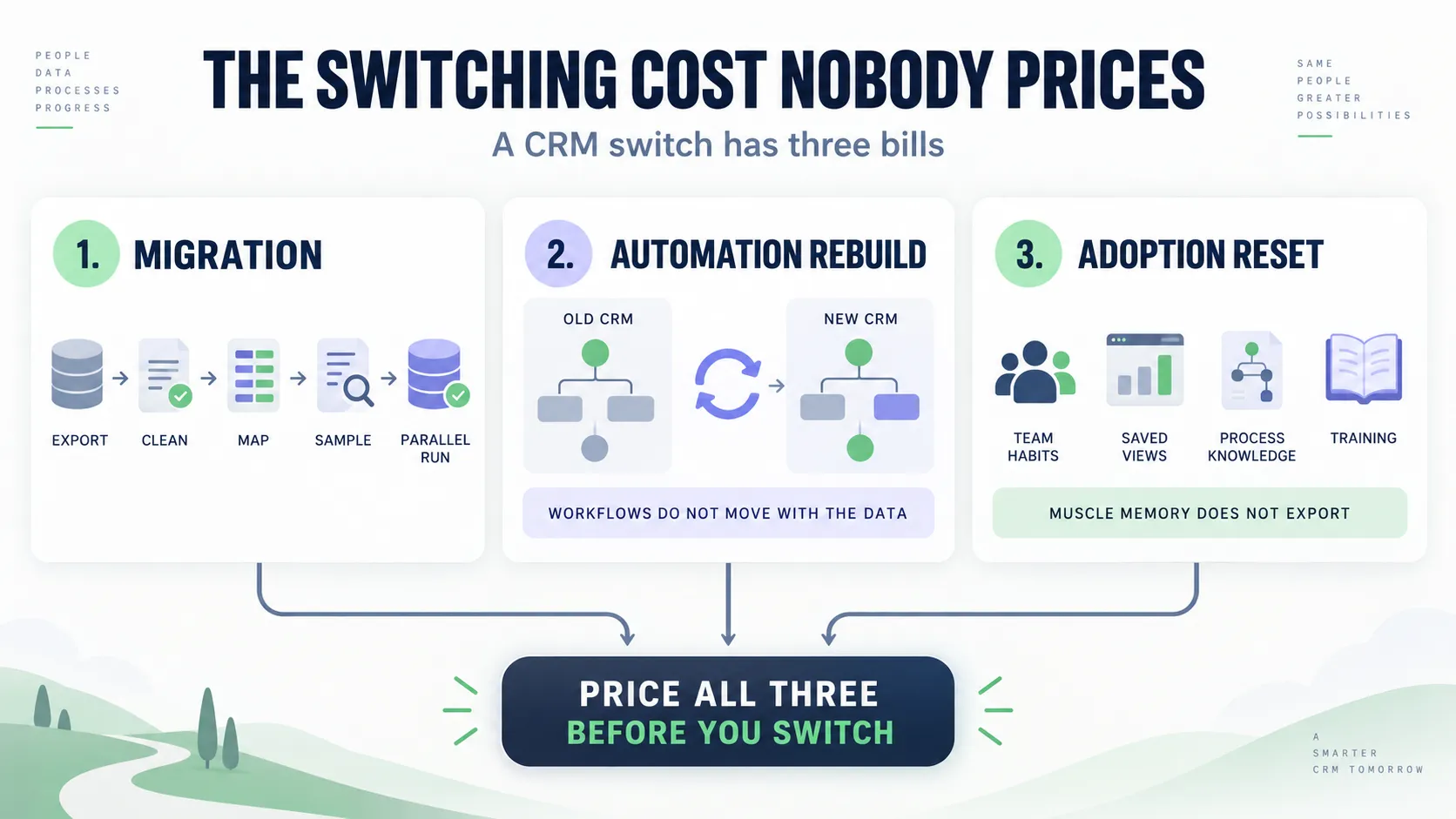
Every migration carries three bills, and only one shows up in quotes.
The migration itself: export, clean, map, sample, match keys, parallel run. Real work, quotable work, the visible bill. It is also the smallest of the three, more often than buyers expect. The automation rebuild comes second.
Workflows do not export between platforms, per the middleware truth, so every zap and sequence gets rebuilt against the new system, tested from zero.
And the adoption reset, the invisible bill. Your team's habits, saved views, and muscle memory reset to zero. Adoption is the asset that took longest to build the first time, and it does not migrate in a CSV.
Price all three before any decision. A switch that pays for itself usually pays through the exit reason, not through the feature grid. Feature deltas fade in a quarter. A solved exit reason compounds for years.
How to Run the Decision
One week, one page.
The Fix-First Week
Take your exit reason to a fix attempt before any demo. Tighten capture, stretch the model, pair the marketing tool, or scope the reimplementation. Some fixes hold, and the search ends cheap. The ones that fail produce something valuable: evidence. Evidence turns the memo below from opinion into case, and cases get budgets.
The Exit Memo
One page. The exit reason. The fix attempted and its result. The named direction. The total stack cost both ways at your real seat count. Circulate it. A memo that survives the team's review is a decision. One that cannot be written yet is a symptom still looking for its cause. The memo also becomes the migration brief if leaving wins, so nothing written here is wasted either way.
How ACS Helps Either Way
Both sides of the decision, disclosed throughout. We rebuild Pipedrive properly when staying wins, and we run the migration when leaving wins, in any of the three named directions. Engagements run fixed fee after a paid and refundable discovery.
Discovery runs the exit interview against your actual portal, data, and stack, and puts the fix-or-leave verdict in writing, with the reasons attached. The document is yours either way, and it survives whichever vendor conversation comes next.
Builds carry the constants: documentation your team keeps, training to named roles, accounts in your name, error-alerted integrations, whichever platform wins. Engagement structure sits on pricing. The record sits in the case studies: 500+ workflows shipped, more than 10,000 hours reclaimed, over $2 million in client savings.
Frequently Asked Questions About Pipedrive Alternatives
What is the best Pipedrive alternative?
By exit reason, honestly, and never universally. Data entry fatigue and outgrown models: Attio. Marketing-led consolidation: HubSpot. Enterprise requirements: Salesforce. Bad implementation: no alternative needed, fix the build. Any answer that skipped your reason is a listicle talking, and listicles bill nobody for being wrong.
Is Attio better than Pipedrive?
Different bets. Pipedrive bets on simplicity with human-fed records. Attio bets on architecture that maintains records itself, on a flexible model. Teams drowning in data entry or entity workarounds gain from the switch. Teams thriving on simplicity should keep it, proudly, and spend the difference on pipeline.
Should I switch from Pipedrive to HubSpot?
When the company is consolidating on a marketing-led suite, yes, with the bill shape and implementation line items priced first. When sales just needs a better build, no. The pairing pattern, Pipedrive plus a marketing platform, remains a legitimate middle path, and often the cheapest one on the table.
When is Pipedrive not enough?
At four walls. Records that need to maintain themselves. Entities the pipeline model cannot hold. A company standardizing on one suite. Enterprise governance requirements. Short of a wall, a better build usually beats a new platform. Walls are structural. Everything else is a build problem wearing a wall costume.
Can Pipedrive handle marketing automation?
Not as a suite, by design. Light automations around deals and contacts, yes. Campaigns, landing pages, and attribution live in paired tools or in a suite migration. Name which capabilities your marketing team actually needs before pricing either path. A wish list prices differently than a requirement list.
Is Pipedrive good for enterprise?
It is built for sales-led small and mid-market teams, and it is honest about that. Enterprise governance, compliance artifacts, and admin depth point to Salesforce. Growing into enterprise requirements is a real exit reason, not a criticism. Tools that know their lane deserve credit for staying in it.
How hard is migrating off Pipedrive?
The data moves cleanly with discipline: export everything, clean first, map to the new model, sample-migrate, keep match keys, run parallel. The harder bills are the automation rebuild and the adoption reset. Price all three, then decide. Budget calendar time too, because parallel runs eat weeks, not days.
What does switching CRMs really cost?
Three bills: the migration, the automation rebuild, and the adoption reset. Only the first appears in quotes. Total them against the exit reason's annual cost, and the decision turns from feelings into arithmetic. Arithmetic survives the demo. Feelings rarely do.
What is the most common reason companies leave Pipedrive?
In our client work, exit reason five: a build that was never done right, wearing the costume of reasons one through four. Vague stages and dead automations get blamed on the platform, unfairly and often. The second most common is the honest one, data entry fatigue, which is architectural and does justify the AI-native direction.
Should I fix my Pipedrive setup before evaluating alternatives?
Almost always, and not as a delay tactic. The fix-first week either solves the pain for a fraction of a migration or produces the evidence that makes the switch defensible. Either outcome beats demo-driven deciding, and both outcomes cost one week.
Ready for the Exit Interview?
Three ways forward.
Name your exit reason. Five candidates above. Ten minutes. The reason picks the direction better than any demo will. Demos are built to flatter every reason at once.
Run the fix-first week. A strong Pipedrive build settles half these searches without a migration, and the week costs less than one demo cycle.
Book a paid discovery. The exit interview run against your real portal and stack, a fix-or-leave verdict in writing, one fixed price, refundable if the fit is wrong. Details on pricing.
The alternative to Pipedrive is sometimes Pipedrive, implemented properly. The rest of the time, the exit reason names the direction, and the field guide above walks you there. Either way, decide from a cause, never from a listicle.