

Here is the pattern behind every CRM implementation story, good and bad, across every platform we build. The failed ones did not fail at configuration. Configuration is the easy part, and everyone selling it knows how. They failed at a handoff, one of four, and the buyer never knew the handoffs were the product. This guide fixes that, because the buyer who names the handoffs buys better.
We build operations infrastructure with engineering discipline for $10M-$50M operators, and CRM implementation runs through our practice across four platforms: Attio, HubSpot, Pipedrive, and Salesforce.
Platform-agnostic and disclosed, as always: the recommendation follows your operating model, not our margin. This guide defines the service. It walks the four handoffs. It prices the models honestly. And it names where each platform gets hard, from direct build experience on all four.
What Are CRM Implementation Services?
CRM implementation services are the work that turns a purchased license into a running system. Your sales process mapped and designed. Your data migrated with history intact. Your other systems integrated. Your automations built. Your team trained to operate all of it, with documentation they keep.
The distinctions matter at purchase time. Onboarding guides your team through setup, with your hands on the keyboard the whole time. Consulting advises on strategy and process, per the role decoder.
Implementation does the build and owns the outcome, end to end. Vendors blur the three in sales conversations, so ask any provider which one they are quoting, deliverable by deliverable. The blur is rarely malicious. It is still expensive, and it is still yours to catch.
Why CRM Implementations Fail: The Four Handoffs
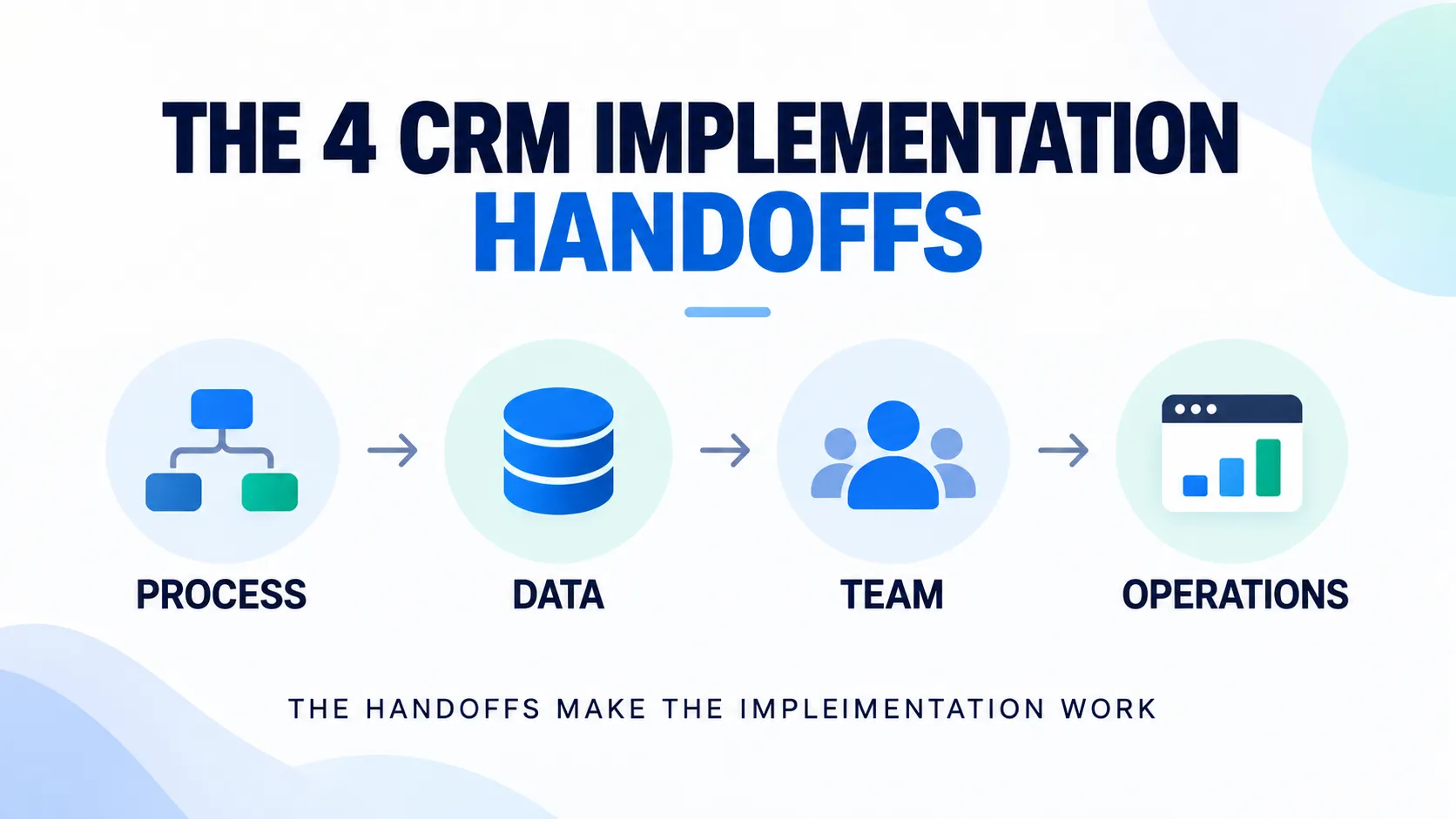
An implementation is four handoffs executed in order. Each one has a failure mode, and every wrecked rollout you have heard about died at one of them. Read your own history against this list. The past failure names its handoff fast, and naming it is how the next attempt goes differently.
Handoff 1: Your Process Into the Map
Discovery moves the truth of how you sell from your team's heads into a written map. Stages defined. Rules named. Handoffs between roles documented. The failure mode is skipping it, or letting the implementer guess.
A portal configured to a guessed process gets configured twice. The second time always costs more than discovery ever did. The map is the foundation deliverable. Everything downstream inherits its accuracy, including every automation and every report, for years after everyone forgets the workshop.
Handoff 2: Your Data Into the New System
Migration moves your history into the new structure: records, relationships, activity, and the years of context your team relies on. The truths hold on every platform. Clean before moving. Migrate a sample first. Keep match keys on everything. Run parallel until the numbers reconcile.
The failure mode is optimism, per our migration guide. Data migration is where quotes go to double, and where honest quotes said so up front. A sample migration in week one surfaces the surprises while they are still cheap to fix.
Handoff 3: The Build Into Your Team
The handoff cheap quotes delete, every time. Training to named roles. Documentation your team keeps, not the builder's notes. Accounts in your name. A review rhythm the team owns. The failure mode is a beautiful portal nobody operates.
The knowledge left with the implementer's last invoice, and nobody noticed until the first question. An implementation is not done when the build works. It is done when your team runs it without calling anyone. Month eighteen is the real acceptance test, and this handoff is the only thing that passes it.
Handoff 4: Launch Into Operations
The final mile most proposals never mention. Hypercare for the first weeks, with fast answers while habits form and questions stay small enough to fix in minutes. Adoption tracked by role, never assumed. Exceptions owned by name.
A named internal owner for the system going forward, in writing. The failure mode is the quiet slide back to spreadsheets, which happens in month two, invisibly, while everyone still calls the project a success. Track logins and record freshness by role, weekly at first. Adoption measured is adoption managed.
What a Real CRM Implementation Includes
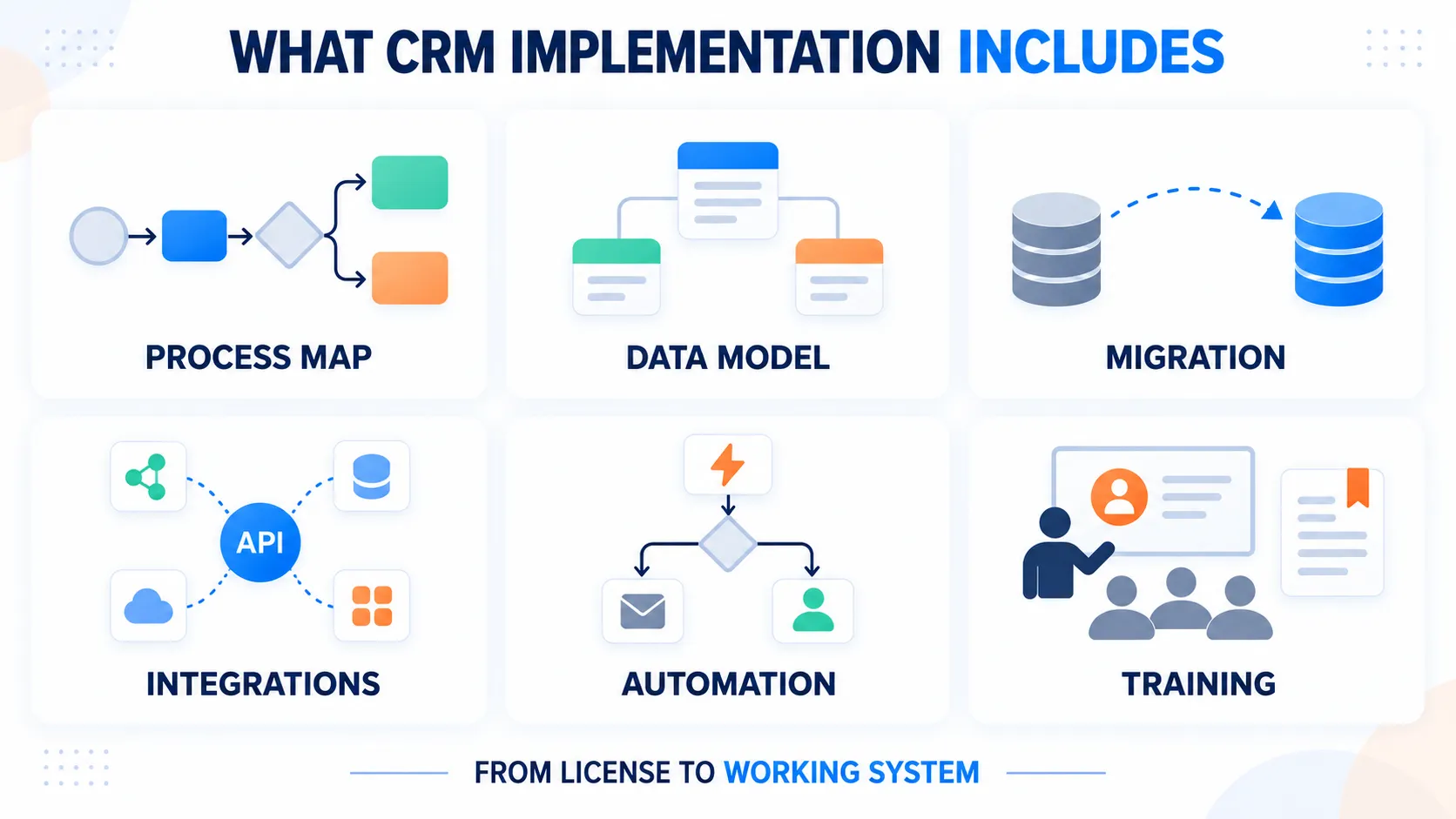
Six deliverables, whatever the platform, whatever the vendor. The process map from discovery. The data model designed for your business. Migrated data that reconciles. Integrations wired and alerted. Automations built on proven workflows.
And a trained team holding documentation, with a named owner. Any proposal missing a line has moved that cost to later, wearing better packaging. Our cost anatomy guide dissects the six as invoice lines, and the anatomy travels across platforms. Read every proposal against the six. The gaps announce themselves in minutes.
How CRM Implementation Services Are Priced
Models, not figures, because figures without scope are theater. Match the model to the work, and half the pricing risk disappears before anyone even quotes.
The Four Models
Fixed-fee after a paid discovery puts scoping risk on the builder who can actually control it, and it is the model we run. Packages bundle standard setups cleanly and squeeze unusual ones, so read the exclusions carefully before comparing any prices.
Capped hourly suits small defined tasks. The cap belongs in writing, with a check-in required before crossing it. Retainers carry ongoing administration after launch, and they earn their fee only while a real roadmap exists and moves.
The One-Page Scope
The buyer's move that beats negotiation. Platform and tier. Record counts by object. Integration list sorted by type. Top workflows with manual versions described. Training audience by role. Send the same page to three providers, and the spread itself becomes information you paid nothing for. Converging quotes confirm the scope. A wild outlier is asking for a different conversation.
Where Each Platform Gets Hard
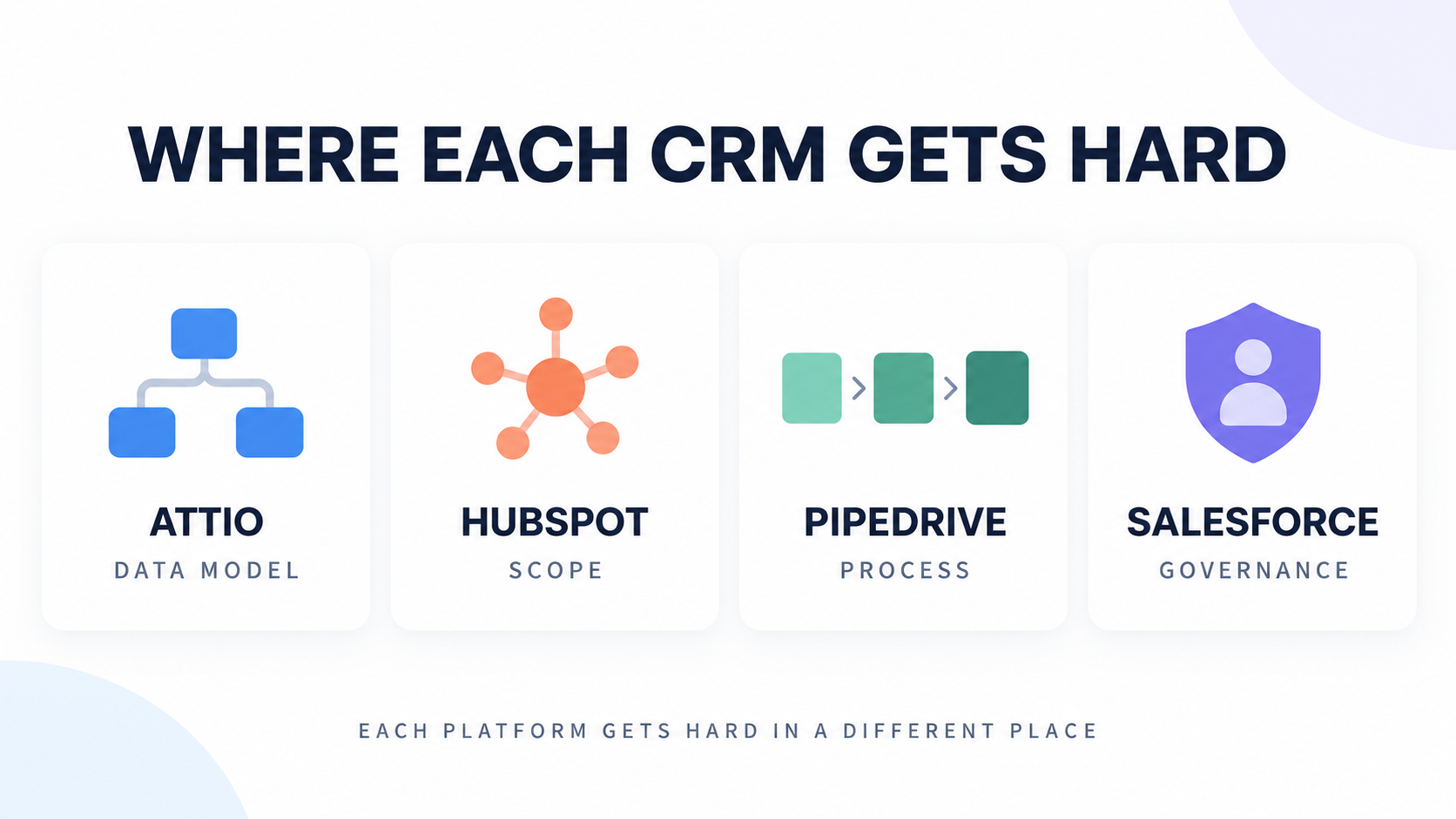
Platform-agnostic honesty, from building on all four. Every platform is easy in the demo. Each one gets hard in a different place, and the hard place is what you are actually budgeting for.
Attio Implementation
The work shifts upstream. Data model design and capture configuration lead, per the implementation guide, with less surface to configure overall. The hard part is thinking, not clicking, and skipping the model workshop is how the AI-native advantage gets wasted. Budget the workshop like it decides the next five years of data, because it does.
HubSpot Implementation
Hub count multiplies scope, and every hub is its own configuration surface. Data migration and integrations carry the variance, per the cost guide. The hard part is disciplined scope across the suite, because unused hubs bill annually either way. Buy the hubs the first year configures, and let the roadmap justify upgrades.
Pipedrive Implementation
Speed is the platform's gift, and process is the hard part. A clear process implements in days. A vague one implements twice. Sequence per the consultant guide: process before portal, portal before integrations, with the practice built to keep simplicity intact. The whiteboard test decides staffing. A pipeline drawn cleanly needs a builder. One drawn with arguments needs a process consultant first.
Salesforce Implementation
Governance weight, honestly earned. Permission architecture, sandbox pipelines, and the admin question decide the engagement, per the mid-market guide. The hard part is matching organizational readiness to platform depth, because the platform assumes an administered org. Fund the admin function before the license, or fund the backlog after it. Those are the only two options the platform offers.
Choosing a CRM Implementation Partner
The evaluation, compressed from our hiring guide. Judge the questions they ask you first, because a serious implementer interrogates your process before touching a setting. Five real questions about your business beat fifty polished screenshots of theirs, in every evaluation we have ever watched.
Demand a narrated walkthrough of a build like yours. Check a documentation sample, since the sample predicts your deliverable. And get the ownership answers in writing: accounts in whose name, documentation kept where, what happens at departure.
Red flags, briefly: instant quotes with no discovery, open-ended hourly with no cap, no training or documentation line, and platform advice from someone compensated to resell licenses, undisclosed. One is a question. Two is an answer. The pattern behind all four is pricing detached from scope, and detached pricing lands on you later.
In-House vs Outsourced CRM Implementation
The honest split, with no commission behind it. In-house works when someone senior owns it as a real project with real hours, the scope is modest, and the platform matches team skill. Real hours means calendar-blocked hours, not evenings and good intentions.
Outsourced earns its fee on migrations, integrations, multi-team rollouts, and any build where architecture mistakes surface months later in reporting and cleanup.
The mixed route often wins: buy discovery and the hard handoffs, keep training rollout and administration in-house. Buy each handoff from whoever executes it best, and put the seams in writing. Seams without owners are where mixed routes leak.
How ACS Runs CRM Implementations
The four handoffs as method, on all four platforms. Engagements run fixed fee after a paid and refundable discovery. Discovery produces the process map and the one-page scope from your actual systems.
It names the platform recommendation with reasons when the choice is open. It prices each handoff visibly, so nothing hides in a lump sum. The document is yours either way, and it converges every quote you gather, including ours.
Builds carry the constants: documentation your team keeps, training to named roles, accounts in your name, error-alerted integrations. Engagement structure sits on pricing. The record sits in the case studies: 500+ workflows shipped, more than 10,000 hours reclaimed, over $2 million in client savings.
Frequently Asked Questions About CRM Implementation Services
What are CRM implementation services?
The work turning a CRM license into a running revenue system: process mapped, data model designed, data migrated, integrations wired, automations built, team trained with documentation. Distinct from onboarding, which guides, and consulting, which advises. Implementation builds and owns the outcome, through all four handoffs.
How much does CRM implementation cost?
Scope decides, through six deliverables and four handoffs. Any figure offered before scoping is a guess wearing confidence. Build the one-page scope, send it to three providers, and compute your number from converging quotes. The cost anatomy travels across every platform, and so does the discipline.
How long does a CRM implementation take?
Scope again, honestly. Clear-process single-team builds move in weeks. Migration-heavy, multi-team, or integration-heavy builds run months. Phasing shortens time to first value either way. Launch the core. Prove it. Extend. The calendar risk lives where the cost risk does, in migration and integrations.
What is the difference between CRM implementation and onboarding?
Onboarding guides your team through setup, with your hands doing the work. Implementation does the build: architecture, migration, integrations, automation, training. The words blur in sales conversations, so ask which one the quote actually covers, line by line. Guided setup priced as a full build is the oldest trick in this category.
Do I need a CRM implementation partner?
At modest scope with a clear process and a capable owner, no. Migrations, integrations, multiple teams, or a process nobody can draw: yes, or at least for those handoffs. The mixed route is legitimate. Buy the hard handoffs, keep the rest in-house, and name the seams in writing.
Can I implement a CRM myself?
For simple scopes, yes, and honorably. Write the process down first, because the one-page pipeline doc prevents most self-implementation regret before it starts. The punishing scopes are the ones where architecture mistakes surface months later. Price your own hours honestly before choosing the free-looking route.
What does a CRM implementation include?
Six deliverables: process map, data model, migrated and reconciled data, alerted integrations, automations on proven workflows, and a trained team with documentation and a named owner. A missing deliverable is a cost moved to later, not a discount. Count all six in every proposal you receive, before you compare a single price.
Which CRM is easiest to implement?
The one matching your situation, honestly. Pipedrive implements fastest with a clear process. Attio shifts work upstream into model design and runs light after. HubSpot scales with hub count. Salesforce assumes an administered organization. Easy follows fit, not brand, and fit follows your operating model every single time.
What is the most common reason CRM implementations fail?
Handoff three, in our client work: the build never truly landed in the team. Training got compressed to one call. Documentation stayed in the builder's drive. The knowledge left with the final invoice. Second place goes to handoff one, the guessed process. Neither failure is a configuration problem, which is why configuration-focused buying keeps producing them.
How do I prepare for a CRM implementation?
Build the one-page scope. Platform and tier. Record counts by object. Integrations sorted by type. Top workflows with manual versions described. Training audience by role. One hour of honesty, most of it made of things you already know cold. It converges every quote, shortens discovery, and makes you the best-prepared buyer any provider meets that month.
Ready to Buy the Handoffs?
Three ways forward.
Write the one-page scope. The preparation FAQ above is the template. An hour that converges every quote you will ever request, including the one you never send for.
Read your platform's hard part. The four platform sections above link the deep guides, cost anatomy included, one platform at a time.
Book a paid discovery. The process map and scope built from your actual systems, each handoff priced visibly, a platform recommendation with reasons when the choice is open, one fixed price, refundable if the fit is wrong. Details on pricing.
Configuration is the easy part. The handoffs are the product. Buy them deliberately, name them in every proposal you sign, and the implementation story you tell later is the good kind.